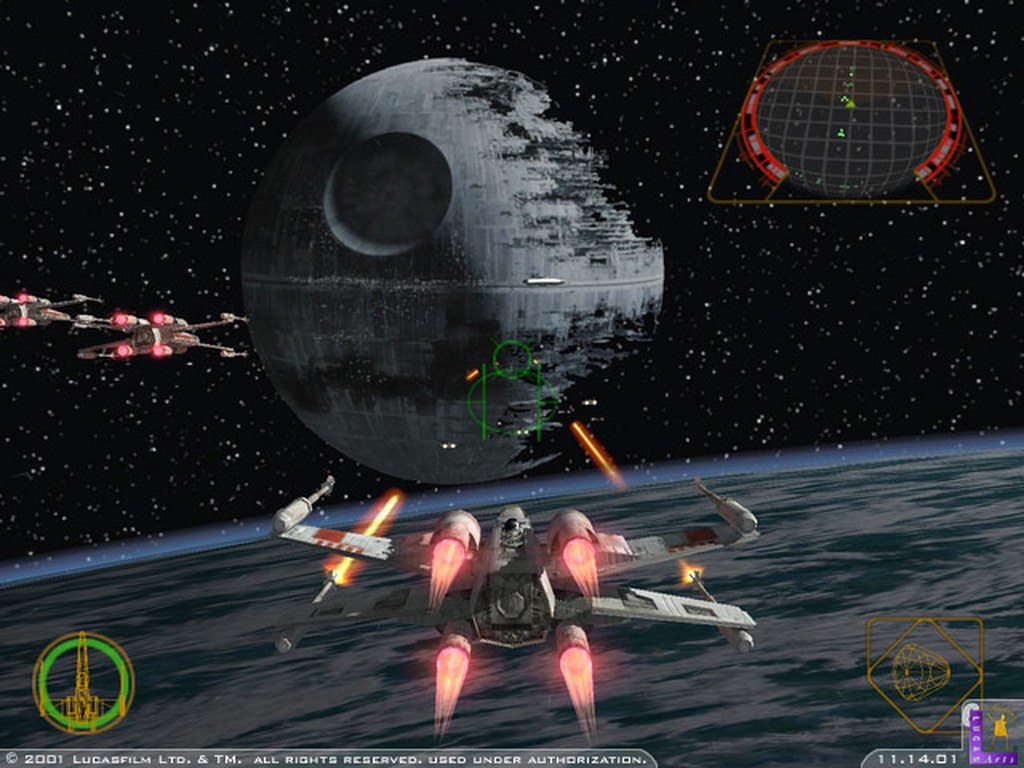
At a glance: Star Wars Rogue Squadron II: Rogue Leader · GameCube · Factor 5 / LucasArts, 2001 · Flight combat · Score: 8.5/10
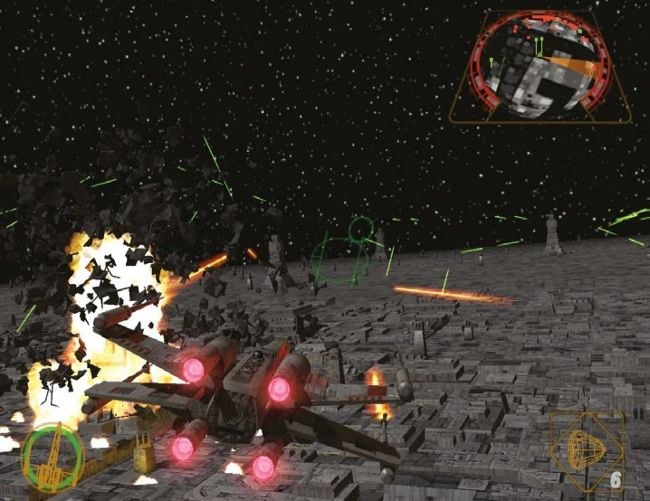
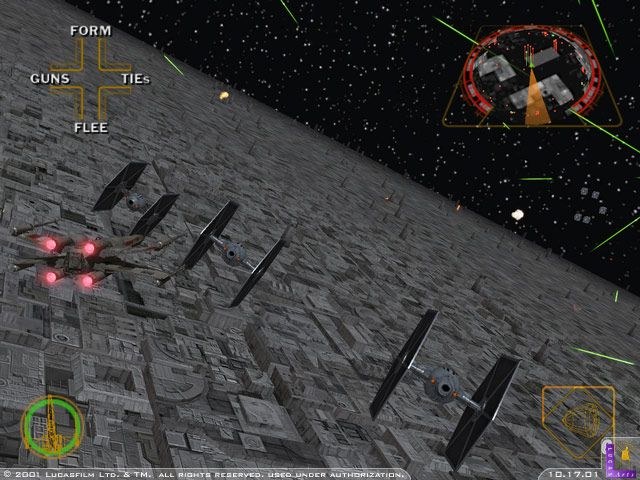
Every console launch has one game whose job is to make the hardware’s case in a single screenshot, and for the GameCube in November 2001 that game was Rogue Leader. The opening mission recreates the Battle of Yavin — the Death Star trench, the surface guns, Darth Vader on your tail in film footage recreated in real time — and it did so at a level of visual fidelity that made magazine screenshots look like stills from the movies. Factor 5, the German-American studio whose technical wizardry had already powered the N64 Rogue Squadron, reportedly built a playable version of this demo in a matter of weeks; the full game they shipped remains, more than two decades on, one of the finest Star Wars flight games ever made and the GameCube’s definitive launch showcase.
Eleven missions, all killer
Rogue Leader retells the original trilogy from the cockpit. You fly as Luke Skywalker and Wedge Antilles through the Death Star assault, the ion-cannon defence and snowspeeder battle of Hoth, a raid on an Imperial shipyard in the clouds, the strike on the second Death Star at Endor, and several original missions — a daring prison-rescue run, a stealth insertion over Bespin, a kamikaze-grade attack run through an asteroid field’s hidden base — that hold their own against the film recreations. Mission design is arcade-tight: objectives layer and mutate mid-flight, the targeting computer lets you frame the battle in a wireframe tactical view lifted straight from the films’ own displays, and the medal system — bronze, silver, gold, each with published statistical requirements — converts every mission into a score-attack puzzle of accuracy, speed, friendlies saved and targets destroyed. Unlockables reward the obsession properly: bonus missions, the Millennium Falcon, a Naboo starfighter, Vader’s TIE Advanced, and a certain vintage car for those who know their cheat codes.
The craft feel distinct in the ways that matter: the X-wing is the all-rounder, the A-wing a glass dart, the Y-wing a bomber that flies like its payload, the snowspeeder’s tow-cable takedowns of AT-ATs remain the single most satisfying Star Wars mechanic in games, recreated with the film’s own logic — circle the legs, mind your speed, watch it fall. Wingman commands on the D-pad, a seamless cockpit-to-external camera, and John Williams’s score in full orchestral arrangements adapted to the action complete a package that treats the licence with a craftsman’s respect.
The Factor 5 technical legend
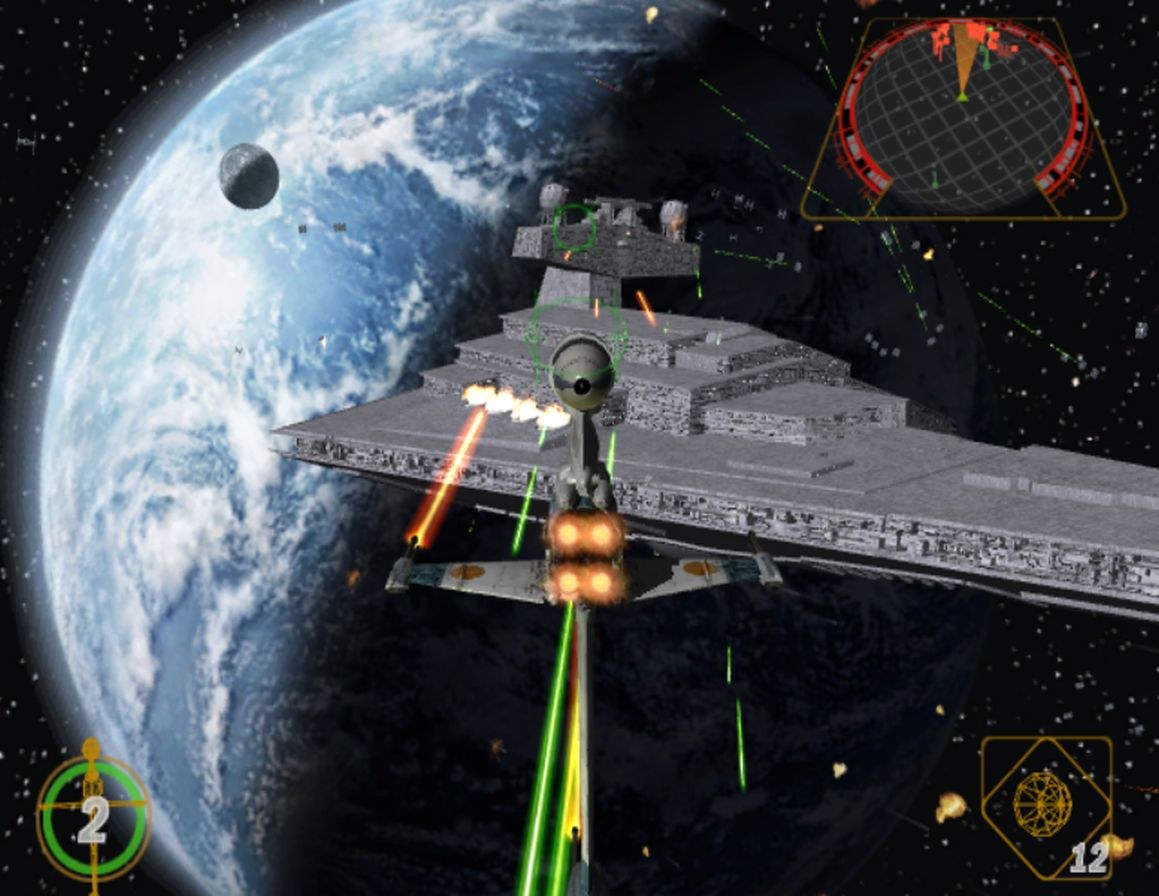
It is difficult to overstate how far ahead of its console generation this game looked at launch. Rogue Leader pushes an enormous number of polygons for its era, with real-time lighting, reflective water, volumetric-ish clouds over Bespin and a Death Star surface of greebled geometry stretching to the horizon — all at a frame rate that holds through the trench run’s chaos. Factor 5 wrote their own microcode-level wizardry for Nintendo hardware twice in a row, and Rogue Leader is their masterpiece: the rare launch title that later games in the console’s life, including its own competent sequel Rebel Strike, never clearly surpassed visually. Played today on original hardware, the Endor space battle — dozens of capital ships, hundreds of fighters, the Death Star filling the sky — still produces the intended intake of breath.
The charge sheet is short but real. Ten story missions plus bonuses is a lean campaign — most players will finish in a weekend — and the difficulty of the gold-medal chase is the game’s true length, which not everyone wants. A couple of missions lean on trial and error in their final phases, the ground-level Bespin and shipyard sequences expose the engine’s weaker terrain work, and there is no multiplayer dogfighting, an absence players felt even in 2001. The voice cast mixes soundalike performances with archival flavour, generally well, though a few lines have become affectionate memes within the fanbase.
Why the original still flies
Star Wars flight games have come in waves since — Squadrons most honourably — but Rogue Leader’s particular alchemy of film recreation, arcade purity and medal-driven mastery has never been reproduced at this concentration. Factor 5 folded long ago, the Rogue Squadron series rests with it, and the GameCube disc remains the definitive way to play its finest hour: no downloads, no service, just a purple console, a trench, and the most famous targeting computer in fiction telling you to switch off and use the Force.
Sound, speech and the Williams factor
Factor 5’s audio work matched their graphics. Rogue Leader streams full orchestral Star Wars music — John Williams’s themes in arrangements that respond to the mission’s state — at a quality the GameCube’s audio hardware was not supposed to manage alongside everything else, a feat the studio achieved with its own MusyX sound tools, which became middleware across the industry. Sound effects are sampled and layered from the films’ own library: a TIE fighter’s scream Dopplers past exactly as it should, and the cockpit fills with authentic radio chatter, much of it performed by a cast doing uncanny work in famous voices, alongside archive flavour. Denis Lawson, Wedge Antilles himself, returned to voice his character — a touch of authenticity that still raises a smile, and one this review will not spoil beyond confirming it exists.
The medal chase also deserves its defence against the “too short” charge, because Rogue Leader is short the way an arcade cabinet is short: the campaign is the tutorial for the real game, which is mastery. Each medal tier silently rewires how you fly — gold runs demand near-perfect accuracy, minimal time and specific rescues simultaneously — and the unlockables gated behind them include some of the game’s best content. Players who bounce off after the credits have played perhaps a third of what the disc contains.
The verdict
Rogue Leader is a launch title that never stopped being a showpiece: brief, yes, but dense with craft, generosity and technical brilliance, and endlessly replayable through its medal chase. For Star Wars fans with a GameCube it is not a recommendation so much as a requirement. For everyone else it remains the clearest proof of what the little purple box could do in the right hands — which, in Factor 5’s case, were the very best hands in the business.
Factor 5’s story ends sadly — the studio closed in the late 2000s after a difficult final project elsewhere — which lends Rogue Leader a memorial quality its makers never intended. This was a team at the absolute peak of its powers, on hardware they understood better than almost anyone, with the greatest film licence in the world and the skill to honour it. The GameCube disc is their monument. Keep it spinning.
It is also, not incidentally, the finest possible first disc for anyone assembling a GameCube in 2026 who wants to know what all the fuss was about: ten minutes from power-on to the Death Star trench, at full spectacle, with no updates, no accounts and no ceremony. Launch games are supposed to promise a console’s future. Rogue Leader simply delivered it, on day one, and never got old.
Score: 8.5/10 — The GameCube’s launch showpiece: a short, spectacular, medal-obsessed Star Wars flight classic that still flies rings around most successors.