
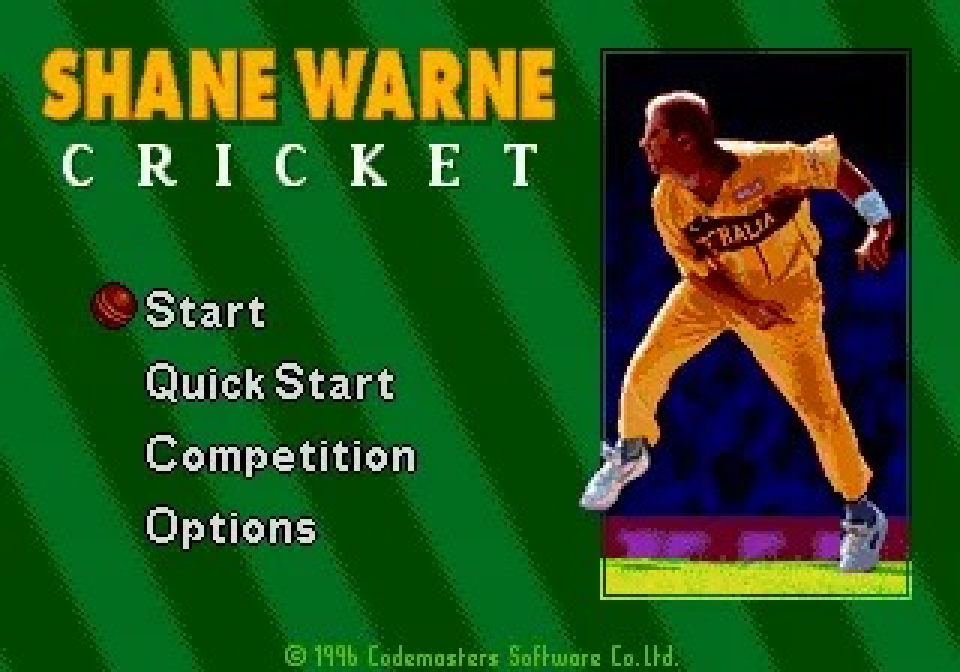
At a glance: Shane Warne Cricket · Genesis · developed by Audiogenic · published by Codemasters · 1996 (the Australian edition of Brian Lara Cricket ’96) · cricket simulation · twelve international sides plus state teams · one or two players
To Australians, Shane Warne was the greatest leg-spinner who ever lived, and you may keep your Muralitharan arguments to yourself. To English supporters of the nineties he was a recurring natural disaster who ruined more summers than the weather. Either way, his name on a cricket game in 1996 meant business, and in Australia and New Zealand it was Warne’s name that Audiogenic’s cricket engine carried — everywhere else, the identical game is Brian Lara Cricket ’96, Lara being the one batsman on earth whose pulling power matched the bowler’s. What both editions share is the most complete cricket simulation the 16-bit era produced: not a great game in any absolute sense, but an honest, deep and largely unbroken one, in a genre that has spent thirty years being none of those things at once.
More Cricket Than You Can Finish
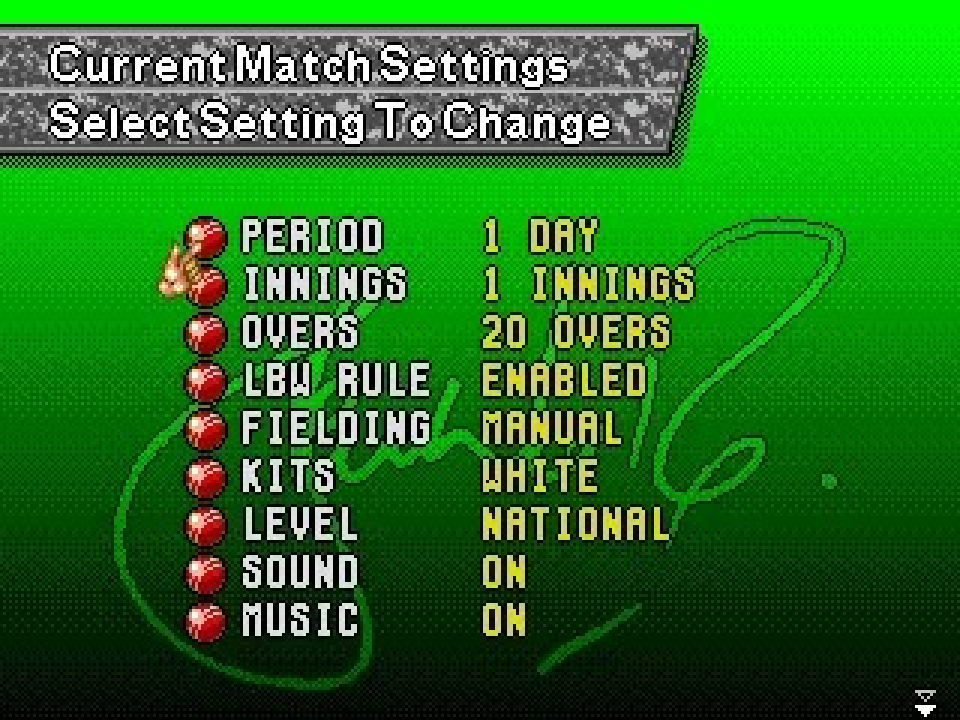
The menu tree is the first argument. One-off internationals sit alongside tournaments, full Test series and a World Cup structure; Tests run their proper course, while limited-overs matches come at a menu of lengths — a 10-over thrash, 20, 30, 50, up to 90 — the settings screen’s 20-over option quietly predating the Twenty20 format’s invention by the best part of a decade. Kits are your choice regardless of format, whites or one-day colours; the LBW law can be switched off for heretics; venues carry their own weather, England’s clouds and rain against India’s heat. Domestic cricket changes with the badge on the box: the Lara edition stocks the eighteen English county sides, the Warne edition swaps in six Australian state teams. Squads are period-authentic down to Hansie Cronje. Then there are the classic matches, mid-game rescues lifted from history — recreate Lara’s 501 not out for Warwickshire, or take over England against Australia in 1981 with a humiliation to avert, Headingley winking at anyone who knows what Botham did there. A performance tracker follows designated players across your sessions, team won-lost records persist for ongoing rivalries, and every venue gets its own between-overs music: a squelchy Rule, Britannia in England, calypso in the Caribbean, and Waltzing Matilda for Australia — and, to their enduring irritation, New Zealand too. Two players can contest any of it, and a shared Test series between friends was, for a certain kind of household in the summer of 1996, not a pastime but a standing engagement.
Bowling Is a Meter, Batting Is a Virtue
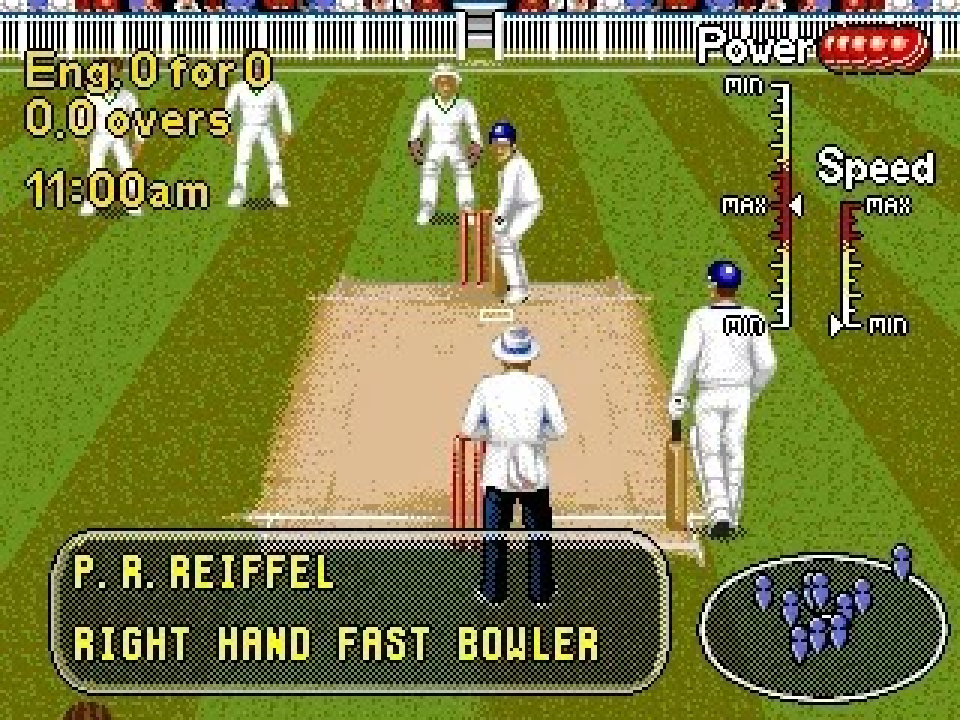
On the pitch, one visual joke never wears out because it is also a genuine flaw: every bowler in the game shares a single run-up, a full fast bowler’s charge, so Warne himself comes steaming in like an express train to deliver a leg-break that floats down at forty miles an hour. Delivery is a three-stage business — place your target, stop a swinging meter to set power, swing or spin, then mash for pace — workable, and kinder than Super International Cricket’s no-ball tightrope on the SNES. Fielding offers manual control that no human reflex can honourably use; by the time you’ve taken charge of a fielder the ball is past him, so the automatic setting does the work, competently, with the occasional drop to keep everyone honest and a computer batsman apparently immune to being run out. Field placements can be redrawn, though the defaults understand the game’s AI better than most experiments will.
Batting is where the design earns its reputation, because it is built on three honest families of shot: A drives along the carpet, B lofts, Up with either blocks dead — each married to a direction, no advancing down the pitch at spinners, no gimmicks. Respectable totals are ground out in singles against set fields, and the game models something few cricket simulations attempt: consequence. Wickets fall for reasons you can reconstruct — the wide one chased and edged to slip, the bouncer hooked at without due care — so dismissal stings like a mistake rather than a dice roll. One inversion deserves noting: where a real batsman grows safer the longer he stays, here the margin for error visibly narrows as an innings builds, which is backwards as simulation and effective as drama, since a century ends up feeling like an achievement scaled a cliff. Even a low-scoring Test can run two hours, which makes the autoplay accelerator a mercy and gives two-player series their epic, Sunday-afternoon scale.
Around the matches sits the workshop. Practice nets offer batting and bowling rehearsals against the same meter systems the matches use — a small mercy for a game whose timing takes an evening to learn — and full team and player editing lets you rename, re-stat and rebuild the squads, the 1996 answer to every roster the selectors got wrong. There is even an alternative side-on camera for those who find the default end-on view too familiar, though familiar is mostly what you want from a cricket broadcast angle. None of these extras is glamorous, and that is rather the point of the whole production: Audiogenic built the cricket game they would have wanted to own, feature by feature, and let the presentation budget go hang. Two players sharing a Test series across a weekend, records accumulating in the tracker, edited elevens settling arguments about the actual Ashes — this is a game designed as a hobby, not a rental.
Functional Looks, Hollow Crack
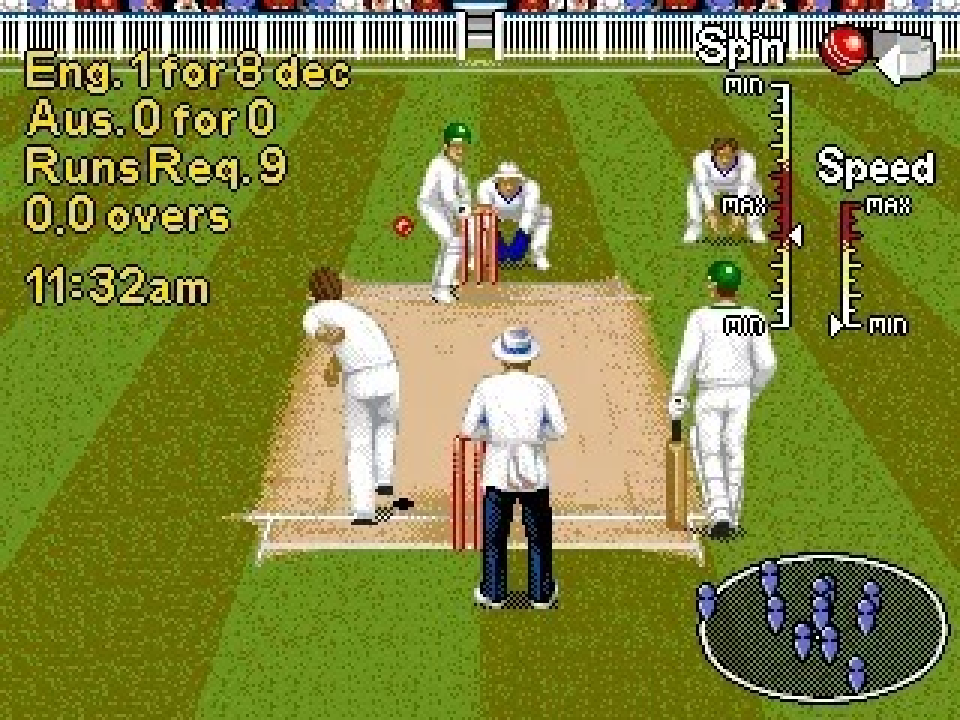
Presentation is serviceable rather than handsome. The bowler’s approach scales towards camera in visible steps, sprites shrink and chunkify when the view pulls back behind a struck ball, and struck batsmen remain serenely upright even when hit in the head, which is simply not cricket. The umpire appears in insets to signal boundaries wearing the same expression he wears for everything else, up to and including, one assumes, his own birthday. Bat on ball lands with a hollow crack, applause is passable, and between overs the regional music does more for atmosphere than any of the graphics manage. The crowd, to its credit, swells for boundaries and wickets with something approaching judgment, as if it too has read the match situation. None of it sparkles. Almost none of it is broken, either — and cricket fans of the era, starved by a genre littered with the unplayable, learned to treat that as the headline feature.
“Not the definitive cricket game — but for thirty years the genre has mostly failed to beat a 1996 cartridge that simply works, all the way down its enormous menu.”
The Verdict
Strip the endorsement away and the game that remains is built like a dour, effective opening batsman: watchful patches, unglamorous method, and a scorecard that simply keeps accumulating. The batting model respects patience and punishes vanity, the bowling is a meter-minding chore shared by the world’s greatest spinner and its journeymen alike, and the options list embarrasses cricket games released decades later. On the Genesis, nothing in whites or colours does the sport better.
Verdict: the best 16-bit cricket game by accumulation — deep, honest and unbroken, with all the flair saved for the menus — 6.0.
Keep reading: the Genesis system archive