
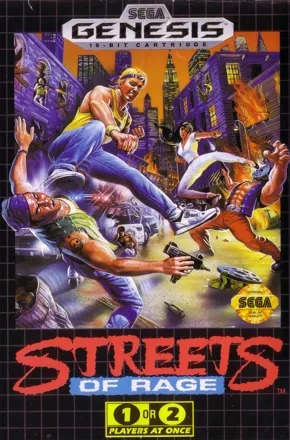
At a glance: Streets of Rage · Genesis · developed and published by Sega · 1991 · side-scrolling beat-’em-up · eight rounds · one or two players, simultaneous
Context explains this game, so start there. Capcom’s Final Fight had defined the scrolling brawler in arcades from 1989, and its 1990 Super Nintendo conversion — exclusive to Nintendo’s machine, cut down, missing its two-player mode — left Sega’s library with a fist-shaped hole at exactly the moment the Genesis was fighting for its life. Streets of Rage, released in 1991, is Sega’s answer, and subtlety was never part of the brief: three fighters, a city owned by a syndicate, eight rounds of pavement between you and a man called Mr. X. It is not a game embarrassed by its influences. It is a game that photocopied the genre’s homework and then, almost in spite of itself, scribbled two or three ideas in the margins that the sequel would turn into a legacy.
Three Ex-Cops, One Moveset, Small Print
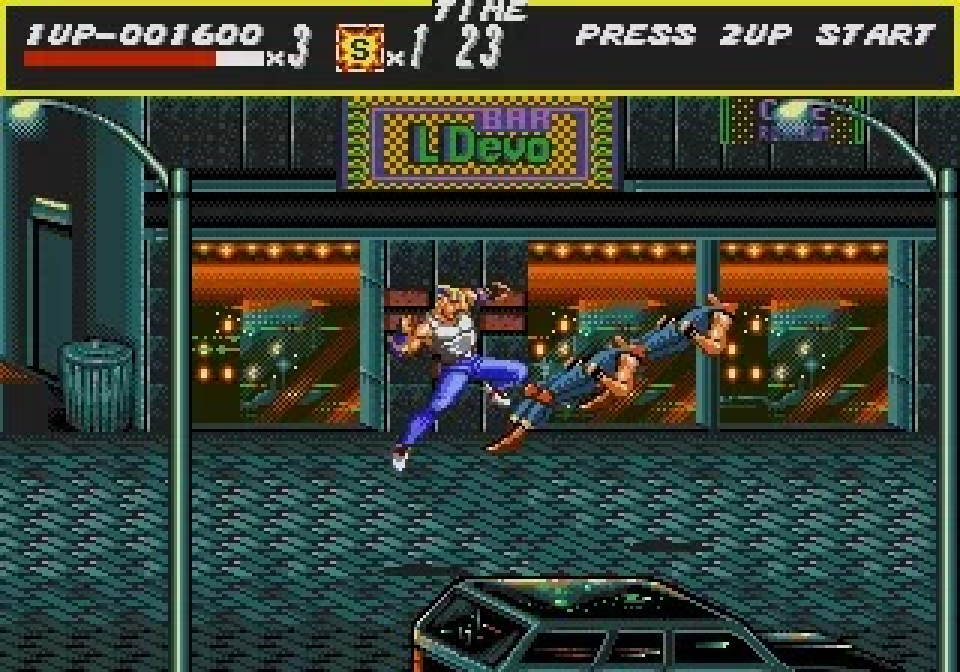
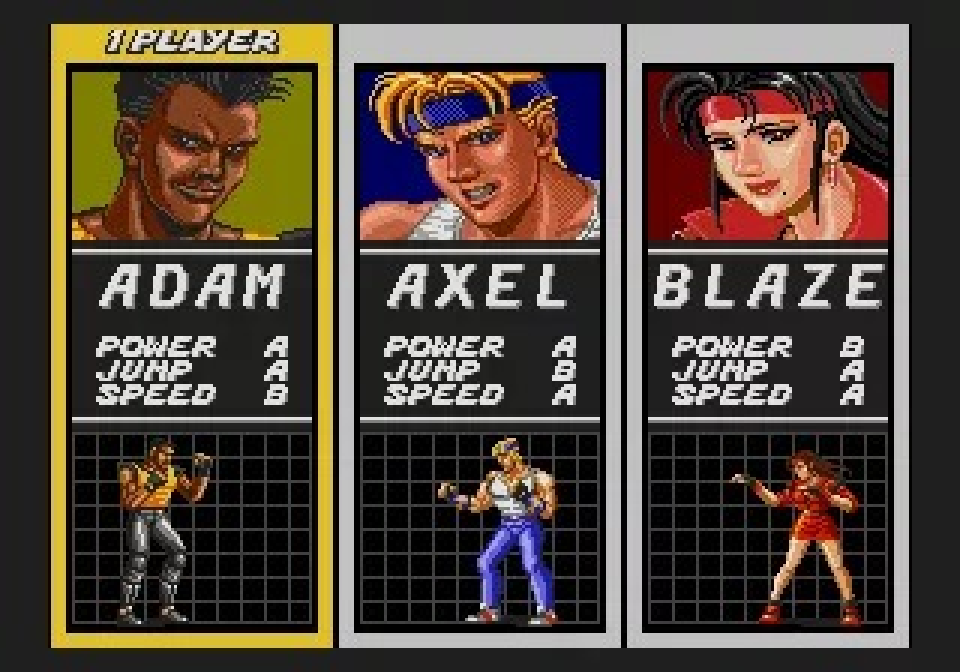
Your vigilantes are Adam Hunter, Axel Stone and Blaze Fielding, police officers who resigned when the syndicate bought their department, and their differences are arithmetic: Adam hits hardest and jumps highest but walks like he’s wading; Blaze is quickest and weakest; Axel splits the difference with the best jump of the three on some charts and the worst on others — the character-select screen grades them all in letters, power, jump, speed. Under the numbers, everyone shares a kit: a strike combo, throws from a grab, a jump attack, and a couple of personality flourishes — the vault over a held enemy that lands behind him in a piledriver, the backfist thrown by pressing away from the fight. Weapons dropped by punks — knives, pipes, bottles, bats — stay in your hand for the whole round unless you’re knocked down, a generosity the genre didn’t usually extend. And on a limited stock, replenished as your score climbs, the A button summons the series’ strangest inheritance: a patrol car pulls up off-screen and an officer you apparently still know clears the street with a rocket launcher or napalm, a special attack outsourced to the force you quit. Every round gets its own theme, and the boss encounters share a rising, percussive cue that still signals trouble the instant it starts; whatever the animation budget failed to fund, the soundtrack quietly covers, round after round.
What dates the game is its stiffness. Sprites are small — the camera sits further back than Final Fight’s, showing more street and less person — and animation is rationed: some enemies punch with a single moving arm, the whip-wielding women on the roster seem to teleport between standing and floored, and nobody gets the little idles and head-shakes that made Capcom’s thugs feel alive. Movement speeds are actually comparable to its rival’s; the wider framing simply makes every walk feel longer. Enemy tactics are honest enough — the basic punks hang back, then rush, and a mistimed swing earns you an unbreakable combo in reply — while the bosses can mostly be dismantled by approaching on a diagonal, with the giant wrestler types obligingly charging face-first into jump kicks until the lesson ends.
The eight rounds themselves trace the genre’s standard grand tour: downtown streets, a shopping district, the beachfront, a bridge over the harbour, a cargo boat, a factory floor, a construction elevator that turns vertical travel into an ambush corridor, and the syndicate tower at the end of the night. Travel between them is brisk, bosses gate every round, and the roster of regulars — the punks, the whip women, the fire-breathing fat men, the towering wrestler borrowed from André the Giant’s silhouette — recycles with palette changes and rising numbers rather than new ideas. Two players together get the game’s best mechanical flourish: proper tag-team attacks, one fighter holding a thug while the other works him over, a back-to-back throw for pairs surrounded on both sides. It is worth pausing on how much of the era Sega squeezed around this cartridge: Streets of Rage was also converted down to the Master System and Game Gear, in respectable form, which makes its Genesis modesty a choice of scope rather than of capability. The machine could do more. The schedule, chasing a hole in the release calendar, settled for enough. The tour takes a full evening the first time through and about ninety committed minutes once the patterns are yours — a fair exchange rate for a first draft of a classic.
The City Looks Better Than Its Citizens
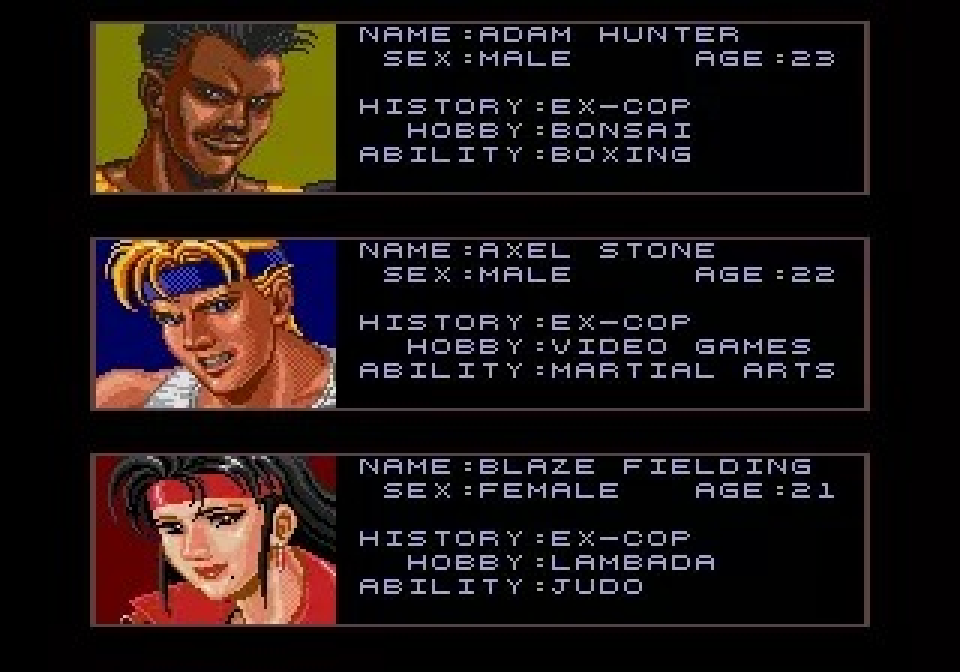
If the fighters underwhelm, the streets themselves do not. The palette is smog and neon — a downtown strip under signage, a beachfront where rain slashes through the fight, a bridge whose far shore reflects in rippling water, a boat round where the harbour slides past the rails. Best of all is the final ascent: Mr. X’s tower plays out through the night, and dawn comes up through the windows as you climb, so the campaign’s last corridors are lit by morning. Over it all sits Yuzo Koshiro’s score, house and techno filtered through the Genesis sound chip with a confidence nothing else on the machine matched in 1991 — bass that thumps rather than buzzes, a title theme people still sample, and a little sustained flourish at the round-end tally that sounds like the console exhaling. The sound effects even cheat productively, borrowing weight from The Revenge of Shinobi’s library. Presentation, in short, is doing heavy lifting that the animation budget wouldn’t.
An Ending with a Knife in It
Then the game saves its best idea for the last sixty seconds. Mr. X, met at last, doesn’t open with a fight. He makes an offer: join the syndicate, take a share of the city. Answer yes alone and the game contemptuously loops you back to an earlier round to think about what you’ve done. But answer in two-player, and split your answers, and the co-op contract that has governed the whole evening is torn up on the spot: the two of you duel, winner takes the solo meeting with Mr. X, and if the winner then refuses him and wins the fight, the ending changes — your fighter photographed on the syndicate throne, the city’s new crime lord, your friend presumably reconsidering several life choices. No brawler of the era ends on a test of the room like that. It is worth the price of the cartridge by itself, and worth mentioning to your partner only afterwards.
“A competent Final Fight alternative with a legendary soundtrack and a treacherous ending — the greatness was coming, but it wasn’t here yet.”
The Verdict
Strip away the sequel’s shadow and this is a solid, well-dressed brawler: complete moveset, simultaneous co-op its inspiration’s home port lacked, varied backdrops, a score for the ages. Stand it next to that shadow and the small sprites, stiff animation and borrowed outline show plainly. Streets of Rage is best understood as a foundation pour — everything the series became is present in embryo, including, in that final offer, a flash of genuine mischief. Foundations are worth visiting. Just know the house next door is bigger.
Verdict: the competent photocopy that started a dynasty — outclassed by its sequel, outscored by nobody in 1991 — 6.5.
Keep reading: the Genesis system archive