
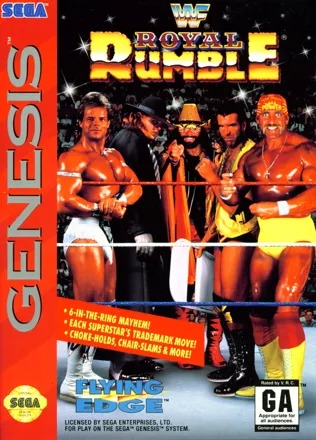
At a glance: WWF Royal Rumble · Genesis · developed by Sculptured Software · published by LJN · 1993 · wrestling · twelve-wrestler roster, five unique to this version · one or two players
Sculptured Software’s WWF trilogy on the 16-bit machines — Super WrestleMania before this, WWF Raw after — made Royal Rumble the middle child, and it plays like one: bigger and rowdier than its older brother, not yet as polished as the sequel, and absolutely determined to be noticed. The template is the arcade one laid down by WWF SuperStars and WrestleFest, twelve wrestlers deep, with the full carnival of early-nineties Federation talent squeezed onto a cartridge. What you get is less a wrestling simulation than a wrestling variety show — strikes, grapples, pins, chairs, disqualifications, a six-man battle royal — and the show is mostly a good one, held back by a control scheme that settles nearly every argument by asking who can hammer one button fastest.
Two Rosters for the Price of One War
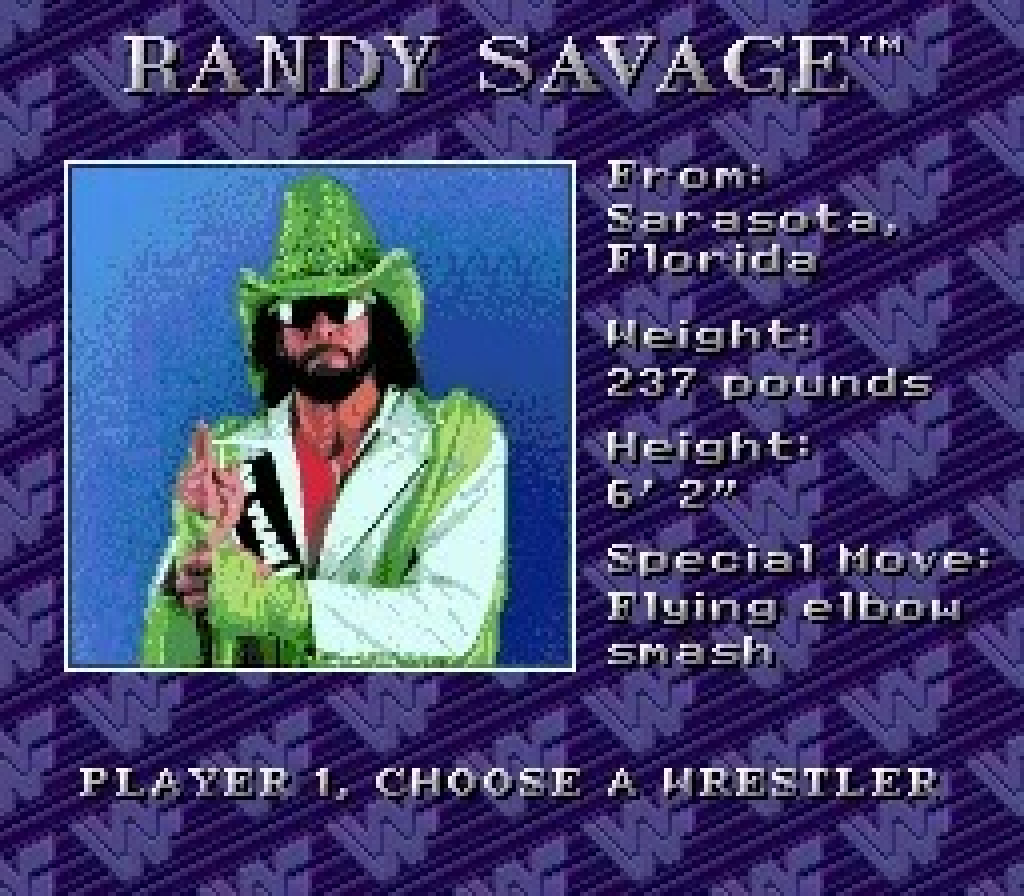
Twelve men make the roster, and the console war reached into the locker room: seven are shared with the Super Nintendo edition — Bret Hart, The Undertaker, Shawn Michaels, Razor Ramon, Randy Savage, Crush and Lex Luger in his Narcissist pomp — while five slots differ by machine. Genesis owners drew Hulk Hogan, Irwin R. Schyster, “Hacksaw” Jim Duggan, “The Model” Rick Martel and Papa Shango; the SNES kept Ric Flair, Mr. Perfect, Ted DiBiase, Yokozuna and Tatanka. Whether that trade favours Sega depends entirely on your allegiances, but it gave each version a genuine identity in an era when ports usually differed by a title screen. Presentation trades on star power: digitised photo cards with heights, weights and hometowns, a snippet of each man’s entrance riff if you linger on the select screen, and in-ring sprites that are stiff yet recognisable — the Genesis palette runs moodier than its rival’s neon, and suits the arenas. A second pad transforms every mode on offer, because the engine was plainly tuned for a human opponent’s spite rather than the computer’s honesty.
Small print completes the picture. The Super Nintendo edition actually reached shops about three months earlier, in the summer of 1993, so Genesis owners waited for their version of a game the other side was already trading in schoolyards; what they got for the wait was Hogan, whose licensing gravity bent rosters around him in every medium of the decade. The publisher’s name on the box is LJN, with Flying Edge — Acclaim’s Sega-facing imprint — sharing the cover, a little corporate archaeology for anyone who remembers when the same company’s wrestling games wore different badges on different machines. And the crowd, often the first casualty in a cartridge wrestling game, is present in the mix: cheers swell audibly when a flashy move lands, a feedback loop that makes the theatrical punches and theatrical eye rakes play better than they animate. Sound design doing crowd work is a small thing, but wrestling is a small-things business — it lives on reaction.
The disappointment waits underneath the photos. Every wrestler works from the identical toolbox: one punch, one kick, the same suplexes and backbreakers available to all. Individuality surfaces in exactly one place — a finisher per man, triggerable only with the opponent’s stamina deep in the red and often only from a specific position, A and B together. The Undertaker’s Tombstone Piledriver and Razor Ramon’s Razor’s Edge are the genuine articles, and landing one feels like a signature rather than a move. One signature each, among a dozen men whose television personas were nothing but signatures, is economy too far.
Every Argument Ends in a Mash
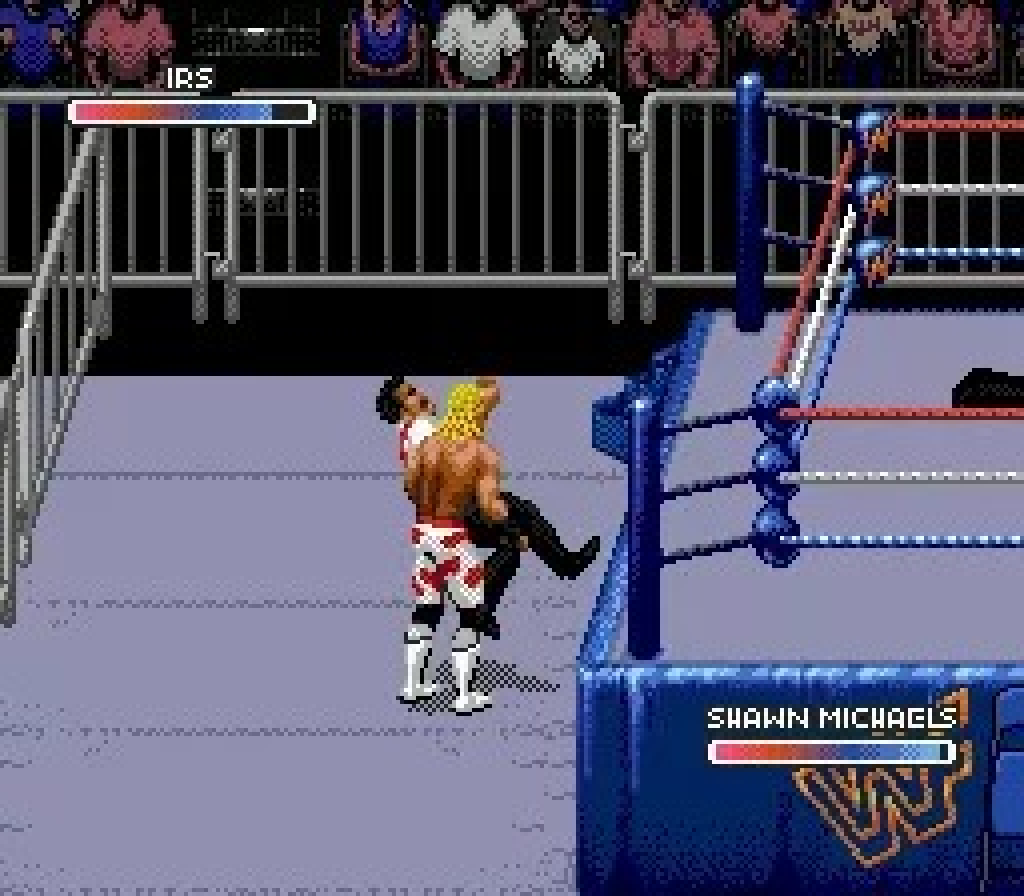
The engine runs on two meters and one habit. Stamina drains with everything you take and, in a singles match, never returns; a weakened man pins easier and grapples worse, so matches have a proper arc from feeling-out to desperation. Grapples are the habit: lock up and a tug-of-war meter opens above both heads, and whichever player mashes his chosen button harder wins the exchange — the button itself picks the prize, one for throws, others for the suplexes and backbreakers. Win with the throw near the ropes and your man bounces back into a dropkick; win with it at the apron and he goes over the top to the floor, where the count of ten starts, folding chairs wait to be weaponised, and a piledriver delivered at the count of eight — while you slip back inside — is as dirty a win as the game allows. Three clean strikes put a man down for pins, stomps and elbow drops, and kicks out of a pin are, inevitably, another mash.
The mischief system deserves its paragraph. Chokes and eye rakes sit on their own buttons but stay locked in a refereed match until the official is accidentally flattened by passing traffic — at which point the rulebook leaves with him. Brawl mode simply never invites the referee, opening the illegal arsenal and the ringside furniture from the bell. Tag matches, in pairs or threes, add the game’s best layer: partners recover a little stamina at ringside, a rested man tags in fresh against a wilting one, and a partner will reach through the ropes to choke-grab anyone careless enough to pass — or join a two-on-one beating when the fight spills outside. A six-button pad is not a luxury here; on three buttons, half of this is buried under combinations you’ll fumble at exactly the wrong moment. Against the computer, one flaw caps everything: past difficulty four of ten, the AI wins every grapple, out-mashing any human thumb and most turbo pads. Tournament mode fixes its own difficulty and declines to tell you which, turning the game’s showcase into a strike-only slog.
Six Men, One Ring, No Friends
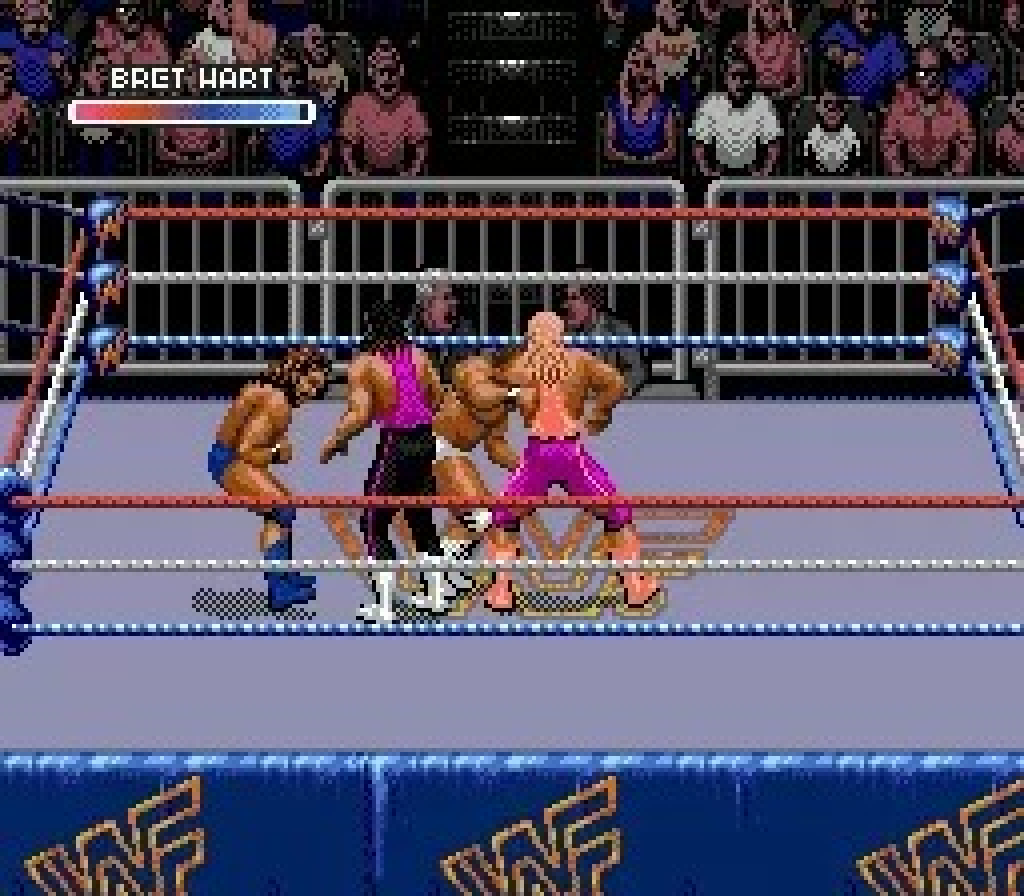
The mode on the box earns its place. The Royal Rumble starts with two, feeds fresh wrestlers in until six share the ring, and repeats until the full dozen have entered; elimination is over the top rope only, and the computer’s men sensibly fight each other as often as they fight you. It is an endurance event judged on stamina bookkeeping — steal rest in corners, let rivals soften each other, and spend your throws on the wounded. As a party piece with a second human sharing the chaos it is the finest thing in the cartridge, and as a solo run it is the one mode where the mashing economy feels like drama rather than admin.
“A generous, star-stuffed wrestling card whose every big moment is decided by a thumb race — brilliant with a friend, rigged against you alone.”
The Verdict
Measured against Super WrestleMania, everything here is more: more wrestlers, more modes, more rule-breaking, a Rumble that justifies the title. Measured against the wrestling it depicts, the shared moveset and mash-first grappling keep it a good arcade brawler rather than a great wrestling game, and the computer’s superhuman thumbs poison the solo tournament outright. With two pads and two players, most of those complaints evaporate into the noise of a very enjoyable evening.
Verdict: a stacked card and the era’s best Rumble, let down by identical movesets and a grappling system rigged for robots — 6.5.
Keep reading: the Genesis system archive