
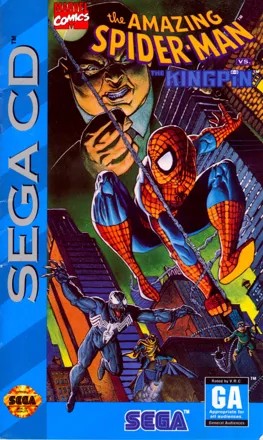
At a glance: The Amazing Spider-Man vs. the Kingpin · Sega CD · developed by Sega of America, from Technopop’s Genesis original · published by Sega · 1993 · action platformer · 1 player
The Sega CD collected a reputation for lazy conversions — cartridge games with a CD soundtrack bolted on and a new price tag glued over the old one. This is the counterexample people forget. The Genesis Spider-Man of 1991, developed by Technopop, was a likeable early platformer that looked rough and sounded rougher, and Sega of America could simply have pressed it onto a disc. Instead the CD version redraws the art, rethinks the structure, adds animated and fully voiced cutscenes, commissions a new soundtrack, brings in extra levels and bosses, and rebalances what you can and cannot do. It is less a port than a second draft, written by people who had read the reviews of the first one. It was overlooked in its day precisely because buyers assumed it was another cash-in. It deserves better company than that assumption gave it.
Not a Port — a Rebuild
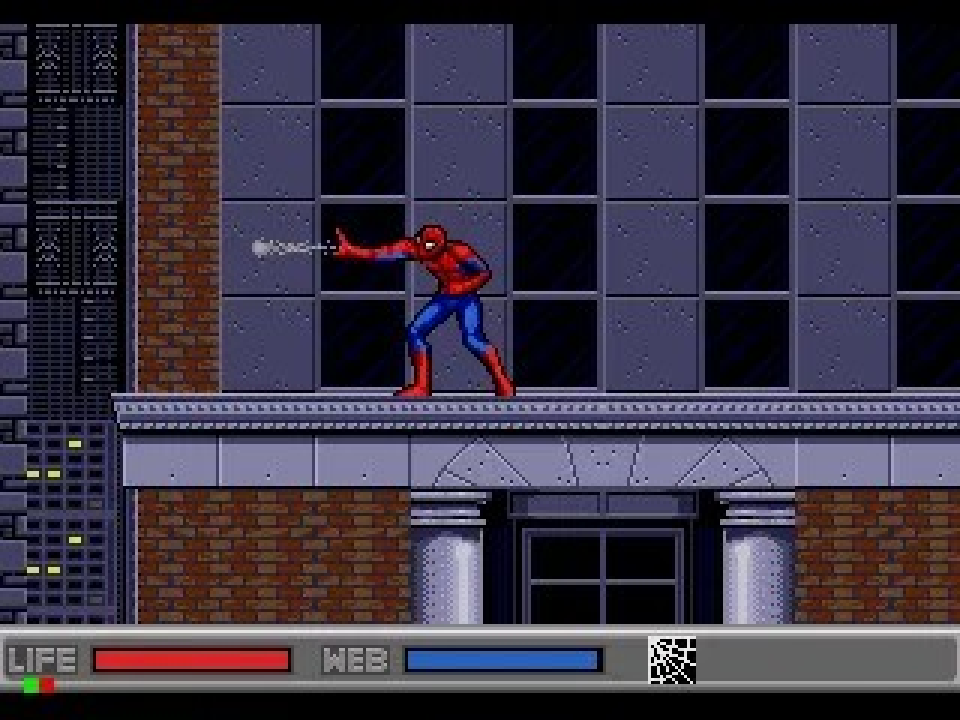
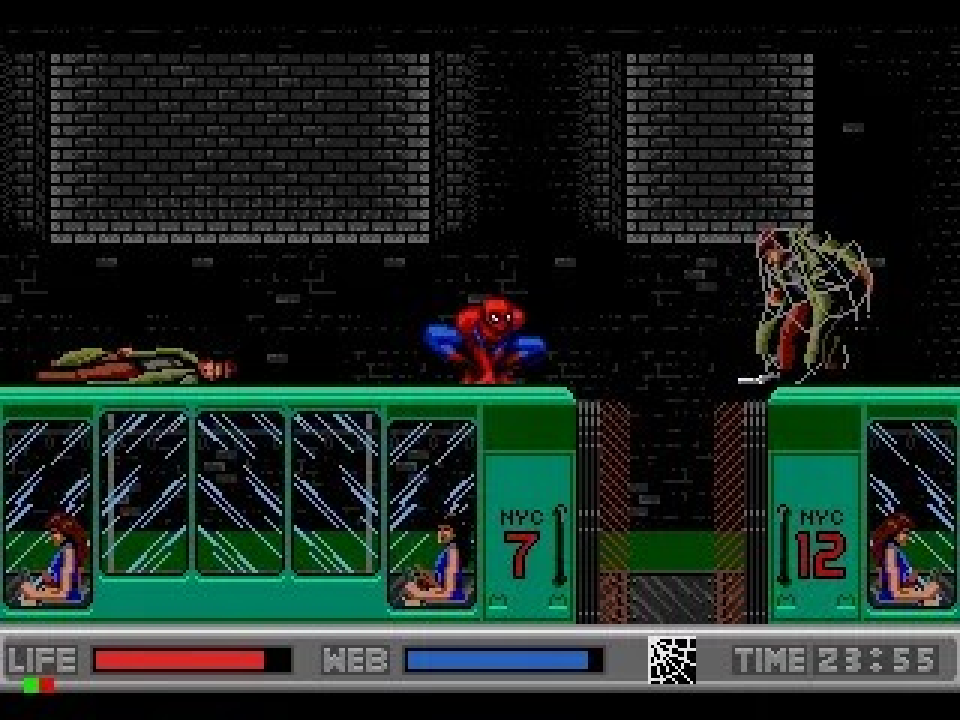
The setup is unchanged and still good pulp. The Kingpin has hidden a bomb somewhere in New York, set it counting down from twenty-four hours, and used his media reach to convince the city that Spider-Man planted it. Five keys, held by five villains, will disarm it. The clock genuinely ticks — accelerated, but always visible — and between you and each key stands a respectable slice of the rogues’ gallery: Doctor Octopus, the Lizard, Sandman, Electro, Hobgoblin and Venom from the original roster, now joined by Mysterio and the Vulture, with Mary Jane’s kidnapping folded into the middle for good measure. The CD redraw flatters all of them. Edges are cleaner, colours sit together better, Spider-Man’s webbing animates with a smoothness the cartridge could not afford, and he moves faster, particularly when crawling — which matters, because crawling is this game’s party trick and it remains delightful: up walls, across ceilings, over the heads of men who would very much like to shoot you.
Controls are simple and mostly satisfying. One button punches, one fires webs — a tap to tie a man up, a hold to wrap him properly — and one jumps, with a web-swing available in the air. Web fluid is now a meter refilled by pick-ups scattered through the levels. The fighting itself is the thinnest part of the design: walk towards a thug, mind his high and low swings, and punch him until he falls over. There is no score-based reason to bother, since your evasive options are so good, and the game knows it — combat is scenery here, and the bosses are the real appointments.
Choose Your Own Hunt Across Manhattan
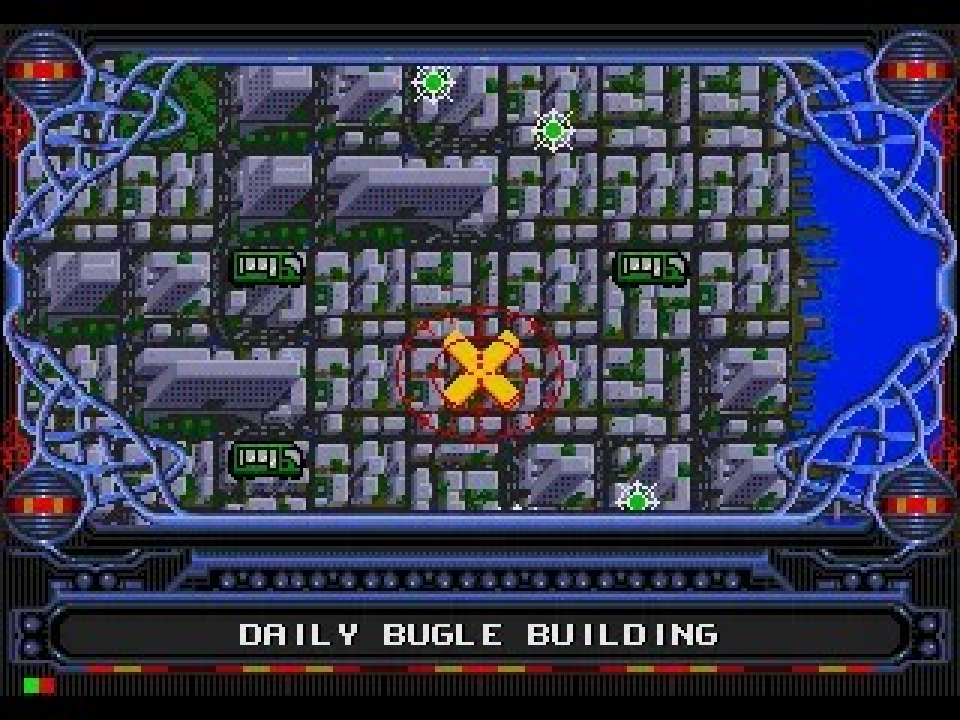
The structural change is the one that lifts the whole game. Where the cartridge marched you down a fixed corridor of levels, the CD opens a map of Manhattan and lets you pick your next destination. Boss locations announce themselves; the other landmarks are optional excursions stocked with health and web refills, worth raiding before a hard appointment. It sounds modest now, when every second game has a map screen, but in a 1993 platformer it changes the texture of play entirely — you plan a route, prepare for a fight, and feel like a hunter rather than a passenger. Hidden in the levels, too, are collectible classic Spider-Man comics, viewable afterwards: a small, affectionate use of all that disc space that suits the licence perfectly.
Two subtractions came with the redesign, and both are worth recording honestly. On the Genesis you could photograph villains and sell the pictures to the Daily Bugle to pay for web fluid — a mechanic so perfectly Peter Parker that its absence is genuinely felt, whatever its clunkiness. You could also retreat to the apartment to recover health and fluid at the cost of precious hours, a lovely little pressure valve. Both are gone, traded for pick-ups and pace. And the new password system, which records your defeated bosses and their keys after each victory, is generous to a fault: entering a password resets the bomb’s clock to a full twenty-four hours, quietly dismantling the tension the timer exists to create.
The exploration that structure encourages is the game’s quiet strength. Optional stops are never purely decorative: a detour across the rooftops restocks the web cartridges and first aid you will want before facing a boss, and the clock keeps ticking while you decide whether the detour is worth it. That single tension — prepare or press on — gives the hunt a rhythm the cartridge version’s straight line never had, and it makes the map feel like a city being patrolled rather than a menu being cleared. Swinging between appointments, dropping on a mugger out of sheer habit, remains the purest pleasure the disc offers.
“The rare CD remake that actually remakes: redrawn, restructured and re-scored — the definitive version of a good game, made better.”
Saturday-Morning Voices, Sunday-Paper Problems
The new animated sequences are a cheese factory and proud of it. Drawn like a budget Saturday-morning cartoon — which, in fairness, predates the celebrated mid-nineties animated series that would set the standard — they are voiced at full radio-theatre volume. Spider-Man delivers every line with the squared jaw of a serial hero, and Cam Clarke works his way through what sounds like the entire supporting cast, differentiating each villain mainly by flavour of mania. It is broad, it is cheap, and it is entirely in keeping with the four-colour spirit of the thing; complaining that it lacks subtlety is like complaining that the bomb plot lacks realism. The soundtrack divides opinion more sharply. The instrumental CD tracks — synth rock, wailing guitar, everything the Sega CD soundscape promised — suit the wall-crawling beautifully. The vocal theme, performed by Eric Martin of Mr. Big, is an eighties power ballad that crash-landed in the wrong decade, catchy in the way a jingle is catchy and lyrically beyond rescue.
What ultimately keeps the game off the top shelf is how little resistance its headline acts offer. Most bosses fold to a simple pattern politely repeated: the Vulture has essentially one attack, telegraphed; Electro strands himself on platforms and waits to be hit; the Kingpin and Doctor Octopus are exercises in patience rather than danger. Only Sandman makes you work, and only if you left the gorilla sharing his level standing. For younger players that is a feature. For everyone else it means the hunt across Manhattan — the travelling, the planning, the crawling — is more memorable than any of its destinations.
The Verdict
Weigh it as a version and it is close to exemplary: better art, better sound, more content, a freer structure, a save system of sorts, and a hero who finally moves at the speed his comics suggest. Weigh it as a game and the caveats are real but survivable — thin street combat, two charming mechanics traded away, a timer its own passwords undermine, and bosses who seem embarrassed to be obstacles. The balance lands firmly in its favour. If you own one Spider-Man game from the 16-bit years, the consensus pick has usually been the cartridge; play both, and the disc makes the stronger case.
It also stands as the answer to a lazy generalisation. The Sega CD’s catalogue is full of discs that used the format for nothing. This one used it for almost everything it had.
Verdict: the best version of a good game, rebuilt rather than reissued — 7.5, and the Sega CD conversion the others should have been.
Keep reading: the Sega CD system archive