
At a glance — Game: The Legend of Zelda: A Link to the Past · Developer: Nintendo EAD · Publisher: Nintendo · Original release: November 21, 1991 · Original platforms: Super Nintendo / Super Famicom · Genre: Action-adventure
It starts on a rainy night, with a voice calling for help and an uncle who tells you to stay in bed. Hold that thought — we will come back to it — because first there is a footnote to be honest about. The anniversary we are marking today belongs to Japan. The Legend of Zelda: A Link to the Past launched for the Super Famicom on November 21, 1991. North American players waited until April 13, 1992, and Europe until that September, so if you grew up with the grey SNES cartridge, your own 35th lands next spring. We are not going to blur that. The game itself never blurred anything. It knew exactly what it wanted to be, and thirty-five years later the rest of the industry is still walking the path it cut.
It is easy to forget how uncertain the series looked in 1991. The original Legend of Zelda had been a phenomenon. Zelda II: The Adventure of Link had been something else entirely — a side-scrolling action RPG with towns, experience points and a difficulty curve that still starts arguments. For the third game, Nintendo EAD, with Takashi Tezuka directing and Shigeru Miyamoto producing, went back to the overhead view of the first game and then rebuilt everything underneath it. What came out was not a sequel so much as a settlement. This, the game said, is what Zelda is.
Back to the Top: Life After Zelda II
The return to the top-down view is the first thing anyone notices, but it is the least of what changed. Link could now move in eight directions instead of four. He could swing his sword in an arc instead of a jab, and cross a Hyrule that felt built rather than tiled. Dungeons ran over several floors, with stairs, pits and drops between levels, so a room could hide its secret one floor down from where you were standing. The scale was not an accident. Most early Super NES cartridges held 4 Mbit of data. Nintendo gave this game 8 Mbit — a full megabyte — and spent it on a world dense with caves, chests, heart pieces and people worth talking to.
Some of the cleverest work was invisible. The Dark World, the game’s parallel Hyrule, does not exist in the cartridge as a second map. It is stored as an overlay on the Light World — the same layout wearing different tiles — which is how the team fitted two worlds into the space of one and change. Koji Kondo’s score pulled the same trick in sound. The original game’s overworld theme returned, rebuilt for the new hardware, and around it Kondo wrote the tunes the series has never let go of since: Zelda’s Lullaby, the Hyrule Castle theme, Kakariko Village, the fairy cave music. Play a modern Zelda and you are still humming A Link to the Past.
The story tightened up too. Kensuke Tanabe wrote the script, Yoshiaki Koizumi wrote the backstory in the manual, and between them they gave Hyrule a creation myth, a war, and a villain with a plan that started before Link was born. You were not wandering anymore. You were cleaning up history.
Two Hyrules: The Light World and Dark World of A Link to the Past
Here is the idea that changed everything. Partway through the game, the wizard Agahnim throws Link into the Dark World — the Sacred Realm after Ganon got his wish on the Triforce and twisted it into a mirror of Hyrule. Same mountains. Same rivers, roughly. Wrong everything else. Kakariko Village becomes the Village of Outcasts. The cheerful shopkeepers are gone. The trees have faces, and not kind ones. Step through a portal as a boy with a sword and, until you find the Moon Pearl, the Dark World turns you into a pink bunny — which remains the boldest statement about powerlessness a Nintendo game has ever made.
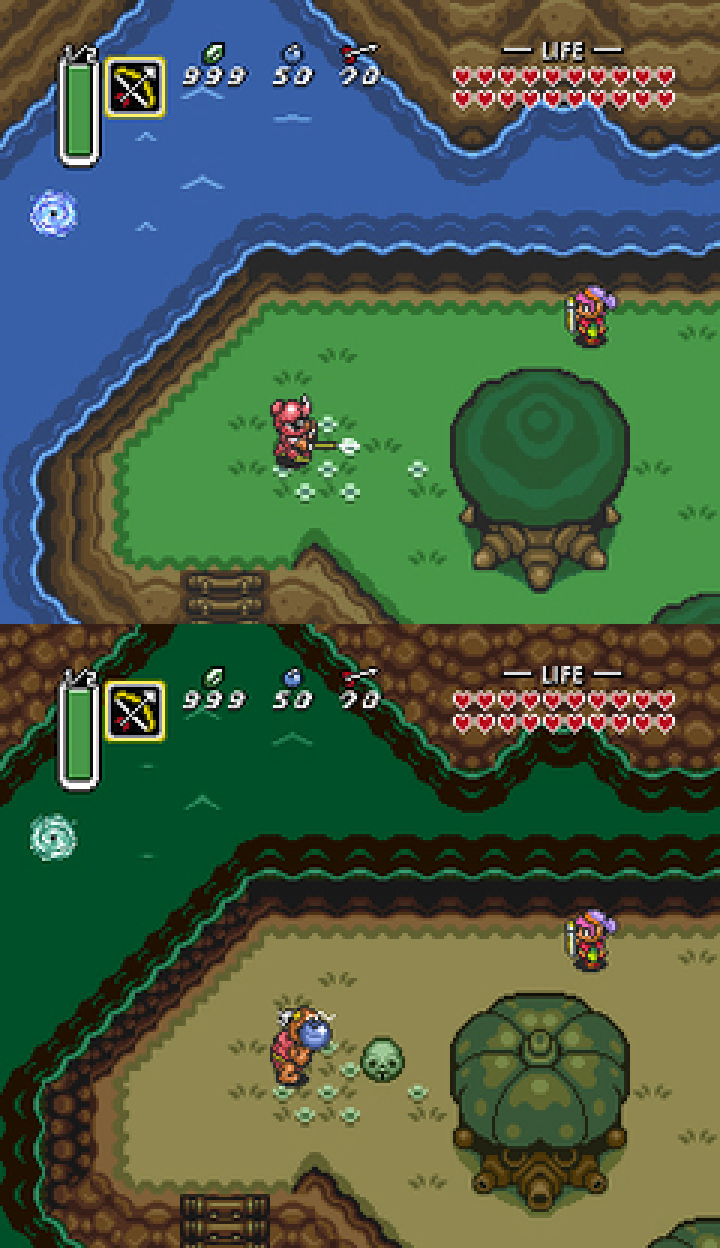
The genius of it is mechanical, not just atmospheric. The two maps share a geography, so knowledge transfers. A cliff you cannot climb in the Light World might have a ledge in the Dark World that drops you exactly where you need to be. The Magic Mirror, which snaps you back to the Light World and leaves a sparkling portal behind you, turns the whole map into a puzzle about correspondence. Every screen is really two screens. Every dead end is a question: what does this place look like on the other side? Games had shipped second worlds before. None had made the two worlds argue with each other this productively, and the idea proved so strong that Nintendo returned to it again and again — most directly in 2013, when A Link Between Worlds rebuilt this exact Hyrule for the 3DS.
It also doubled the game honestly. Three pendants in the Light World earn you the Master Sword — the first appearance of the blade, the pedestal and the whole sacred ritual around it. Then the Dark World opens seven more dungeons and a second, harder quest that is not a repeat but an escalation. In 1991, on one cartridge, that was an almost unreasonable amount of game.
Dungeons, Gadgets and the Big Chest
If the two worlds are the game’s architecture, the items are its grammar. Each dungeon hides one big chest, and in that chest sits the tool the rest of the dungeon — and usually the rest of the game — is built around. The Hookshot. The Fire Rod. The Hammer that flattens stakes and smashes mole heads. The Flippers that turn Hyrule’s rivers from walls into roads. Nothing is decorative. The bow you win in the Eastern Palace is still solving puzzles on Death Mountain hours later, and the game trusts you to remember your whole toolkit instead of checking one key against one lock.
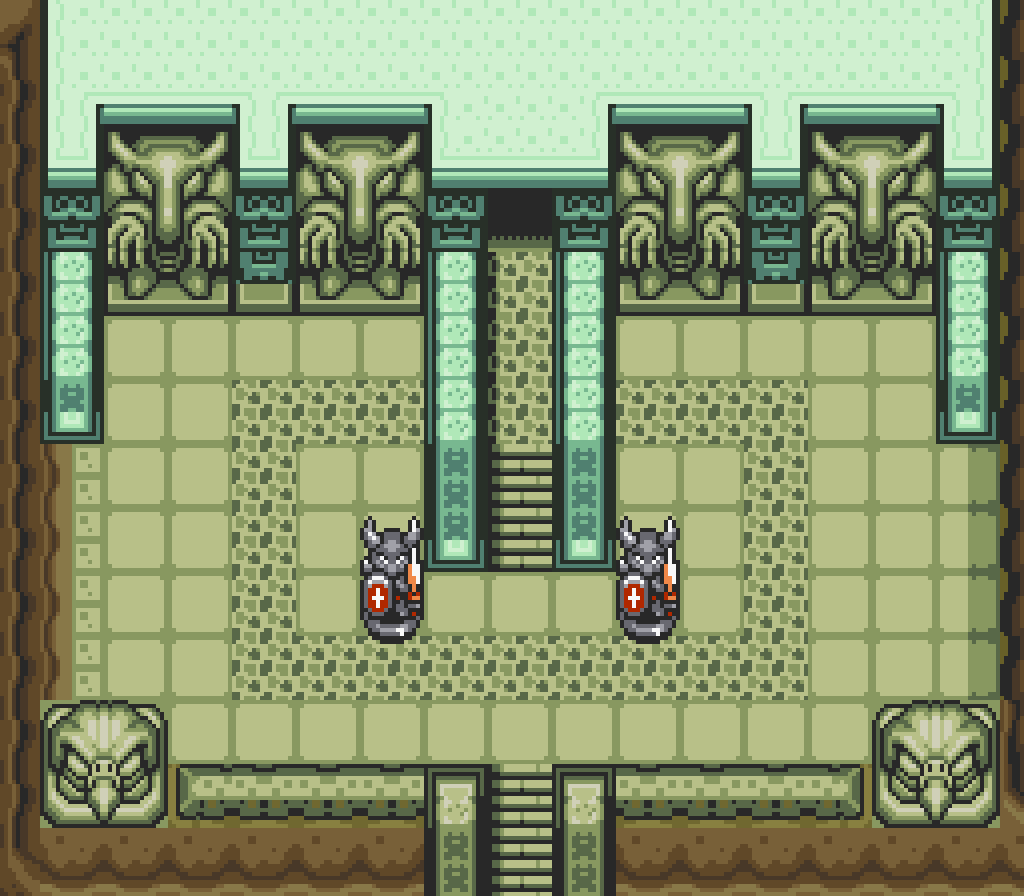
The dungeons themselves were a step up in cruelty and craft. The Eastern Palace teaches. The Desert Palace tests. By the time you reach the Swamp Palace, with its water levels to raise and lower, or Turtle Rock, with its pipe mazes and the Mirror Shield waiting inside, the game is running a quiet masterclass in teaching through layout. Bosses followed the same logic: the Armos Knights stomp, Moldorm knocks you off its platform and makes you climb back up to start the fight over — a piece of pure 1991 spite that players still describe with genuine feeling — and Helmasaur King hides behind a mask your new Hammer exists to break.
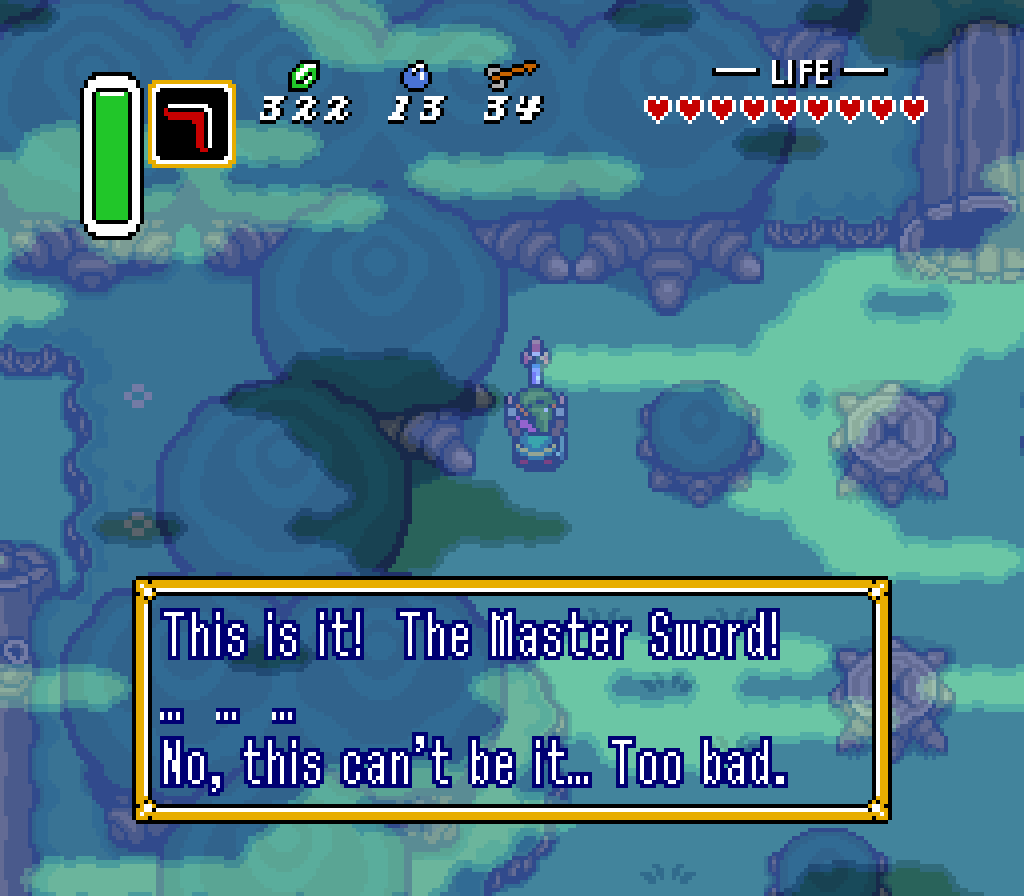
And then there are the jokes the game plays on you. The Lost Woods are full of fake Master Swords, planted by thieves, and the game lets you pull one and read the deflated little message before you trudge on. Somewhere in the code sits a room full of rupees and a greeting from Chris Houlihan, a Nintendo Power contest winner whose prize was a secret almost nobody found until the emulator era dug it up. This is a game confident enough to hide things it never expected you to see.
Triforce of the Gods: The Name Nintendo Changed
In Japan, this game is not called A Link to the Past. It is Zeruda no Densetsu: Kamigami no Toraifōsu — The Legend of Zelda: Triforce of the Gods. North America never got that title. Nintendo of America’s content guidelines in that era barred religious references, so the gods came off the box, and the game picked up the punning subtitle the West knows instead — a link, a past, a prequel. The policy ran through the whole localisation. Agahnim, a priest in the Japanese game, became a wizard. The unreadable Hylian writing, drawn in the Japanese version from Egyptian hieroglyphs, was redrawn for English players because the original glyphs carried religious meaning.
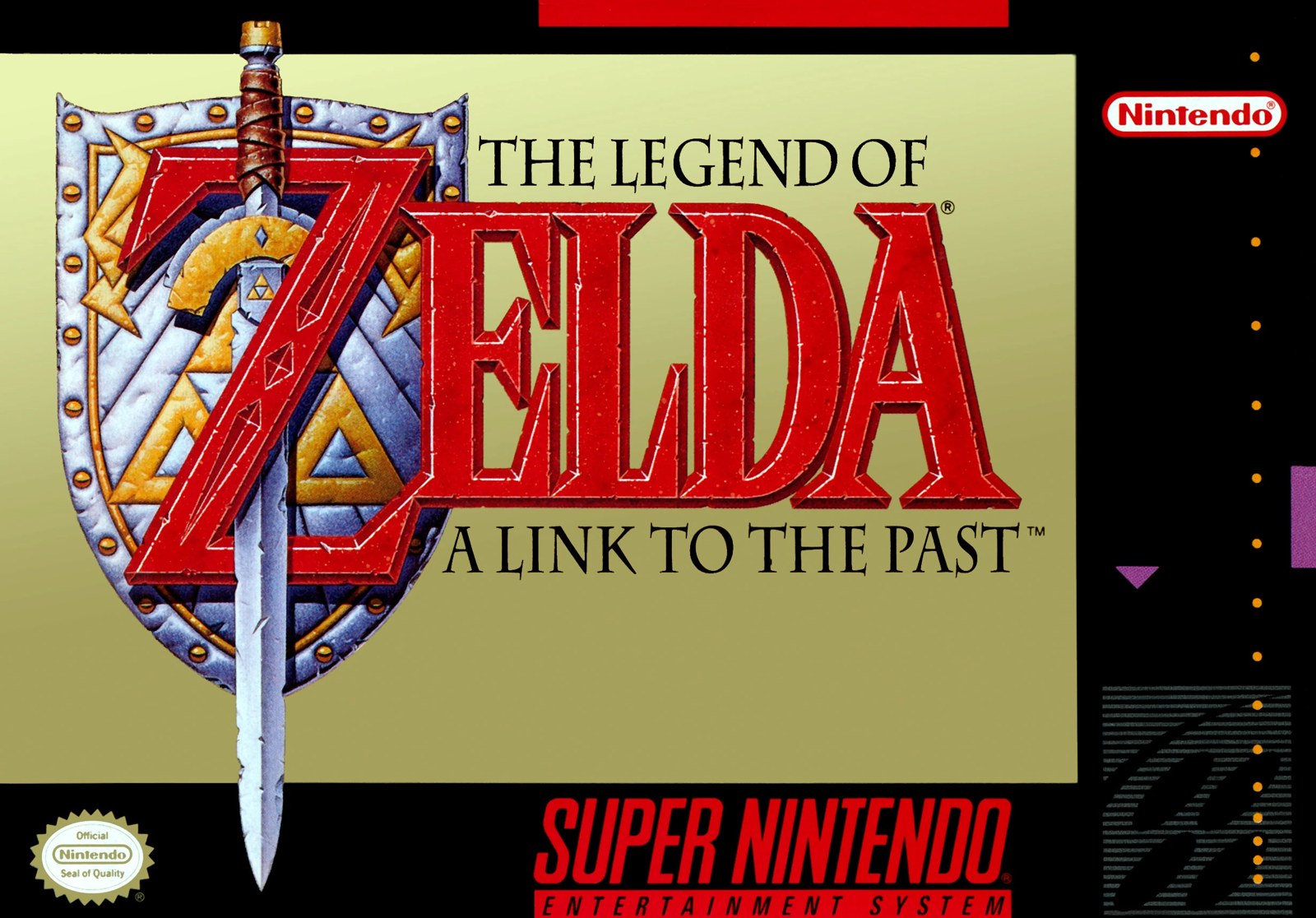
None of it hurt the game, and the Western title arguably fits a story about a hero tidying up an ancient war. But it is worth knowing what your cartridge was originally called, because Triforce of the Gods tells you what the game is actually about: not a boy, not a princess, but an object left behind by gods, and what everybody in Hyrule is willing to do to touch it. Nintendo’s own Japanese page for the game still carries that title today, and still sells the adventure on the same terms the game sold itself in 1991 — two worlds, light and dark, and dungeons full of tricks.
The Port, the Lists and the Long Shadow
The numbers came first. The game topped the Japanese charts through the end of 1991, sold a million copies in the United States in 1992, and reached 4.61 million on the Super NES alone. Famitsu‘s reviewers gave it 39 out of 40 — a near-perfect score, the first of its kind for the magazine. Then, in December 2002, it arrived on the Game Boy Advance as A Link to the Past and Four Swords, a port built by Nintendo with Capcom that carried the original faithfully, added voice clips borrowed from the Nintendo 64 games, and bundled Four Swords, a multiplayer adventure whose completion unlocked one more dungeon, the Palace of the Four Sword, inside the main game. The GBA version sold 1.89 million more, taking the combined total to 6.5 million by 2004, and topped Metacritic’s all-time chart for the handheld at 95. If you want to walk this Hyrule yourself in a browser, our A Link to the Past Live Map is waiting.
The lists came next, and they never really stopped. Entertainment Weekly named it the best game of all time in 2006. Next Generation and Popular Mechanics did the same. IGN’s editors placed it second on their all-time list in both 2015 and 2019, GamesRadar ranked it the third-best Super NES game ever made, and Edge readers voted it sixth in a poll of the hundred best games. Lists are lists. But when the same cartridge keeps surfacing near the top of them for thirty years, across magazines that agree on nothing else, the pattern is the story. It has been re-released on the Wii, Wii U and New 3DS Virtual Consoles, on the Super NES Classic Edition, and on Nintendo Switch via Nintendo Classics, where it arrived in September 2019. As we argued in A Link to What’s Next, the series’ greatest run still runs through here.
Why does it hold? Because almost everything a Zelda game is expected to do, this one did first, and did cleanly. The Master Sword in its pedestal. The hookshot, the bottles, the heart pieces. A world with a dark reflection. A story that starts with a voice calling for help on a rainy night — your uncle telling you to stay home, and you going anyway, in your pyjamas, with no weapon. Thirty-five years on from a November morning in Japan, that opening still has no wasted second in it. Neither does the game that follows.
More of the 16-bit era lives on our Super Nintendo hub, where the system’s landmarks are gathered in one place.
— Chip
The Legend of Zelda: A Link to the Past is filed in This Day in Gaming History under November 21 — see the full day’s entries there.