
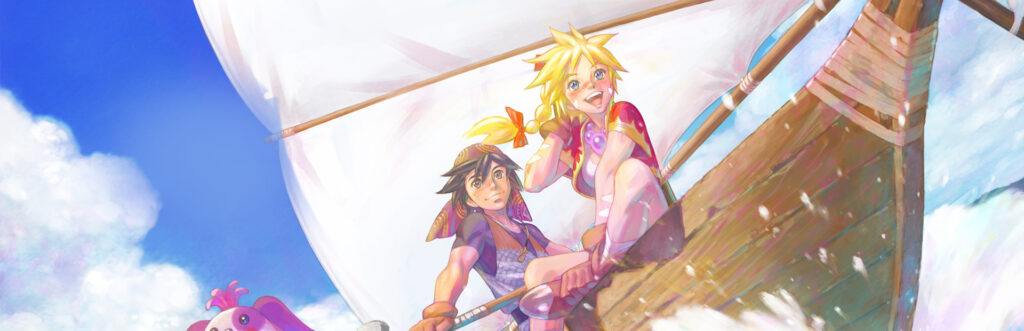
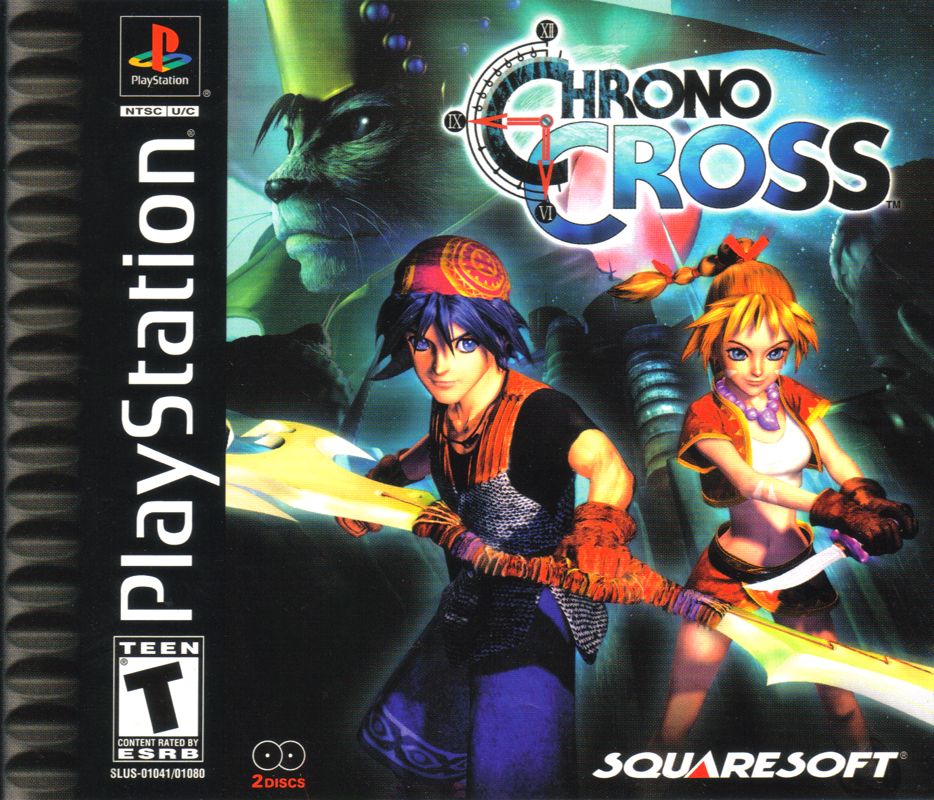
At a glance — Game: Chrono Cross · Developer: Square · Publisher: Square (Japan); Square Electronic Arts (North America) · Original release: November 18, 1999 (Japan; North America August 15, 2000) · Original platforms: PlayStation · Genre: Role-playing · Director: Masato Kato · Music: Yasunori Mitsuda
There is a beach in Chrono Cross where the whole game turns on a single fact: in the world on the other side of the water, Serge is dead. He drowned there as a child, ten years ago, and the grave is real, and the boy standing in front of it is also real. Twenty-seven years after Square released it in Japan — on November 18, 1999, with no European release for the original at all — Chrono Cross remains the boldest thing a sequel can do: refuse to be one, and then spend forty hours proving the refusal was the point.

Not Chrono Trigger 2 — on purpose
Masato Kato, scenario writer of Chrono Trigger and director of its Satellaview side story Radical Dreamers, said it plainly: “Chrono Cross is not Chrono Trigger 2. It doesn’t simply follow on from Trigger, but is another, different Chrono that interlaces with Trigger.” Producer Hiromichi Tanaka backed him in the same terms — had it been a direct sequel, it would have been called Chrono Trigger 2. Square began planning the game immediately after Xenogears shipped in 1998; full production ran from mid-1998 with a team that peaked at 80 people, plus 100 quality assurance testers, all of them working under the shadow of Trigger’s “Dream Team”. Kato hired Nobuteru Yūki for character design and Yasuyuki Honne for art direction, and set the game not across time but across a split: two parallel dimensions, Home World and Another World, diverging on the day a boy did or did not drown.
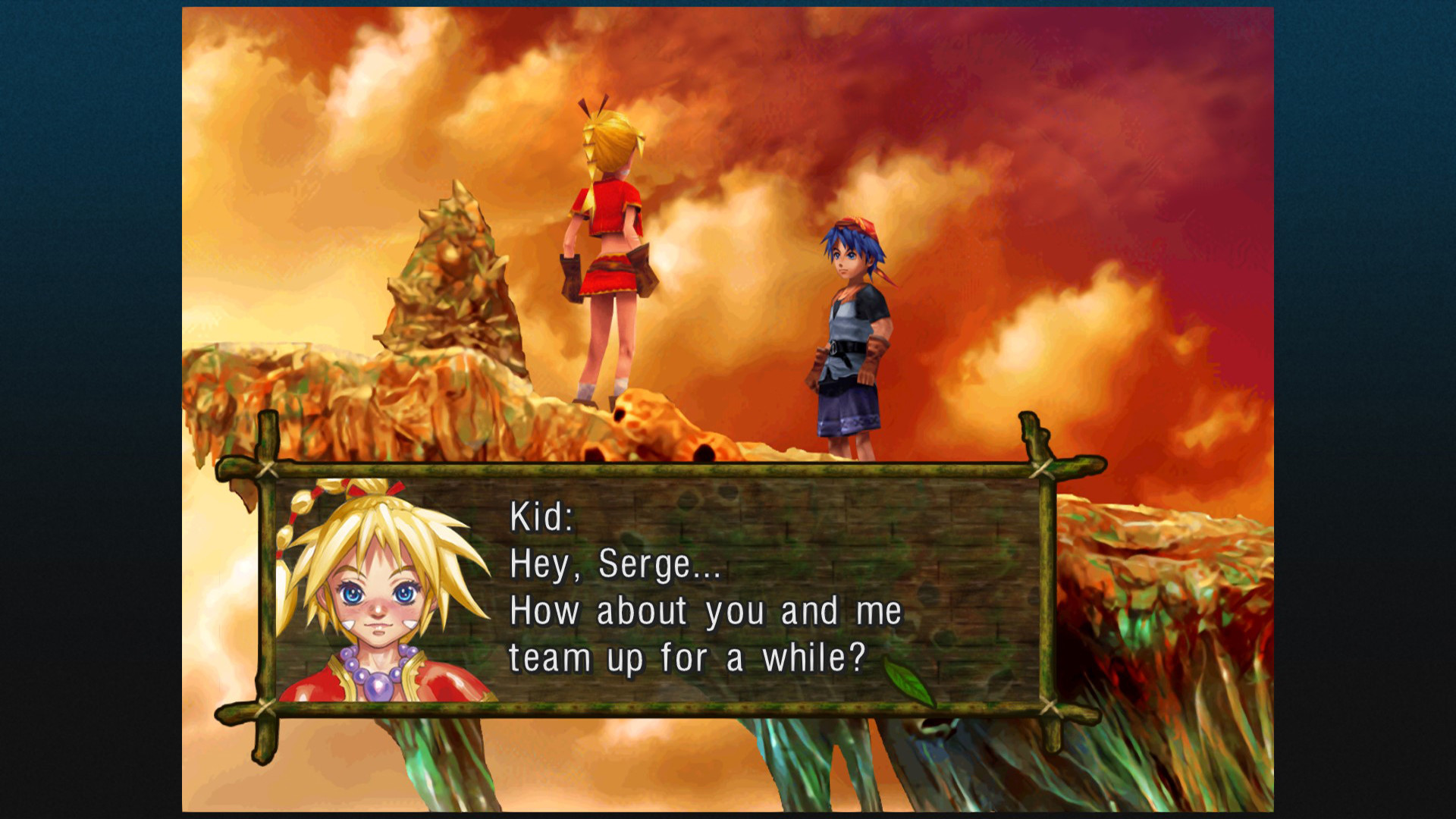
The story that unfolds between those worlds — the thief Kid hunting the Frozen Flame, the panther-man Lynx switching bodies with Serge at Fort Dragonia, the supercomputer FATE, the Dragon God, and the long shadow of Schala and Lavos reaching out of Chrono Trigger‘s ending — is famously dense. Kato called it an “ole’ boy-meets-girl type of story” with shocking twists, and deliberately left its most important question unanswered. It borrows its bones from Radical Dreamers, the text adventure almost nobody outside Japan had played, and resolves that game’s unfinished business at epic scale.
The craft underneath matched the ambition. El Nido’s field maps were modelled in full 3D, then rendered from a single chosen angle into the painterly 2D backdrops the PlayStation could carry; the programmers wrote entirely new, proprietary systems rather than reusing any existing Square code — work that later endured as the basis of the Final Fantasy XI engine. The schedule bit hard enough that Square merged the Final Fantasy VIII team into Chrono Cross two months before the Japanese launch, and the humour stayed deliberate throughout: battle techniques and animations were loaded with tongue-in-cheek touches specifically to distance the game from the house style of Final Fantasy.
Forty-five characters and a battle system with no grinding
The ambition ran in every direction at once. The team originally planned 64 playable characters, each with endings that could vary three ways; production reality trimmed the roster to 45 — still an absurd number, and impossible to complete in a single playthrough, which is precisely why the New Game+ and its twelve endings exist. To keep 45 characters’ dialogue distinct, programmer Kiyoshi Yoshii built an accent generator that rewrites plain text into each character’s verbal tics; translator Richard Honeywood had to build a more robust version of the same system for the English script.
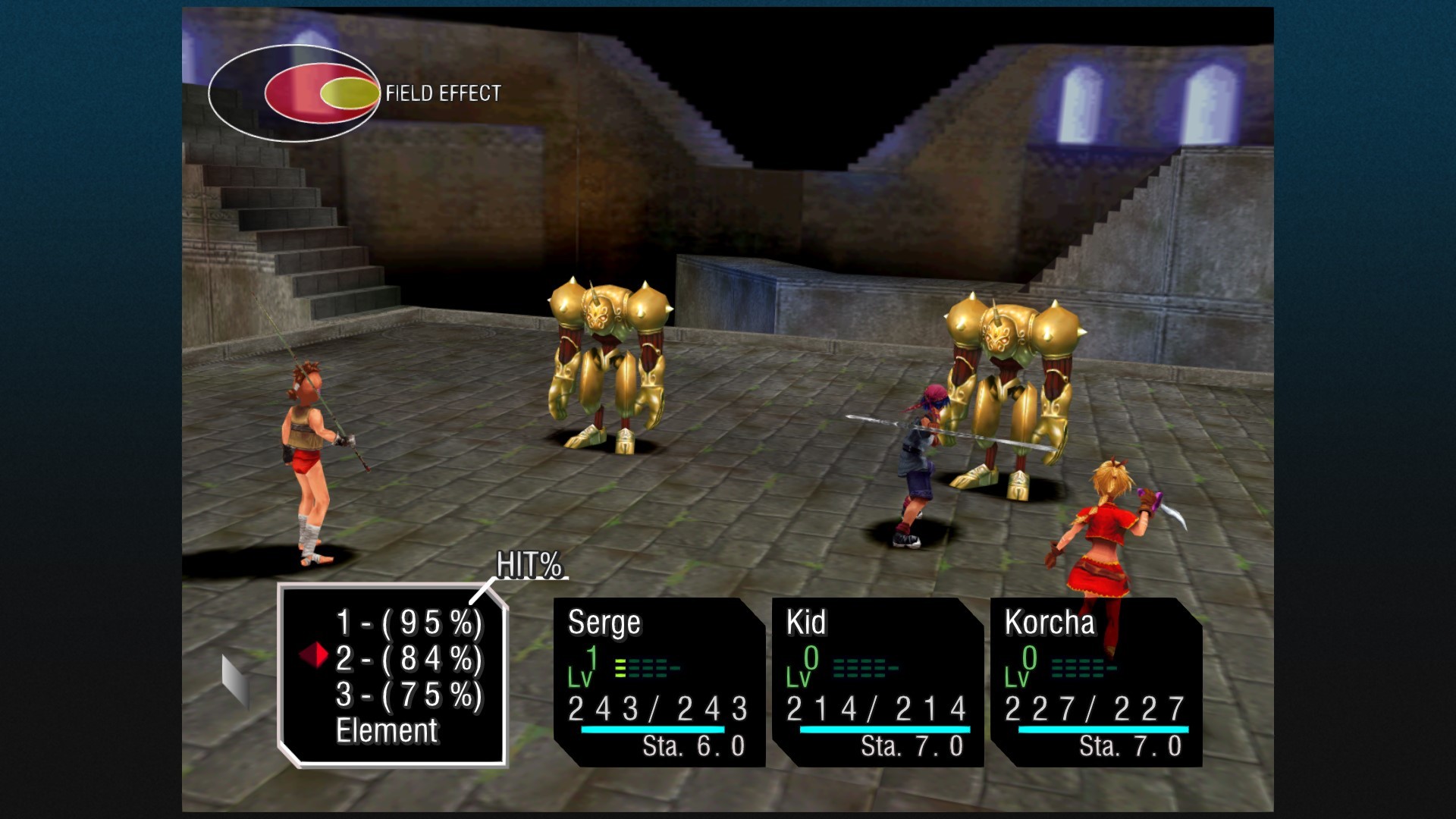
Combat was rebuilt from zero. There are no random encounters and no experience points: stats grow in small increments after battles, then hold until a boss falls and adds a star. The Elements system treats magic like equipment — colour-coded into six opposed pairs, slotted into per-character grids across eight tiers — layered over a stamina bar that makes every attack a small wager, and a field effect that tracks the colours spent in battle until the field runs pure enough to loose a summon. You can run from every fight in the game, including the last one. Kato designed it all to kill grinding, and Tanaka compared the Elements grid to a card game: total control, dealt by the player.
Midway through, the game performs its cruelest trick: at Fort Dragonia, Lynx uses the Dragon Tear to switch bodies with Serge, then stabs Kid while the real Serge watches helplessly in his enemy’s shape. Banished to the Temporal Vortex and returned as a stranger in his own world — his allies scattering at the sight of him — Serge has to rebuild everything from nothing, in the body of the villain. It is one of the great midpoint reversals in the genre, and it powers the journey into the Dead Sea, a wasteland frozen in time where Crono, Marle and Lucca themselves appear to tell Serge that his survival dooms the future. Few sequels have ever dared to make their own hero the problem.
A perfect score and a long argument
North America received Chrono Cross on August 15, 2000, after three months of translation and two of debugging, and the reviews were extraordinary — GameSpot awarded it a perfect 10.0, a score the site has handed out only a handful of times in its history. The game shipped 1.5 million copies worldwide by 2003, earned a Greatest Hits re-release, and joined Japan’s Ultimate Hits line. Yasunori Mitsuda’s score — Celtic-tinged, built around the melodies of Radical Dreamers — became one of the most celebrated soundtracks on the PlayStation. And yet the argument never stopped: for a loud share of Chrono Trigger‘s faithful, Cross was a betrayal wearing a masterpiece’s clothes, a sequel that sidelined the cast they loved and answered their story with riddles. Europe, notably, never got to argue at all — the original was never released there.
And then there is the music. Yasunori Mitsuda, who had scored Chrono Trigger, returned at Kato’s personal request and built the soundtrack outward from the melodies of Radical Dreamers — the little Satellaview text adventure whose story Cross exists to finish. The result moves between Celtic folk, Mediterranean guitar and quiet melancholy in a way no PlayStation RPG had sounded before, and it is the element of the game that even its detractors almost never attack. When players describe remembering Chrono Cross, they are usually, whether they know it or not, describing remembering how it sounded.
Why Chrono Cross at 27 endures
Time has been kind to the heresy. The 2022 remaster, Chrono Cross: The Radical Dreamers Edition, finally carried the game worldwide on modern hardware — and, in a gesture that closed a 23-year loop, bundled an English edition of Radical Dreamers itself. What survives best is the design courage: a sequel that trusted players to follow parallel worlds instead of timelines, a battle system that abolished the genre’s grind, and an ending that sends its heroine out into a modern city to search for someone, possibly you. At 27, Chrono Cross is not the sequel anyone ordered. It is the one that still starts arguments — and arguments, in this medium, are a form of immortality.
— Chip
For more launches from this date, see This Day in Gaming History: November 18.