
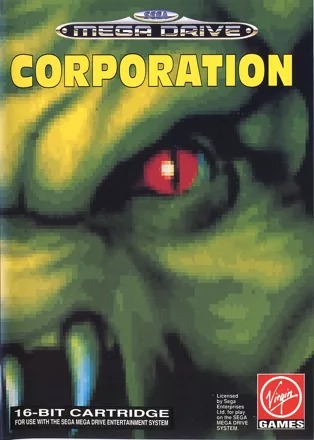
At a glance: Cyber-Cop · Genesis · developed by Core Design (from Synthetic Dimensions’ 1990 original) · published by Virgin Games · 1992 · first-person immersive crawler · six selectable agents · single player
The chronology needs untangling before anything else, because this game’s reputation depends on it. Corporation — Cyber-Cop in North America — began life on the Amiga in 1990, designed by Kevin Bulmer and programmed by Bill Allen at Synthetic Dimensions for Core Design. That original is a landmark: a first-person game with free 360-degree movement through flat-shaded polygon rooms, dynamic lighting, stealth, hacking and body-part damage, two years before Wolfenstein 3D and four before System Shock started assembling the immersive sim. The Genesis port, arriving in September 1992, inverts the bragging rights entirely — Wolfenstein had already shipped that May — and asks a cartridge machine to run an engine that strained the computer it was born on. What follows is one of the most interesting failures in the Genesis library: a genuinely visionary game, present and correct in design, suffocating in execution.
The UCC Job
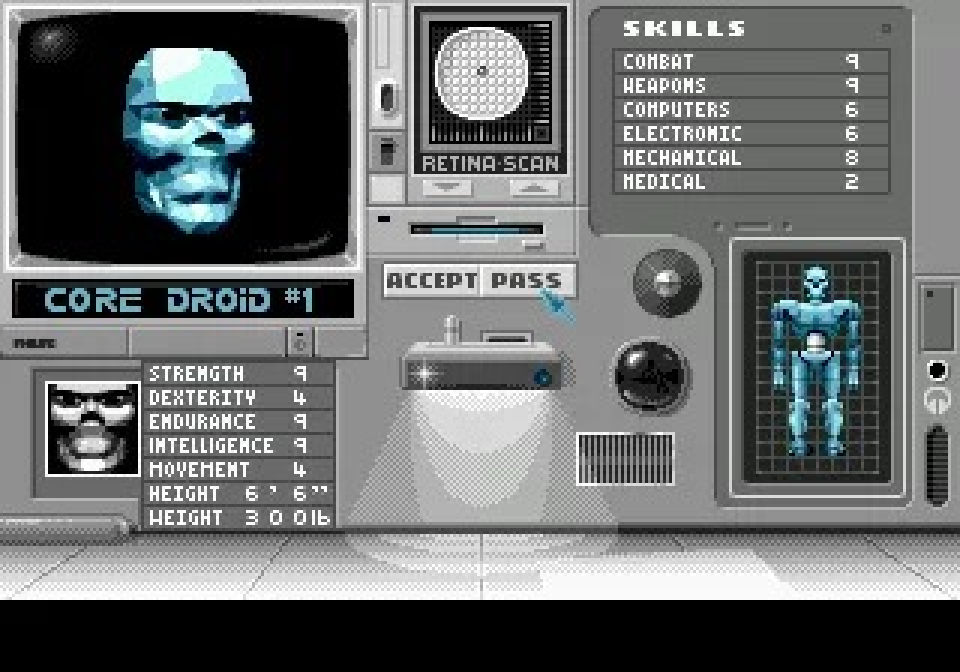
The Universal Cybernetics Corporation has been conducting genetics work at a complex outside London, and its prize specimen — a hulking green mutant — has escaped and developed an appetite for the neighbourhood. The government wants an agent inside: terminate the creature, and bring out proof of what UCC has been doing. You choose from six operatives — two men, two women, two cyborgs — with fixed statistics and skill spreads; there is no customisation beyond the choice itself, so you are really picking an emphasis: healing, melee strength, movement speed, or the cyborgs’ built-in scanners and vision modes, offset by their dependence on spare parts and power cells rather than medkits and snacks.
Your one shopping trip happens before infiltration and is never repeated, which gives it a campaign-trail tension: every credit spent on a heavier gun is a credit not spent on armour, lockpicks or the minimap that will shortly become your sanity. The complex runs to a dozen floors, and progress is a matter of clearance — find terminals, raise your access card’s level, ride the lift, repeat — interrupted by code-locked doors that yield to electronic lockpicks or to holographic photographs which conceal their digits in the image itself, one early example hiding a door code inside a picture of a hand typing it, readable only by shifting your viewpoint across the fingers. That is a 1990 computer-game idea of real elegance, and it survived the port intact.
One Battery, One Body
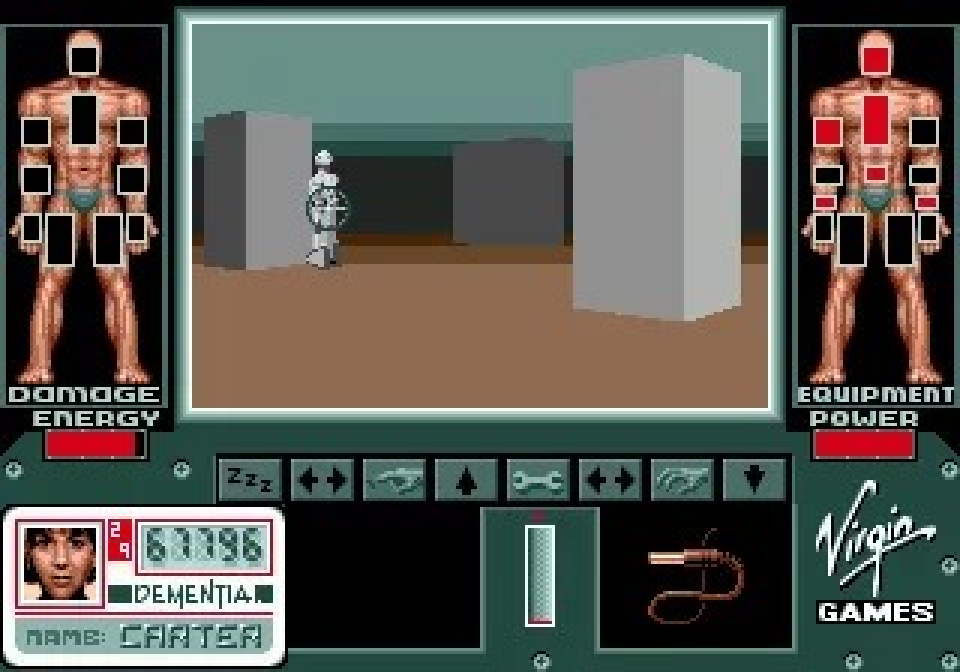
Two economies govern everything. The first is energy: a single battery feeds your minimap, your weapon’s recharge, your powered armour and the vision modes that reveal infrared alarm beams and gas clouds, so every convenience is quietly spending your survival. Cells found in the complex are rations, and you will learn to navigate in the dark with the map off, hoarding charge the way other games teach you to hoard ammunition. The second economy is your own body, drawn as a diagram at the screen’s edge and filled in segment by segment as damage arrives. Legs shot to ruin slow your stride; a head wound brings blindness creeping in; medkits heal the critical systems first and leave you limping if the cupboard is bare. Humans restock from chemical and nutrition packets scavenged on site; cyborgs need parts and power. Few games of any era — let alone 1990 — modelled a protagonist this physically, and the systems interlock beautifully on paper.
On the Genesis, the paper is where they stay interlocked. The engine manages perhaps ten to fifteen frames per second down an empty corridor, with scenery popping into view a few feet ahead; add enemies and it degrades past slideshow into something closer to a flip-book with missing pages, pad inputs swallowed whole while the machine thinks. One early floor, whose closets keep manufacturing mutants, becomes effectively impassable — not difficult, but unresponsive, the game freezing under the weight of its own population. Walls are featureless slabs, so nose-to-glass navigation is a white void with no sense of turning; the energy-hungry minimap is not an accessory but a prosthesis. The mouse-driven interface of the original is rethought for a pad with mixed success, auto-aim replaces the cursor and cheerfully snaps onto destructible ceiling lights while the alarm camera beside them goes unshot, the equipment diagram on the right sits decorative and unusable, the repair system appears broken in a way that dropping an item and picking it up again mysteriously cures, and the psionic abilities humans could develop on the Amiga are simply absent — no stat, no icon, no trace. One piece of music loops throughout, and turning it off is the first setting most players will change. Context matters, too: Virgin Games kept the original name for Europe, so British players knew this game as Corporation — only North America got the Cyber-Cop badge — and Core Design’s own magazines coverage sold it as the thinking player’s shooter, a pitch the Amiga reviews had largely justified. The Genesis edition inherited the reputation and then spent it.
That interface deserves a fairer hearing than the frame rate allows it, because the thinking behind it is pure immersive sim. Press Start and a horizontal command bar opens over the view; the left window inventories whatever lies on the floor at your feet, the right window works through your pockets, and the Use verb is context-aware enough to chain actions — select the gun, then the charging cable, and the game understands the sentence. Terminals are fully mocked-up little computers rather than text boxes. On a 1990 Amiga with a mouse, this was close to witchcraft. On a three-button pad it becomes a corridor of menus between you and every decision, with inventory scrolling the worst offender, and the port never finds an answer better than tolerable. Hold the two facts together — a control scheme years ahead of its genre, a frame rate years behind its platform — and you have the whole paradox of the cartridge in one screen. The designers were building the vocabulary that System Shock, and after it Deus Ex, would write famous sentences in. The Genesis simply could not speak it at speed. The cartridge survives now as the most instructive cautionary tale in console shooter history — not a bad game, exactly, but the right game documented at the wrong frame rate, on the wrong machine, one console generation too early.
Fighting Through Treacle
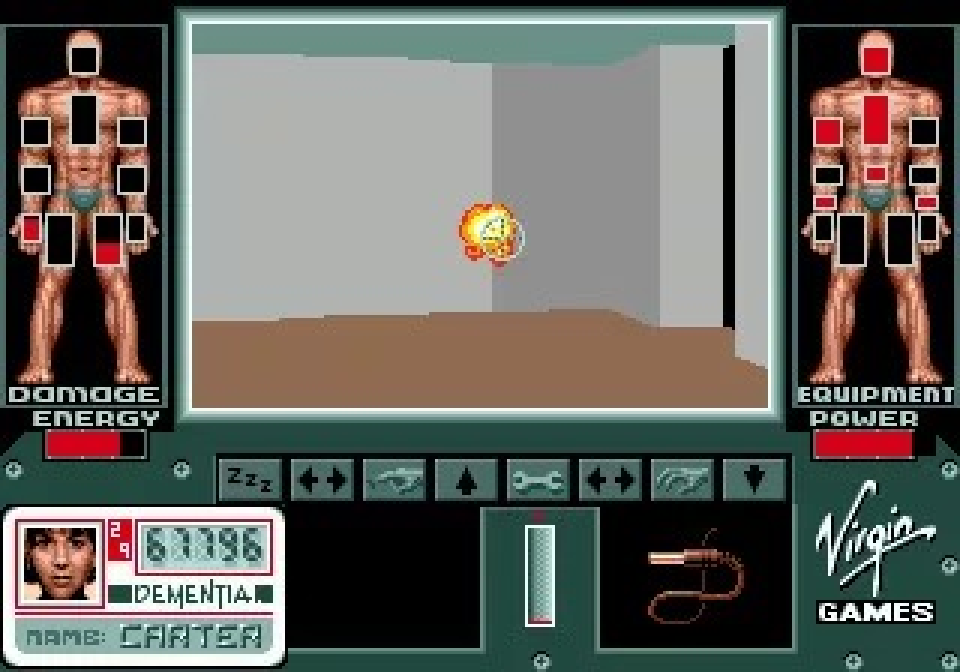
Status effects are part of the simulation, too — the portrait panel in that screenshot is already flagging dementia, a creeping condition tracked alongside the body diagrams — and combat folds into the same ledger as everything else: firing spends battery, recharging takes time you may not have, and every exchange with a patrolling robot or a spawned mutant is conducted at whatever speed the polygons currently permit. The ideas remain remarkable. Their tempo is the obituary.
“Every system in Cyber-Cop is ahead of its time; the tragedy is that the Genesis port runs about two years behind its own engine.”
The Verdict
None of this diminishes the design, which reads today like a blueprint the industry spent a decade catching up with — and the curious should absolutely meet it, on the Amiga or DOS originals where it can breathe. As a Genesis cartridge it is a museum piece that fights its visitors: fascinating for ten minutes, exasperating for the hours its dozen floors demand, and comfortably outclassed as a console shooter by Ack’s Zero Tolerance, a game built for the hardware instead of ported at it. Admire the ambition; play it elsewhere.
Verdict: a landmark immersive crawler crushed by its own port — visionary design, near-unplayable Genesis execution — 4.0.
Keep reading: the Genesis system archive