
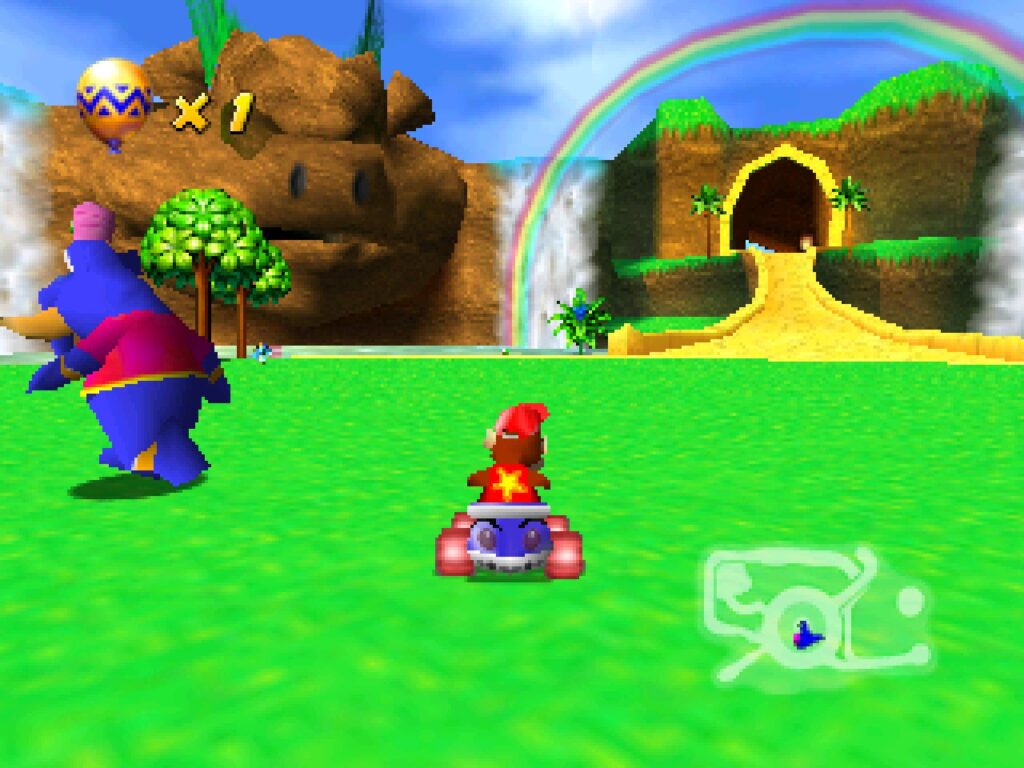
At a glance — Game: Diddy Kong Racing · Developer: Rare · Publisher: Rare · Original release: November 21, 1997 (Japan and Europe; North America November 24, 1997) · Original platforms: Nintendo 64 · Genre: Kart racing · Music: David Wise
The villain is a giant pig wizard from space. That tells you most of what you need to know about Diddy Kong Racing’s ambitions — a kart racer with an adventure game wrapped around it, three kinds of vehicle, boss races, a hub world, and Wizpig looming over all of it. It was not supposed to exist. It began as a Disney-flavoured adventure, became a sequel to an NES radio-controlled car game, and only got Diddy Kong at all because Banjo-Kazooie slipped to the following summer and Rare suddenly needed a star for Christmas. What shipped on November 21, 1997 in Japan and Europe — and November 24 in North America — was stranger and more ambitious than the game it was forever compared to. Twenty-nine years on, the comparison has flipped. Mario Kart 64 is the bigger name. Diddy Kong Racing is the bigger game.
Three games died so this one could race
The project started after Killer Instinct 2, when a Rare team split between Killer Instinct Gold and a new Nintendo 64 racing game. The racing game kept changing shape. First a prehistoric time-travel strategy concept. Then a Walt Disney World-influenced adventure called Wild Cartoon Kingdom and later Adventure Racers, in which characters could climb out of their vehicles and wander a theme-park hub. Kevin Bayliss’s tiger cub character Timber — modelled for a Lion King-inspired prototype — came along through every version. By June 1997 the game had become Pro-Am 64, a follow-up to the NES’s R.C. Pro-Am, with Timber leading a cast of new animals on three-wheeled trikes.
Then Banjo-Kazooie was delayed until summer 1998, and Rare’s Christmas slot stood empty. The team judged that Pro-Am 64 did not have a strong enough name to carry a holiday season. So the licence changed: Timber kept his game but lost the cover to Diddy Kong. Lee Musgrave recalled that Nintendo enjoyed the choice of Diddy over Donkey Kong — Diddy was Rare’s creation in a way Donkey Kong never was. The crocodile character Krash was repainted as a Kremling and renamed Krunch, the visuals and packaging were reworked at speed, and a team of just fourteen people chased a target Musgrave stated plainly: make it run as fast as Mario Kart 64, except with fully 3D racers instead of sprites.
An adventure mode hiding inside a kart racer
The structure was the revolution. Diddy Kong Racing opens on Timber’s Island, a drivable hub linking five worlds — Dino Domain, Snowflake Mountain, Sherbet Island, Dragon Forest and the hidden Future Fun Land — each holding four racetracks, a battle stage locked behind a hidden key, and a boss race against one of the island’s four guardians, brainwashed by the intergalactic wizard pig Wizpig. Progress is gated by Golden Balloons, earned by winning races and then won again in Silver Coin challenges that make you collect eight coins scattered off the racing line while still finishing first. Beat Wizpig, collect every amulet piece and gold trophy, and the game opens Adventure 2: mirrored tracks, platinum balloons, everything harder. Nothing else in the genre asked this much of a single player in 1997, and Edge said the quiet part out loud — the single-player mode was everything Mario Kart 64 should have been.
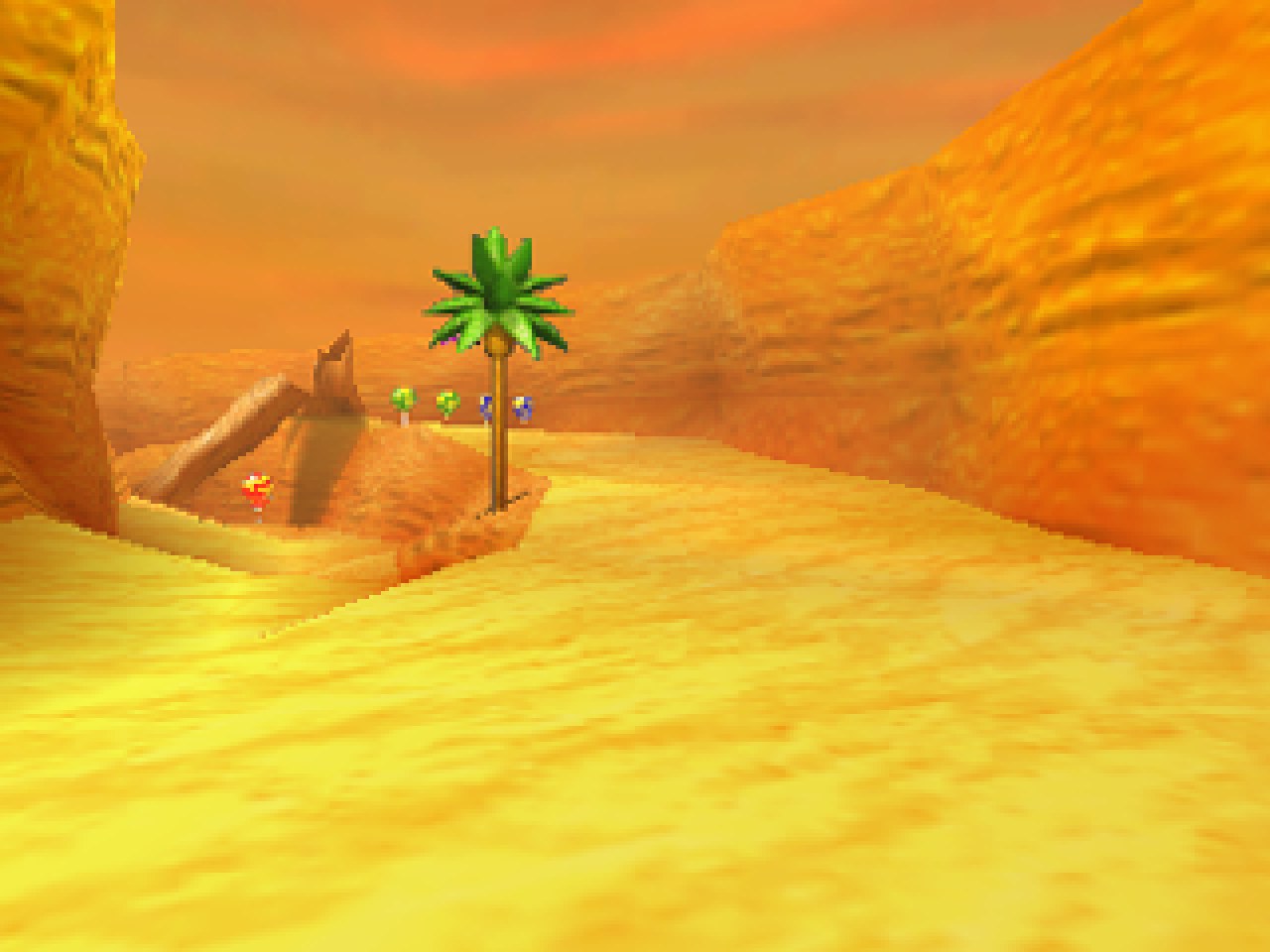
The racing itself had range Mario Kart did not attempt. Ten characters, three vehicles. The kart as all-rounder, the hovercraft for sand and water, and the plane — slow in a straight line, but free of the track entirely. Power-ups came from coloured balloons: red for missiles, blue for boost, yellow for shields, green for traps, rainbow for a magnet that drags you toward the racer ahead. Grabbing the same colour again upgraded the weapon, twice. Bananas, up to ten, bought raw speed and could be stolen by a hit. David Wise, fresh off the Donkey Kong Country games, wrote a soundtrack so confident that the American CD release was pressed in the shape of Diddy Kong’s head — a disc some CD players physically could not play.
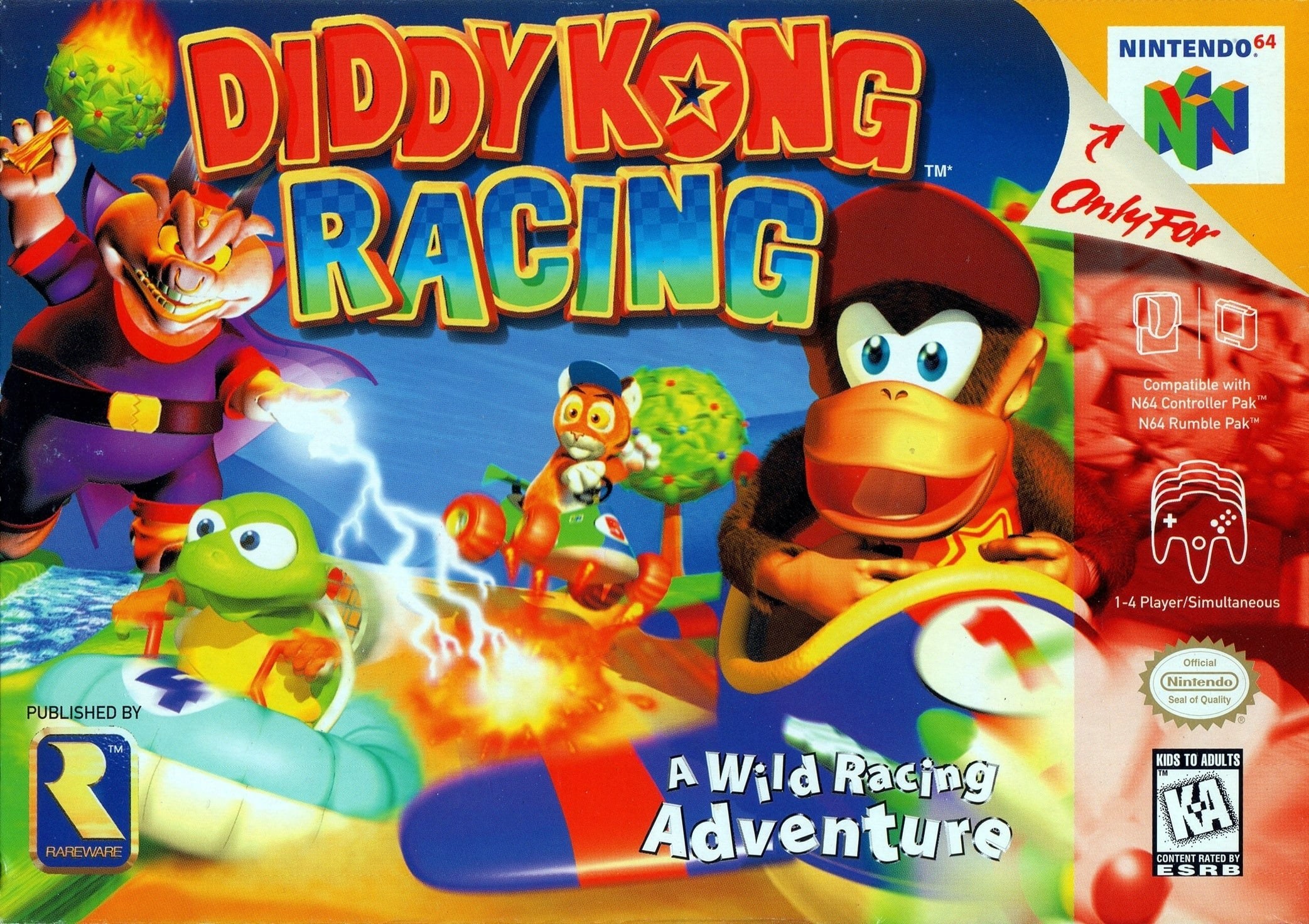
The Christmas Nintendo bet the year on
Because so much of the Nintendo 64’s 1997 Christmas line-up had slipped into 1998, Diddy Kong Racing became the platform’s main holiday release, and Nintendo spent accordingly. The majority of its $200 million annual advertising budget went behind the season this game headlined, with $20 million of marketing in North America alone. It was also the only game in North America’s Christmas line-up whose development Nintendo had contracted itself. The bet paid out immediately: a million copies sold in the United States within three weeks, 4.8 million worldwide in total, eighth place among all Nintendo 64 games, and a Gold prize at the 1999 Milia festival for European revenues above €15 million.
The reviews were a fascinating split. Electronic Gaming Monthly named it Game of the Month, and one reviewer wrote that it beat Mario Kart 64 in every department. Edge scored it 9 out of 10. The Academy of Interactive Arts & Sciences named it Console Racing Game of the Year for 1998, ahead of Mario Kart 64 itself. The dissenters mostly attacked the flip side of its ambition: having to replay the same tracks under different objectives struck GameSpot‘s reviewer as repetition that ultimately killed it, even while conceding it was far better than Mario Kart. The Nintendo 64 version sits at 88 on Metacritic. History has largely sided with the majority — in 2009 Official Nintendo Magazine placed it on its list of the greatest Nintendo games of all time.
It even left a ghost in the machine of pop culture. The giggling children heard over the Rare logo as the game boots are a stock sound effect from a Hollywood library, used in films and television for years. But this game attached itself to the sound so completely that it is now commonly known simply as “the Diddy laugh”. Bayliss has explained that the team, inspired by the newly launched Teletubbies, layered in recordings of Tim Stamper’s own children laughing and singing alongside the library effect. A throwaway two-second joke, still being identified by name nearly three decades later.
Banjo, Conker, and the sequels that never started
Two of its racers were famous before their own games existed. Banjo the Bear and Conker the Squirrel were both shown to the public at E3 in June 1997 as stars of upcoming titles, but Banjo-Kazooie and the very different Conker’s Bad Fur Day arrived after Diddy Kong Racing — making this cheerful kart game, improbably, the debut of both. The legacy it could not secure was its own sequel. Donkey Kong Racing for the GameCube, built around riding animals instead of driving vehicles, was shown at E3 2001 and cancelled when Microsoft bought Rare for £375 million in 2002. The concept mutated into the also-cancelled Sabreman Stampede. A Game Boy Advance follow-up, Diddy Kong Pilot, became Banjo-Pilot after the buyout. What the game got instead was a remake: Diddy Kong Racing DS in 2007, developed by Rare for Nintendo — the last Nintendo-published game Rare ever made — with Banjo and Conker swapped out for Dixie and Tiny Kong, and reviews notably cooler than the original’s.
Why Diddy Kong Racing at 29 still laps the field
Kart racers are supposed to be party games with a single-player mode attached as an afterthought. Diddy Kong Racing inverted the formula twenty-nine years ago: a full adventure, with exploration, bosses, secrets and a villain worth beating twice, that happened to be raced in karts, hovercraft and planes. The genre’s biggest modern names have spent years edging toward exactly that structure. It took a cancelled adventure game, a borrowed monkey and a fourteen-person team racing a Christmas deadline to get there first. At 29, Diddy Kong Racing remains the kart racer that trusted its players with a whole island — and the one every story-mode racer since has quietly been chasing.
— Chip
For more launches from this date, see This Day in Gaming History: November 21.