
At a glance — Game: F-Zero · Developer: Nintendo EAD · Publisher: Nintendo · Original release: November 21, 1990 (Japan) · Original platforms: Super Famicom / Super Nintendo Entertainment System · Genre: Racing · Players: 1
Two games. That is all Japan got on Super Famicom launch day, November 21, 1990. Super Mario World was one. F-Zero was the other.
I still think about what that second slot means. Nintendo had a brand-new console to sell. They picked a racing game set in the year 2560, made by eight people, and said: this one. This shows what the machine can do.
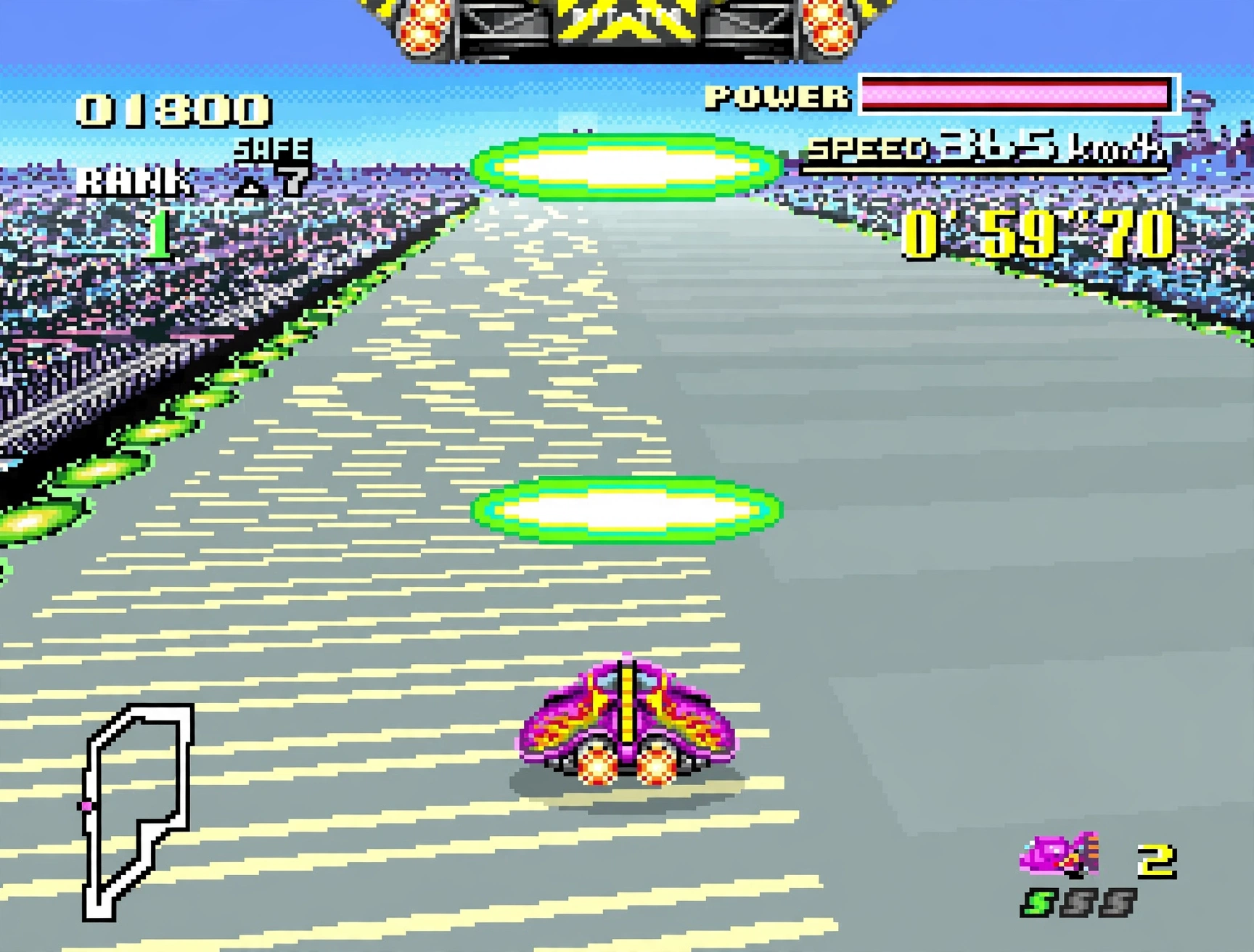
They were right. You fire up Mute City and ten seconds in you get it. The track moves like nothing on the Famicom ever moved. North America got the same shock in August 1991, when F-Zero launched with the SNES there. Thirty-six years on, the question is a real one. Consoles are hundreds of times more powerful now. So why does this one still feel faster than almost everything since?
Nine people, one insult, and a Batman movie
The story starts with a rejection. Nintendo’s own developers told it years later, in the company’s Classic Mini SNES interview series.
Director Kazunobu Shimizu had made a sequel to Famicom Grand Prix: F1 Race, the old Famicom racer. He took it to Nintendo of America. They tore it apart. “This isn’t a racing game! Racing cars should be cooler!” They told him it would not sell.
He was mad. Properly mad. And while he was in America, Tim Burton’s Batman was everywhere. He bought a pile of Batman comics and flew home with that near-future world stuck in his head.
Back in Kyoto, the young programmers at Nintendo EAD had new hardware and orders to experiment. Yasunari Nishida was one of them. Third year at the company. The first programmer EAD had. His assignment was a racing game using Mode 7, the Super Famicom mode that scales and rotates a background.
His demo rotated the bottom four-fifths of the screen. The top fifth stayed still. Distant landscape. Shimizu saw it and said, “This is it!”
Takaya Imamura joined as designer. First year at Nintendo. First game he ever worked on. Total team: eight people. Nine with producer Shigeru Miyamoto. And F-Zero was made entirely in-house, back when Nintendo still outsourced most of its programming.
I love how honest the team is about the future setting. It was not pure vision. It was problem-solving. Wheels were a problem. A turning tyre meant piles of hand-drawn sprite frames, one for every angle. So the machines hover. Problem gone.
Buildings were a problem too. They could not render 3D buildings well. So the courses float in the air, with a city far below. Nobody asks about shadows on a floating track. Even the Guard Beam posts are round for a reason. A round object looks the same from every angle. A few elements, reused forever.
Constraint after constraint. And every single one became part of why this game looks like itself and nothing else.
How Mode 7 made F-Zero feel impossible
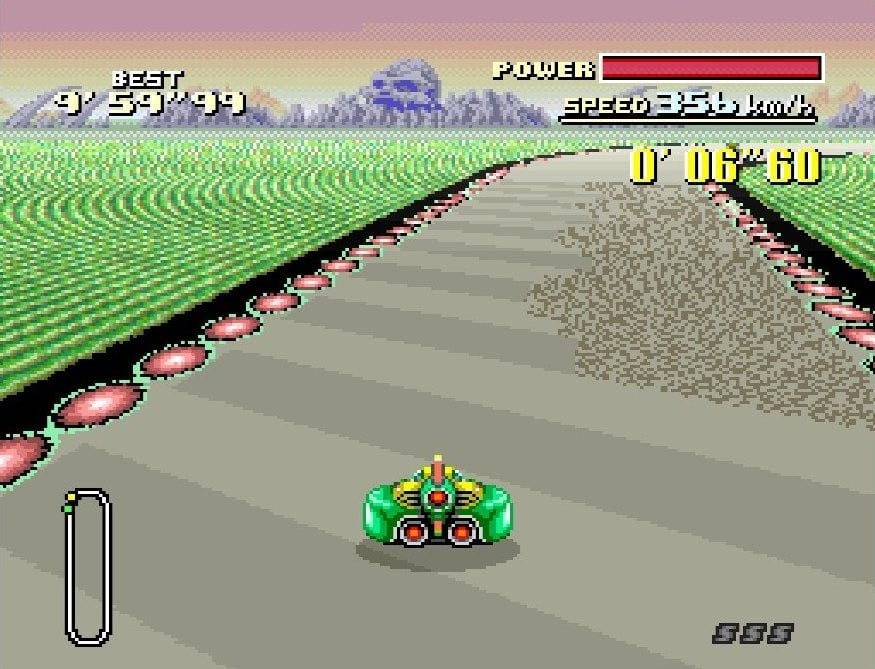
Mode 7 is simple to describe. It takes one flat background layer and scales it, rotates it, scanline by scanline, around your machine.
That is it. There are no polygons in F-Zero. No true 3D at all. One plane, spinning under you. And your brain buys it completely, because the track rushes at the horizon and the whole world swings when you corner. In 1990. On a home console. In a launch game. Nothing moved like this.
Then came two decisions that turned a tech demo into a game I am still playing in my head decades later.
First, the wall came out. For most of development an invisible wall kept you on the course. Imamura felt something was missing. At Miyamoto’s suggestion, the wall went away. Jump Plates went in. Now the brave line through a corner could leave the track entirely. A huge jump. A shortcut. And a landing you had to survive, because if you fell, your machine blew up. The team made the explosion sound as loud as they could. Of course they did.
Second, the accident they kept. Hold the throttle before the start and your engine overheated. Your power dumped. It was a penalty, carried over from the Famicom game. But if a rival bumped you from behind in that state, you shot into the lead. The Rocket Start started life as a punishment. The team saw it, laughed, and shipped it as a technique. Players loved it. Still do.
F-Zero SNES is a mean game, and that is the point
Let me be straight about playing this thing. It is mean.
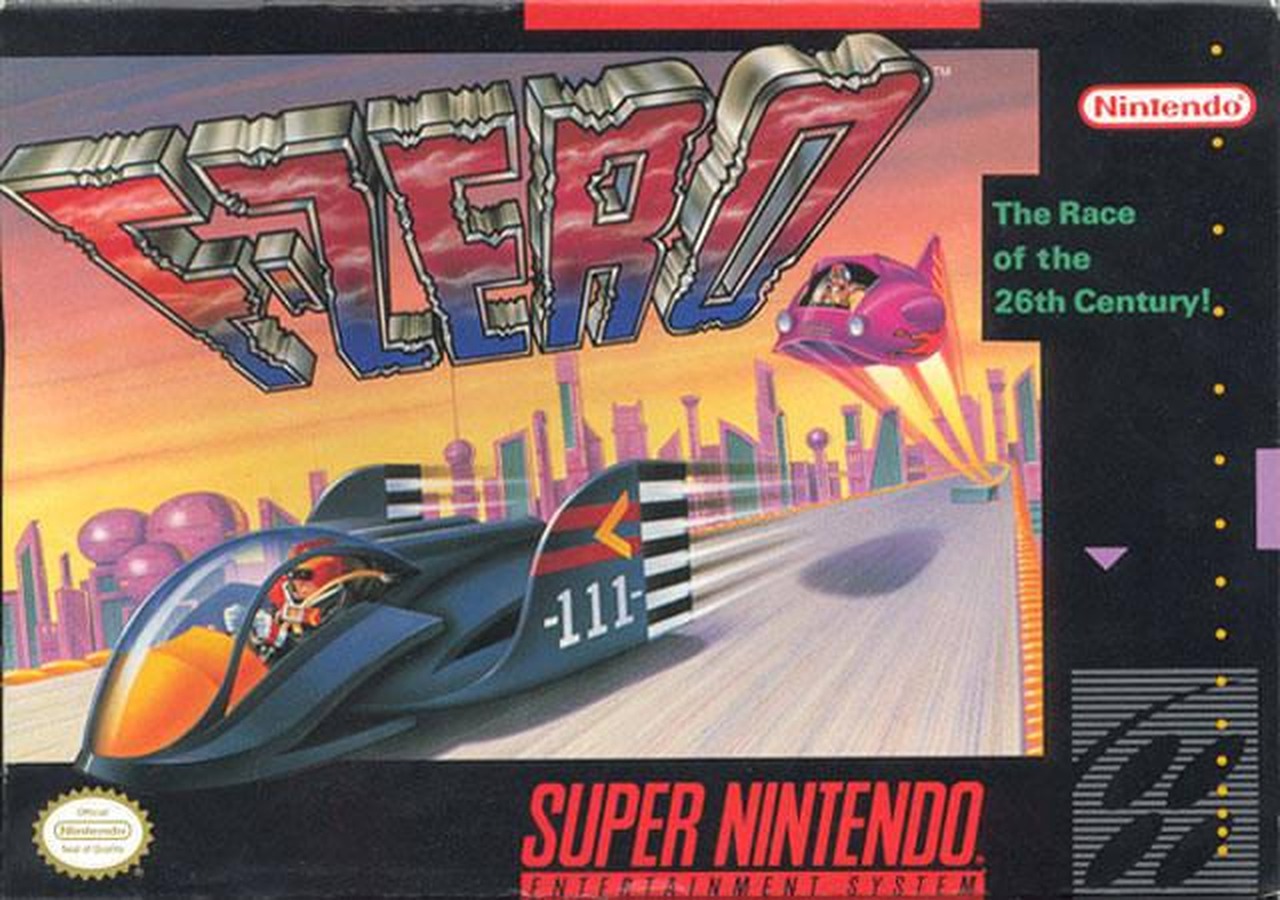
Fifteen tracks. Three leagues — Knight, Queen, King. Grand Prix and Practice modes. Five laps a race. Four pilots to pick from. Captain Falcon in the Blue Falcon, balanced and honest. Dr. Stewart in the Golden Fox, quick and fragile. Pico in the Wild Goose, heavy as a truck. Samurai Goroh in the Fire Stingray, the fastest of the lot and a fight in every corner.
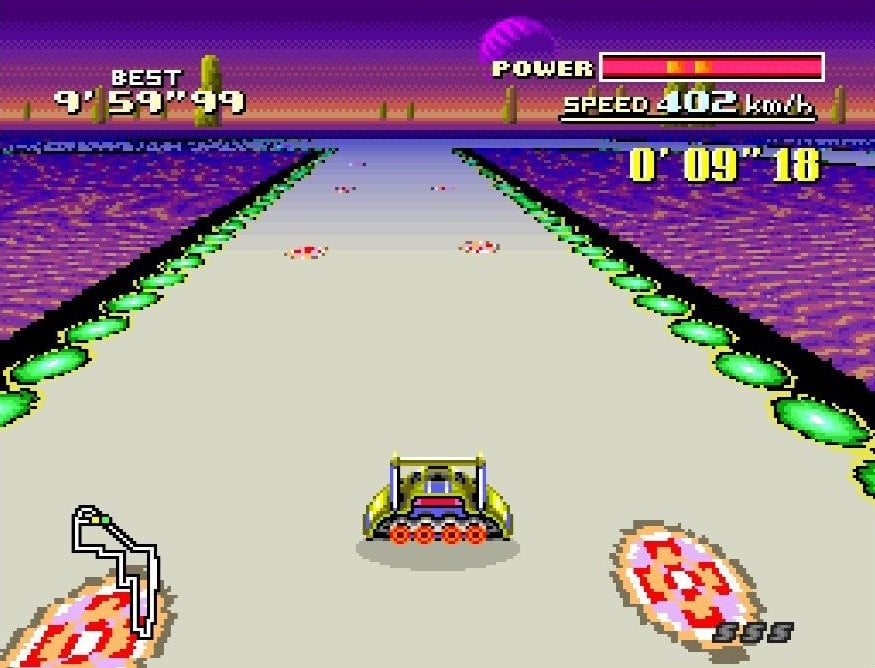
Your Power meter is your health. Both. Every scrape on the Guard Beam costs you. Every rival’s shoulder costs you. Every mine costs you. The pit lane gives it back, slowly, and charges you places for the visit. Finish a lap and you earn a Super Jet boost. You will spend it in the wrong place. I always did. The right place never quite shows up.
And there is no multiplayer. None at all. A launch racing game with one player, chasing his own best times. Times the game records down to one-hundredth of a second, because of course the hundredths matter. They still do.
That should have dated it. It did the opposite. Strip away everything else and F-Zero is a time-trial game in Grand Prix clothes. The track can be learned. The machine can be known. Every explosion is your own fault. Speeds pass 400 km/h and the game does not blink. Neither do you. A clean lap of Death Wind still feels like something you earned. Stand-up-and-shout earned.
The pilots were almost an afterthought
Strangest detail in the whole Nintendo interview: the characters were not in the plan.
The game was nearly finished before anyone thought hard about pilots. Captain Falcon came from somewhere else entirely. Imamura got asked for a mascot for the Super NES itself. “A name like Captain Something.” So he drew a hero in Super Famicom controller colours. Red. Blue. Yellow. That mascot walked into F-Zero and became Captain Falcon.
The manual even had an eight-page comic about one of Falcon’s bounty-hunting missions. A racing hero who is also a bounty hunter. Nobody in 1990 needed that explained. We just went with it. I miss that.
One more thing. The music. Yumiko Kanki and Naoto Ishida wrote this soundtrack, and Mute City’s theme alone has outlived the hardware. It does not sit still for a second. Nothing in this game does.
Thirty-six years on, the speed never left
F-Zero set the standard for futuristic racing. The genre spent the next decade chasing it.
The game keeps coming back, too. It was on the Super NES Classic Edition in 2017. It launched the SNES library on Nintendo Switch Online in September 2019. Then in 2023 Nintendo dropped F-Zero 99. The original tracks. The original machines. Ninety-nine players at once. A new generation found out what we already knew. The tracks still bite. The boost still tempts you at the worst moment. The hundredths still count.
Nintendo never quite let it go, either. In the mid-1990s, a sequel’s worth of new courses reached Japan through the Satellaview satellite service, as BS F-Zero Grand Prix. The full follow-up, F-Zero X, arrived on the Nintendo 64 in 1998. Bigger. Louder. Thirty machines on track. And still, when people say the name F-Zero, the picture in their head is this one. A flat world spinning under a hovering machine. A blue sky. A clock that will not forgive you.
I think that is because this game respects you. It does not explain itself to death. It does not hand you the win because you showed up. It says: here is the track, here is your machine, the hundredths are waiting. Learn it. Earn it. Few launch games talk to a player like that. Almost none do it in their first ten seconds.
So why does F-Zero still feel this fast?
Because the speed was never about power. Eight people built this. One rejected prototype. A stack of Batman comics. A flat plane of pixels, spinning. And a game where speed is a choice you make every second. Boost or brake. Jump or hold your line. Take the shortcut or take the explosion.
Modern racers give you more of everything. F-Zero gives you less, aimed better. Thirty-six years on, Mute City is still the first ten seconds of the future. Every time I hear that theme kick in, I am right back there. Thumbs ready. Heart going. Go.
— June
For more launches from this date, see This Day in Gaming History: November 21. More from this system: our Super Nintendo hub.