
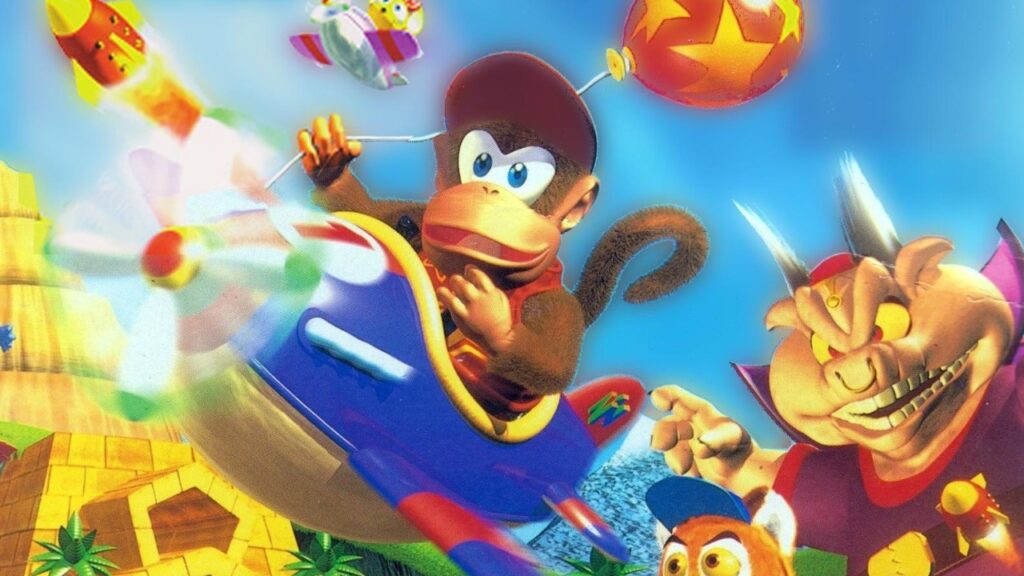
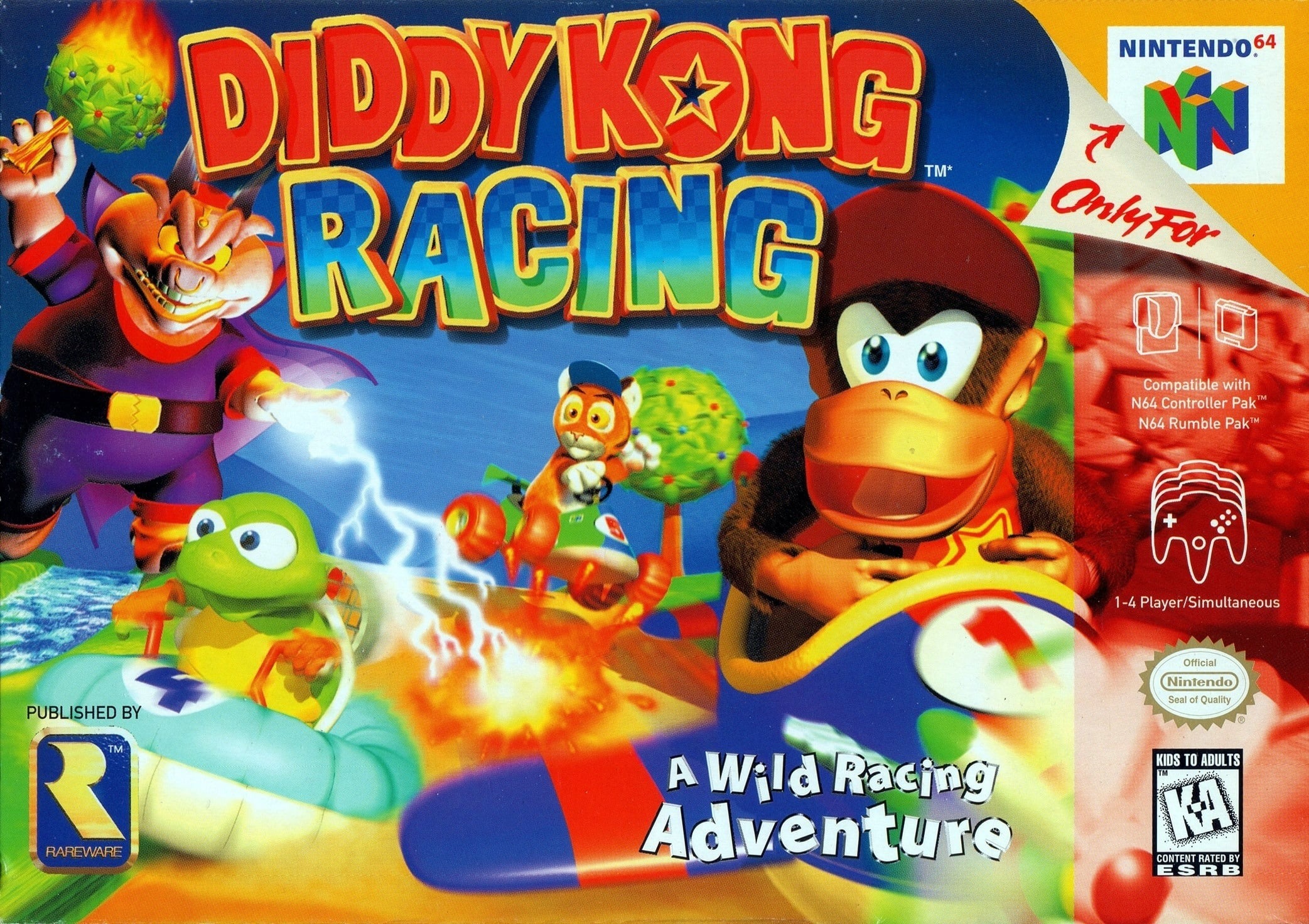
At a glance — Game: Diddy Kong Racing · Developer: Rare · Publisher: Rare · Original release: November 21, 1997 (Japan and Europe; North America November 24, 1997) · Original platforms: Nintendo 64 · Genre: Kart racing · Music: David Wise
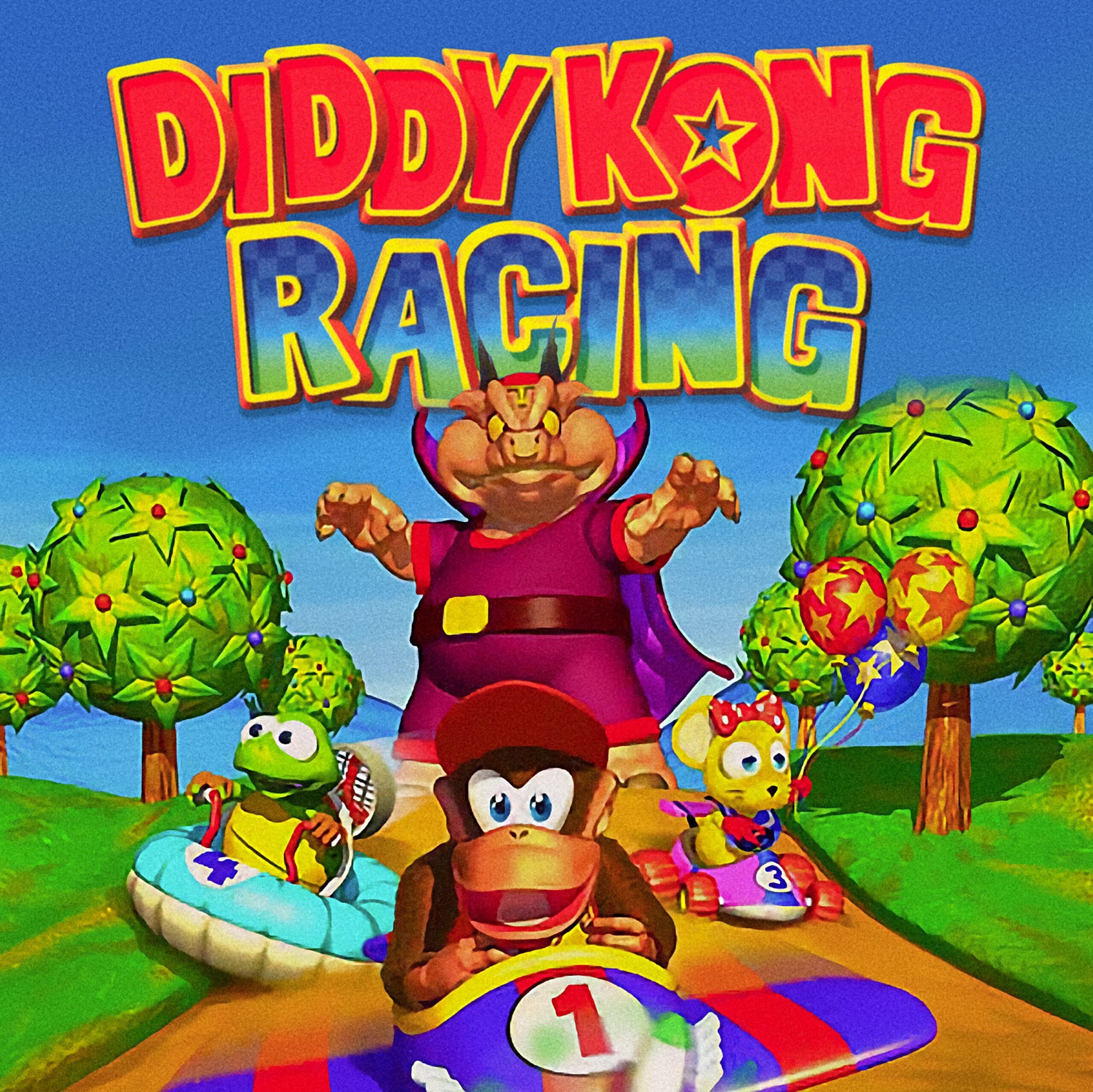
I rented this game first. Most of us did. It was late November 1997, the box had a pig wizard on it, and the rental copy came home for a weekend that was supposed to be about quick races before dinner. Then the game opened on an island. An actual island, with doors and beaches and a genie, and I remember just driving around it before I entered a single race. Kart racers were not supposed to have a front door. This one did.
It had come out in Japan and Europe on November 21, 1997. North America got it three days later, on November 24. Mario Kart 64 had already settled the shape of the genre earlier that year. Eight racers. Cups. Split-screen bragging. Diddy Kong Racing kept all of that and then asked a rude question. Why can’t a racing game be an adventure too?
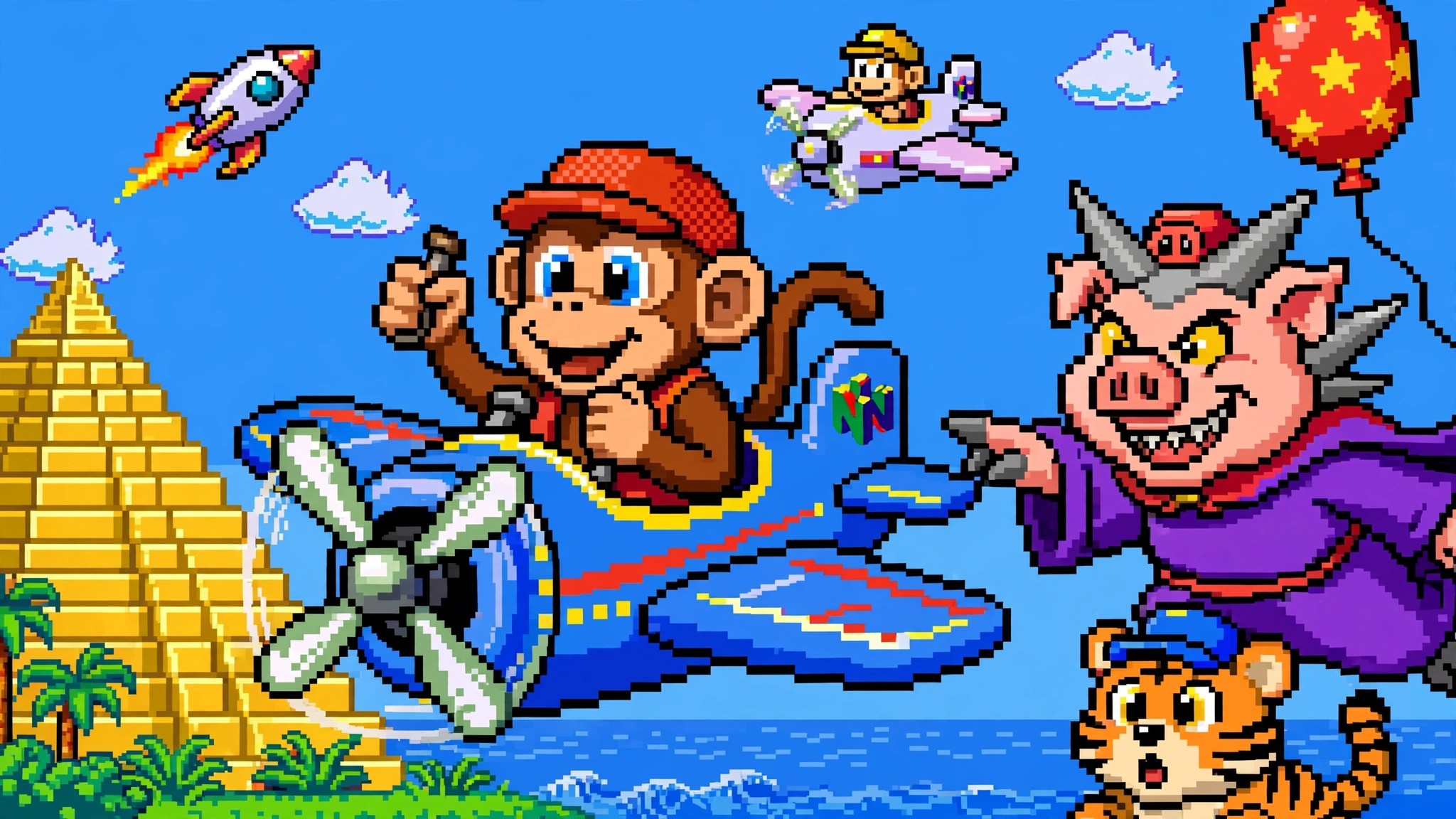
Diddy Kong Racing turned a kart racer into an adventure
The story comes out of the instruction booklet, and it is pure Saturday morning. Timber the Tiger’s parents go on holiday and leave him in charge of Timber’s Island. Bad timing. Wizpig shows up, an intergalactic pig-wizard who has already conquered his own planet and fancies this one next. He seals the island’s racetracks. He turns its four guardians into his henchmen: Tricky the Triceratops, Bluey the Walrus, Bubbler the Octopus and Smokey the Dragon. Drumstick the Rooster, the best racer on the island, challenges him and gets turned into a frog. A frog. That is the stakes-setting in this game, and I love it.
Timber sends a letter out with Squawks the parrot. Diddy Kong answers it. He brings Banjo the Bear and Conker the Squirrel with him. Krunch, a Kremling, tags along to spy, which tells you everything about Krunch. And Taj, an elephant-like genie who lives on the island, helps out from the hub.
The hub is the thing. Adventure mode borrows from Super Mario 64 as much as from Mario Kart, and nobody had done that to a racer before. The island links five worlds. Dino Domain. Snowflake Mountain. Sherbet Island. Dragon Forest. And Future Fun Land, hidden away for later. Four racetracks in each world, twenty courses in total, and Golden Balloons gate the whole map. Win a race, get a balloon, open the next door. There are balloons hidden around the island too, if you go looking. I went looking.
Clear a world’s four tracks and you get its boss, one on one. Beat the boss and the game just asks for more. Now it is the Silver Coin Challenge. Eight Silver Coins are hidden on each track, some of them in nasty places, and collecting all eight means nothing unless you still finish first. Then you race the boss again. Win that and you get a piece of the Wizpig amulet and a run at the world’s Trophy Race. It is a lot of game. Single-player kart racers were not built like this in 1997. Arguably they still are not.
Three vehicles changed how the tracks worked
Then there are the vehicles. Car, hovercraft, plane. Not skins. Three different machines with different physics, and the tracks are built to care which one you are in.
The car is the honest one. Good on tarmac, slow on sand and water. The hovercraft is made for water and loose ground, and it is a handful. Slow off the line, wide through corners, always feeling like it wants to slide somewhere you did not point it. Learning the hovercraft took me longer than learning any single track. The plane is the slowest in a straight line and the most fun anyway. It is agile, it barrel rolls, it loop-the-loops, and it finds routes over the top of courses that the other two vehicles will never see. A track you know by heart in a car is a new track in the plane. Taj waits in the hub to switch your vehicle, and he sets his own challenges in each of the three, which is how the game makes sure you actually learn all of them.
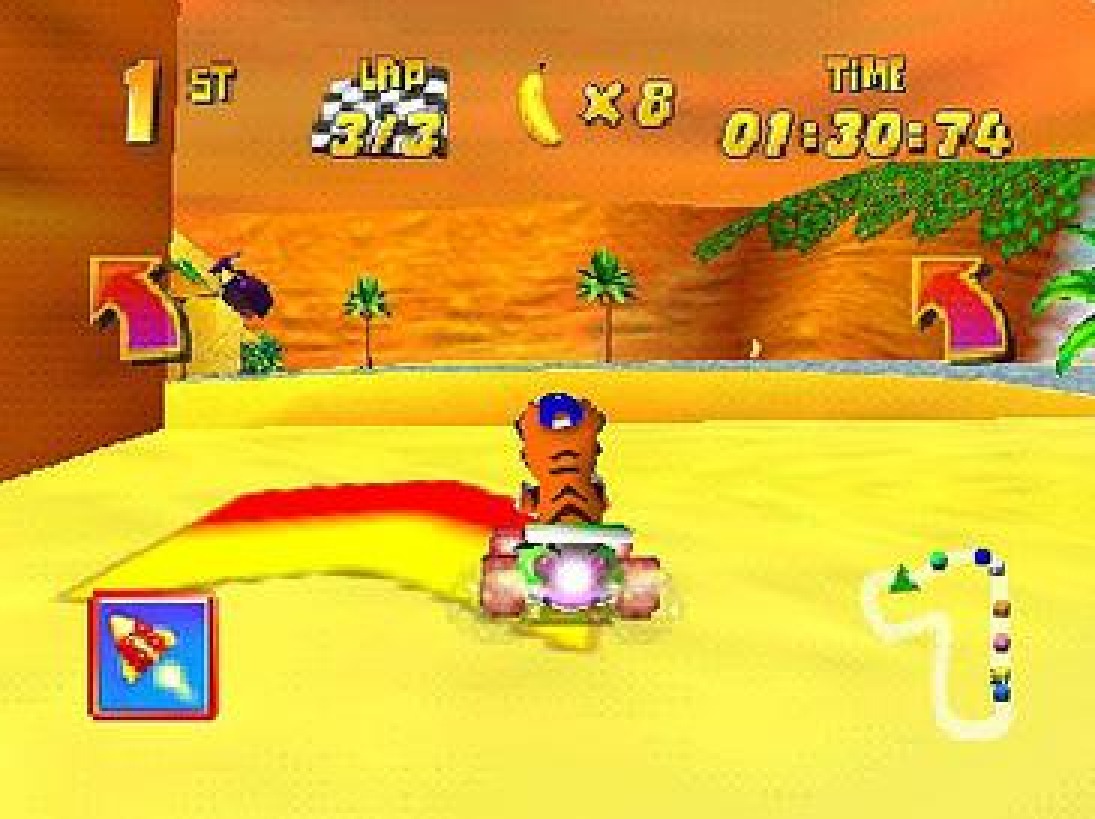
The items reward patience, which was new. Coloured balloons line every track. Red is missiles. Blue is a boost. Green drops a trap behind you. Yellow is a shield. Rainbow is a magnet that drags you toward the racer in front. Here is the clever part. Pick up a second balloon of the same colour and the weapon upgrades. A third upgrades it again. So do you fire the missile now, or hold it and go hunting for two more reds? That little decision, mid-race, at speed, is the whole game in miniature. Bananas work the same quiet way. They sit on the racing line and raise your top speed, ten at most. Get hit and you drop two. And the boost pads, the zippers, are placed just meanly enough that the fastest line and the smart line are rarely the same line.
Banjo and Conker were here first
Ten racers, eight of them there from the start. Diddy. Timber. Bumper the Badger. Pipsy the Mouse. Tiptup the Turtle. Krunch. And two faces nobody had played as before. Banjo the Bear. Conker the Squirrel.
Both had been shown at E3 in June 1997, stars of their own games. Those games were not ready. So their first actual appearances happened here, as supporting racers in a Diddy Kong game, which is a strange way for two future headliners to enter the world. Banjo-Kazooie arrived the following summer. Conker’s road to Conker’s Bad Fur Day took a turn nobody at this game’s Saturday-morning table saw coming.
The last two racers are earned the hard way. Drumstick, once you have un-froggified him. And T.T. the stopwatch, who is yours only after you beat his ghost on every track in Time Trial. I never did get T.T. I want that on the record. Some of those ghosts are still out there, unbeaten, and I have made my peace with it. Mostly.
Multiplayer got the same treatment. Four players, Versus mode, any mix of vehicles you like. And four battle modes, two deathmatch maps, an egg-hatching contest and a banana-hoarding battle, all of them locked behind keys hidden out in Adventure mode. Even the multiplayer had homework. My friends complained. Then they went and found the keys.
Built in a hurry, aimed at Christmas
None of this was the plan. Development started after Killer Instinct 2 in 1996, and the project kept changing shape. First it was a prehistoric time-travel strategy game. Then a Walt Disney World-influenced adventure called Wild Cartoon Kingdom. Then Pro-Am 64, a follow-up to the NES racer R.C. Pro-Am, with Timber in the lead.
Then Banjo-Kazooie slipped to the summer of 1998, and Rare had a hole where Christmas 1997 was supposed to be. Pro-Am 64’s cast of unknowns was not going to carry a holiday season, so the game got re-centred on Diddy Kong. Lee Musgrave said later that Nintendo enjoyed the choice of Diddy over Donkey Kong. Diddy was Rare’s, in his telling. Donkey Kong was Nintendo’s. Fourteen people made the final game. Fourteen. Their technical target was simple to say and hard to do: run as fast as Mario Kart 64 while drawing the racers as fully 3D models, where Nintendo’s game used 2D sprites. This was the same Rare that had shipped GoldenEye 007 that August. What a year that studio had.
Christmas made it a hit. Most of the Nintendo 64’s holiday line-up had slid into 1998, so this was the console’s main Christmas release, and Nintendo backed it with a $20 million marketing budget in North America. Retailers ordered 800,000 copies in the two weeks before Christmas. Guinness called it the fastest-selling game of its time. Lifetime sales reached 4.8 million copies, the Nintendo 64’s eighth best-selling game. The reviews landed too. An 88 on Metacritic. Edge gave it 9/10. IGN gave it 8.4/10. The praise went to the graphics, the sound and the sheer amount of game in the cartridge. The complaint, where there was one, was repetition, all those challenges run and re-run. Fair enough. I still ran them.
And the music. David Wise composed the soundtrack, and it never sits still. Fairground bounce in the hub. Sleigh bells hiding in the Snowflake Mountain themes, because of course there are. Japan got a 42-track soundtrack album on April 1, 1998. The American CD had sixteen tracks and came on a disc shaped like Diddy Kong’s head, which was a delight and also refused to play in certain CD players. I choose to remember the delight.
The remake, and the sequel that vanished
Beat Wizpig on his own world, collect every amulet piece and gold medal, and the game opens Adventure 2. Every track mirrored. Every balloon platinum. The whole campaign backwards, and harder. It is a generous way to end a game, and for a long time it was the last word.
A sequel was started. Donkey Kong Racing, for the GameCube. It was abandoned in August 2002, and the following month Microsoft purchased Rare for £375 million. That was the end of that road. What arrived instead was a remake. Diddy Kong Racing DS, developed by Rare and published by Nintendo, came out in North America on February 5, 2007 and in Europe on April 20, 2007. It is still the most recent Nintendo-published game Rare has made. The DS version added online multiplayer and a touch-screen track editor, both genuinely good ideas. But Banjo and Conker belonged to Microsoft now, so Dixie Kong and Tiny Kong took their seats, and something essential had gone out of the roster. The remake scored a 63 on Metacritic. The original’s two most famous racers had become guests who could not get back in.
So the 1997 game stands. Other kart racers borrowed from it in pieces over the years. A hub here. A campaign there. Vehicles that change shape somewhere else. And the bear who first showed up on this start line went on to his own classics, Banjo-Kazooie the following summer and Banjo-Tooie after it. But nobody in 1997 put the whole thing together the way this game did. An island. A villain. Bosses. Three ways to race every road. A pig wizard at the end of all of it, waiting.
Mario Kart 64 was the better party game. Plenty of weekends settled that. Diddy Kong Racing was the bigger game, and on the weekends when it was just me and that island, it was not close.
— June
For more launches from this date, see This Day in Gaming History: November 21.