
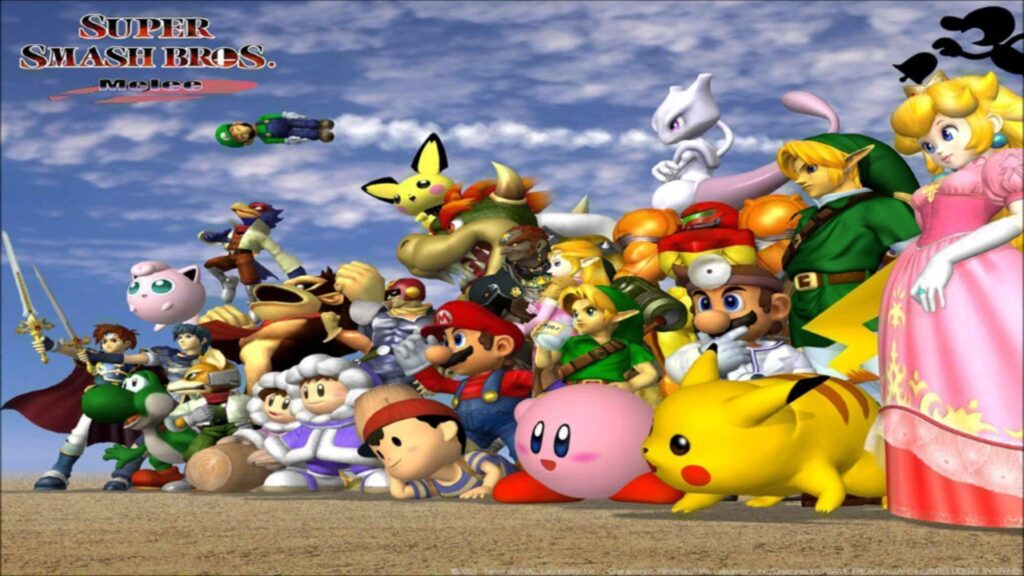
At a glance — Game: Super Smash Bros. Melee · Developer: HAL Laboratory · Publisher: Nintendo · Original release: November 21, 2001 · Original platforms: GameCube · Genre: Fighting
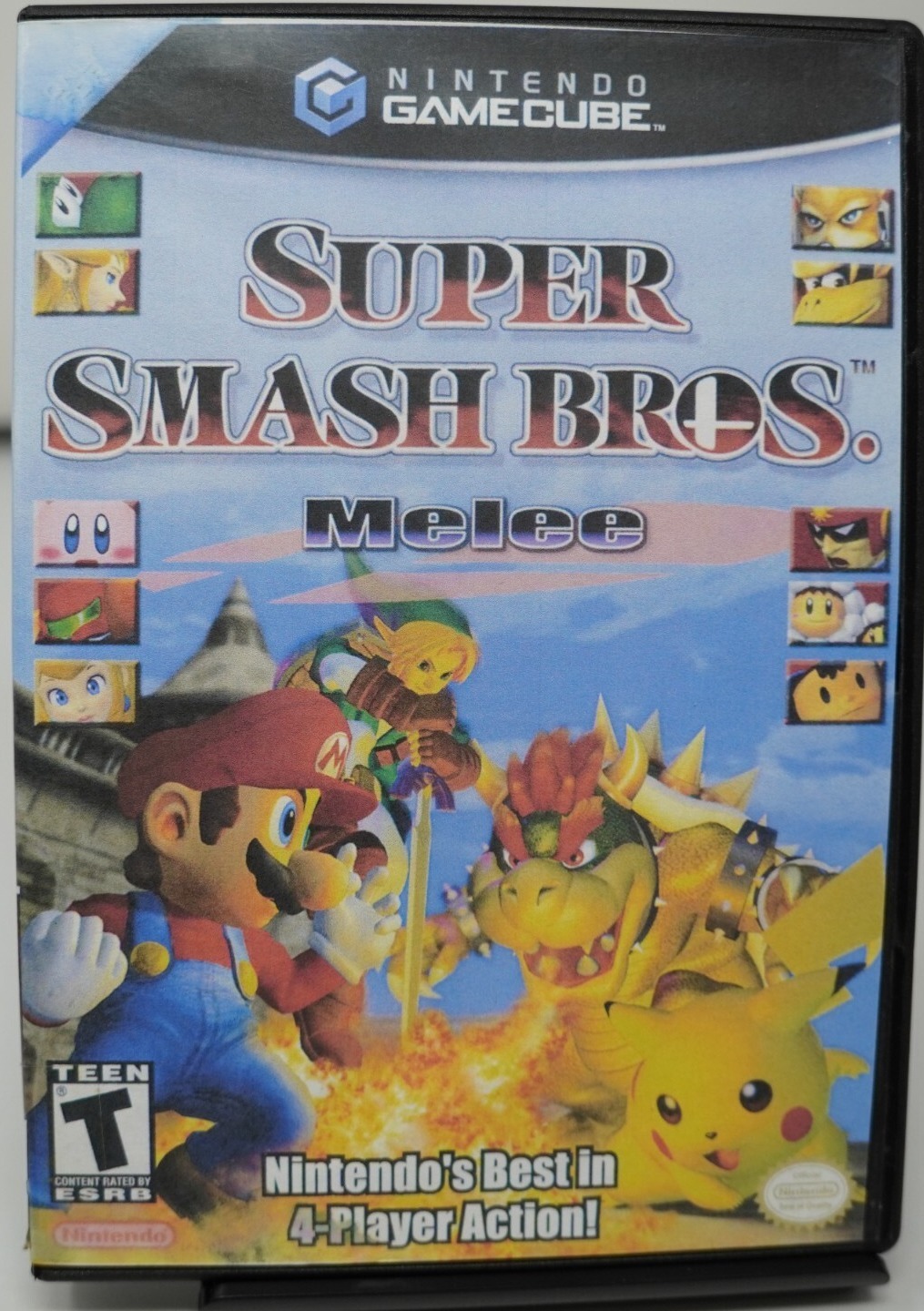
It was built in thirteen months by a small team whose director barely slept, and it is still the game the GameCube is remembered for. Super Smash Bros. Melee went on sale in Japan on November 21, 2001, days after the console itself, and North America followed on December 3. A quick note on the date, because it matters to us: this anniversary is the Japanese launch. If you grew up with the North American box — the one pictured further down this page — your Melee turns 25 in early December. We are celebrating the first release, and we would rather say that plainly than quietly borrow a date.
What arrived that November was the sharpest fighting game Nintendo has ever published. Faster than its predecessor in every direction. Deep enough to sustain a competitive scene that is still running tournaments a quarter of a century later. And stuffed so full of Nintendo history that half the fun was simply opening it up and looking inside. Our GameCube hub covers the machine it launched on; this piece is about the game that machine is still remembered for.
Thirteen Months, No Holidays: Super Smash Bros. Melee at Full Sprint
The first Super Smash Bros. had been an experiment that worked. Released for the Nintendo 64 in 1999, it took a dozen Nintendo characters, threw away the health bar in favour of a damage percentage that sent you flying further the higher it climbed, and sold well enough that a sequel for the upcoming GameCube was an easy decision. Director Masahiro Sakurai, who had created the series at HAL Laboratory, finished the design document for the follow-up on July 5, 1999. Then the hardware took its time arriving. When full production finally began, around the autumn of 2000, the calendar had become the enemy.
Melee was developed in 13 months. Sakurai has described his lifestyle across that period with one word: “destructive.” No holidays. Short weekends. The pressure, he later said, came from knowing this was no longer an experiment — it was the biggest project he had ever led, a launch-window showcase for a new console, and a sequel to a game people loved. Nintendo co-produced, with Shigeru Miyamoto among the producers, and HAL worked with three separate Tokyo graphics houses just to build the opening film, which Sakurai wanted as a homage to the GameCube’s debut. Watch that opening today and it still does its job: a trophy comes to life, the camera sweeps across a quarter-century of Nintendo, and the game announces exactly what it intends to be.
The schedule showed in public, too. Nintendo presented Melee as a playable demo at E3 in May 2001, then brought an updated build to Space World that August and ran a fan tournament around it. Six months after that first showing, the game was finished and in Japanese shops. In a 2010 interview, with two more sequels behind him, Sakurai looked back at the one made in the worst conditions and called it “the sharpest game in the series,” adding that “it just felt really good to play.” The crunch that produced it is nothing to celebrate on its own terms. But the feel he was describing — the snap, the weight, the speed — is precisely what thirteen months of obsession bought, and players noticed immediately.
Twelve Fighters Became Twenty-Six
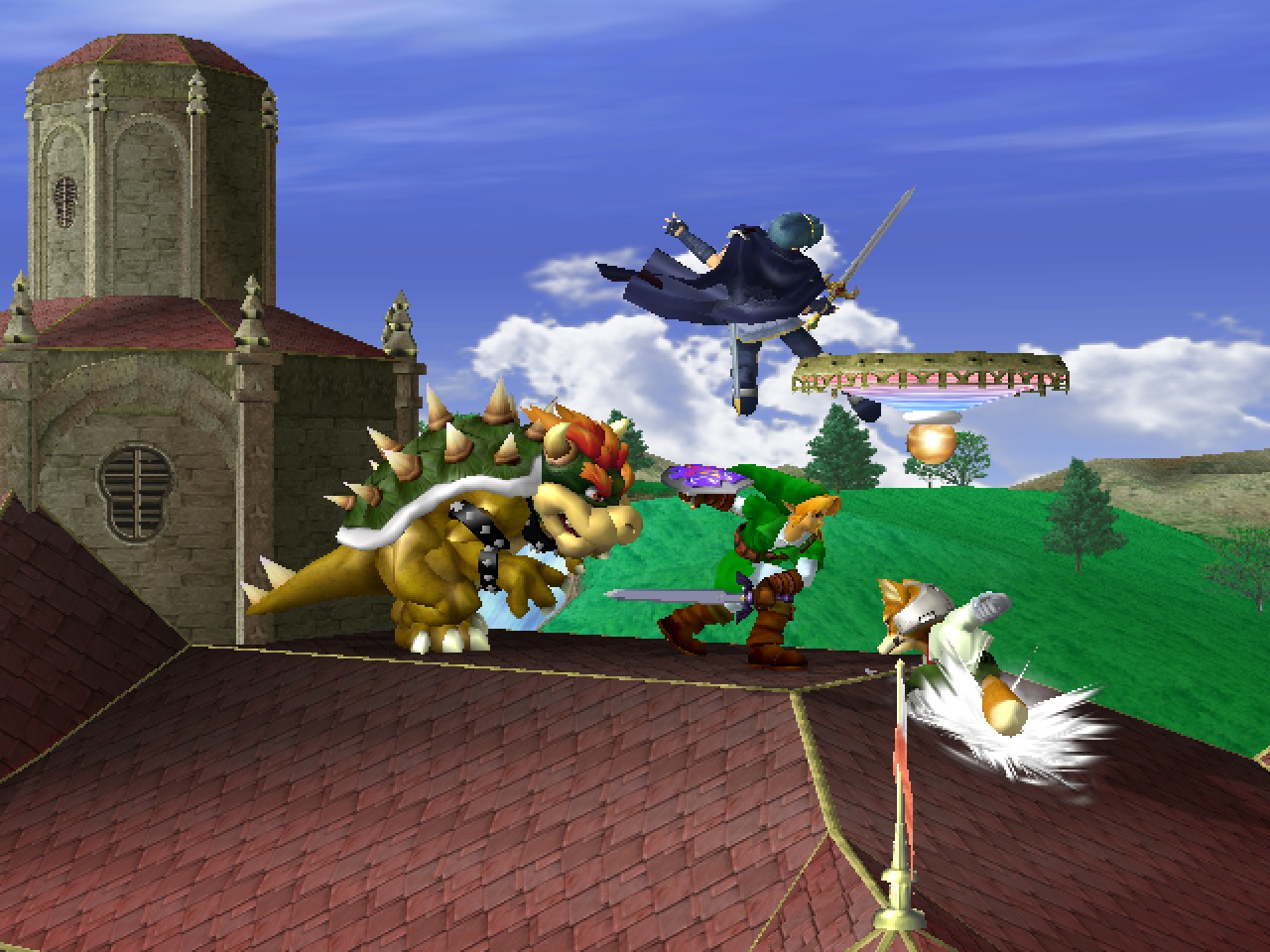
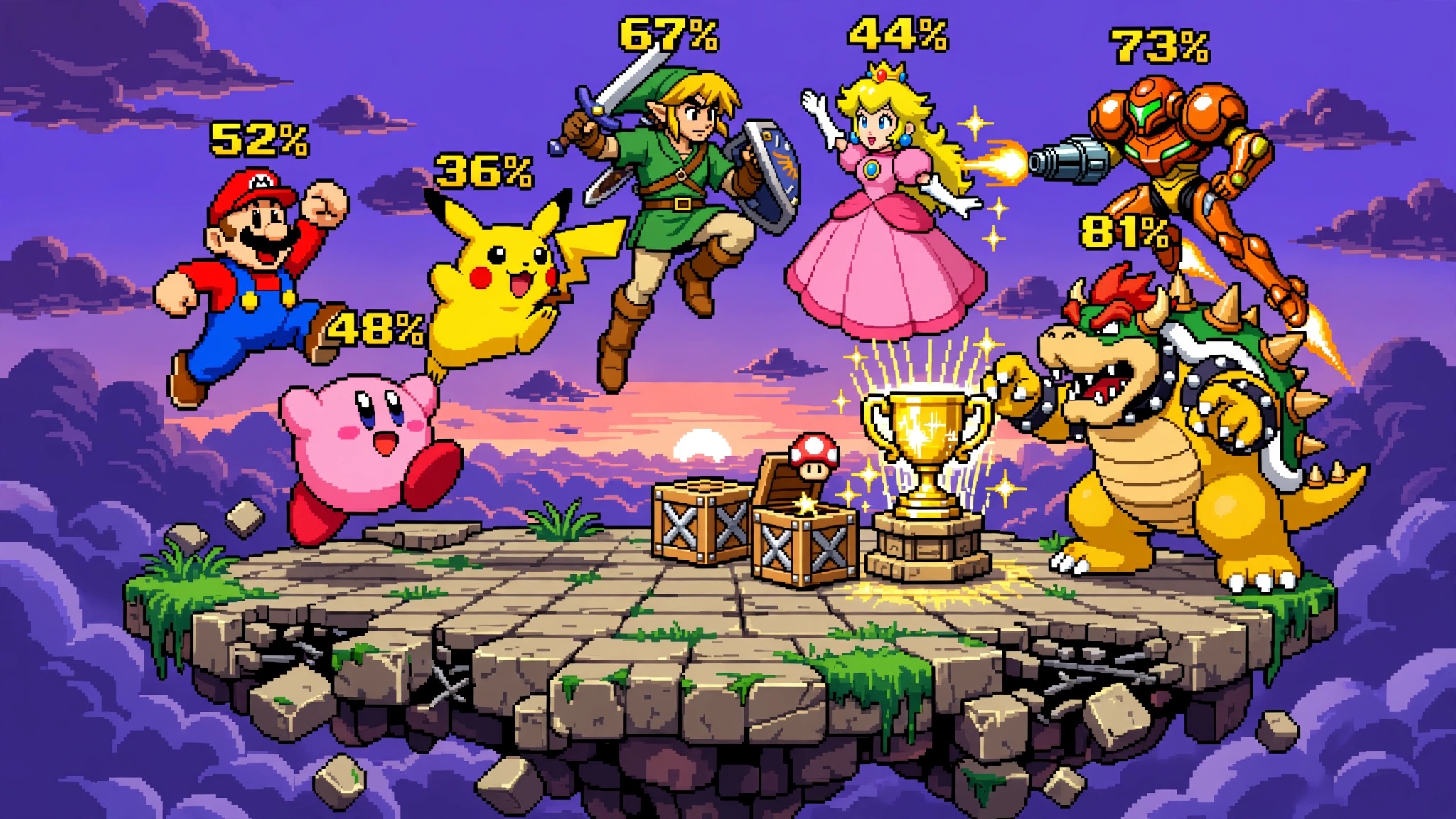
The Nintendo 64 game had 12 playable characters. Melee kept every one of them and more than doubled the roster: 25 character slots, 26 fighters if you count Sheik separately from Zelda, whose transformation move made her two fighters sharing one slot. Fourteen were there from the start. The rest had to be earned — and earning them was a game in itself.
The newcomers tell you how wide Nintendo was willing to cast the net. Peach and Bowser finally joined from the Mario series, Ganondorf and Young Link from Zelda, Mewtwo and Pichu from Pokémon, Falco from Star Fox, and Dr. Mario from his own puzzle spin-off. The Ice Climbers were picked from four candidates to represent the Famicom and NES era. Mr. Game & Watch arrived as a flat, beeping piece of 1980 handheld hardware made playable. And then there were Marth and Roy, the two Fire Emblem swordsmen, from a series that had never been released outside Japan at all. They were originally intended to stay exclusive to the Japanese version; the response during North American localisation was good enough that Nintendo kept them in, and their popularity is widely credited with helping bring Fire Emblem west for good.
The roster could have been stranger still. Sakurai has told the story himself: Hideo Kojima asked for Solid Snake, Sonic Team’s Yuji Naka asked for Sonic, and both requests came when development was too far along to act on. Ness, meanwhile, nearly lost his place to Lucas from the still-delayed Mother 3, and kept it only because that game slipped. Snake and Sonic would get their invitations one game later, in Brawl. Melee’s 26 had to be enough — and for most of us swapping a controller around a television in 2001, 26 felt like an impossible number.
Too Fast to Die: The Competitive Second Life
Here is the thing nobody at HAL planned. Melee’s movement had layers that the community spent years uncovering: wavedashing, sliding across the ground out of an air dodge; L-cancelling, halving the landing lag of an aerial attack with a perfectly timed shield press; a whole grammar of dash-dancing, edge-guarding and directional influence. Sakurai built a party game that welcomed everyone at the door. Underneath it, almost by accident, sat one of the most demanding competitive fighters ever made, running at 60 frames per second with no patches and no balance updates to rescue or ruin it. The game you bought in 2001 is the game tournaments still play. That frozen, known quantity became a sport.
The timeline is remarkable for a console game with no online play. Nintendo itself ran an early tournament, Premium Fight, in August 2001. Major League Gaming put Melee on its Pro Circuit from 2004 to 2007, and Ken Hoang — “The King of Smash” — was considered the game’s best player from 2003 to 2006. The Evolution Championship Series hosted Melee in 2007, dropped it, and then brought it back in 2013 after the community won a charity vote for the final slot; the turnout kept it on the Evo stage every year through 2018. A crowd-funded 2013 documentary, The Smash Brothers, told the scene’s story to people who had never touched a GameCube controller. In 2020, the community-built Slippi project added rollback netcode and matchmaking to Melee through emulation, giving a 2001 party game modern online infrastructure its makers never gave it — and when Nintendo’s lawyers sent a cease and desist to a major online tournament that year over Slippi’s use, the argument only underlined the point. Twenty-five years on, Melee is not a nostalgia act. It is a fixture, the way certain arcade fighters are fixtures: old, solved in theory, and somehow still producing new matches worth watching. We made the same case in our Super Smash Bros. Melee review, and the tournaments have kept proving it since.
Adventure Mode, and a Trophy Cabinet Full of Nintendo
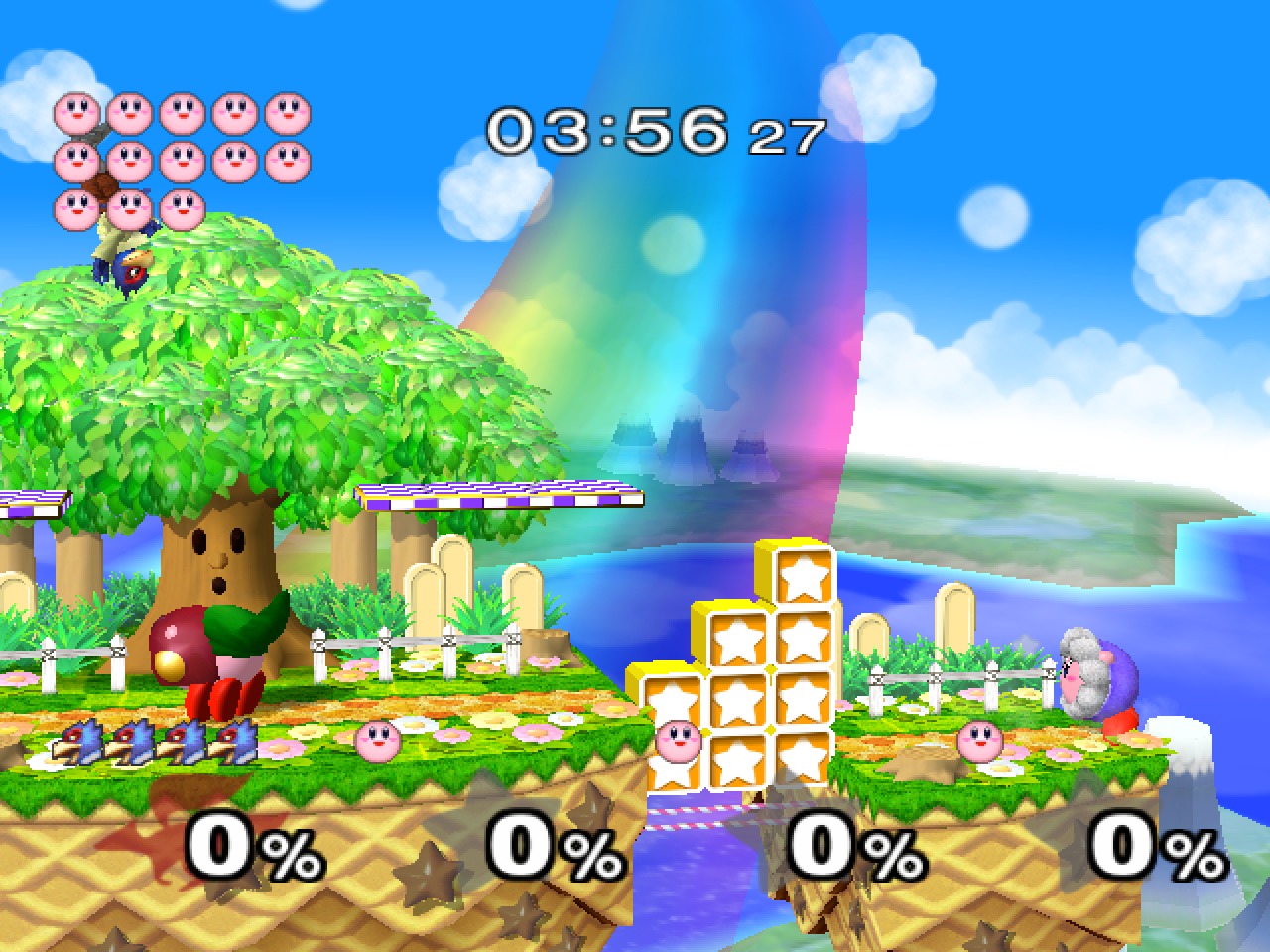
For everyone who never learned what a wavedash was, Melee’s single-player offering was the generous half of the disc. Classic Mode returned, but the headline was Adventure Mode: a journey through the Nintendo worlds themselves, side-scrolling through the Mushroom Kingdom, escaping Brinstar as the planet counts down, fighting a team of Kirbys, a swarm of Yoshis and a giant Donkey Kong, and finishing against a giant Bowser — or, on harder settings and without continuing, something considerably worse wearing his shape. Around those sat Event Matches with their own little scenarios, the Home Run Contest, a Target Test built individually for every character, and the unlockable All-Star Mode, which asked you to beat the entire roster on one life.
And then there were the trophies. Melee scattered 290 of them through its modes — won in a lottery, earned for clearing modes with each character, hidden inside Adventure stages — each one a small 3D figure with a written description. They covered the playable cast, certainly, but they kept going: the obscure, the forgotten, the never-released-outside-Japan. For a generation of players, the trophy gallery was a Nintendo history course disguised as a collectible, and it is no accident that Melee is the game that introduced Western players to characters and series they had never had the chance to buy. The orchestrated soundtrack pulled the same trick for the ears, rearranging themes from across Nintendo’s catalogue; its live orchestral album, Smashing… Live!, was good enough to be given away with Nintendo Power subscriptions in North America.
The GameCube’s Best-Seller, and Still Its Argument
The numbers settled the question early. In Japan, Melee sold 358,525 copies in its first week, the fastest-selling GameCube game to that point, and passed a million copies within two months — the first GameCube title to do it. North America sold 250,000 copies in nine days. By March 2008 it had sold more than seven million copies worldwide, making it the best-selling GameCube game outright; the figure most often cited for it since, from Nintendo’s own sales data, is 7.09 million. At one point it was estimated that around 70 percent of GameCube owners had a copy. Critics of the day were nearly as emphatic: a 92 on Metacritic, a 9.6 from IGN, praise for the visuals, the soundtrack and above all the multiplayer — with a minority, Edge among them, grumbling that it was too fast and too similar to its predecessor. History has been kinder to the speed than to the grumble.
Melee never got a remake, and it never needed one to stay alive. It just kept being played — on original hardware, on CRT televisions hauled to tournament halls long after flat screens won everywhere else. Its director moved on to Brawl, to the 3DS and Wii U games, and to Ultimate, each bigger than the last. None of them replaced it. Twenty-five years after a thirteen-month sprint in Kyoto, the sharpest Smash is still the one Sakurai’s team shipped in November 2001 — still selling the GameCube’s story better than any other game on the system, and still, somehow, in the middle of its competitive prime.
— Chip
Super Smash Bros. Melee first launched on November 21, 2001. See what else happened on that day in This Day in Gaming History: November 21.