
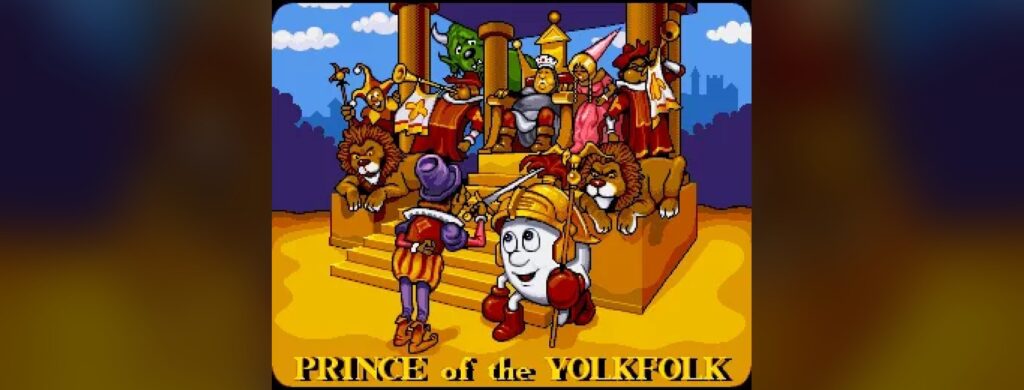
At a glance — Game: Dizzy: Prince of the Yolkfolk · Developer: Big Red Software · Publisher: Codemasters · Original release: December 1991 · Original platforms: Amstrad CPC, ZX Spectrum, Commodore 64, Atari ST, Amiga, MS-DOS, NES · Genre: Adventure, platform
There is a particular kind of British childhood that smells of cassette tape and tastes of pocket money, and at the centre of it, somersaulting across a fairytale kingdom in red boxing gloves, is an egg. Dizzy was never a mascot in the corporate sense — no focus groups, no cartoon deal, no theme park. He was two brothers, a bedroom-coding success story and a hero you could buy for the price of a magazine. And of all his adventures, the one now dragging him back into the headlines — onto a Mega Drive cartridge, of all things, in the run-up to his fortieth birthday — is the sixth: Dizzy Prince of the Yolkfolk, from December 1991.
The timing is not an accident, and we will get to the cartridge. But first the game deserves its own moment, because Prince of the Yolkfolk is peak-era Dizzy in the purest form: compact, kind-hearted, faintly ridiculous, and built around the radical idea that most problems in a fairytale kingdom can be solved by carrying the right object to the right creature and being polite about it.
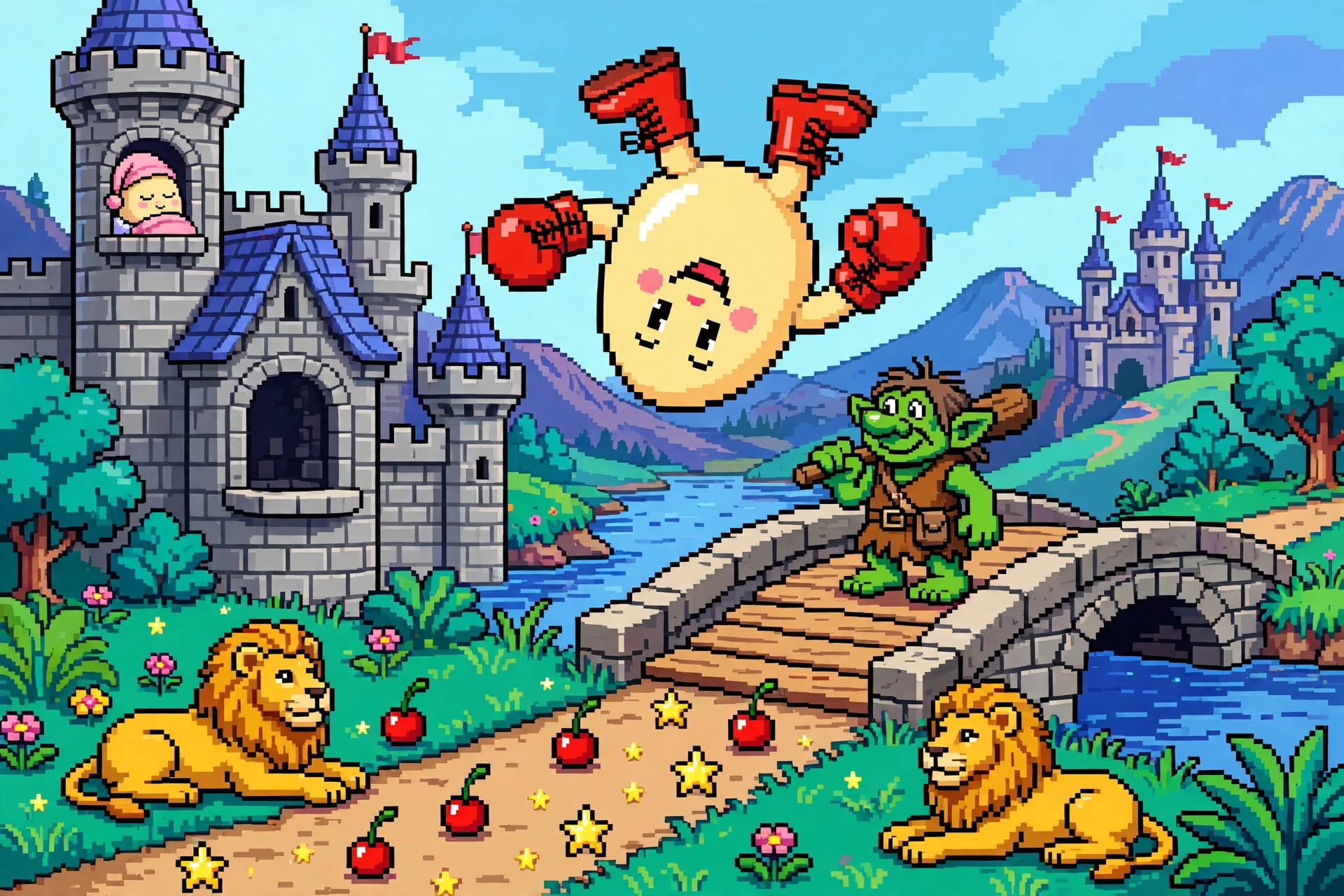
Dizzy Prince of the Yolkfolk: The Peak-Era Adventure
By the end of 1991 the Dizzy formula was a well-oiled little machine. Philip and Andrew Oliver — the Oliver Twins — had created the character back in 1987 with Dizzy: The Ultimate Cartoon Adventure, and the series had grown, game by game, into one of the most successful European computer-game brands of the late 1980s. For Prince of the Yolkfolk, the Twins outsourced design and development to Big Red Software, the team that had also just delivered Spellbound Dizzy — and Big Red understood the assignment completely. The interface and mechanics deliberately step back to the beloved Magicland Dizzy template, discarding the experimental changes of the fifth game. This is a refinement, not a reinvention.
It was the sixth game in the Dizzy adventure series, and it arrived the way so many budget classics did: initially only as part of a compilation, Dizzy’s Excellent Adventures. Think about that for a second. One of the best-loved entries in Britain’s best-loved budget series was, at first, a component in a multi-game pack. That was the economics of the £3.99 cassette — and Dizzy thrived in it, because the games were never really about spectacle. They were about a small, legible world you could hold in your head, a pocketful of objects, and the slow, satisfying click of a fairytale logic puzzle falling into place.
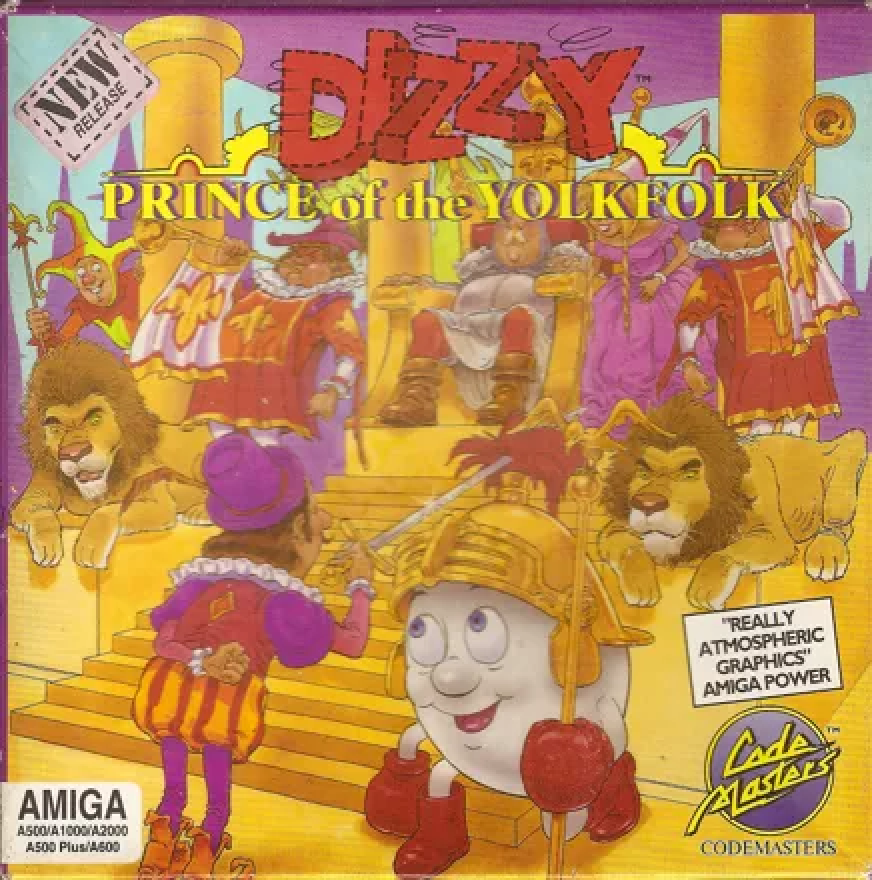
The critics of the day were charmed. Amiga Action scored it 90%, Sinclair User 88%, Amiga Power 85% — the kind of numbers a budget adventure had no business collecting, earned on atmosphere as much as mechanics. Allister Brimble’s music, written across the Amiga, CPC, Spectrum and C64 versions, is a large part of that atmosphere: wistful, slightly mysterious tunes that make a kingdom of twenty-odd screens feel like a place with weather in it.
Trapped, Then Out Into the Fairytale
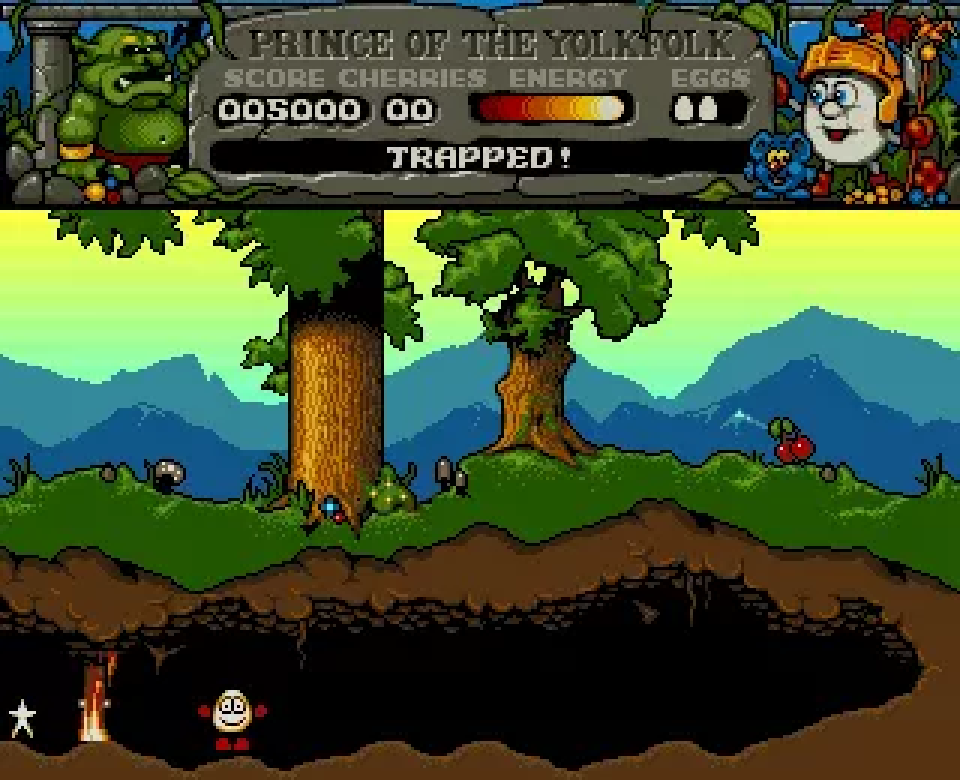
The setup is pure Dizzy. Rockwart the Troll has cast a spell on Daisy, leaving her asleep for a hundred years — and thanks to an errant spell of his own, Dizzy begins the game trapped underground, in a cell, with a jug of water, a pile of leaves and a box of matches as his entire inheritance. That opening is a small masterpiece of teaching-by-doing: the series’ whole grammar — pick things up, carry a few at a time, use the ordinary object in the sideways way — is contained in one locked room. Escape, and the kingdom opens up: castle, lake, enchanted forest, clouds you really can walk on, and a ferryman waiting on the bank of a very mythological river.
Along the way there are cherries and stars to gather, food to replace the energy that the kingdom’s many hazards cheerfully drain, and the Yolkfolk themselves to talk to — Daisy, Denzil, Dora, Dozy, Dylan and Grand Dizzy, the egg family who turned a platform hero into a community. And there is Pogie, the little furry Fluffle who made his name in this game, scampering through the fairytale as if he owned it.
The puzzle everyone remembers — the one Philip Oliver himself has said he wishes the Twins had invented — is the lion with a thorn in its paw. No key, no lever, no trick: you help the lion, because helping is what Dizzy does, and the fairytale pays you back in kind. It is a tiny thing, and it explains the entire series better than any review score. Dizzy’s world runs on kindness administered via inventory items.
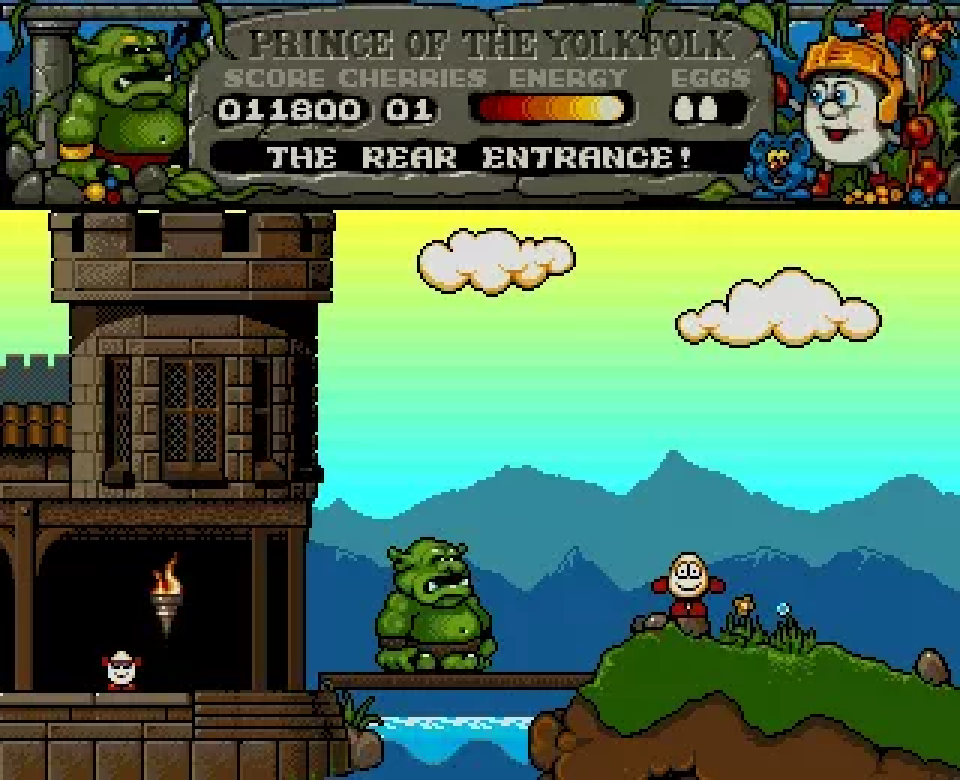
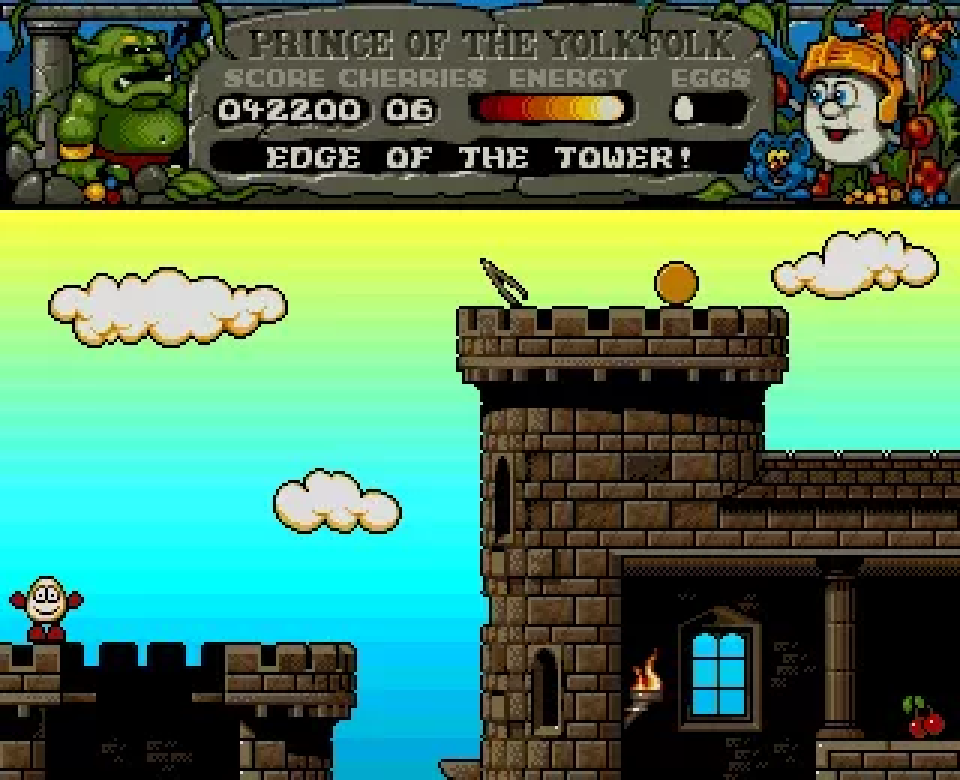
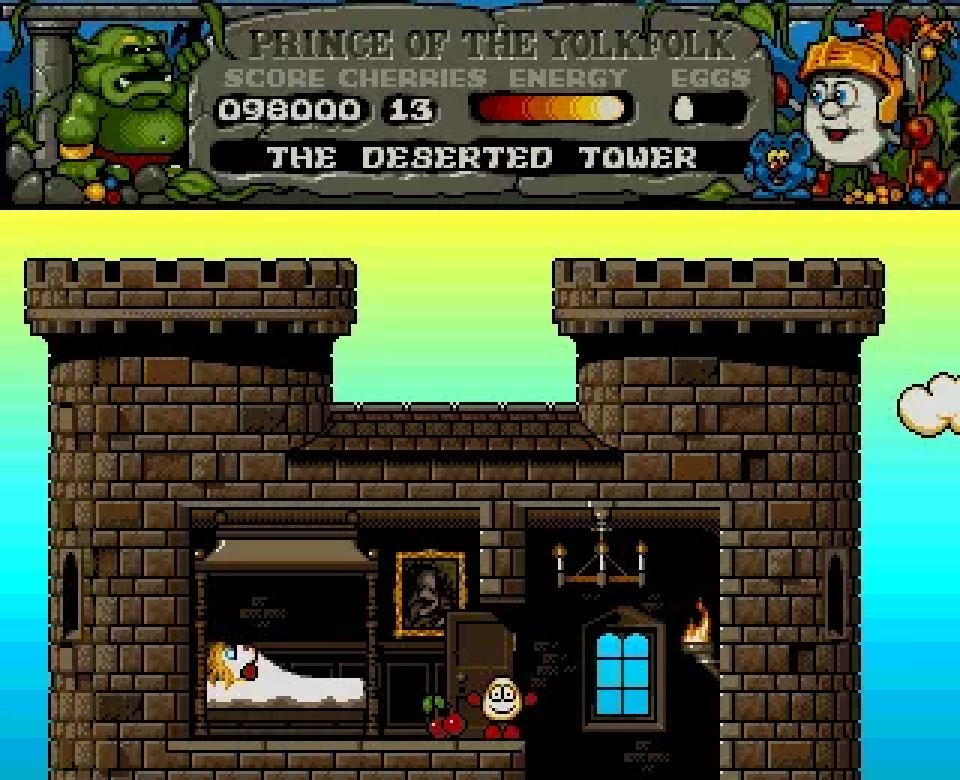
Is it short? Yes — honestly short, completable in about an hour once you know the route, and some players at the time marked it down against the sprawling Spellbound Dizzy for exactly that. Sitting with it in 2026, the shortness reads differently. This is a fairytale told at fairytale length: a beginning in a cell, a middle in a kingdom, an ending at a bedside. Nothing in it is padding, and every screen earns its place in your memory — which is why, thirty-five years on, people can still draw you the map.
The Egg Who Never Got a Mega Drive Game
Now the strange part, and the reason for the headline. Dizzy was everywhere in 1991 — Spectrum, CPC, Commodore 64, Amiga, Atari ST, DOS, even the NES — and Sega’s machines were not entirely Dizzy-free: Fantastic Dizzy reached the Mega Drive. But Prince of the Yolkfolk itself, in the form most console players would meet it, never did. In November 1992 the game was enhanced and re-released for the NES Aladdin Deck Enhancer under a new name, Dizzy the Adventurer, and in 1993 it headlined The Excellent Dizzy Collection alongside two arcade companions, Go! Dizzy Go! and PANIC! Dizzy. That collection was a console proposition — and its Mega Drive version never shipped. The egg’s finest fairytale stayed a home-computer and NES story.
Yolkfolk kept finding new doors, mind you. In December 2011, twenty years after the original, an HD remake arrived on iOS and Android — for a while, the first official new Dizzy release in years was a phone remake of this exact game. The fairytale was clearly the one the series itself kept returning to. But a Sega cartridge? That door stayed shut for more than three decades.
Until Now: Three Games, One Dizzy Prince of the Yolkfolk Cartridge
Which is what makes the Oliver Twins’ Eggcellent Dizzy Collection such a satisfying piece of unfinished business. The Kickstarter campaign is live now — it opened on November 5 and runs until December 3, 2026 at 10pm, with a £9,500 target — and it puts those same three games, Dizzy the Adventurer, Go! Dizzy Go! and PANIC! Dizzy, onto a Mega Drive and Genesis cartridge for the first time. Dizzy the Adventurer is the collection’s version of Prince of the Yolkfolk, so the fairytale at the heart of this piece is, finally, the headline act on the one mainstream 16-bit machine it always missed. There is even a collector’s flourish: a signed gold-cartridge edition, limited to 100 copies.
A housekeeping note, because this site does not carry dates it cannot stand behind: no cartridge shipping date has been confirmed; the campaign’s coverage points to a March 2027 delivery estimate, and an estimate is all that is printed here. What is confirmed is the shape of the thing — three games, one physical 16-bit cartridge, the Twins themselves behind it, under an agreement with Codemasters — and the occasion it is aimed at. Dizzy turns forty in 2027. The campaign coverage has also been upfront that AI tools were used to reinterpret the collection’s cover art, a disclosure worth knowing and one the Twins have not hidden from.
Consider what that anniversary really marks. Forty years of an egg who was never the fastest, never the toughest and never, ever the coolest character on the shelf — who outlasted nearly all of them anyway, on the strength of small worlds, kind puzzles and a somersault. Prince of the Yolkfolk is where that formula was at its most distilled. If you have never played it, the Mega Drive cartridge is a genuinely lovely way in: the fairytale first, the arcade games as the encore. And if you played it in 1991, well — you already know the way out of the cell. Some of us never really left the kingdom.
— Sal
For more from this month in gaming history, see This Day in Gaming History. More from this system: our Genesis hub.