
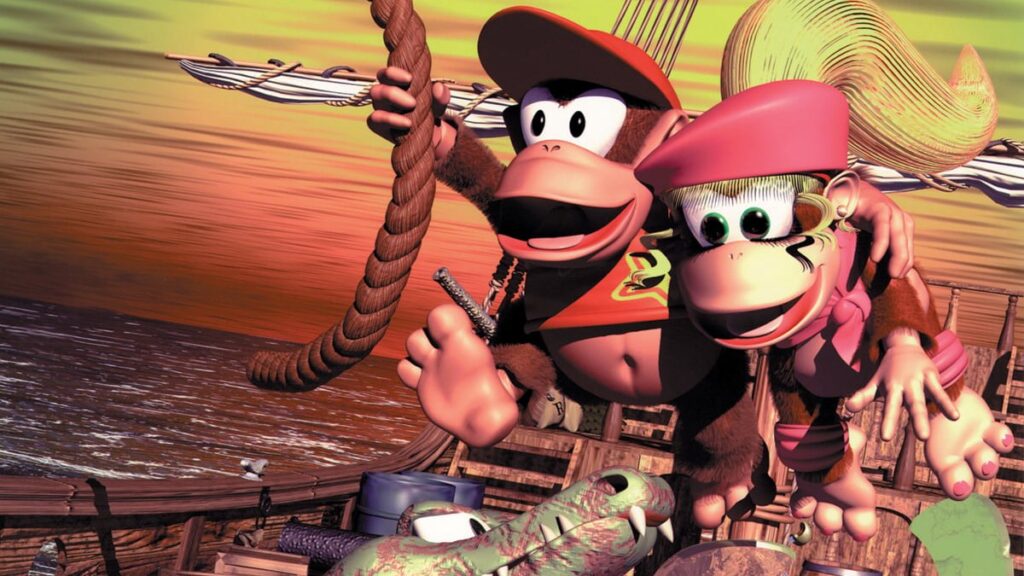
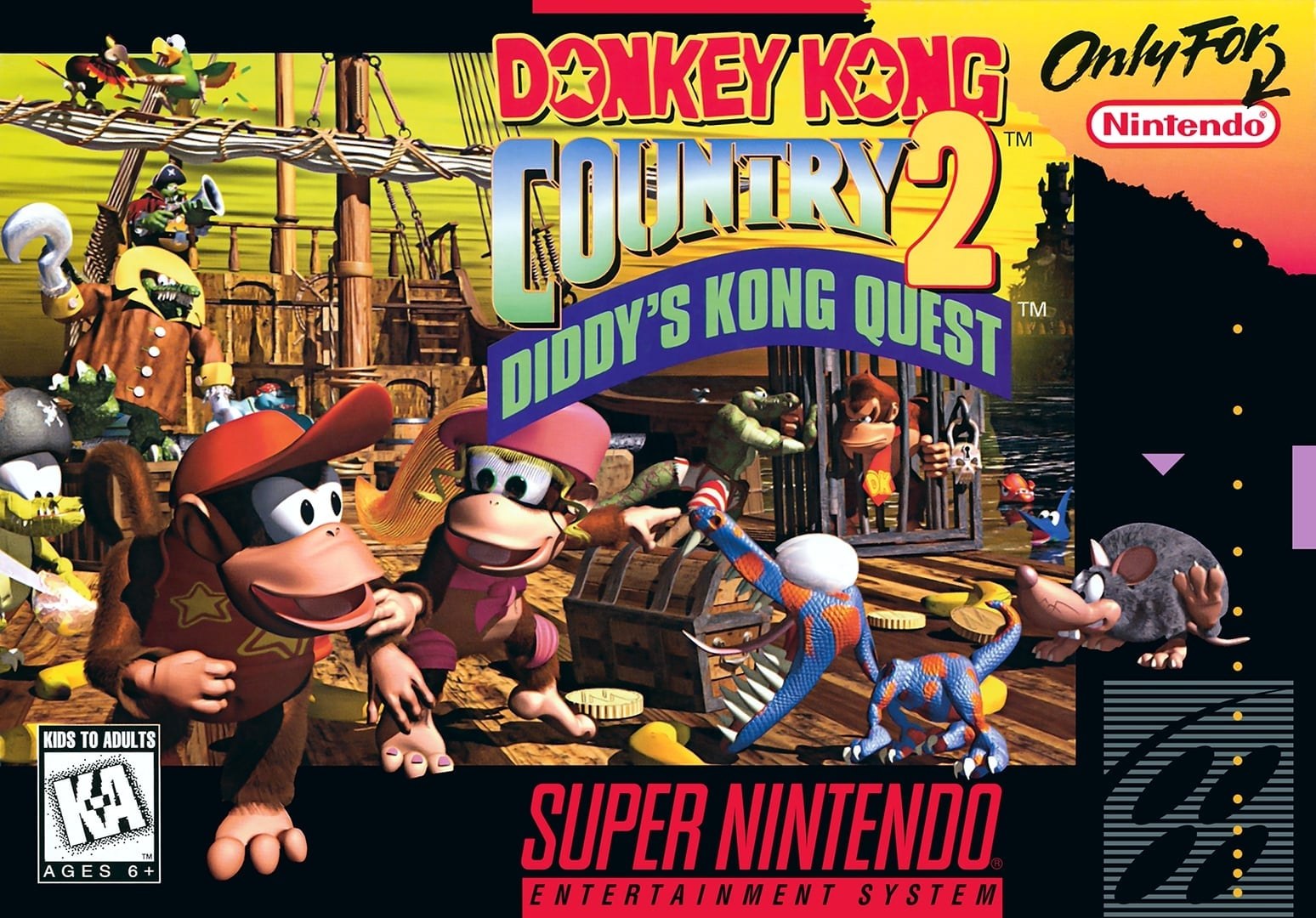
At a glance — Game: Donkey Kong Country 2: Diddy’s Kong Quest · Developer: Rare · Publisher: Nintendo · Original release: November 21, 1995 (Japan; North America December 4, 1995) · Original platforms: Super Nintendo Entertainment System · Genre: Platform · Music: David Wise
Donkey Kong is tied up on a pirate ship. That is the whole pitch, and the nerve of it still startles: one year after Donkey Kong Country had sold the SNES a Christmas and restarted a franchise, Rare kidnapped the star, handed Donkey Kong Country 2 to the sidekick, gave the sidekick a brand-new partner with a helicopter ponytail, and made the whole thing harder, stranger and better. Diddy’s Kong Quest launched first in Japan on November 21, 1995 — as Super Donkey Kong 2: Dixie & Diddy — reached North America on December 4, and has spent the thirty-one years since being called, with unusual consistency, one of the greatest 2D platformers ever made. The first game was the spectacle. This is the masterpiece.
A sequel designed to be harder
Development began shortly after the first game shipped, before its success was even known, and the brief Rare set itself was pointed. Veteran players had found Donkey Kong Country too easy, so the sequel would push back. Director Tim Stamper and designer Gregg Mayles — 23 years old during production — rebuilt the game around exploration rather than flow. Where the original arranged its set pieces so a perfect run never stopped, Donkey Kong Country 2 hides its rewards: bonus barrels behind breakable walls, DK Coins in deliberately cruel places, and a toll gate guarded by an enormous Kremling named Klubba, who charges fifteen Kremcoins for passage to the Lost World, the secret zone humming at the island’s core. Finish everything — every level, every bonus, every DK Coin, a visit to each Kong family member — and the save file reads 102 per cent.
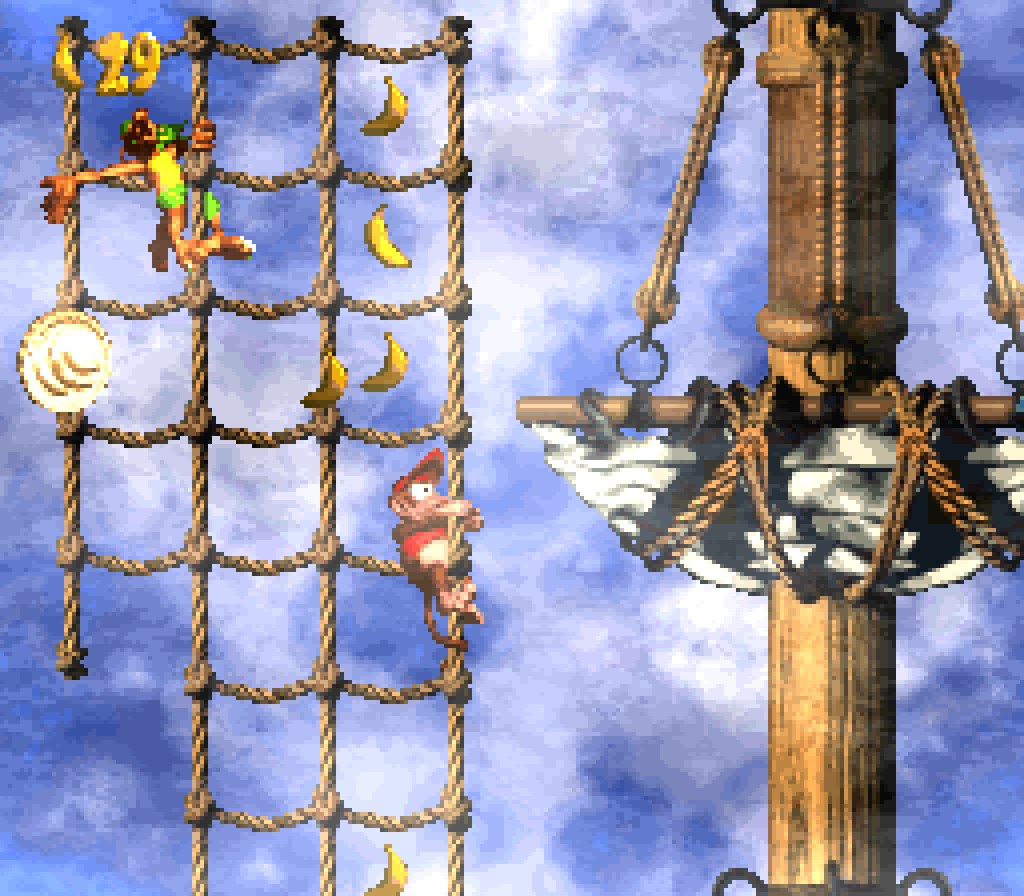
The structure grew with the ambition: 52 levels across eight worlds on Crocodile Isle, the Kremlings’ home turf, dressed in a pirate theme that came from Mayles’s fascination with the Golden Age of Piracy. Sunken galleons. Bramble thickets in the sky. A haunted fairground. Beehives slicked with honey you can climb. A roller coaster you ride in a skull-shaped cart while a ghost chases you through a library. The Silicon Graphics rendering pipeline from the first game returned, but the art direction darkened — this is a moodier, more detailed world than the jungle postcard of 1994, and contemporary reviewers noticed the backgrounds reaching, as one put it, newer heights.
Dixie Kong changes everything
The boldest decision was the cast. Mayles has said the team could sideline Donkey Kong precisely because they were young enough not to fear it: Diddy was their character in a way Donkey Kong, Nintendo’s icon, was not. Keeping the two-character system meant inventing a partner who played differently, and Dixie Kong is a small masterclass in character design. Diddy is quicker on the ground. Dixie jumps higher and can spin her ponytail to glide, which quietly rewrites every jump in the game. Nearly fifty names were considered — Didene, Dee, Daisy, Dandi, Dizzie, Ducky — before Dixie stuck, and Shigeru Miyamoto contributed ideas for the motif on her beret. The pair can also throw each other, turning your partner into a weapon, a platform and a rescue line in one move.
The pirate dressing was not decoration, either. Rare built the levels as places with a logic to them — a galleon you board in the first world and fight across the deck of, a lava-lit castle, a kraken-haunted galleon graveyard in Gloomy Gulch — and the difficulty curve follows the theme, easing you in on Gangplank Galleon and ending in the Lost World’s Krokodile Kore, a volcano core that expects everything the previous 51 levels taught you. Even the target pad at the end of each stage, which pays out a spinning prize if you land on it from the right height, turns finishing a level into one last small game of nerve.
The supporting cast widened around them. Cranky Kong returned by, as the game puts it, popular demand, charging for secrets in his Monkey Museum. His wife Wrinkly made her debut running Kong Kollege, part tutorial, part save point. Swanky hosted a quiz show bonanza that paid out in extra lives, Funky flew you between worlds, and the animal buddies expanded: Squitter the spider, who shoots webs he can stand on; Rattly the snake, who bounces to absurd heights; Enguarde and Squawks returning, joined by a sword-wielding living blade of a boss in Kleever and a giant bee, King Zing, who remains a rite of passage. K. Rool himself rebranded as Kaptain K. Rool, kidnapper now, demanding the banana hoard as ransom — the hoard he had failed to steal the first time.
Stickerbush Symphony and the sound of the SNES growing up
David Wise’s soundtrack for Donkey Kong Country 2 is the rare game score that critics write about the way they write about albums. Wise drew on Koji Kondo, on the Follin brothers’ work on Plok!, on 1980s synthesizer film scores, and — for this game’s darker orchestral colour — on Prokofiev, Tchaikovsky and Mussorgsky. All of it was produced through the SNES’s SPC700 chip to sound like the Korg Wavestation he composed on. The range runs from big band to disco to hip-hop, often inside a single world.
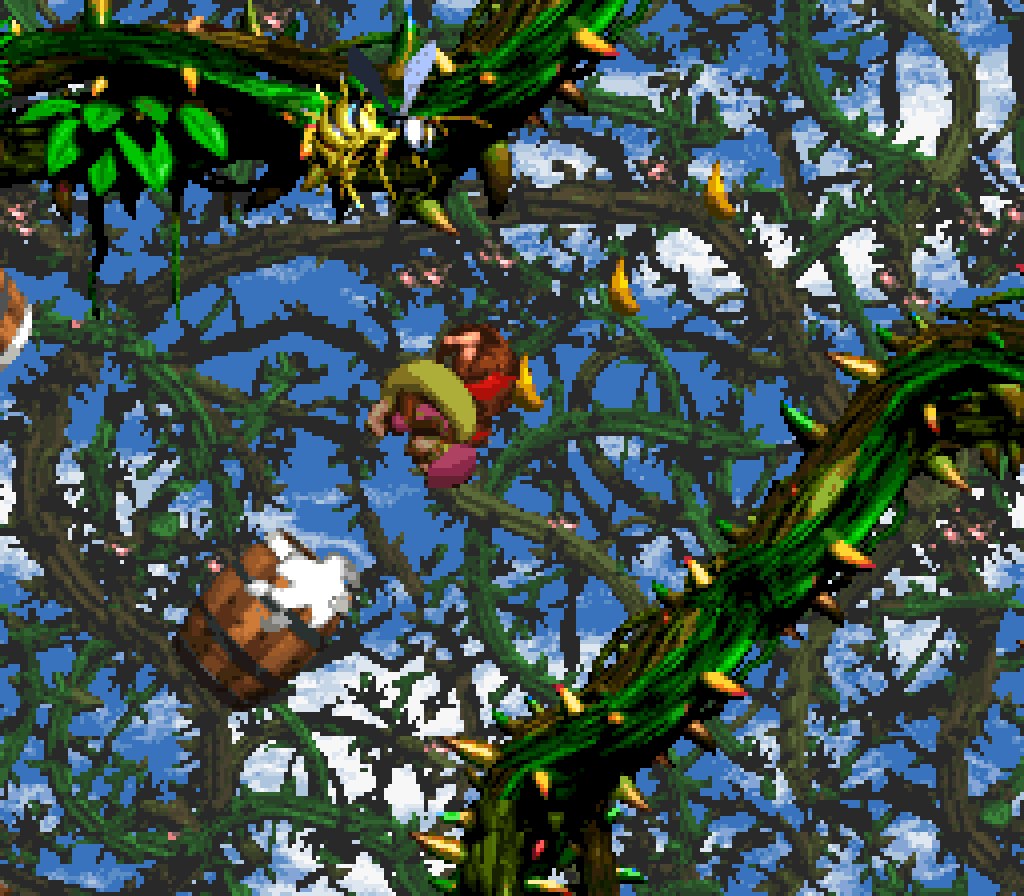
One track escaped the game entirely. “Stickerbush Symphony”, the music for the bramble levels, has been called a dreamy, forlorn new-age ballad unlike anything else in a mascot game — melancholic and reflective while still up-tempo enough to move to. One critic simply called it one of the best songs ever written. Paired with Bramble Blast, a level that asks you to blast between barrels through thorns while Squawks carries you over the worst of it, it produces the most famous five minutes on the SNES. When OverClocked ReMix built the tribute album Serious Monkey Business around this soundtrack, Wise himself remixed the closing track, with Grant Kirkhope on guitar and Robin Beanland on trumpet. Composers do not usually come back to honour their own work like that. The work had earned it.
The second best-selling game of 1995
Retailers struggled to keep it in stock. Donkey Kong Country 2 sold 4.37 million copies across the United States and Japan alone — 2.21 million in Japan, 2.16 million in the US — making it the second best-selling game of 1995 behind Yoshi’s Island and the sixth best-selling game on the SNES. The reviews matched the sales: a 92 per cent aggregate on GameRankings for the SNES version, perfect scores in GamePro across graphics, sound, control and fun, Best SNES Game of 1995 from GamePro, and Video Game of the Year from the Video Software Dealers Association. The one reservation critics raised — that it refined rather than reinvented — reads oddly now, when refinement at this level is exactly what the game is remembered for.
It also completed Rare’s takeover of Nintendo’s late SNES era. A third game, Donkey Kong Country 3, followed in 1996, and the partnership rolled onto the Nintendo 64. Donkey Kong Country 2 itself has been re-released steadily: a Game Boy Advance remake in 2004, Virtual Console editions for Wii, Wii U and New Nintendo 3DS, and a place on the Nintendo Switch’s classics service in September 2020.
Why Donkey Kong Country 2 at 31 is still the one to beat
Put the two Rare platformers side by side and the first game is the louder achievement — the render trick, the CES ambush, the sales record. But Donkey Kong Country 2 is the better game, and time has settled that argument: harder without being unfair, denser without being cluttered, and carried by a soundtrack that players hum three decades later. It trusted a sidekick with the cover, a newcomer with the glide that defines it, and an audience with secrets that take real work to find. At 31, Diddy’s Kong Quest is not the sequel to a classic. It is the classic the sequel had to live up to — and mostly, nothing since has.
— Chip
For more launches from this date, see This Day in Gaming History: November 21. More from this system: our SNES hub.