
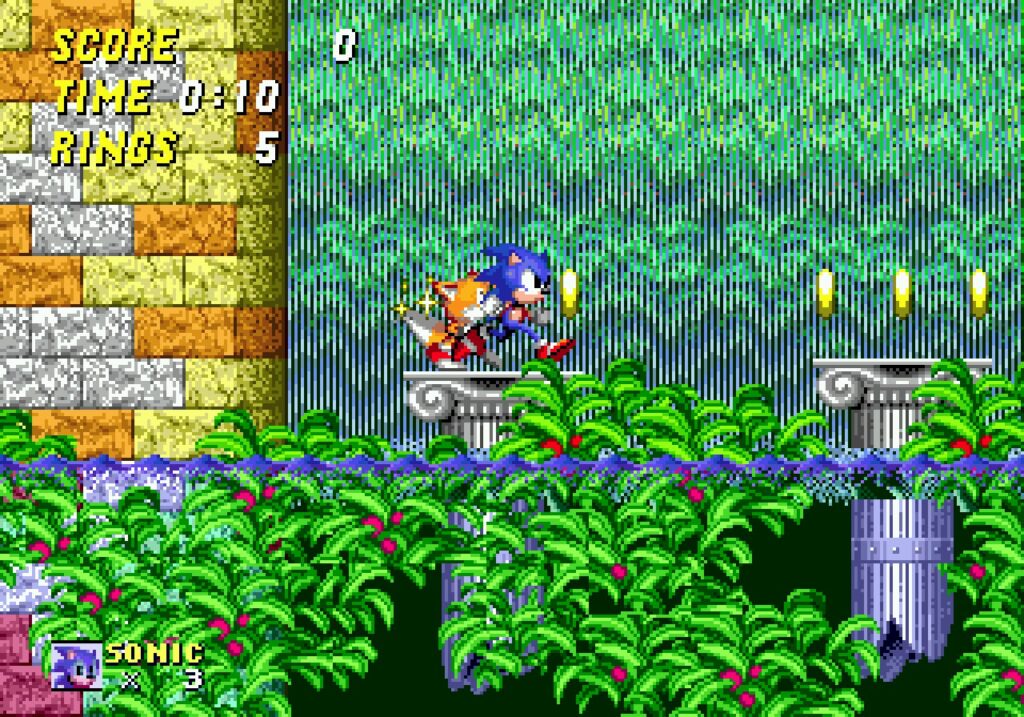
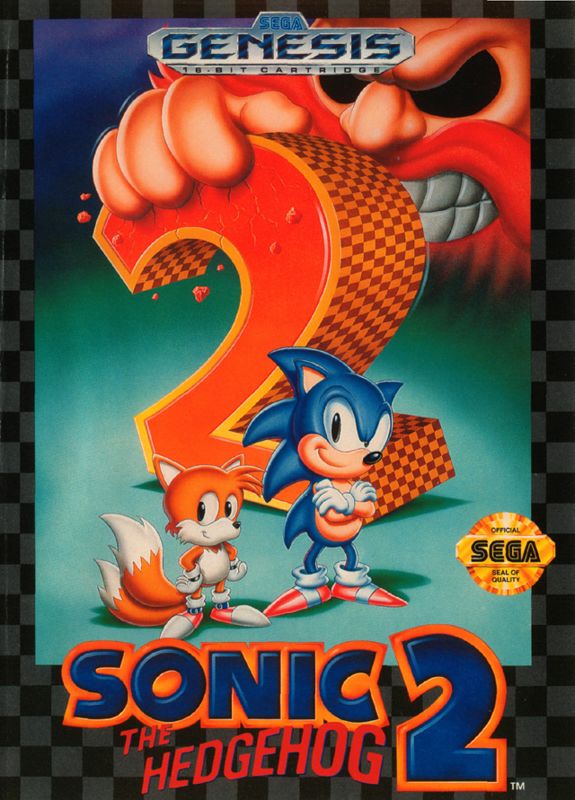
At a glance — Game: Sonic the Hedgehog 2 · Developer: Sega Technical Institute · Publisher: Sega · Original release: November 21, 1992 (Japan; North America and Europe November 24, 1992) · Original platforms: Sega Genesis · Genre: Platform · Music: Masato Nakamura
Three planes landed at Heathrow carrying copies of the game, with fifty people in Sonic costumes waiting on the tarmac. Sega did not just release Sonic the Hedgehog 2 — it air-freighted it, so that shops across the West could all put it on sale on the same Tuesday. That Tuesday, November 24, 1992, got its own name: Sonic 2sday. Japan had actually gone first, three days earlier on November 21, which is the date this anniversary hangs on. Thirty-four years later the stunt is easy to smile at, but the game underneath it earned every bit of the noise. Sonic 2 is the sequel that took a fast hedgehog and made him faster. It gave him a friend, a spin dash, a Death Egg to climb to — and turned a mascot into a franchise.
A sequel Sega nearly did not make
The strangest thing about Sonic the Hedgehog 2 is that Sega of America initially did not want it. The first Sonic had transformed the Genesis in North America and taken Sega to roughly 65 per cent market share against Nintendo. Yet when Mark Cerny — founder of the California-based Sega Technical Institute — pitched the sequel in September 1991 as the studio’s Christmas 1992 project, Sega of America thought it too soon, and was still not fully confident in the character. STI spent two months exploring other ideas. Then Sega reversed course in November and announced it needed Sonic 2 for the 1992 holidays after all. The lost months mattered. Full-scale development only began in early 1992, leaving a team built around programmer Yuji Naka and designer Hirokazu Yasuhara — both lured from Japan to California — about nine months to outdo one of the biggest games in the world.
The setup was Cerny’s experiment: an elite studio mixing Japanese and American developers. In practice the mix was friction. The Japanese staff were used to crunching through the night and sleeping in cubicles; the American offices were locked at night. The language barrier made the intended mentoring relationship hard work. Cerny himself left partway through, and when the cuts came — and they came heavily — most of what was removed was American work. That the game coheres at all is remarkable. That it coheres into this is close to a miracle.
Faster, bigger, and with a fox in tow
Yasuhara’s ambitions ran far beyond what nine months allowed. His early outline had Robotnik conquering the world and Sonic time-travelling to stop him, with a world map that changed across eras. Hill Top Zone survives as a fossil of the idea — a past version of Green Hill — while Chemical Plant and Casino Night were drawn from the Robotnik-ruled future. The time travel went, but the scale stayed: eleven zones and twenty acts, most zones finishing in two acts instead of the first game’s three, and everything built bigger. The speed cap that had quietly held Sonic back in the first game was lifted outright. And Naka’s spin dash — curl up while standing still, rev, and launch — abolished the old ritual of backing up to build momentum. It is the single most imitated move in the series, and it exists because players of the first game kept complaining, correctly, that a game about speed made them walk backwards.
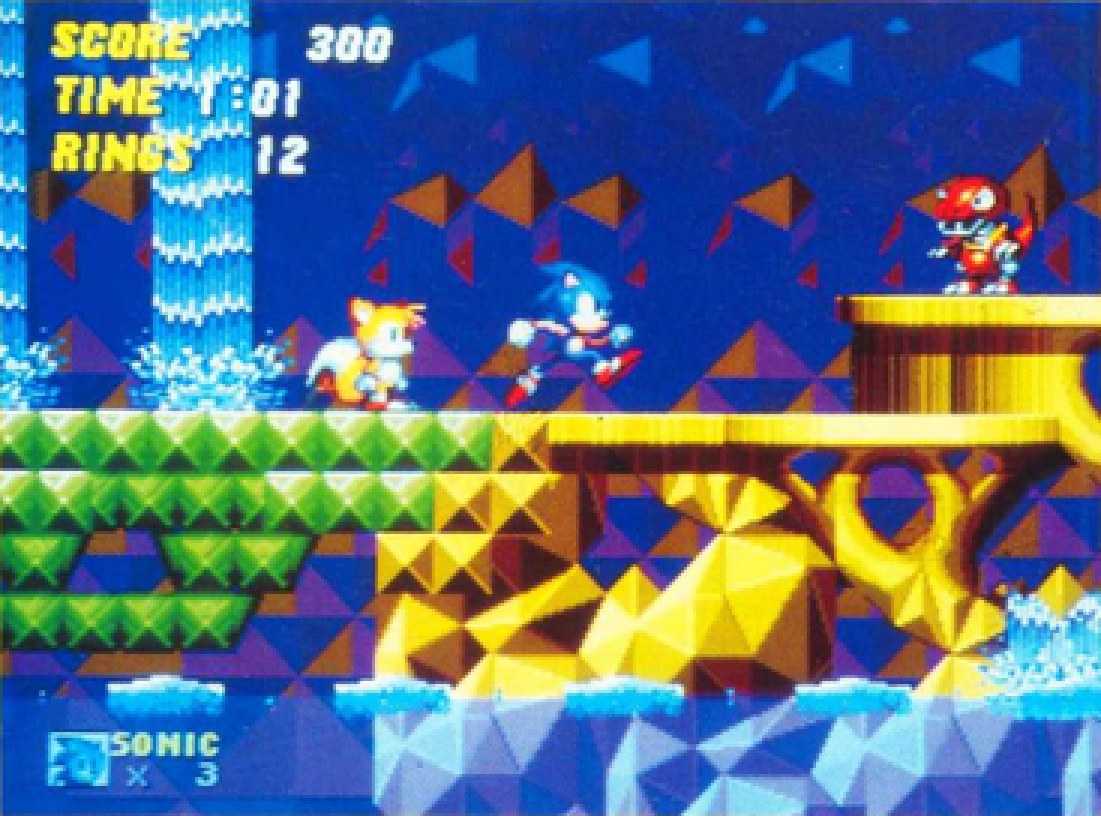
Then there is Tails. Yasuhara wanted a second character so siblings could play together. Naka wanted someone endearing and beginner-friendly rather than a rival. An internal contest produced Yasushi Yamaguchi’s two-tailed fox, named Miles Prower — miles per hour — until Sega of America pushed for the nickname “Tails” and a compromise put both names on the box copy. In play he is Sonic’s shadow, run by a simple routine that mimics your movements, and a second player can grab a controller at any moment and take him over. Sonic the Hedgehog 2 also spends him wisely in its other headline feature: a split-screen multiplayer race, built on the Genesis’s rarely used interlaced mode, which took six months of the schedule on its own.
The half-pipe, the Emeralds and the palace that vanished
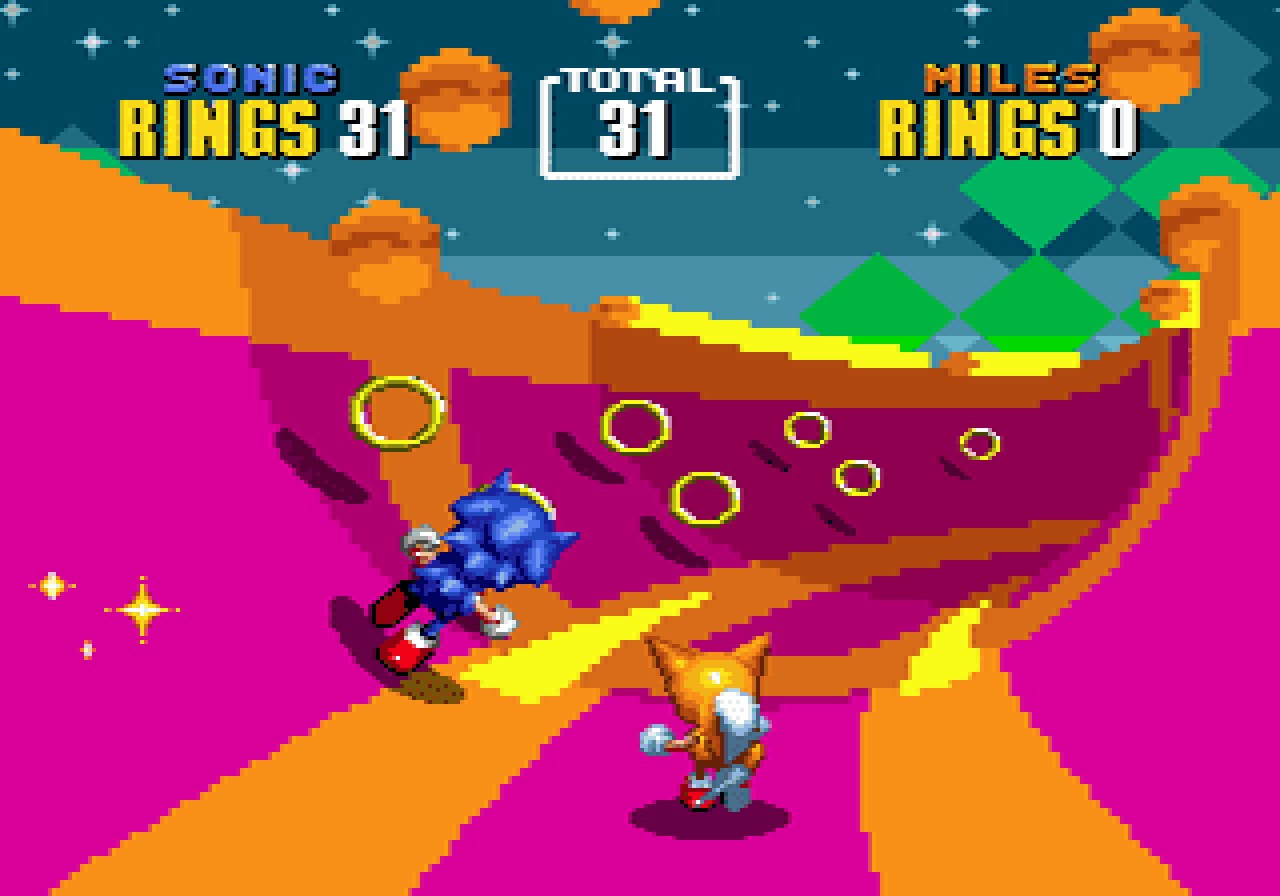
The special stages are where Sonic 2 shows off. Pass a checkpoint holding fifty rings and you are dropped into a pseudo-3D half-pipe — pre-rendered polygons, compressed and squeezed into the cartridge — chasing ring quotas and dodging bombs for a Chaos Emerald. Collect all seven and Sonic turns into Super Sonic: faster, higher, nearly invincible, and burning a ring a second for the privilege. It is a risk-reward loop the series has reused ever since, and in 1992 it looked like the Genesis was doing something it plainly should not have been able to do.
What players never saw was Hidden Palace Zone. Planned as the secret stage that would explain the Chaos Emeralds and grant Sonic his super form, it appeared in prerelease advertising and was one of the first levels built — and was cut shortly before completion for want of time and cartridge space, alongside a forest level and a desert level. The cartridge itself nearly sank the schedule. The team planned on the same 4-megabit size as the first game, ran out of room, and only a last-minute appeal up the Sega chain doubled the ROM so the game could make Thanksgiving. Sonic 2 was not playable from start to finish until the final 48 hours of development. The lost palace became legend anyway: prototypes leaked from 1999 onward fed a whole datamining community, and the stage was finally restored in the 2013 mobile remake, twenty-one years late.
Sonic 2sday and the $450 million winter
Sega spent roughly $10 million marketing the game, and spent it theatrically: teaser posters asking “Are You Up 2 It?”, countdown boards in stores, preorder T-shirts, and the synchronised Western launch on Tuesday, November 24 — Sonic 2sday — achieved by reconfiguring distribution around air freight so every major store could sell it the same day. Simultaneous launches are routine now. In 1992 they were a logistical flex. And it worked: the game sold 400,000 copies in its first week in the US and 750,000 in the UK — at the time the fastest-selling game in British history, taking 48 per cent of all UK software sales that week. It grossed over $450 million in 1992 and had sold six million copies by 2006, second only to the original Sonic among Genesis games. Critics handed it year-end awards, including two Golden Joystick Awards, and mostly agreed it improved on the first game in every department except difficulty.
Masato Nakamura’s soundtrack deserves its own line in that success. The Dreams Come True musician composed the score early, working from concept art alone and treating the game like a film, simultaneously writing his band’s album The Swinging Star — whose closing track, “Sweet Sweet Sweet”, is an alternate version of the game’s ending theme he made as a gift to the developers. Sega of America had briefly tried replacing him with in-house music, heard the result, and rehired him at his new, considerably higher price. It was money well spent. Chemical Plant’s bassline alone has carried the game through three decades of re-releases.
Why Sonic the Hedgehog 2 at 34 still sets the template
Every Sonic game since has been measured against this one, and most of them know it. The spin dash. The two-tailed sidekick. The seven Emeralds, the super form, the Death Egg finale, the two-act zone structure. The series’ grammar was written here, in nine months, by a divided studio that finished the game two days before it had to ship and sent the code to Japan on separate planes in case one crashed. Sonic the Hedgehog 2 has never been out of circulation since: compilations, emulation, the 2013 remake, Sonic Origins in 2022. At 34 it remains the argument that a sequel does not have to be safer than the original. It can be the original, with the speed limiter removed.
— Chip
For more launches from this date, see This Day in Gaming History: November 21. More from this system: our Genesis hub.