
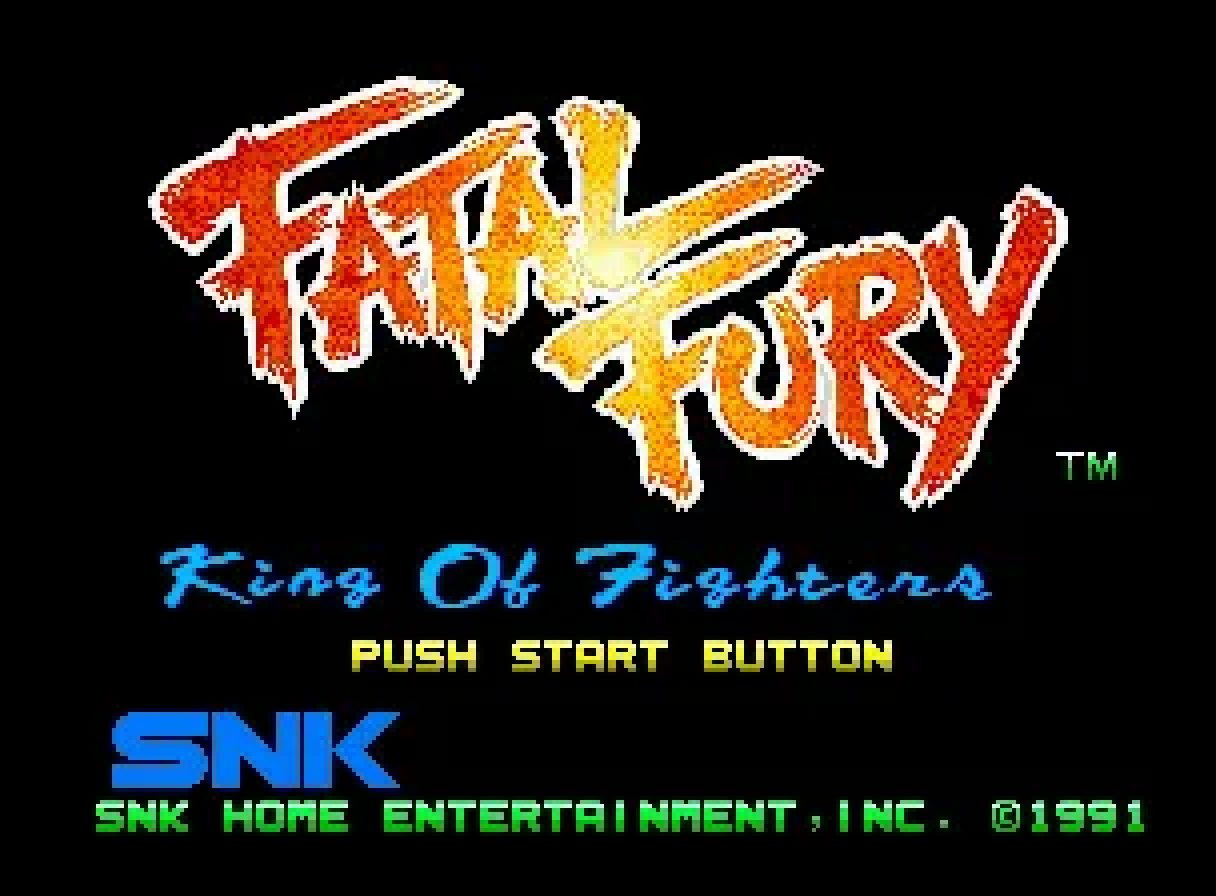
At a glance — Game: Fatal Fury: King of Fighters · Developer: SNK · Publisher: SNK · Original release: November 25, 1991 · Original platforms: Arcade (Neo Geo MVS), Neo Geo AES · Genre: Fighting
Every fighting-game family tree has a root system, and most of them run through South Town. Before The King of Fighters was a series, it was a tournament — one crooked tournament, in one crooked city, run by the man who murdered Jeff Bogard. Fatal Fury 1991 is where Terry Bogard first pulled his cap down and went looking for Geese Howard, and thirty-five years on, with the series back in the spotlight again, it is worth going back to the first bell and remembering what this game actually was: not the biggest fighter of 1991, but the one with a story it insisted you care about.
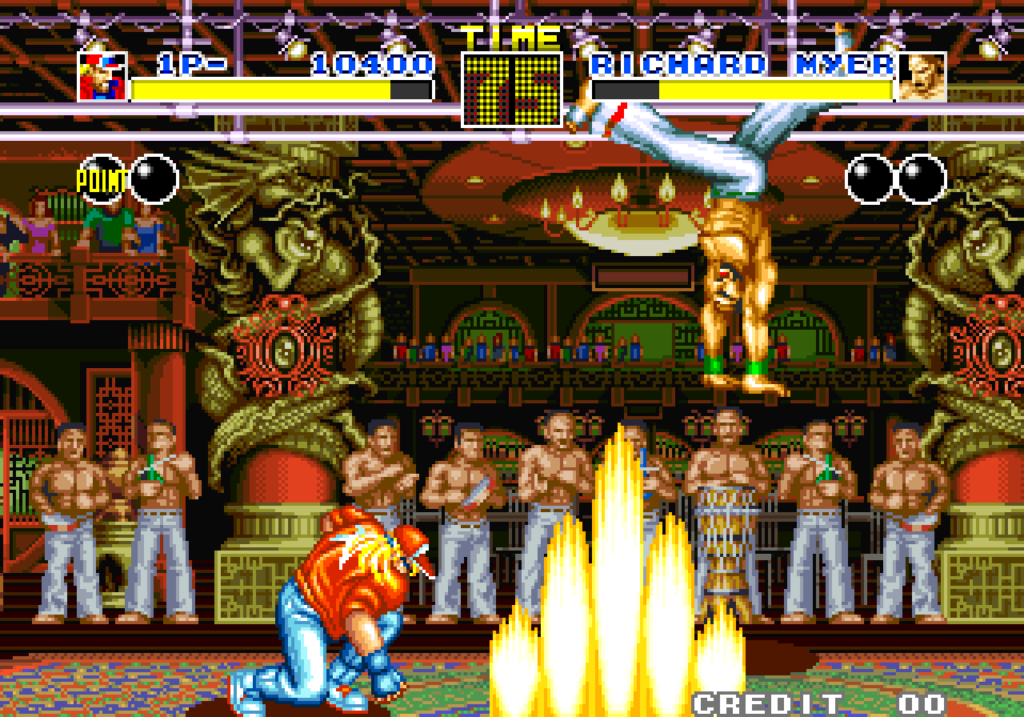
I still remember the first time I saw the cabinet. The sprites were enormous — that was the Neo Geo flex, arcade-perfect at a time when home ports were apologies — but what stuck wasn’t the size. It was the attitude. This wasn’t a world tournament of national stereotypes. It was a revenge story with a bracket attached.
Fatal Fury 1991: a revenge story first, a fighter second
The setup is pure pulp, and it works because the game never winks at it. Ten years before the opening round, Geese Howard — South Town’s crime boss, a man who runs the city the way other men run a tab — murdered martial artist Jeff Bogard for trying to expose his crimes. Jeff’s adopted sons swore an oath: train for ten years, then come back. Terry Bogard spent the decade wandering America, fighting anyone who’d teach him something. His younger brother Andy went to Japan and learned Koppōjutsu and Shiranui-ryū ninjutsu. When Geese announces his King of Fighters tournament, the brothers reunite, pick up Muay Thai champion Joe Higashi along the way, and enter — not for the prize money, but because the bracket is the only road to Geese that doesn’t end at a locked door.
That framing was director Takashi Nishiyama’s whole point. Nishiyama had created the original Street Fighter at Capcom in 1987, then moved to SNK, and he built Fatal Fury as the game he’d wanted to make all along — a fighter where the characters had reasons. He called it “my Street Fighter II,” and Terry himself began life as a scrapped Street Fighter concept: a Caucasian man in a leather jacket who traded the jacket for a cap and a vest and became SNK’s mascot for a generation.
The roster: three heroes, eight problems
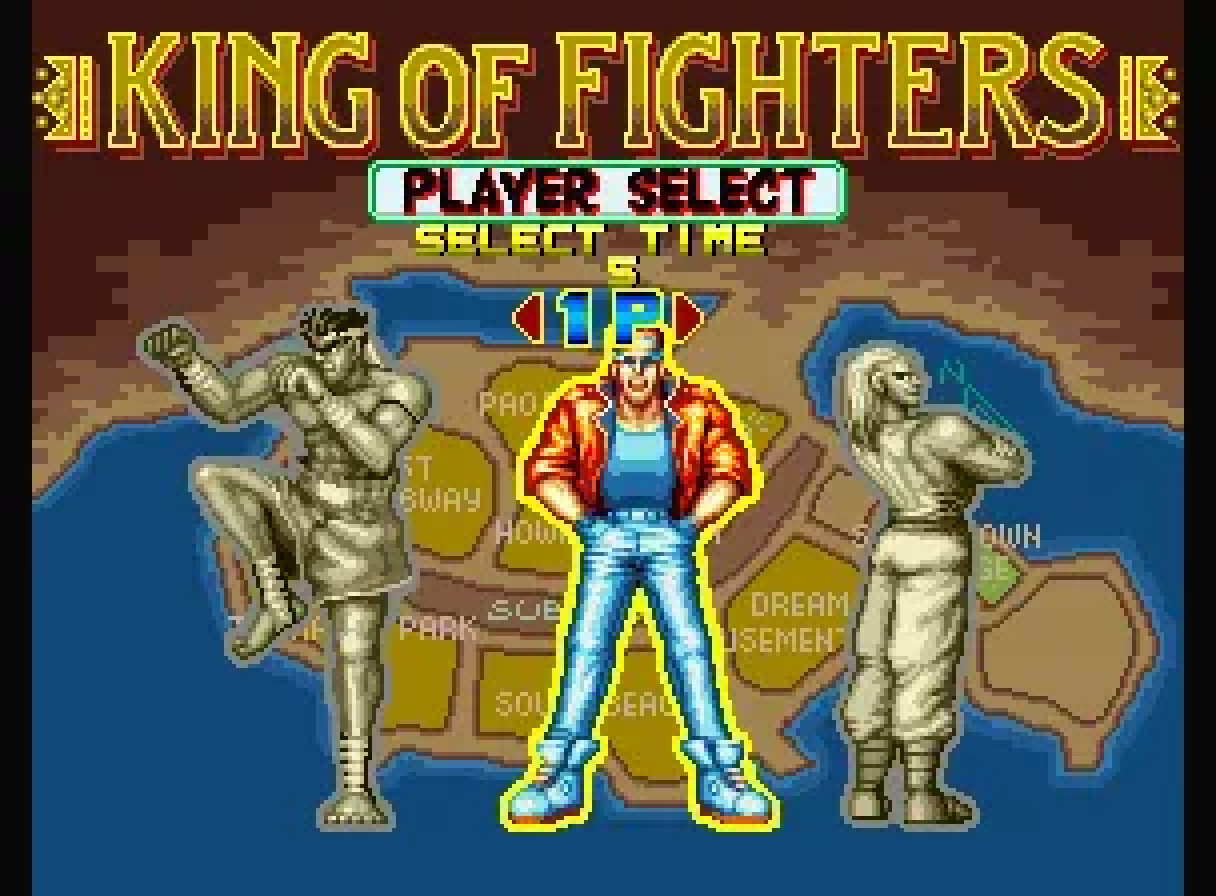
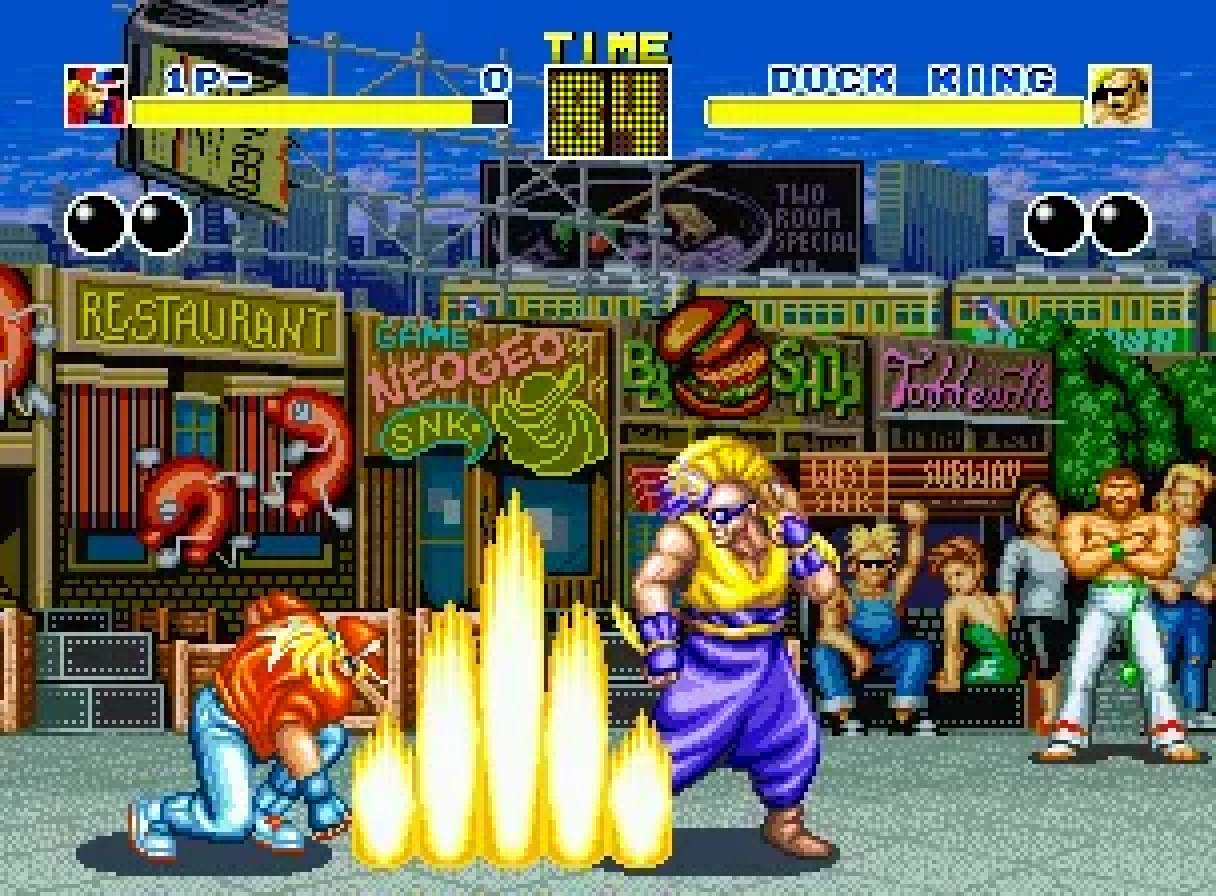
Here’s the thing modern players trip over first: you can only pick three fighters. Terry, Andy, or Joe. That’s the roster — for you. The other eight are the mountain. First come the challengers: Richard Meyer, the Brazilian capoeira master (the first capoeira fighter in the genre’s history); Michael Max, a boxer with a Tornado Upper and no interest in your feelings; Duck King, a street dancer who fights in rhythm and makes it look easy; and Tung Fu Rue, the elderly Bajiquan master who taught the Bogard brothers and who, once he’s taken enough damage, transforms into a musclebound giant — still one of the great visual gags of the era, except he’s not joking.
Then the sub-bosses, in fixed order: Hwa Jai, the Muay Thai fighter who drinks something unnamed and gets considerably worse to be around; Raiden, the heel wrestler with his Vapor Breath; and Billy Kane, Geese’s right hand, a bōjutsu master who holds the tournament’s undefeated championship. Beat Billy and your fighter gets kidnapped to Geese Tower for the final nobody sanctioned — Geese himself, all aikido counters and Reppuken projectiles, waiting at the top of his own building. Win, and he goes off the tower. Lose, and you do. For 1991, that’s not a boss fight, that’s a finale.
Two planes, one brilliant idea
Fatal Fury’s signature mechanic is the one nobody else was doing: many stages have two lanes, a foreground and a background, and fighters hop between them. It sounds like a gimmick until Duck King is dancing in the back row and you’re whiffing punches at the air he used to occupy. In versus play either fighter can switch lanes at will; in the single-player game you generally have to wait for the CPU to move first, which turns every lane change into a little negotiation. The system would evolve across the series — the Real Bout games refined it into the sway system — and our Real Bout Fatal Fury Neo Geo CD review covers where it ended up. Garou: Mark of the Wolves eventually dropped it entirely, but in 1991 it was a genuine second dimension in a genre that was still mostly fighting on a tightrope.
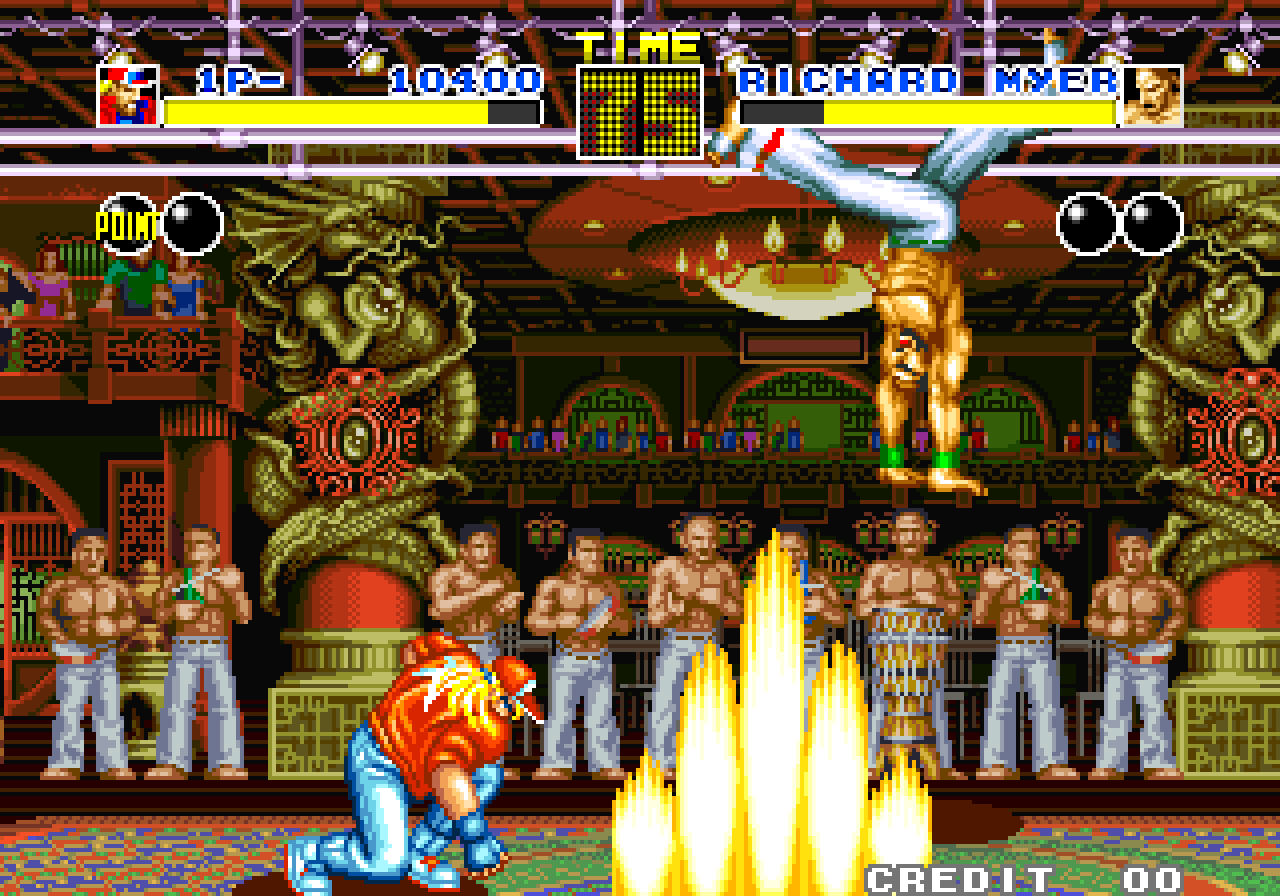
And then there’s the co-op twist, the one I wish every fighter had stolen: if a second player joins mid-match in a one-player game, you don’t immediately fight each other. You both team up on the CPU opponent, two-on-one, and only settle your own score afterwards. Add the arm-wrestling bonus rounds between tournament matches — mash, suffer, repeat — and you have a game that kept finding ways to make the arcade social. Three buttons (punch, kick, throw), best two of three, special moves taught in-game after the bonus rounds instead of printed on a cabinet card. It trusted you to learn by playing.
It did not beat Street Fighter II, and it never had to
Let’s get the chronology straight, because the mythology gets it wrong. Street Fighter II launched in Japanese arcades on February 6, 1991. Fatal Fury followed on November 25, 1991 — nine and a half months later. Nishiyama knew it, too: when Fatal Fury released, he said, Street Fighter II “was already very popular.” Fatal Fury was developed in parallel as his answer, not as a pre-emptive strike, and the honest comparison flatters both games. Capcom’s was the better pure fighting machine in 1991. SNK’s was the one building a world.
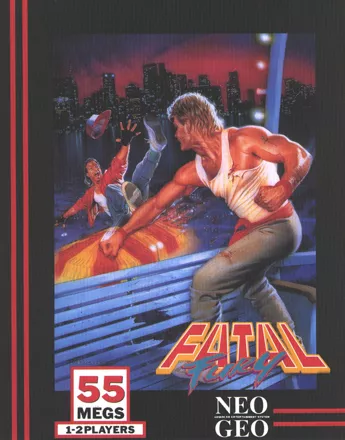
The contemporary receipts back the game up on its own terms. Computer and Video Games gave the Neo Geo version 94%, praising the huge sprites and animation; GamePro scored it 5/5. In Japan it was the third most successful table arcade unit of December 1991 and finished as the country’s fourth highest-grossing arcade game of 1992 — behind the two Street Fighter II versions and Captain Commando, which is not bad company. RePlay had it as North America’s second most popular arcade game in February 1992. The home version followed on December 20, 1991, arcade-identical on a 55-meg cartridge — the Neo Geo promise in its purest form, at a Neo Geo price, which is why most of us met it in the arcade or not at all.
The ports tell their own story about what made the original special: the SNES version (Takara, 1992–93) dropped the two-lane system and the two-on-one battles entirely, and the Genesis version cut Hwa Jai and Billy Kane as fighters. The thing that made Fatal Fury itself was the first thing the 16-bit ports couldn’t hold. If you play it today, play the Neo Geo original — the ACA Neo Geo line has it on everything — and play it on the Neo Geo terms it was built on.
The King of Fighters before The King of Fighters
The legacy is almost absurd for a game with three playable characters. Fatal Fury 2 arrived a year later with Mai Shiranui and Kim Kaphwan; Special, Fatal Fury 3 and the Real Bout games followed; Garou: Mark of the Wolves closed the century in 1999 with Geese’s son Rock Howard in the lead. The anime came fast — two TV specials and the 1994 theatrical film. And the tournament name Geese Howard invented for his rigged bracket became, in 1994, The King of Fighters, the crossover series that would carry SNK for decades. This month the wheel turns again: a villain created for that 1994 film joins City of the Wolves, the series’ modern revival — a piece of South Town history folding back into the games after thirty-two years.
Fatal Fury 1991 is not the best Fatal Fury. It’s not even the best fighter of its own year. But it is the first page of one of fighting games’ great sagas — the night Terry, Andy and Joe walked into Geese’s tournament with a ten-year-old promise to keep. Everything South Town became starts here, two lanes deep, with the biggest sprites in the arcade and a story that refused to be set dressing. That’s worth a quarter, then and now.
— Sal
For more launches from this date, see This Day in Gaming History: November 25. More from this system: our Neo Geo hub.