
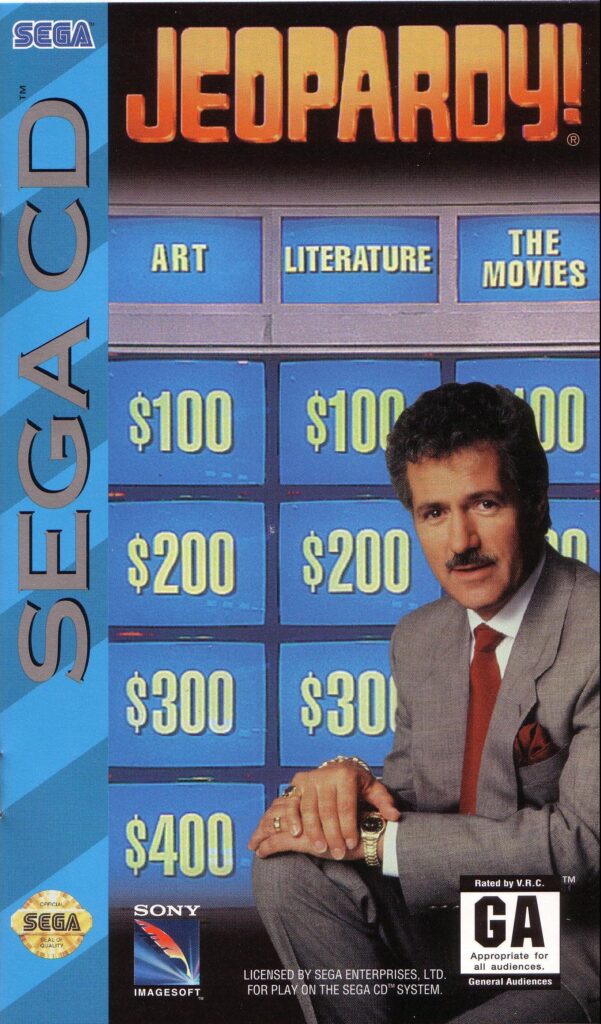
At a glance: Jeopardy! · Sega CD · developed by Absolute Entertainment · published by Sony Imagesoft · November 1994 (US) · TV quiz show · about forty-five minutes to an hour per game · 1–3 players
Some licences ask a game to invent almost everything; this one asks for the opposite. Jeopardy! on television is a fixed ritual — six categories, five values each, responses phrased as questions, a host keeping order — and a home version succeeds simply by reproducing that ritual without breaking it. Cartridge editions had been doing a respectable job for years, so the Sega CD version, handled by Sony Imagesoft itself rather than GameTek, needed a reason to exist. Its reasons were the compact disc’s storage, a modest amount of video, and the real Alex Trebek. It makes good use of the first, partial use of the other two, and ends up as perhaps the most faithful console Jeopardy! of its era — faithful, unfortunately, in its difficulty as well as its format.
The Show, Transcribed
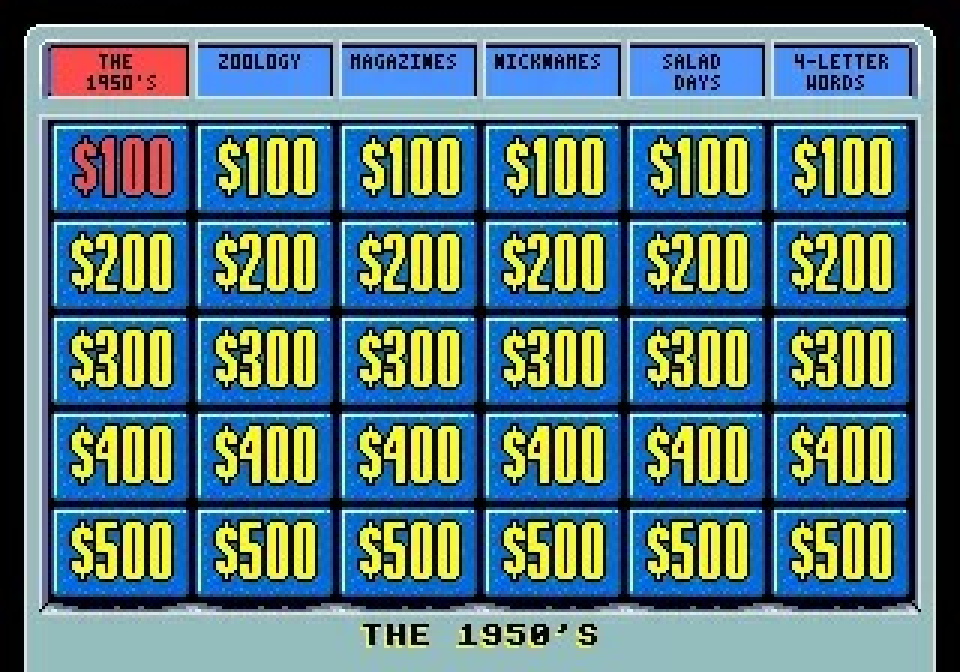
A game follows the broadcast structure to the letter. You choose and name one of a small cast of video contestants, then play the opening round, Double Jeopardy! with its doubled values, the hidden Daily Doubles, and Final Jeopardy!, typing every response letter by letter on an on-screen keyboard. Up to three people can play, with computer opponents filling empty podiums, and the machine handles the bookkeeping throughout. Two small mercies inherited from earlier versions deserve mentioning: a short pause after each clue appears gives everyone a fair chance to read it before buzzing, and the timers are generous — fifteen seconds to ring in, a full minute to spell out a response. Spelling, though, is enforced strictly. The television show forgives a mangled pronunciation; this game will not forgive a mangled letter, and long formal titles must be typed in full, without shortcuts. The minute you are given starts to feel less generous halfway through some of them.
The disc’s capacity is the headline improvement, and it is a real one. Where cartridge players learned to recognise repeat clues within a few sessions, the CD holds a far larger bank, drawn mostly from history, geography, literature and science, and repeat encounters stay rare for much longer. Just as clever is what the game does with the console’s internal memory. Progress through a match is saved automatically, question by question, across three slots — walk away mid-round, or lose power entirely, and the game resumes where you left it. A returning champion’s identity and lifetime winnings persist too, so a household rivalry can run across weeks with the title properly defended. Plenty of later quiz games failed to bother with courtesies this sensible.
Alex Is in the Building, Briefly
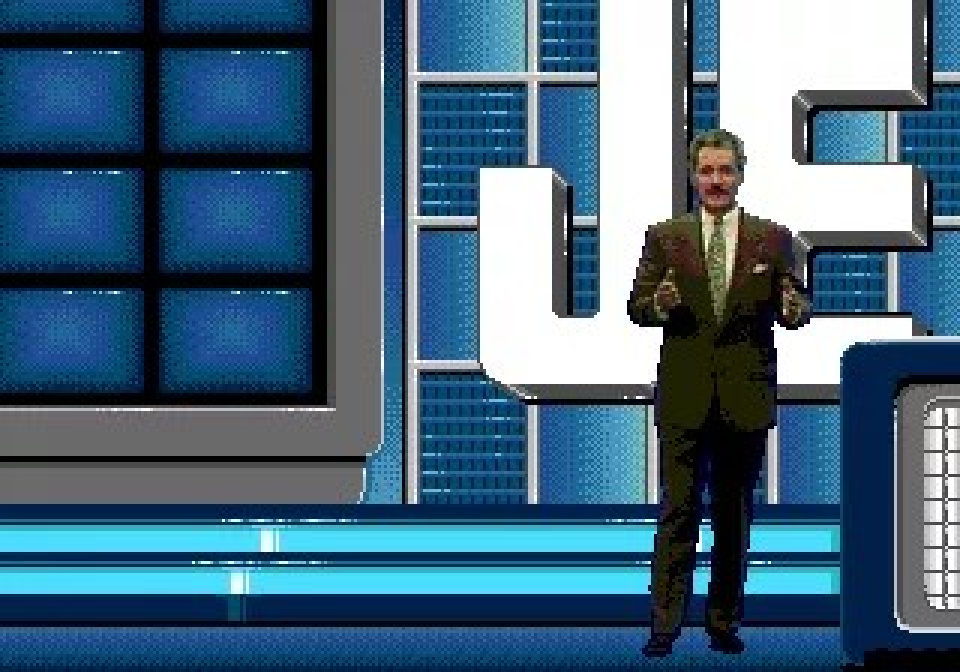
Trebek’s presence was the selling point, and it is genuine but thin. He appears in video to open proceedings, to frame clues with a generic lead-in, and to deliver a rotating set of confirmations and condolences. He does not read the clues. He does not announce the categories. Announcer Johnny Gilbert is absent from the introduction altogether. What you get is closer to a Trebek sample pack than a hosted show, and while his delivery still lends the thing an authority no imitator could, the gap between the box’s implication and the disc’s reality is the game’s most obvious disappointment. The contestants are a similar story: real actors, filmed smiling and reacting, but silent — their mouths move, no voices come out — and the selection is small enough that your representative will be somebody else’s representative in the next game too. Their celebration and despair clips repeat after nearly every clue, mercifully brief, unavoidably familiar.
Around those centrepieces, the audio is authentic where it counts. The theme, the Daily Double sting and the time-expired tones are lifted straight from the broadcast and sound exactly right, because there was never any reason for them not to. Visually the set is drawn rather than photographed, in the show’s own blues, and it holds up well; the video laid over it carries the format’s usual grain and crushed shadows, worst in the contestants’ dark suits, but nothing here depends on the video being beautiful. This is a game you read, mostly, in long stretches of companionable silence.
“The most faithful Jeopardy! of its generation — including the part where the questions are pitched at people considerably cleverer than you.”
A Quiz That Assumes You Read Encyclopaedias
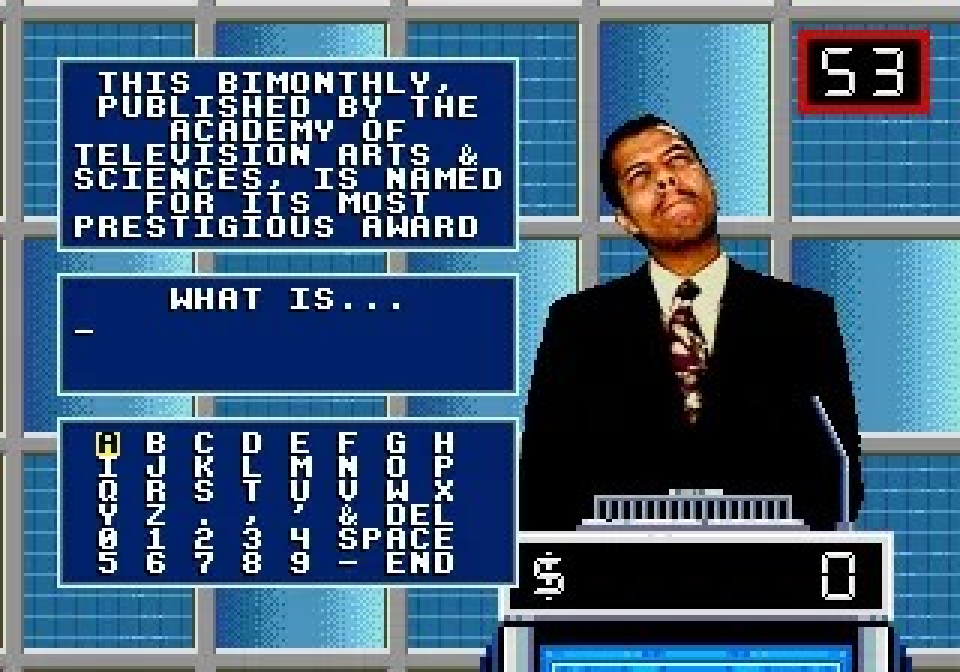
And so to the difficulty, which is the thing everybody who played this version remembers. These clues come from the show’s sterner years, when even a mid-board value expected real knowledge rather than recognition. Pop culture barely troubles the board. Instead you are asked for the sculptor of the Concord minuteman statue, the country containing the mountain where Moses is said to have died, the founder of a Norwegian music academy in 1876 — the kind of material that rewards a house full of reference books and punishes everyone else with great consistency. It is not that the clues are unfair, or dated into trickery; most are timeless, in the worst way. It is that the game makes no concession at all: no difficulty setting softens the bank, no multiple choice offers a foothold, and the computer opponents know a dispiriting amount.
The pace suffers for the same reasons the authenticity shines. A full board must be cleared, every clue played, and with generous timers plus reaction clips after each one, a complete game settles in at three-quarters of an hour or more. Against two human rivals, passing the pad and arguing, that is an evening well spent. Against the computer, waiting out its turns category by category, the show’s famous snap drains away. This was always the format’s problem at home, and the CD does nothing new to solve it — it simply gives you a much bigger, much harder pile of the same excellent problem.
It is worth saying plainly who this version served best: households where the television show was appointment viewing and the audience overlapped with its writers. Trivia-game design usually fails by being too shallow; this fails, when it fails, by assuming a living room full of people who treat the encyclopaedia as light reading. There is no shame in admiring that ambition from a respectful distance, and a great deal of pleasure in finally being asked a question about Soviet space dogs that you actually know.
The Verdict
As a reproduction of a television institution, this is careful, generous work: the structure is exact, the question bank dwarfs the cartridge editions, the automatic saving is genuinely thoughtful, and the sounds of the show are all where they belong. As a demonstration of what CD multimedia might add to a quiz, it is timid — a host who never reads a clue, Daily Doubles with no audio or video component, contestants who mime their delight. And as a game for the merely quite-knowledgeable, it is a stern evening indeed.
None of which stops it being the version a Jeopardy! household should have owned in 1994. It respects the show, it respects the format, and if it does not always respect your ego, well — neither did the programme.
Verdict: the real quiz, faithfully transcribed and formidably hard — 6.5, with the disc’s huge clue bank doing the heavy lifting.
Keep reading: the Sega CD system archive