
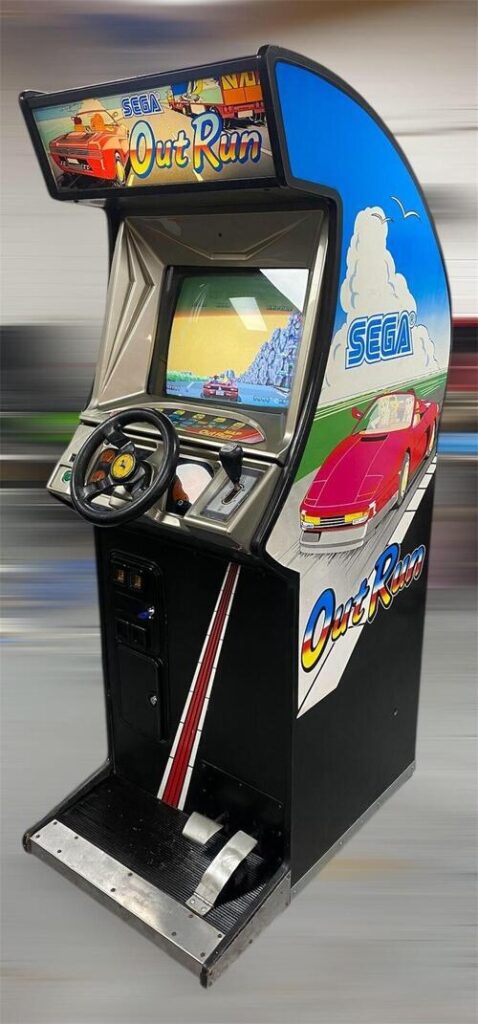
Of all the game-to-film announcements of the last decade, one pairing stopped the retro community mid-scroll: Universal Pictures is developing a film of Out Run, Sega’s 1986 arcade driving masterpiece, with Michael Bay producing and directing and Sydney Sweeney producing and attached to star, from a screenplay by Jayson Rothwell. Announced in April 2025, the project is the strangest and, on reflection, maybe the most fitting adaptation imaginable — because Out Run was never really about racing. It was about the feeling of driving beautifully, somewhere sunny, with someone beside you and the perfect song on the radio. If any director’s visual language was built for that brief, it is the man who made an art form of golden-hour horsepower.
What Out Run actually is
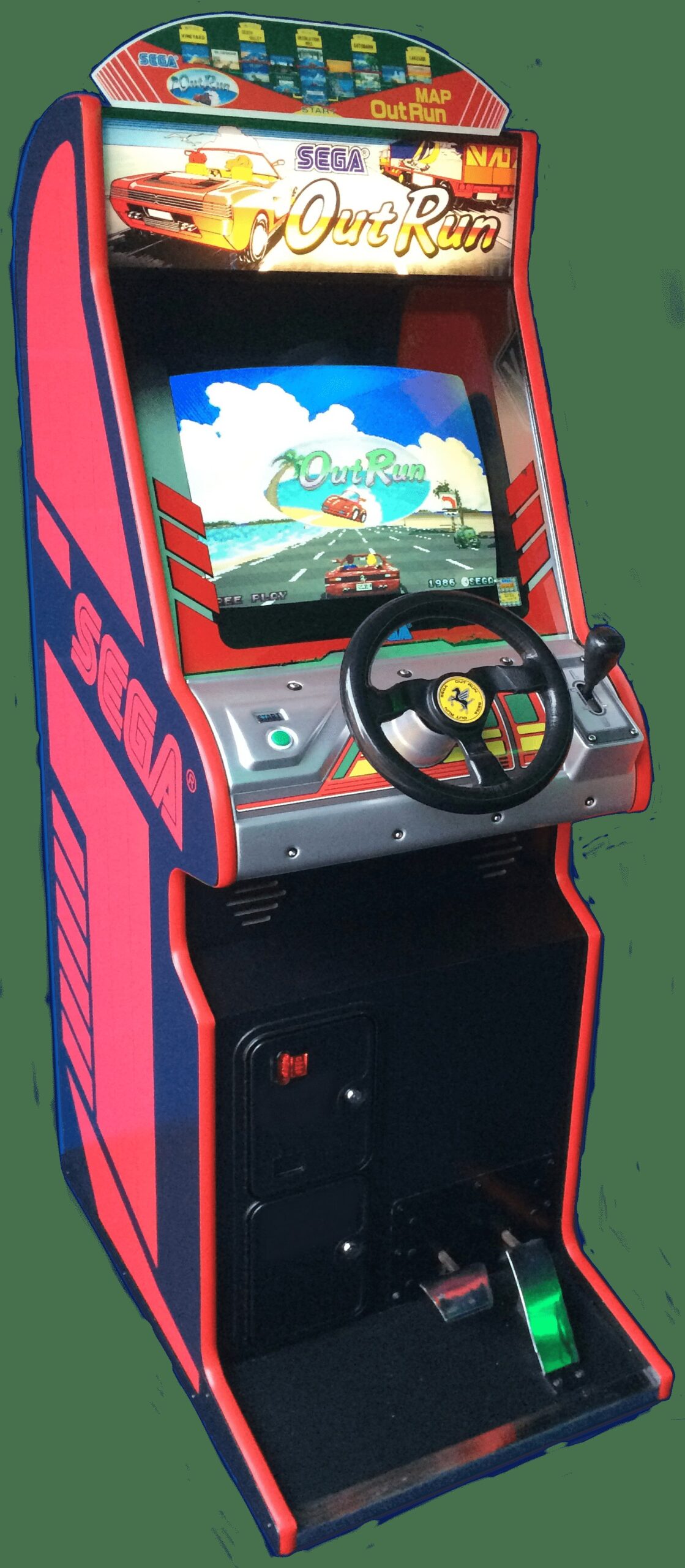
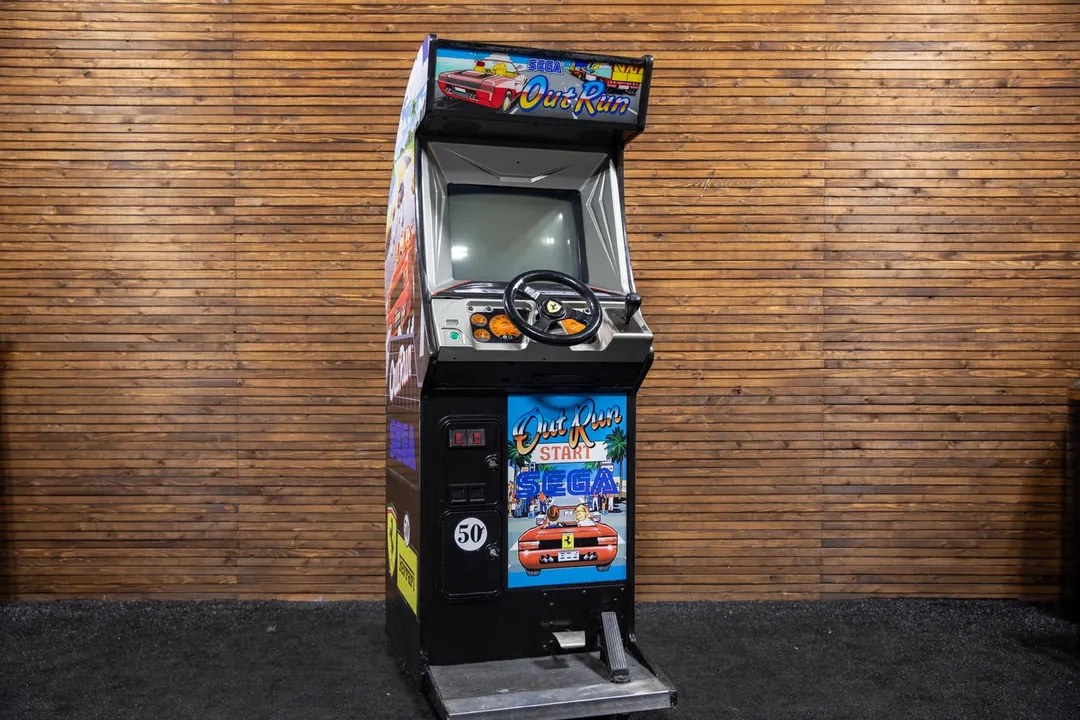
To understand the announcement you have to understand the game Yu Suzuki and Sega AM2 released in 1986. Out Run put you in a red convertible — modelled in spirit on a Ferrari Testarossa Spider — with a passenger at your side, and replaced the stopwatch tyranny of earlier racers with a branching journey across a sun-drenched, fictionalised landscape. Reach a checkpoint, choose left for an easier route or right for a harder one, and see one of five endings. The genius was tonal. Hiroshi Kawaguchi’s soundtrack, selectable from the car radio before you set off — Magical Sound Shower, Passing Breeze, Splash Wave — made the game a mood as much as a challenge. Its sit-down deluxe cabinet, which tilted and shook with the road, was the arcade’s definitive luxury object. Out Run was not a simulation. It was a holiday you could drive.
Why Bay and Sweeney make a weird kind of sense
Michael Bay’s filmography is, whatever else one thinks of it, a decades-long study in photographing beautiful machines at speed in beautiful light. The Transformers films, for all their chaos, are car commercials raised to opera. Out Run needs exactly that eye and very little plot machinery: a journey, a couple, a landscape, an escalating series of roads. Sydney Sweeney’s involvement is the other half of the logic — she is a genuine car enthusiast who restores classic cars and documents the work, which gives the project something adaptations usually lack: a star who personally cares about the machine at its centre. Sega, for its part, arrives with momentum. After the Sonic films proved its catalogue could anchor blockbusters, the company has been systematically developing its library for the screen, with Out Run among the most prestigious properties it owns and Like a Dragon already adapted for television.
What a good Out Run film would look like
The game’s structure is more filmable than it first appears. The branching map is a road-movie skeleton: five stages, five landscapes, a choice at every fork between the easy road and the beautiful one. The passenger — the unnamed woman who rides beside the driver in the game, reacting to every near miss — is a ready-made second lead and the obvious role at the story’s heart. The soundtrack is non-negotiable; a film that licenses or lovingly recreates Kawaguchi’s three radio tracks will win the audience that matters in the first trailer. And the ending structure is a gift: Out Run famously ends not in triumph alone but in five different fates, from champagne to comic disaster, depending on your road. A confident film could nod to all of them.
The risks are equally legible. An adaptation that mistakes Out Run for a generic street-racing property, loads it with plot, or buries the journey under franchise scaffolding would miss the entire point of the source. The game’s narrative content is close to zero by design; its emotional content is enormous. The film will live or die on whether it trusts the mood.
Sega’s screen strategy, and where Out Run fits
The announcement did not arrive in isolation. Sega has spent the years since the first Sonic film’s success building a deliberate transmedia strategy around its catalogue, mining precisely the properties whose names carry generational recognition. Shinobi, Streets of Rage, Crazy Taxi and others have all been reported in development for screens large or small, alongside the games revival that put new entries for several of those series into production simultaneously. Within that slate, Out Run occupies an unusual position: it is the prestige object, the one whose value is aesthetic rather than narrative, and its casting of a major director and a rising star signals that Sega and Universal regard it as an event film rather than a catalogue filler. That ambition cuts both ways — event films get budgets, marketing and creative freedom, and they also get expectations that a modest adaptation would never face.
There is a pleasing symmetry available to the production, if it chooses to take it. The game was itself Sega’s love letter to an idealised, cinematic version of the open road — Suzuki has spoken of drawing inspiration from films of cross-country driving. A film that returns the compliment, translating the game’s pastel skies, branching geography and radio-driven mood back into cinema, would close a forty-year loop between the two media. Few adaptations get the chance to be that elegant. This one starts with the material for it, a star who wrenches on her own cars, and a director who has never once been accused of under-lighting a sunset. The rest is execution.
Play the original while Hollywood decides
Development timelines being what they are, the wisest response to the announcement is to treat it as an invitation to revisit the game, which has never been easier to play well. The Arcade Archives and Sega Ages lineages have kept Out Run in circulation on modern hardware, the 3DS conversion remains a small masterpiece of stereoscopic sunshine, and the arcade original anchors Sega collections across every platform. Played today, its fifteen-minute journeys and five endings feel startlingly contemporary — a game built from short, replayable, mood-first sessions, decades before the industry had language for that design. Notice, on your next run, how little it asks of you and how much it gives back: no upgrades, no unlocks, no narrative homework. Just a road, a radio and a passenger who believes in you. If the film captures even half of that contract with its audience, it will have justified every sceptical eyebrow the announcement raised.
The road ahead
As of writing, the film remains in development, with no release date announced — the normal, long gestation of a studio production, and a status worth stating plainly rather than dressing up as news. But the announcement alone did something valuable: it sent a new generation to the game, which remains widely available in Sega’s modern collections and as a superb 3D Classics conversion. Watch the horizon for casting and production news. Meanwhile, the original is waiting, the radio still works, and Passing Breeze still sounds like the best decision you will make all day.
Postscript: the trailer test
Every game adaptation eventually faces the same examination, and it happens long before release: the first trailer, watched in silence by the faithful, who will decide in ninety seconds whether the production understands the assignment. For Out Run, the faithful will be listening before they are watching. Give them the opening bars of Magical Sound Shower over a red convertible at golden hour, a passenger laughing as the road forks toward the sea, and the internet will do the marketing department’s work for a year. Give them a gravel-voiced monologue about family and street racing, and no amount of horsepower will recover the room. The encouraging news is that everyone attached to this production has a documented relationship with the material’s spirit — a director who treats cars as cinema’s most expressive machines, a star who restores classics with her own hands, a publisher in Sega that has learned, across the Sonic films, to protect the feeling of its properties as fiercely as their plots. Development continues. The radio, as ever, is already tuned.