
In 1985, the American video game industry was not in decline. It was over. Retail sales had collapsed from $3.2 billion to roughly $100 million in two years; stores were landfilling cartridges; the trade press used the past tense. Into that graveyard, a Japanese playing-card company carried a grey plastic box it was forbidden to call a video game. The Nintendo Entertainment System did not merely revive the industry – it rewrote its constitution: how games were licensed, how quality was policed, how a platform holder rules. It sold some 62 million consoles, put Mario in the Macy’s parade, and built the template every platform since has either followed or rebelled against. This is the complete story of the resurrection machine.
The Corpse of an Industry
The crash of 1983 had causes stacked like cordwood: a flood of terrible cartridges sold by companies with no quality control and less shame; retailers burned by returns; home computers undercutting consoles; a public that concluded, reasonably, that the fad had passed. By 1985 the American trade had a settled conviction – video games were pet rocks with circuit boards. Toy buyers would not stock them. Department stores would not shelve them. This is the wall Nintendo’s American team, led by Minoru Arakawa, faced when it brought over the Famicom – already a phenomenon in Japan since 1983 – and tried to sell it as a toy. The Japanese design, red and white and cheerful, was replaced by a sober grey box that loaded cartridges like a VCR, designed by Lance Barr to look like anything but a game machine. Even the vocabulary was laundered: not a console but a Control Deck, not cartridges but Game Paks, not a system but an Entertainment System. Every word was camouflage against a single retail sentence: we don’t carry video games anymore.
The Trojan Horse: October 18, 1985
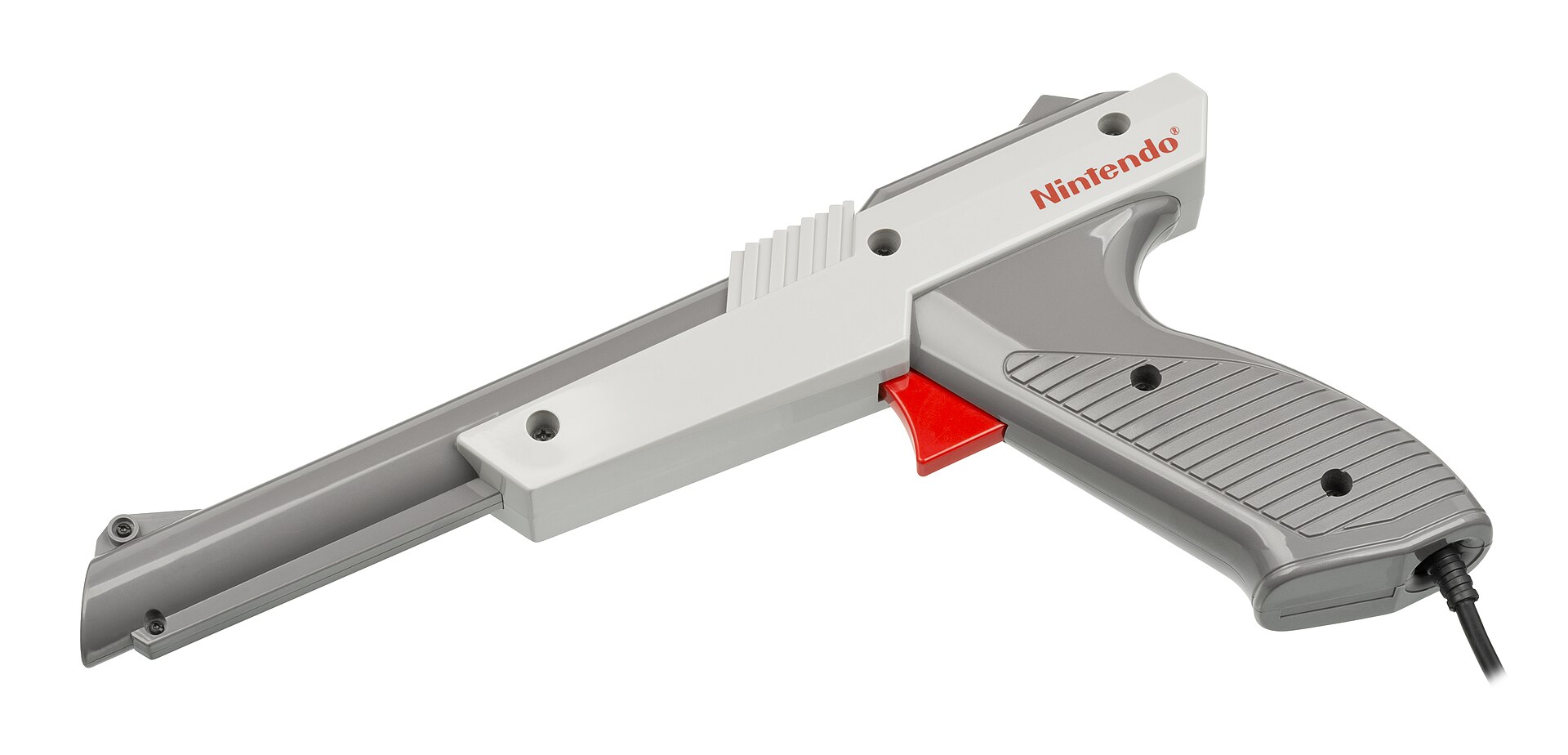
Nintendo tested the machine in New York City in the autumn of 1985, and the legend understates the grind. Sales representatives built displays by hand, staffed the kiosks, and guaranteed the stock – Nintendo famously offered retailers terms unheard of in the business, absorbing the risk itself because nobody else would carry it. The advance guard included two pieces of stagecraft: the Zapper, a light gun that made the system legible as a toy-store object, and R.O.B., the Robotic Operating Buddy, a slow, charming gyroscopic robot who played exactly two games and whose real function was to stand in the FAO Schwarz window looking like the future. He was a Trojan horse with blinking eyes. The test sold through its initial 50,000 units; Los Angeles followed in February 1986, and by that September – with Super Mario Bros. as the pack-in the test markets had begged for – the NES was national. The resurrection had a beachhead, a mascot, and a robot who had served his purpose and could retire to mythology.
The Famicom Difference
Japan’s story ran three years ahead and several degrees stranger. The Family Computer launched in July 1983 – and promptly hit the industry’s first great recall, when a chip fault crashed early units and Nintendo replaced the motherboards at punishing expense, buying with that honesty a reservoir of trust it still draws on. The Famicom then enjoyed the ecosystem the NES never had: the Disk System of 1986, with its rewritable yellow disks sold through convenience-store kiosks, hosted The Legend of Zelda’s debut and a culture of cheap, updatable software the West never saw; third parties operated under Japanese rules that were firm but familial; and Dragon Quest III’s 1988 release produced queues of a million people and a national legend – part myth, part police-blotter real – about truancy and theft in its name. The same hardware wore two cultures: in Japan, a family appliance that grew up in public; in America, a controlled substance dispensed by a toy company that had lawyers where its manuals should be. Comparing the two libraries is the quickest education in how platforms are really made – not by chips, but by who is allowed to sell what, where, and at whose sufferance.
The Lockdown: How Nintendo Ruled
Having survived the crash, Nintendo designed a constitution to prevent its return, and the constitution was control. Inside every licensed cartridge sat the 10NES lockout chip, without which the console refused to play; over every box sat the Seal of Quality; behind every licensee stood the terms: five games a year, no porting them elsewhere for two years, Nintendo manufactures the cartridges, Nintendo gets paid first. It was, by any measure, a velvet tyranny – and in 1987 it looked like genius. The quality floor rose instantly. Retailers, who remembered the shovelware flood in their bones, trusted the seal. Developers grumbled and signed anyway, because the NES was rapidly becoming the only shelf that mattered. The system’s library filled with a density of classics that no open platform has ever matched for hit rate: The Legend of Zelda (1987) with its battery-backed saves and gold cartridge; Metroid’s lonely labyrinth; Mike Tyson’s Punch-Out!!; Capcom’s and Konami’s and Hudson’s best work, made under Nintendo’s rules, to Nintendo’s standard, on Nintendo’s silicon schedule. The lockdown built the cathedral. It also banked the resentment that would cost Nintendo the next generation, when Sega’s open door started to look like freedom. But that reckoning was years away. First came the mania.
The Sound of the Resurrection
The NES’s voice was a five-channel orchestra living inside its CPU: two square waves, a triangle, a noise channel, and a crude digital sampler that Sunsoft’s basslines turned into the era’s most recognizable low end. Great composers treated the limits as form. Koji Kondo wrote the most famous melodies in the medium inside them. Hip Tanaka scored Metroid as ambient dread. Manami Matsumae made Mega Man swing. And Japan kept a secret the American lockdown withheld: Famicom cartridges could carry expansion audio chips – Konami’s VRC6 and VRC7 added oscillators and FM shimmer that made the Japanese Castlevania III sound like a different, richer game than the one Americans heard, a regional difference collectors still cross oceans to hear. The chiptune cultures of the next forty years – the demoscene’s trackers, the anode of modern synthwave – are the NES sound chip’s descendants rehearsing its constraints on purpose. The grey box was many people’s first computer, first arcade and first record player, all three disguised as a toy.
The Mania: 1988-1990
By 1988 the NES was not a product but a weather system. Nintendo Power launched that summer and became one of the best-selling magazines in America, a house organ children read like scripture. The Game Counselors – a phone bank of oracles who had beaten everything – fielded the stuck and the desperate. Chip shortages made headlines; parents hunted restocks; the 1988 holiday season belonged to a grey box and its 8-bit plumber. Super Mario Bros. 3 arrived in February 1990 trailing The Wizard, a feature film that functioned as a 100-minute unveiling ceremony, and became the era’s defining cartridge: a billion-dollar phenomenon on its own sales curve, the best-selling standalone game of its age. The Nintendo World Championships toured America turning playground skill into stadium sport. Cultural supremacy was total enough to draw the government’s eye: antitrust complaints over the licensing terms and retail pressure produced a 1991 resolution – a consent decree, state settlements, and five-dollar coupons mailed to millions of buyers, the empire taxed lightly for its methods. Nintendo’s dominance was never again this complete, because dominance this complete had taught every rival exactly what to attack.
The Rebellions: Tetris, Tengen and the Rental Wars
The lockdown’s wars are the era’s great legal sagas. Atari Games, publishing as Tengen, chafed at the licensee terms and reverse-engineered the 10NES chip – obtaining the lockout code, it later emerged in court, by misrepresenting itself to the U.S. Copyright Office in a maneuver that remains the most audacious in industry legal history. Nintendo sued; the courts unwound Tengen’s advantage; its unlicensed cartridges (in sinister black shells) became collector scripture. Tengen’s other bet detonated worse: it sold a Tetris it did not properly own. The Tetris rights were a hall of mirrors – a Soviet state agency (ELORG), a Hungarian-born broker named Robert Stein, Mirrorsoft, Spectrum HoloByte – and into the maze walked Henk Rogers, who flew to Moscow and secured the handheld rights that made Tetris the Game Boy’s pack-in and Nintendo’s crown jewel. Nintendo’s own NES Tetris buried Tengen’s in the marketplace while the lawyers buried it in court; Tengen’s version was recalled, and the whole affair remains the definitive lesson that in games, owning the paper is a feature. Meanwhile Nintendo fought Blockbuster over rentals and lost the big point – games could be rented like movies – winning only the skirmish over photocopied manuals. The empire was winning its wars and spending its goodwill to do it; both facts shaped the 16-bit decade that followed.
The Genie and the Menagerie
The lockdown had cracks, and the cracks had lawyers too. In 1991 Nintendo sued Lewis Galoob Toys over the Game Genie, a pass-through cartridge that let players rewrite games as they played – infinite lives, moon jumps, glorious cheating. Nintendo argued it created unauthorized derivative works; the courts disagreed, in a ruling that consumers may adapt what they own for private use, a fair-use landmark the industry still lives under. The Genie sold millions and every kid with one became a tiny ROM hacker. Around the edges of the law flourished the unlicensed menagerie the lockout couldn’t quite stop: Color Dreams and its religious arm Wisdom Tree, pressing Bible games onto blue cartridges that defeated the chip with a voltage spike; Camerica’s Codemasters-built titles with their little compatibility switches; American Video Entertainment’s blacklist-defying catalogue. Nintendo squeezed retailers who stocked them, sued where it could, and learned the permanent lesson of platform governance: control works exactly as far as the courts and the clone-makers allow, and not one cartridge further. The menagerie’s games were mostly terrible and occasionally inspired, and they are utterly collectible now – the black-market scripture of the grey box’s church.
The Long Tail and the Quiet End
The NES shared its late years with its own successor and never disgraced itself. Kirby’s Adventure (1993) – HAL’s pink debut, polished until the 6502 seemed to sweat – pushed the hardware to a visual summit reviewers compared to 16-bit work. Nintendo redesigned the console as the top-loading NES-101 in 1993, fixing the original’s temperamental cartridge slot a decade late, and quietly ended production in 1995. Final accounting: roughly 62 million consoles worldwide – 34 million in North America alone – and a licensed library of more than 700 games in the West. The system that had launched into a market worth $100 million left behind an industry worth billions, a licensing model that became the industry’s operating system, and a generation for whom “Nintendo” was not a company but the generic noun for the medium itself.

The Blinking Light: A National Folk Ritual
The resurrection machine had one flaw, and it became a rite of childhood. The front-loading VCR-style slot – chosen so the console would look like an appliance, not a toy – bent its connector pins a fraction with every cartridge, until one day the power light blinked, the screen flashed, and a generation learned percussive maintenance. The rituals were universal and entirely unscientific: blow on the contacts (moisture, corrosion, hope), reseat the cartridge with a thumb’s authority, wedge it with another cartridge, hold reset, pray. Nintendo eventually offered cleaning kits and repairs with the patience of a company that knew a design debt when it saw one, and the 1993 top-loader quietly confessed the error. But the blink had done something no marketing could buy: it made the NES a machine you had a relationship with – temperamental, coaxed, beloved in the way of old cars and family dogs. Reliability is a virtue. Character is a legacy. The grey box had both, in that order of intention and the reverse order of effect. Ask anyone who grew up with one to describe the sound of the cartridge door, the spring’s resistance, the particular patience of the third try – the machine is stored in their hands, not their heads.
The Afterlife: Scripture and Miniatures
No platform has been more thoroughly canonized. The NES library became gaming’s scripture – speedrun culture grew up frame-counting Super Mario Bros.; the preservation movement, whose work sites like this one chronicle from the Video Game History Foundation’s rescues to lost-prototype recoveries like the UWC wrestling prototype, treats its cartridges as primary sources. Nintendo itself returned to the well with the NES Classic Edition in 2016 – thirty games, $60, and a retail riot: instant sellouts, scalper frenzies, a discontinuation and resurrection cycle that proved the grey box could still clear a shelf in an afternoon. The homebrew scene went further than nostalgia: the NES has a living commercial underground, with new cartridges like KHAN Games’ NEScape! designed for hardware older than their makers, and a ROM-hacking culture that produced everything from HD texture packs to kaizo torture editions of Mario 3. Analogue’s FPGA Nt machines made it a boutique object; Nintendo’s own Switch Online service rents the library back by subscription. Forty years on, the resurrection machine is the one platform that has never actually been discontinued in the culture’s mind.
The Canon
Super Mario Bros. 3 (1988/90) – the platformer perfected; the era’s biggest cartridge. The Legend of Zelda (1986/87) – the open world in embryo, saved to a battery. Super Mario Bros. (1985) – the resurrection’s opening argument. Metroid (1986/87) – isolation as atmosphere. Castlevania III: Dracula’s Curse (1989/90) – Konami’s gothic summit. Mega Man 2 (1988/89) – the run-and-gun refined to music. Contra (1988) – co-op’s founding text, thirty lives deep. Mike Tyson’s Punch-Out!! (1987) – the boss fight as character study. Dragon Warrior (1986/89) – the JRPG’s western beachhead. Final Fantasy (1987/90) – a last gamble that named a dynasty. Tetris (1989) – the perfect game, won in a Moscow office. Kirby’s Adventure (1993) – the hardware’s beautiful last word.
What the Grey Box Proved
The NES proved the industry could die and be reborn stricter, stranger and bigger – that a platform is not hardware but governance: a set of rules about quality, access and trust, enforced by a chip and a seal and an iron will. Its methods built the modern business and its resentments built the modern competition; Sega’s rebellion, Sony’s coup and today’s storefront wars are all arguments with the constitution Nintendo wrote in 1985. Forty years later the grey box sits under a hundred million televisions’ worth of descendants, and the blinking light that meant a dirty connector has become the medium’s most beloved flaw. The fad, it turned out, was forever.