
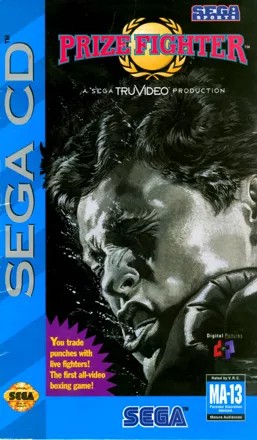
At a glance: Prize Fighter · Sega CD · developed by Digital Pictures · published by Sega · 1993 (North America), March 1994 (PAL) · first-person FMV boxing · four opponents across two discs · 1 player
Full-motion video always sounded best in the pitch meeting. Why render a boxer when you can film one? Prize Fighter, from Night Trap studio Digital Pictures, takes the idea at face value: you are an unknown hopeful called The Kid, and the entire game unfolds through your own eyes — walking to the ring, listening to your corner, and facing men who were filmed, in black and white, actually throwing punches at the camera. The director, Ron Stein, had choreographed fights for boxing pictures, and it shows in every frame. As an interactive film, this is one of the Sega CD’s most confident productions. As a boxing game, it collapses on a single, fatal point: you do not decide when to punch.
A Boxing Movie That Loves Boxing Movies

The homage is thorough and cheerfully unsubtle. The monochrome photography is a direct nod to Raging Bull, the period dressing suggests boxing’s glory years, and the story beats arrive exactly where a lifetime of fight films says they should: reporters doubting the newcomer, a ringside heckler laying bets against him, a promoter in a nice suit suggesting that losing might pay better, and veteran character actor Dick Miller in your corner. Michael Buffer announces the bouts. The opponents, three of them played by professional stuntmen, are cast for character as much as menace — a soft first opponent in the Glass Joe tradition, a showman who winds up cartoon punches, one who barks at you mid-fight like a dog. Beating them feels good partly because the film wants you to enjoy beating them; a landed right hook sends a man bouncing off the ropes with real physical conviction, because a real man did bounce.
That production quality is the game’s durable asset. The photography is clean by Sega CD standards — the black-and-white footage compresses about as gracefully as the format allowed — the sound is strong, and the camera work sells the fiction: the picture rocks when a shot lands on you, clinches fill the screen with an opponent’s body, and the walk-ons and corner talks hold the whole thing together as a little feature film you happen to be standing inside. Plenty of FMV games shot their footage like a corporate training video. This one shot it like a B-picture that knew exactly what it was.
Press the Button the Film Tells You To
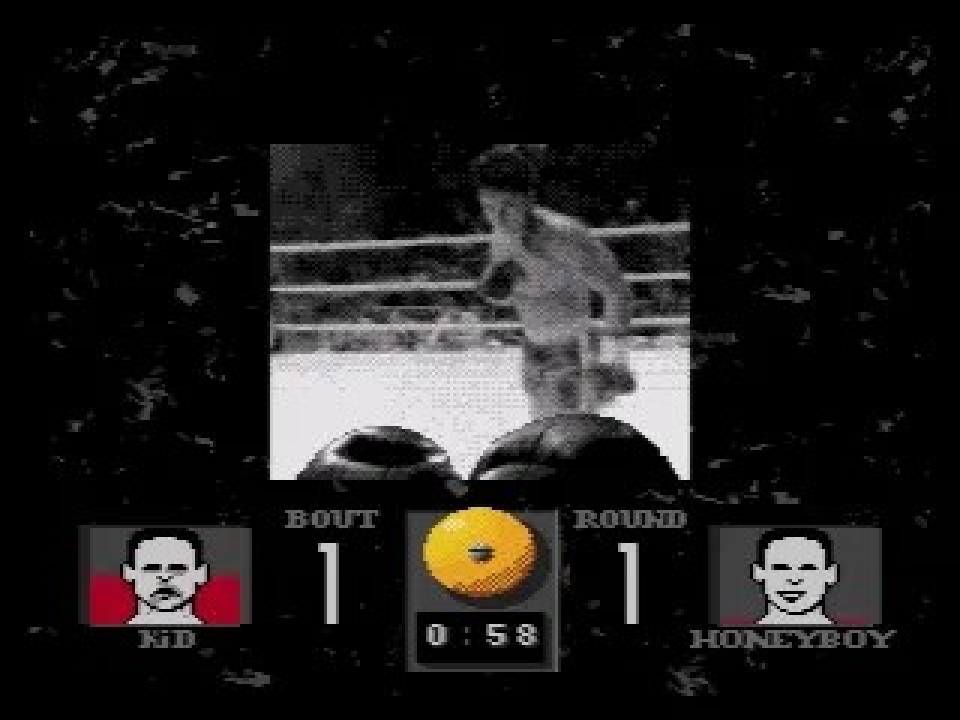
Then the bell rings, and the compromise shows. Your gloves hover as sprites at the bottom of the frame. The pad throws jabs, hooks, body blows and uppercuts, shifts modify them, sideways movement bobs and weaves, and one button covers up completely — safe, blind and useless. It feels like a fighting system until you notice that your punches connect only inside brief, pre-set windows buried in the footage. An opponent can stand square in front of you, guard down, chin presented like a gift, and a punch thrown a fraction early or late will simply happen to nobody. There is no depth to misjudge and no opening to read; there is a timecode to hit, chosen by somebody else, invisible to you. Your first sessions will be spent swinging at a man who appears to be made of weather.
The game’s answer is a training mode that rings the picture with arrows telling you which punch each moment wants. It works — with the arrows, bouts become a brisk, sometimes genuinely exciting test of reflexes and memory — but it concedes everything. You are not learning to box; you are learning the film, cue by cue, and the arrows only cover the first round anyway. Landed punches cut away to a half-second insert of the blow connecting, then snap back to the main footage mid-motion, which scrambles whatever rhythm you had built and makes combinations a fantasy. Fights are assembled from seven or eight such clips, each one identical every time, shuffled into a random order and separated by clinches. Learn a clip and you have learned it forever. Ducking, at least, works whenever you do it — the one honest mechanic in the building.
Between rounds, at least, the corner talks earn their place. Your man studies each opponent and tells you what he has spotted — a weakness to work on, a habit to exploit — and the advice is genuine information rather than flavour, one of the few places the film and the system cooperate. Linger too long on those quiet screens and the crowd starts amusing itself at your expense, a small, funny touch that keeps the presentation alive even when the game is waiting on you. None of it changes the fundamental arrangement. You are a memorisation exercise wearing a leading man’s face, and the face, for an evening, is almost enough.
“A boxing film you can genuinely enjoy — provided you accept that the film, not you, decides when a punch exists.”
Four Men, Ground Down to Size
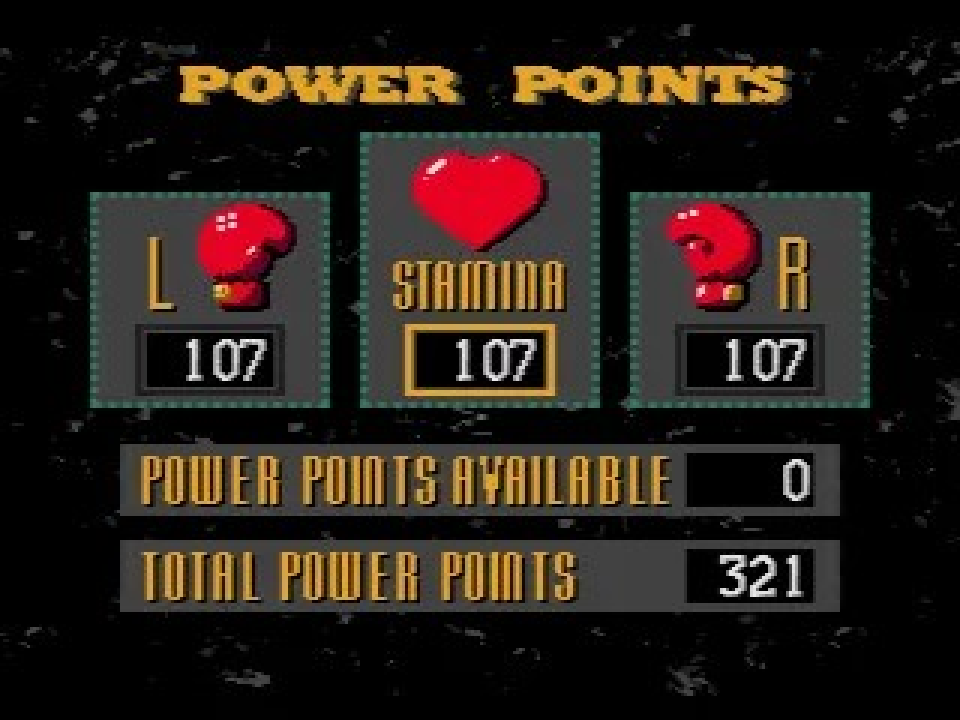
Even mastery of the cues is not enough, because underneath the film sits a spreadsheet. Winning earns experience, spent on your left hand, your right hand or your stamina, and the final opponent, Nuke “The Duke” Johnson, carries totals in the thousands against your starting few hundred. Timed perfectly or not, under-built punches bounce off the top men and your health will not outlast the lesson, so the three lesser fighters must be farmed — repeatedly — until the numbers relent. Worse, quick, clean wins pay out less experience than long ones, so the game quietly rewards you for dawdling against men you have already beaten a dozen times. Saving to the console’s memory at least means the grind can be spread across sittings.
And there are only those four men. Two discs, four opponents, one short career. The film around the fights never changes either: the same taunts delivered as first meetings, the same promoter’s glare after each supposedly surprising win, the same phone number collected from the same admirer. The first pass through all of this is campy and likeable. The fifteenth, undertaken because the arithmetic demands it, is a chore performed in front of footage that has stopped pretending otherwise.
The Verdict
Prize Fighter deserves its small reputation as one of the better FMV games, because its makers understood their material: the footage is acted, lit and choreographed by people who loved boxing pictures, and standing inside it is a novelty that has not entirely faded. But the interaction at its centre is a memory test dressed as a sport, the roster is four deep, and the stat system turns the back half into bookkeeping. Holyfield’s Boxing, for all its plainness, let you throw a punch because the moment called for one. This never does.
Watch it, enjoy it, beat it once with the training arrows on and a six-button pad in hand — that is the good version of this game, and it lasts an evening. The version that asks you to farm three men for the right to face a fourth is the same evening, repeated until the film wears out.
Verdict: a likeable boxing movie trapped inside a timing test and a spreadsheet — 5.0, carried almost entirely by its production.
Keep reading: the Sega CD system archive