
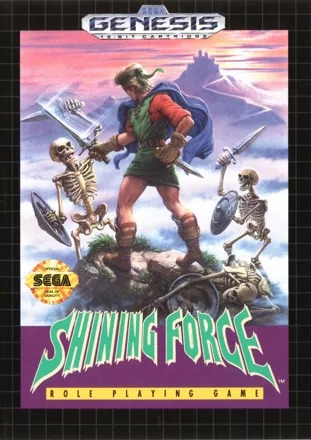
At a glance: Shining Force · Genesis · developed by Climax Entertainment and Sonic! Software Planning · published by Sega · Japan 1992, North America 1993 · tactical role-playing game · battles for up to twelve units drawn from a cast of thirty · single player
Nintendo had Fire Emblem; Sega, for a while, had nothing like it. Shining Force filled that gap in March 1992 in Japan — North America followed in July 1993 — and it remains one of the defining cartridges of the Genesis library: a tactical role-playing game in which a dozen heroes at a time move across gridded battlefields like chess pieces with hit points, while towns, shops and recruitment fill the spaces between wars. You lead as Max, a young swordsman of Guardiana, a name the game itself never quite gets around to giving him in conversation. The kingdom of Runefaust is on the march, its lord Darksol intends to resurrect the Dark Dragon, and the force you assemble — the Shining Force of the title — is what stands in the way. The plot machinery is stock fantasy and knows it. The battles are the argument.
Twelve Pieces at a Time
Thirty characters can join across the campaign, recruited through the story, found hiding in corners, or stumbled upon by talking to everyone in every town. Only twelve march into any single fight, which turns headquarters into a pleasant recurring dilemma: the centaur knights are your reliable spears, quick and long-reached; archers and mages unpick problems from a distance but crumple if anything reaches them; birdmen and other fliers ignore terrain entirely and scout half the map in a turn. Then there are the joys no sober designer would include — a magical creature sealed inside steam-driven armour, and a young dragon whose growth curve, given patience, turns him into a one-unit air force. Enemy design keeps pace, mixing melee bruisers, archers and casters with zombies that shrug off blades yet hate fire, wyverns whose breath ignores armour and can strike twice, and — late on, as the fantasy veneer thins — laser cannon and mechanical squid. And presiding over the game’s whole sense of humour, if you know where to look, is Domingo: a flying squid in a little helmet, hatched from an egg you can find in a chest and carry until it does, the strangest recruit in a roster that already includes a werewolf.
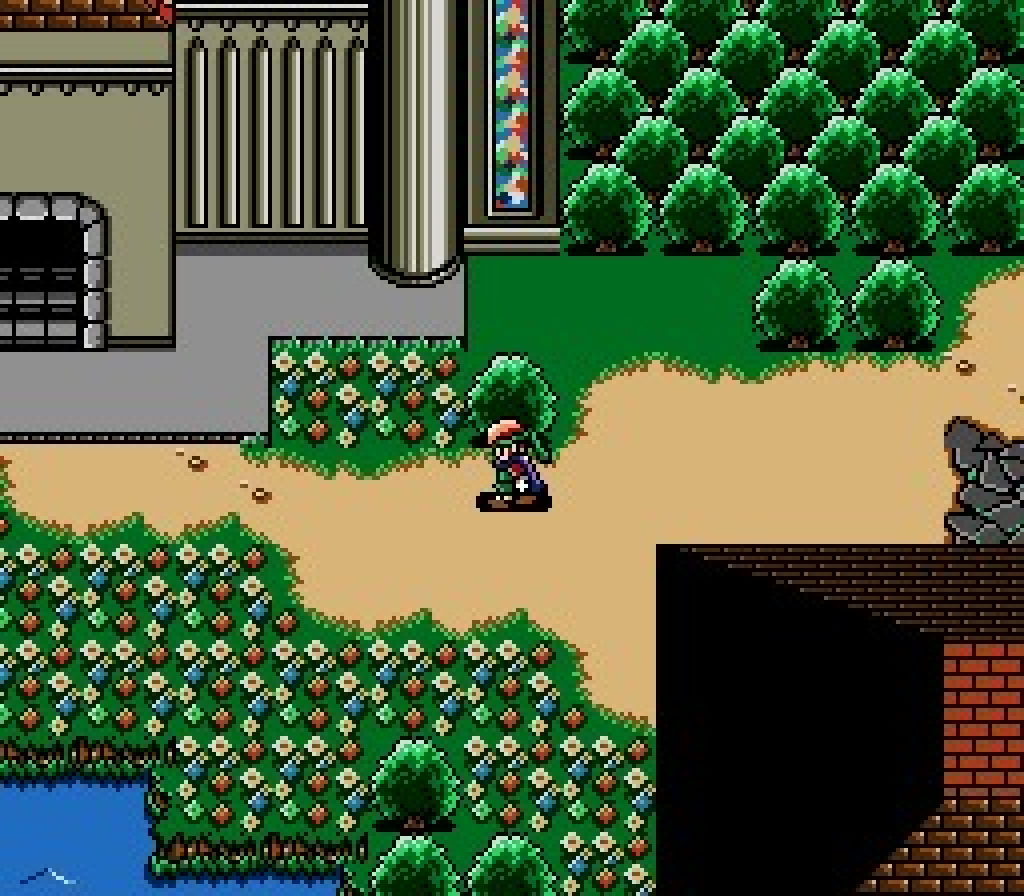
The rules underneath are admirably legible. Terrain matters, through a land-effect percentage that trims damage for units standing in forest or rough ground. Formation matters more: stragglers get mobbed, while a tight knot of heroes is an engraved invitation to area spells. Nothing about the system is complicated, and that is its strength — every defeat can be traced to a decision you made, which makes every victory feel earned rather than rolled.
The Cutaway Is the Reward
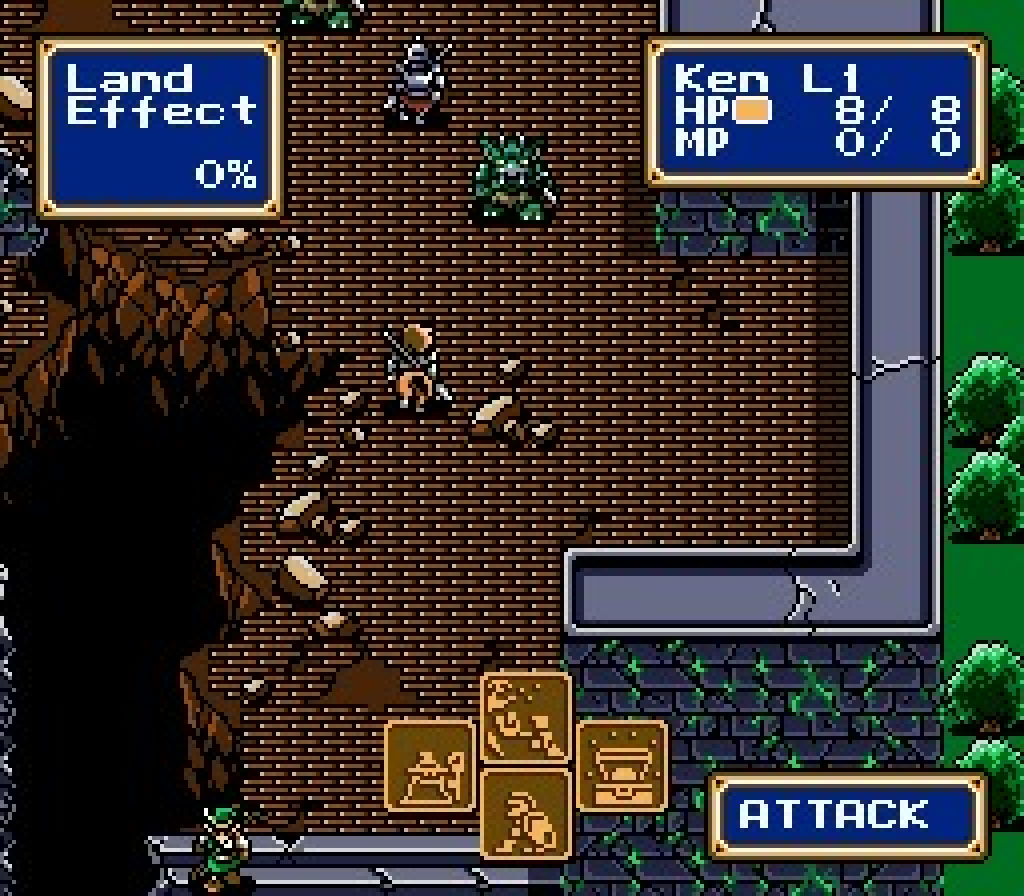
On the map, your army is rendered as small, cheerful sprites — charming, but hardly imposing. The game’s masterstroke is what happens on contact: the view cuts away to a full side-on tableau where attacker and defender appear as large, animated figures against a painted backdrop, and the blow lands with genuine ceremony. A centaur rears and drives his spear home; a mage’s spell floods the screen; the dragon, when he finally comes into his own, fills it. These cutaways convert arithmetic into theatre, and they are a large part of why grinding here feels less like labour than in its contemporaries — you are not watching numbers climb, you are watching your people perform.
Growth has one great decision woven through it. Any character may be promoted from level 10 onwards, dropping back to level 1 of an advanced class with temporarily reduced statistics but a far higher ceiling. Promote early and the force surges now; hold out until level 20 and the same character ends stronger, at the cost of carrying them through the hardest stretch unpromoted. Add late recruits who arrive levels behind the veterans — and who must be nursed through fights, fed finishing blows by colleagues who have softened targets for them — and team-building acquires a long, satisfying tail. The one chore that never becomes charming is the inventory: four slots per character, some consumed by equipment, and every found item lands in Max’s pockets first, so redistribution becomes a small logistics exercise after every battle. Promoted units also unlock the serious hardware — the named bows, lances and axes of the late game — so the veterans you raised end up visibly, individually yours in a way few RPG parties of the period managed.
A Plain Tale, Warmly Told
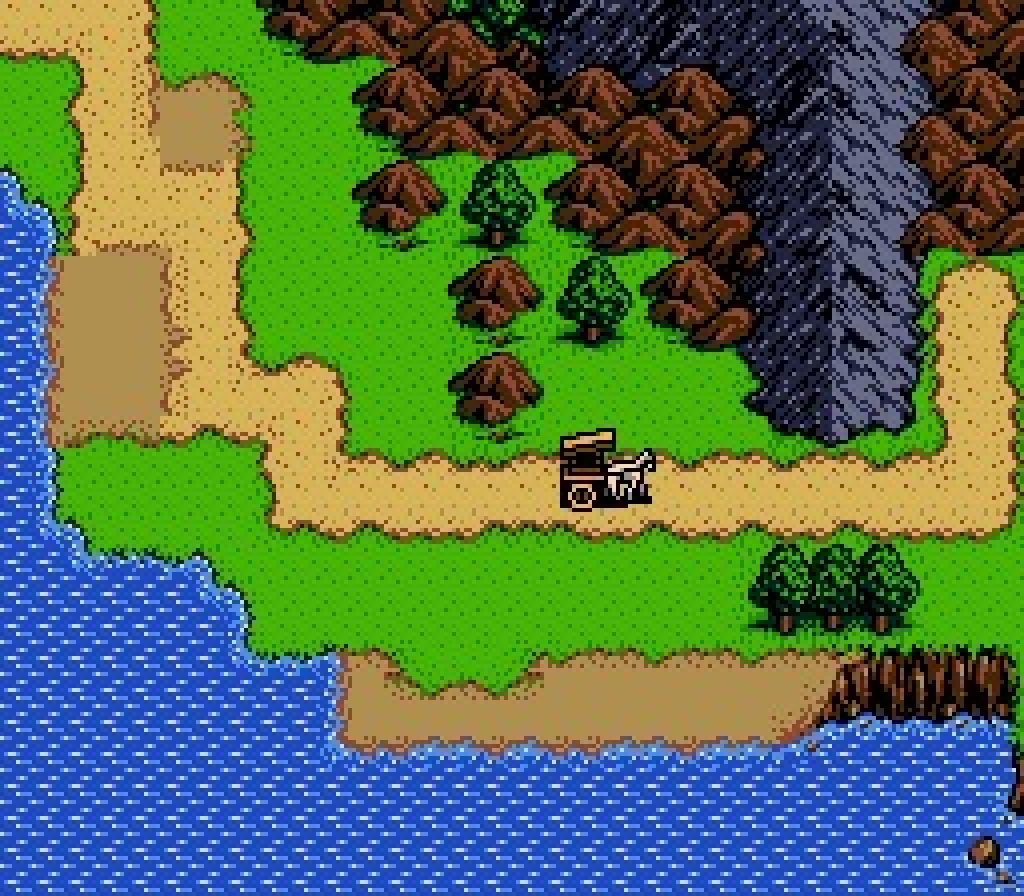
Between fights, you walk towns in a simple top-down view, restocking weapons, reviving the fallen at the priest and listening for the villager whose nephew happens to be a werewolf with availability issues. The writing is functional rather than memorable: Darksol schemes, his general Kane provides the honourable-enemy counterweight, allies arrive with a speech and then largely fall silent, and Max — in the way of early-nineties heroes — says nothing at all, ever. The 2004 Game Boy Advance remake, Resurrection of the Dark Dragon, expanded the script, added characters and battles and even gave Max a voice; it also sanded down some of the original’s eccentricities, the dragon included. The cartridge under review is the sparer text, and honestly the battles carry it. The structure — town, march, battle, repeat — is a rhythm the genre still uses because it works.
The campaign’s architecture deserves more credit than it usually gets. The war is told in chapters, each a self-contained campaign of linked battles that closes on a set-piece, and between engagements your headquarters screen gathers the whole thirty-strong company in one place — the reserves watching from a little hall while the priest saves your progress, resurrects the dead and reads fortunes in the form of promotion advice. It is a small thing, but it makes the force feel like an organisation rather than a menu: the twelve you field are visibly drawn from a larger company with a home. Max himself carries one of the era’s most quietly essential spells, Egress, which extracts the entire force from a losing battle at the cost of replaying it — the tactical RPG’s ejector seat, and the reason this game’s difficulty can afford its occasional spikes. A lost fight costs you half your gold and your pride, not your evening. Later games in the genre would formalise all of this; Shining Force had it working, in cartridge form, while most of its audience was still learning what a tactical RPG was.
“Simple rules, twelve pieces, and a cutaway that turns every attack into a little ceremony: the tactical RPG’s console coming-of-age.”
The Verdict
Time has added conveniences this cartridge lacks — the interface expects patience, the inventory expects more, and the story would not win prizes in any decade. What time has not dated is the core: readable tactics, a roster full of oddballs worth raising, promotion decisions with real trade-offs, and presentation that punches far above the map sprites. Alongside its sequel, this is the Genesis doing strategy as well as the 16-bit era managed anywhere. Newcomers raised on modern Fire Emblem will find the skeleton familiar and the charm intact.
Verdict: the tactical RPG done right on the Genesis — deep where it counts, creaky only in the cupboards — 8.0.
Keep reading: the Genesis system archive