
At a glance — Game: Pyramid Rush · Developer: Coachable LLC · Publisher: Coachable LLC · Original release: September 2026 · Original platforms: Android · Genre: Action platformer
Full disclosure up front, because this one arrived the honest way: Coachable LLC pitched this game to us, and they pitched it well. Instead of a generic press release, they aimed it at a specific piece of ours — our feature on why Castlevania’s staircases still terrify — and argued that their ladder-climbing platformer is built on the opposite philosophy. That is a claim worth checking. So this is a spotlight, not a review: no score, no verdict, built from the developer’s press kit — three frames of recorded Android gameplay, game UI and all, rather than store-gallery screenshots — and from the live Google Play listing. What follows is what the game demonstrably is, and why its one design idea deserves the comparison it asked for.
King of the Hill, one pyramid at a time
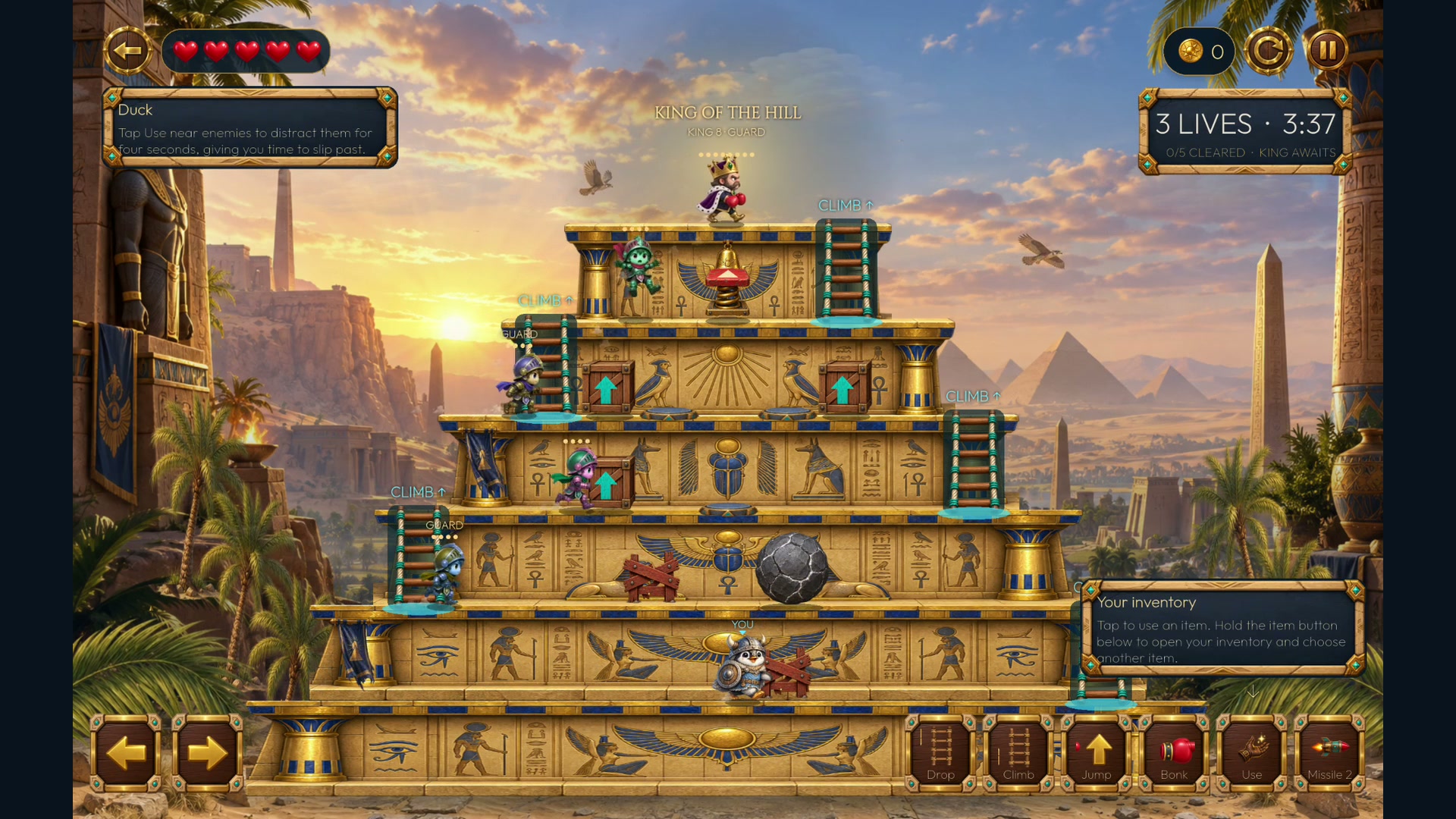
The structure is stated on screen, in gold letters: King of the Hill. Each level is a single stepped pyramid of open terraces joined by ladders, shown whole, in one screen. Guards patrol the terraces. A crowned king waits at the summit. You start at the bottom with three lives and a countdown timer, and the HUD keeps the terms in front of you — in the Egyptian frame it reads “0/5 CLEARED · KING AWAITS.” Clear the guards, work your way up, take the crown.
The moveset is a ladder-climber’s kit. On-screen touch controls run along the bottom: move, drop, climb, jump, bonk, use — plus an item slot. The items are tools for reading a terrace before you enter it. A duck, deployed near enemies, distracts them for four seconds so you can slip past — the game’s own first-pickup tip says exactly that. Bombs crack armoured enemies that a plain bonk won’t move. Crates get pushed onto platforms, boulders get rolled, switches get operated, broken crossings get repaired. It is, in the oldest and best sense, a game about stairs and what is standing on them.
The frames Coachable sent fill in the texture. Guards wear their status openly — dotted pips float above their heads, and the word GUARD sits under the king’s name at the top of the screen. A golden bell waits on the summit terrace. Item tips arrive in a framed panel the first time you pick something up, so the game explains each tool at the moment it becomes relevant. None of it is hidden in a menu. It is all out on the pyramid, where you can see it.
Castlevania’s staircases hid the bill. Pyramid Rush shows it first.
Our staircases feature made the case that a Castlevania staircase is a boss fight disguised as furniture. Step onto one and Simon Belmont commits: no jumping, no bailing out, no retreat faster than a funeral procession, and a knockback that turns one touch into a fall down the whole climb. The staircase’s cruelty is informational as much as physical — it removes your options first, and then the Medusa Heads arrive on their fixed sine waves to collect. You find out what the climb costs while you are already paying it.
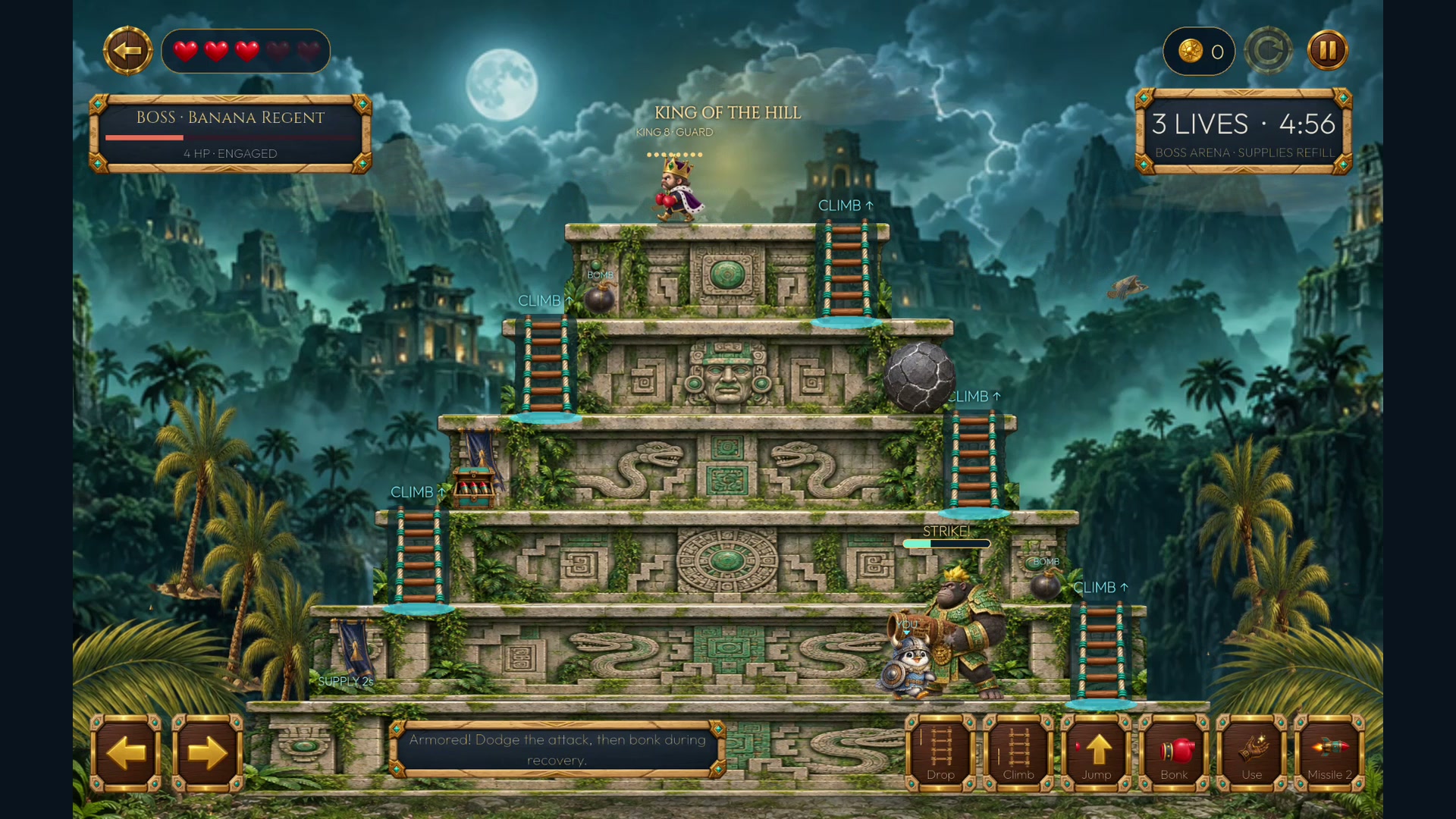
Pyramid Rush inverts every term of that contract. The whole climb fits on one screen, and the ladders are literally labelled — CLIMB, with an arrow. From the bottom step you can survey every terrace above you: which guard patrols where, which crate sits by which ladder, and — in the Maya frame Coachable sent us — a boulder parked on the same terrace as the next ladder, in plain sight, before you have climbed a single rung. The boulder is not a surprise. It is a question the game asks you early enough to answer.
That moves the tension from execution under duress to planning. Which ladder first? Do you spend the duck here, or save it for the terrace with two guards? The game teaches the same lesson in its boss fights: the Maya frame’s tip line, mid-fight, reads “Armored! Dodge the attack, then bonk during recovery.” Dodge, watch for the opening, strike back — the Play listing’s own summary of its combat is “fight with a plan,” and the frames back it up. There is older DNA in this, too: ladders, terraces and patrolling guards are the grammar of Lode Runner, a game that has been asking players to read a whole screen before moving since 1983. Pyramid Rush speaks that language fluently, and says the quiet part out loud.
None of which makes the climb free. The countdown in the Egyptian frame stands at 3:37 and the lives counter at three, and a plan you can see is still a plan you have to execute — bonks timed to a boss’s recovery window, a duck spent on the right terrace, a boulder rolled the right way at the right moment. Castlevania rationed information and charged you for the shortage. Pyramid Rush hands you the information and charges you for the execution. That is a fairer bill, and a more modern one.
Six worlds, six heroes, one staircase at a time
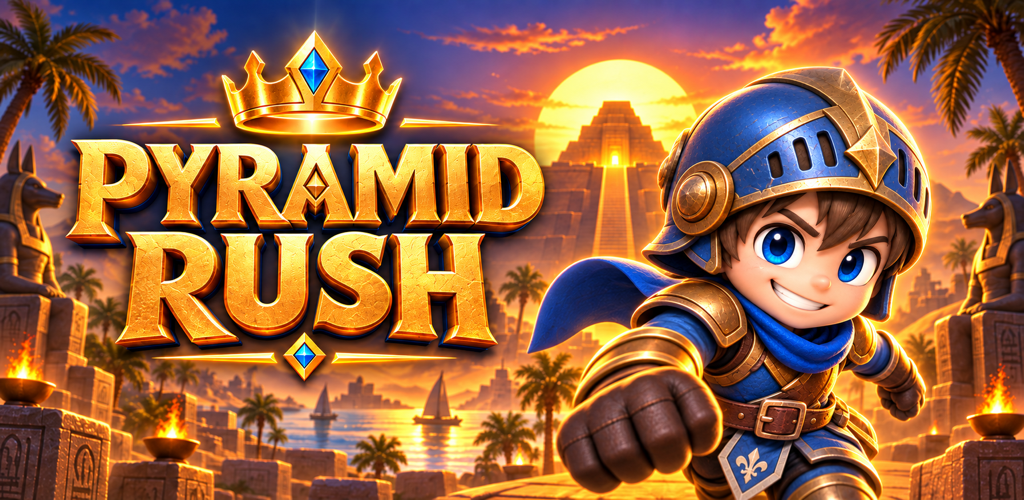
The campaign climbs through six worlds: Egypt, Maya temples, Nordic ruins, Khmer towers, Andean heights and Japanese shrines. There are six playable characters, including the original knight from the key art and a Viking penguin named Victor. Treasure earned on the climb becomes gold, and gold unlocks outfits and armour. On the money question, Coachable’s own September 17 update note is unusually plain: optional gold packs can be bought through Google Play, but “earned treasure gold remains available for every item” — the shop takes patience as readily as payment, which is the right way round for a free game.
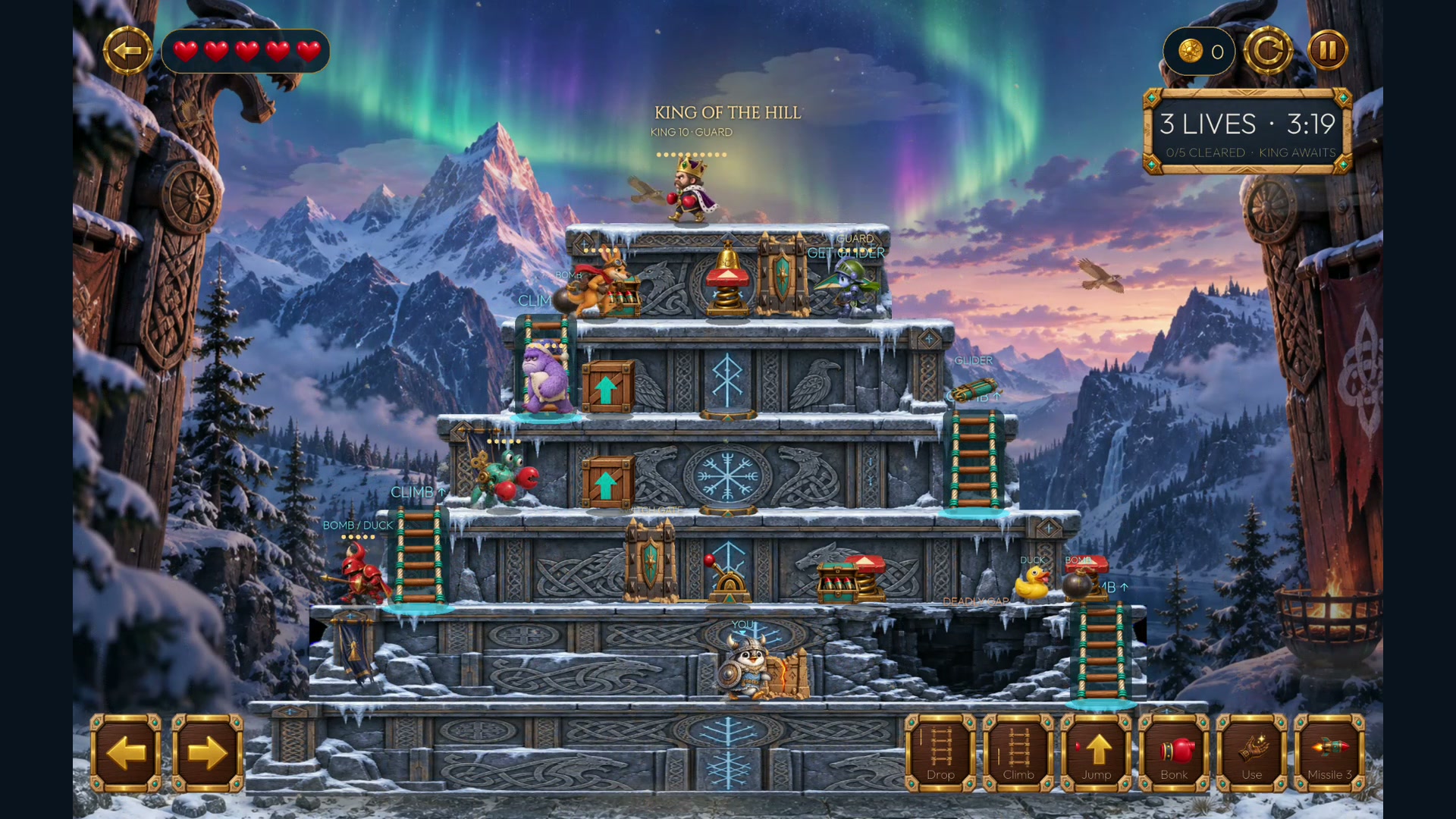
The presentation is bright, hand-painted-looking and unapologetically cheerful — sunset gold in Egypt, moonlit jungle in the Maya world, and in the Nordic frame, ice-covered terraces under a full aurora. It is built for landscape play with touch controls, carries original music and sound effects, and asks for no account: download it and climb. Your progress saves, so a pyramid can be returned to later — a small mercy Castlevania never once offered.
The small print
Pyramid Rush is out now on Google Play for Android, free to download, with in-app purchases — the optional gold packs described above. It launched in September 2026 and was last updated on September 17, 2026. It is a small, new release from a small studio, and this spotlight rests on the developer’s recorded gameplay and store listing rather than long hours of our own play. Coachable notes the frames were recorded with a scripted sequence of ordinary controls, game UI visible — which is the right way to send a press kit. If we put serious time into the climb, we will say so and write the follow-up.
But the idea at its centre is a real one, and it is rarer than it should be: a climbing game that respects the player’s eyes. Castlevania made the staircase terrifying by hiding its cost until you were committed. Pyramid Rush makes the climb interesting by showing you everything — the guards, the boulder, the bomb by the terrace edge — and asking what you intend to do about it. Forty years of ladder-climbing design separate those two philosophies, and there is room on the shelf for both.
Pyramid Rush is free on Google Play.
— June