

At a glance — Game: Half-Life 2 · Developer: Valve · Publisher: Valve · Original release: November 16, 2004 · Original platforms: Windows PC · Genre: First-person shooter · Writer: Marc Laidlaw · Music: Kelly Bailey · Metacritic (PC): 96/100
Twenty-two years ago today, Gordon Freeman stepped off a train into City 17, and the man on the platform screens welcomed him with the most sinister line ever delivered in a customer-service voice: “Welcome to City 17. It’s safer here.” Nothing about that morning was safe for the rest of the industry. Half-Life 2 arrived on November 16, 2004, after five years of development, one of the most damaging leaks in the medium’s history, and a launch that forced every PC player on Earth to install a piece of software most of them did not want. It then proceeded to win 39 Game of the Year awards, sell 12 million copies, and quietly rewrite the rules for how shooters tell stories, how physics behaves in a game world, and how games are sold at all. Anniversaries are usually an excuse for nostalgia. This one is an audit — because most of what a modern blockbuster does by default, it does because Half-Life 2 did it first.
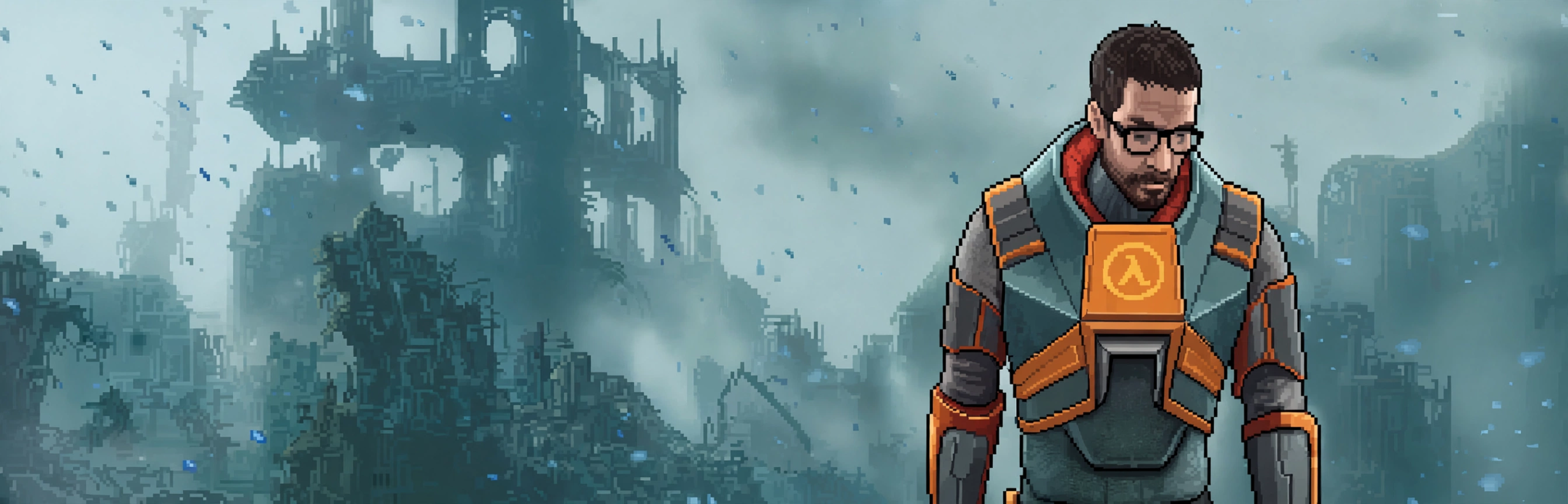
Welcome to City 17: the story Half-Life 2 tells without ever taking the camera away
The boldest decision in Half-Life 2 is what it refuses to do. There are no cutscenes in the conventional sense — no moment where the game wrestles the controls from you and plays a film at you. From the G-Man’s opening whisper (“Rise and shine, Mr. Freeman”) to the frozen final frame, you are inside Gordon Freeman’s eyes, and the story happens around you, at you, sometimes pointedly in spite of you. The famous train-station arrival is ten minutes of walking, queuing, being shoved by Civil Protection officers and listening to Dr. Breen’s avuncular propaganda — and it teaches you the entire political situation of Earth under the Combine without a single line of exposition dumps. A man tells you he was on his way to a ration line. A couple whispers that they drank the water and now they can’t remember things. You learn by being there.
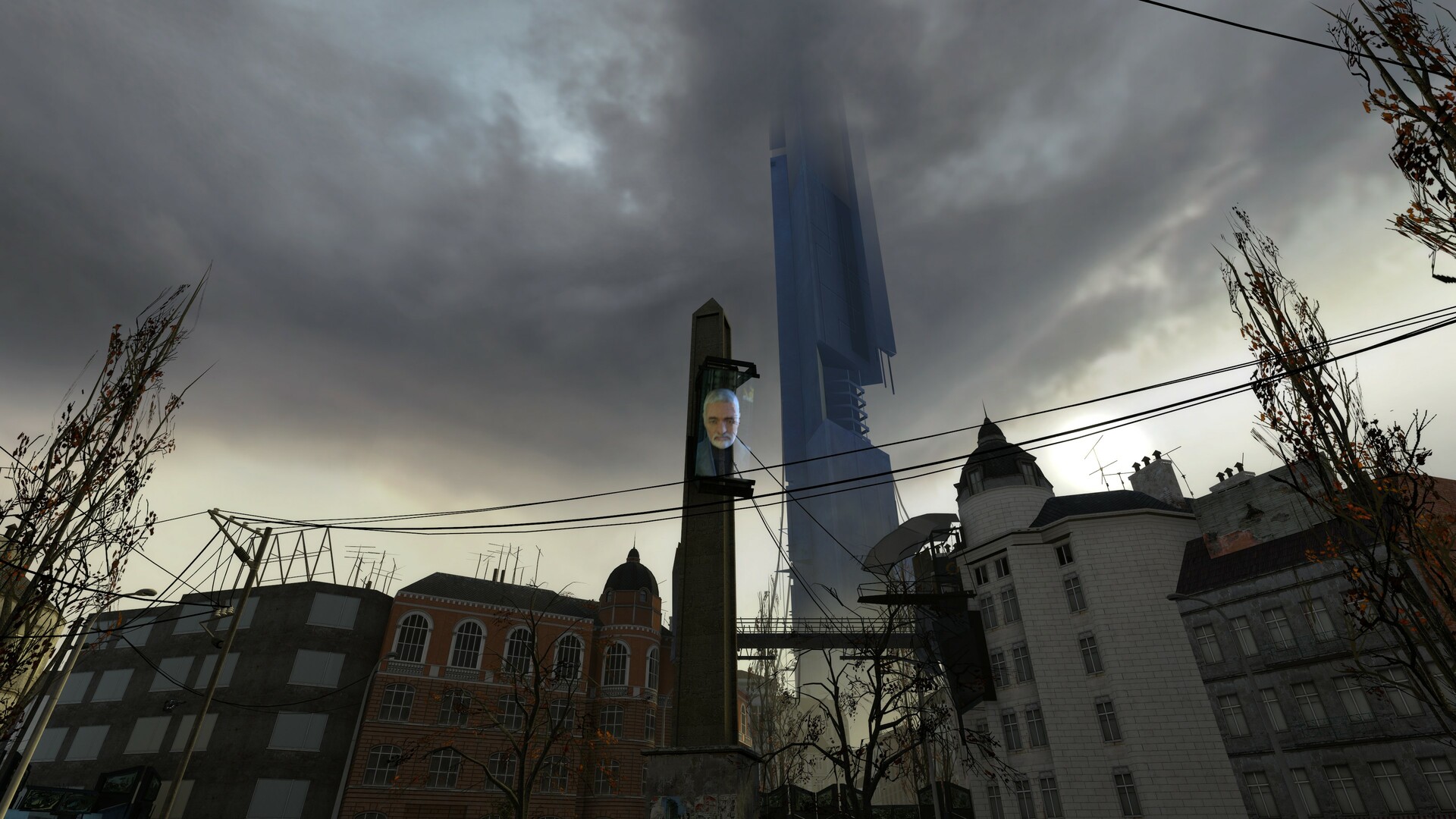
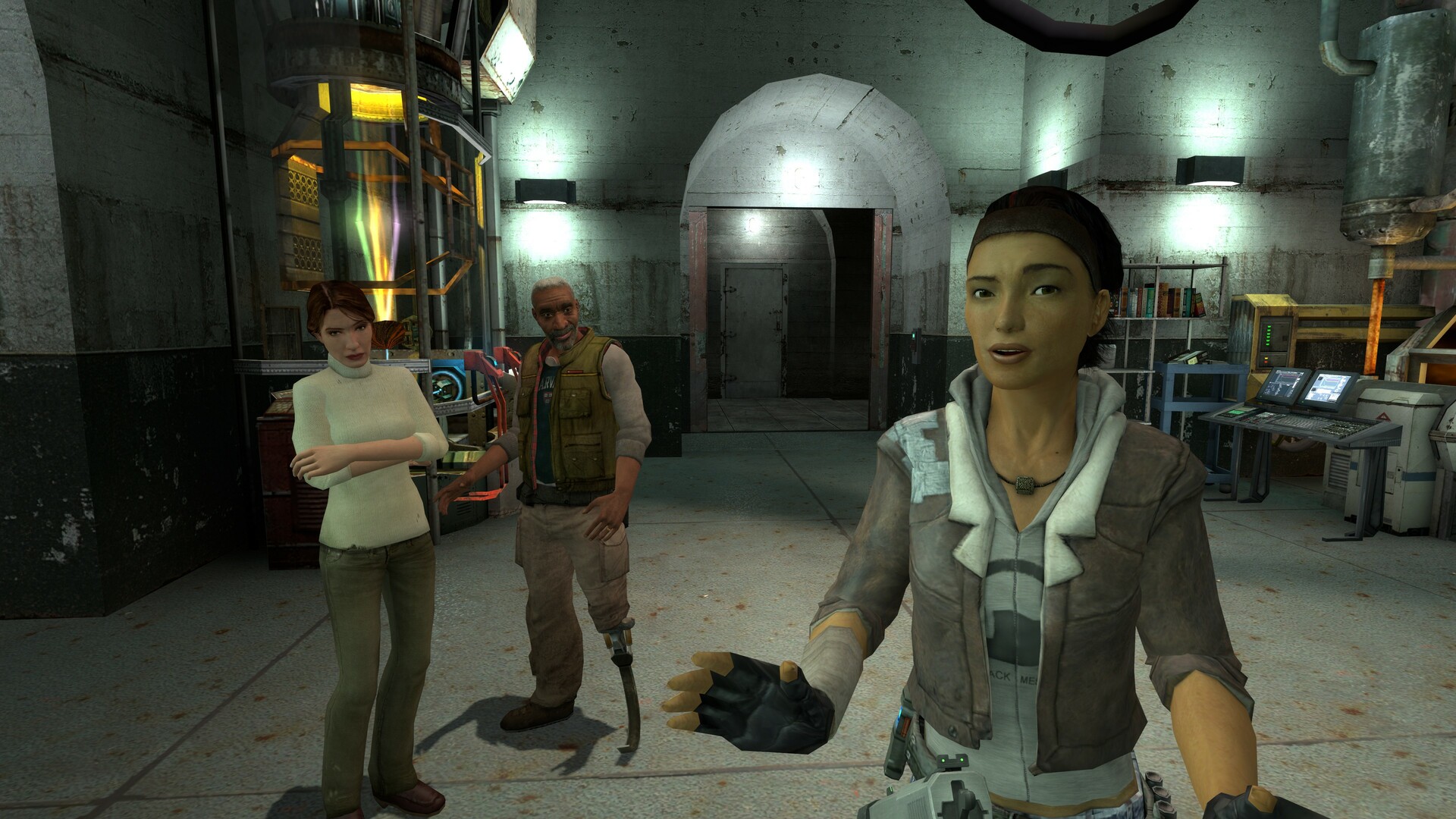
The city itself was the second breakthrough. Art director Viktor Antonov, who was Bulgarian, steered Valve away from generic American sci-fi toward an Eastern European city of Habsburg facades and Soviet concrete, slowly being digested by alien architecture — the Citadel rising over the rooftops like a splinter the planet is trying to expel. And inside that city, for the first time, were faces that could act. Animator Ken Birdwell studied psychologist Paul Ekman’s research into how facial muscles express emotion, and writer Marc Laidlaw built the drama on what he called a “basic dramatic unit everyone understands” — a family: Eli Vance, his daughter Alyx, and the people who loved them before the world ended. Alyx Vance, played by Merle Dandridge, was the revelation — a companion who made eye contact, cracked jokes under fire, grieved on camera — backed by a cast that included Robert Guillaume as Eli and Robert Culp as the oleaginous Breen. Shooters had had characters before. They had never had performances.
The Gravity Gun: when physics stopped being scenery
Every era of the first-person shooter has a weapon that defines it, and 2004’s was not really a weapon at all. The Zero Point Energy Field Manipulator — the Gravity Gun — was introduced to the player as a tool for fetching and carrying, a toy Alyx’s robot Dog plays fetch with. Valve had spent years integrating the Havok physics engine into its new Source engine, testing the simulation with internal minigames like Zombie Basketball, and the Gravity Gun was the moment all that engineering became play. In the haunted town of Ravenholm, it became a weapon of glorious improvisation: sawblades sliced zombies in half, paint cans and radiators became artillery, and the game’s puzzles — weighing down a seesaw with bricks to make a ramp, catching an enemy grenade and returning it to sender — treated physics not as decoration but as the rule set.
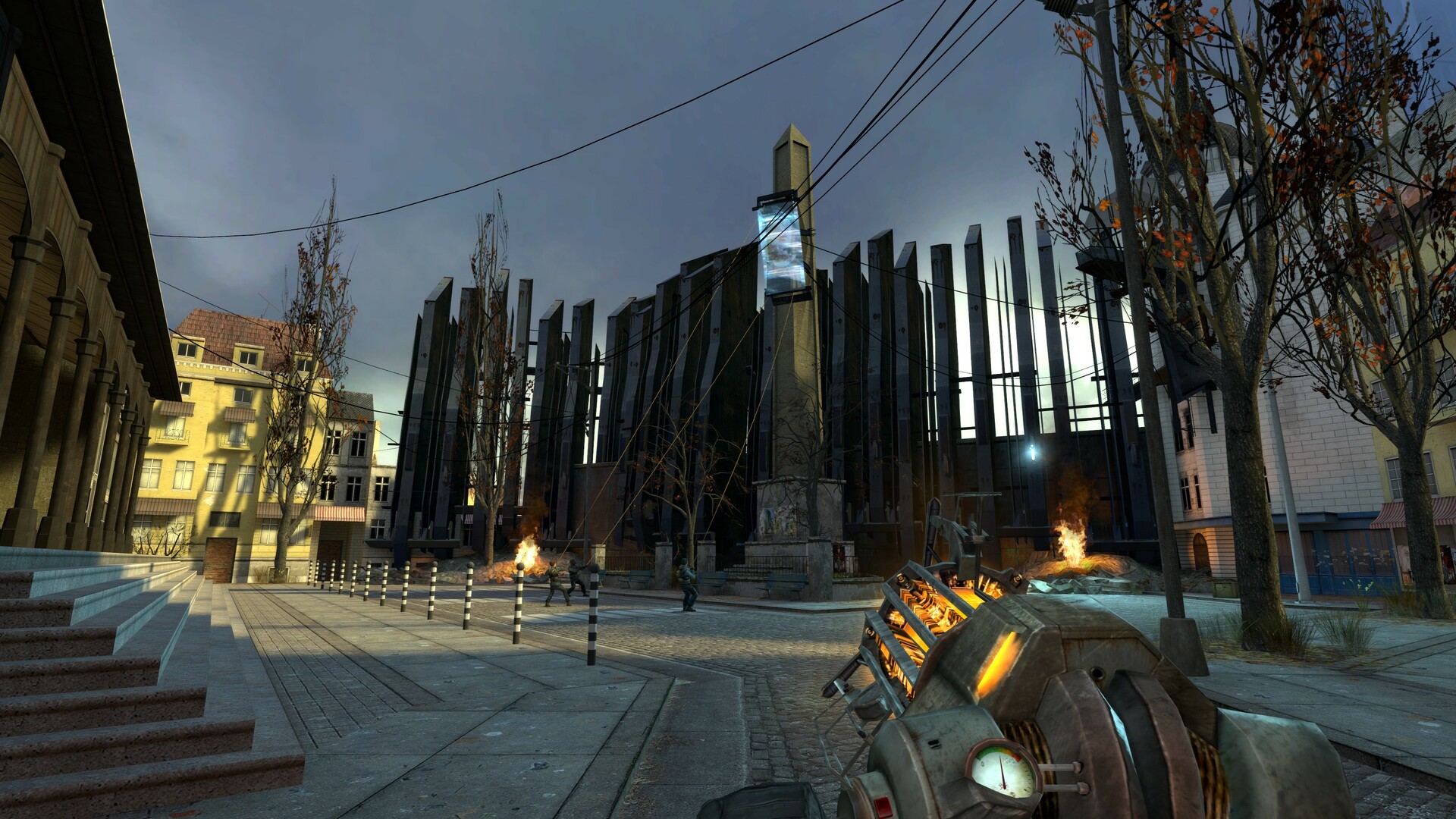
The game saves its thesis statement for the finale, when a Citadel security field strips your arsenal but accidentally supercharges the Gravity Gun — suddenly you can hurl soldiers and rip machinery off the walls, and the tool you were given as a novelty is revealed as the most powerful weapon in the game. In 2008, Guinness World Records credited Half-Life 2 as the first game to feature a gravity gun. The deeper legacy is that after 2004, physics in a shooter was no longer a tech-demo bullet point. It was gameplay, and everyone else had to answer for theirs.
Five years, $40 million and one catastrophic leak
It very nearly didn’t happen. Development began in June 1999, six months after the original Half-Life, with a team that grew to around 82 people and a brief from president Gabe Newell that brooked no modesty: redefine the genre. “If Half-Life 2 isn’t viewed as the best PC game of all time,” Newell told them, “it’s going to completely bum out most of the guys on this team.” Valve announced the game at E3 2003 to rapturous applause — it won the show’s top honours — and promised it on September 30. By July, the team knew that date was fiction. The announcement of a delay, days before the deadline, brought the first backlash.
Then came the disaster that still defines “leak” for the whole industry. A German hacker, Axel Gembe, had infiltrated Valve’s internal network; on September 19, 2003, the game’s source code was stolen, and in early October it escaped online. Fans compiled the unfinished code into a playable Frankenstein version that revealed, brutally, how far from done the game was. Morale at Valve cratered. Newell eventually worked with the FBI on a sting — a fake job interview designed to lure Gembe to the United States — but German police arrested him at home first; in November 2006 he received two years’ probation. The final year of development cost a reported $1 million a month, in long hours and no small misery, before the team produced a version playable from start to finish in March 2004 and completed the game on October 13. That it emerged as a masterpiece rather than a cautionary tale remains one of the great escapes in development history.
The boxed game that dragged Steam into the world
If you bought Half-Life 2 in a shop in November 2004, you bought the box below — Sierra’s logo on the front, an ESRB M, and a “98% — PC Gamer Editors’ Choice” badge. What the box did not advertise was the toll booth inside. Half-Life 2 was the first major game that required Steam: Valve’s digital storefront, launched the year before to general indifference, was mandatory for everyone. Retail buyers had to install it, create an account, register their key and permanently lock the game to that account before they were allowed to play a product they had physically purchased. Those who had preloaded the game through Steam — a gigabyte of encrypted files made available from August 26, an astonishing novelty in 2004 — simply watched it unlock on the morning of the 16th.
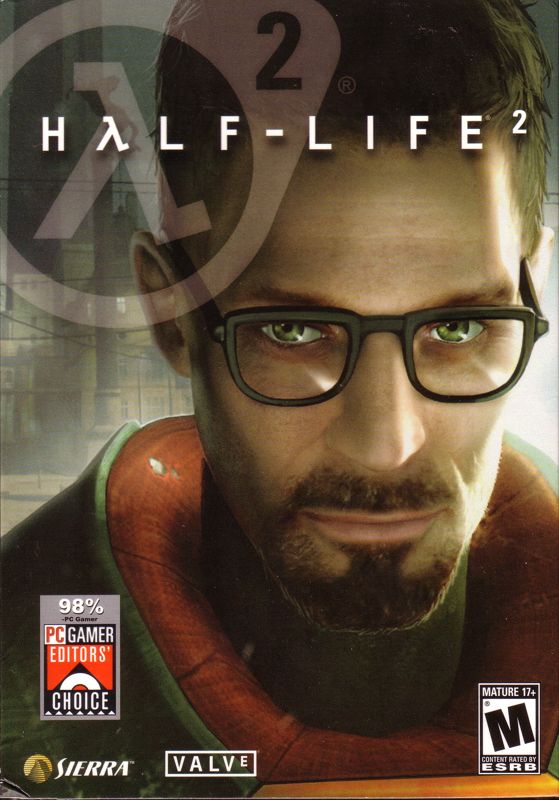
The reaction was fury, and the critics of the day said so in print — the required Steam installation, the account registration, the permanent lock and the launch-week installation difficulties all drew formal complaints in otherwise glowing reviews. Valve and its retail partner Vivendi then sued each other over distribution rights; a court ruling went Valve’s way that November, a settlement followed, Vivendi’s Sierra ceased distributing Valve’s games in August 2005, and Electronic Arts took over the retail deal. The irony is now total. The software players resented being forced to install became the default way PC games are bought, period — and the 12 million copies Half-Life 2 had sold by 2011 flowed overwhelmingly through the storefront it had dragged into existence. Steam’s forced birth was resented for a year and has ruled for twenty-two.
Half-Life 2 at 22: what still holds up, and what finally shows its age
Replay it today and the shock is how modern the pacing feels. Half-Life 2 is structured as a sequence of self-contained novellas, each introducing a new idea and retiring it before it tires: the unarmed dread of the arrival, the canal chase on the airboat, Ravenholm’s survival-horror detour, the coastal road trip, the antlion beach assault, the street war through the burning city, the ascent of the Citadel. Computer Games Magazine, naming it the year’s best technology and writing award-winner in 2004, called it “a masterful single-player experience that plays a constant game of one-upmanship with itself” — and that, more than any single system, is why it survives. November 2004 was a pile-up of giants — Halo 2 had rewritten the console shooter a week earlier — and Half-Life 2 is the one whose level design is still taught.
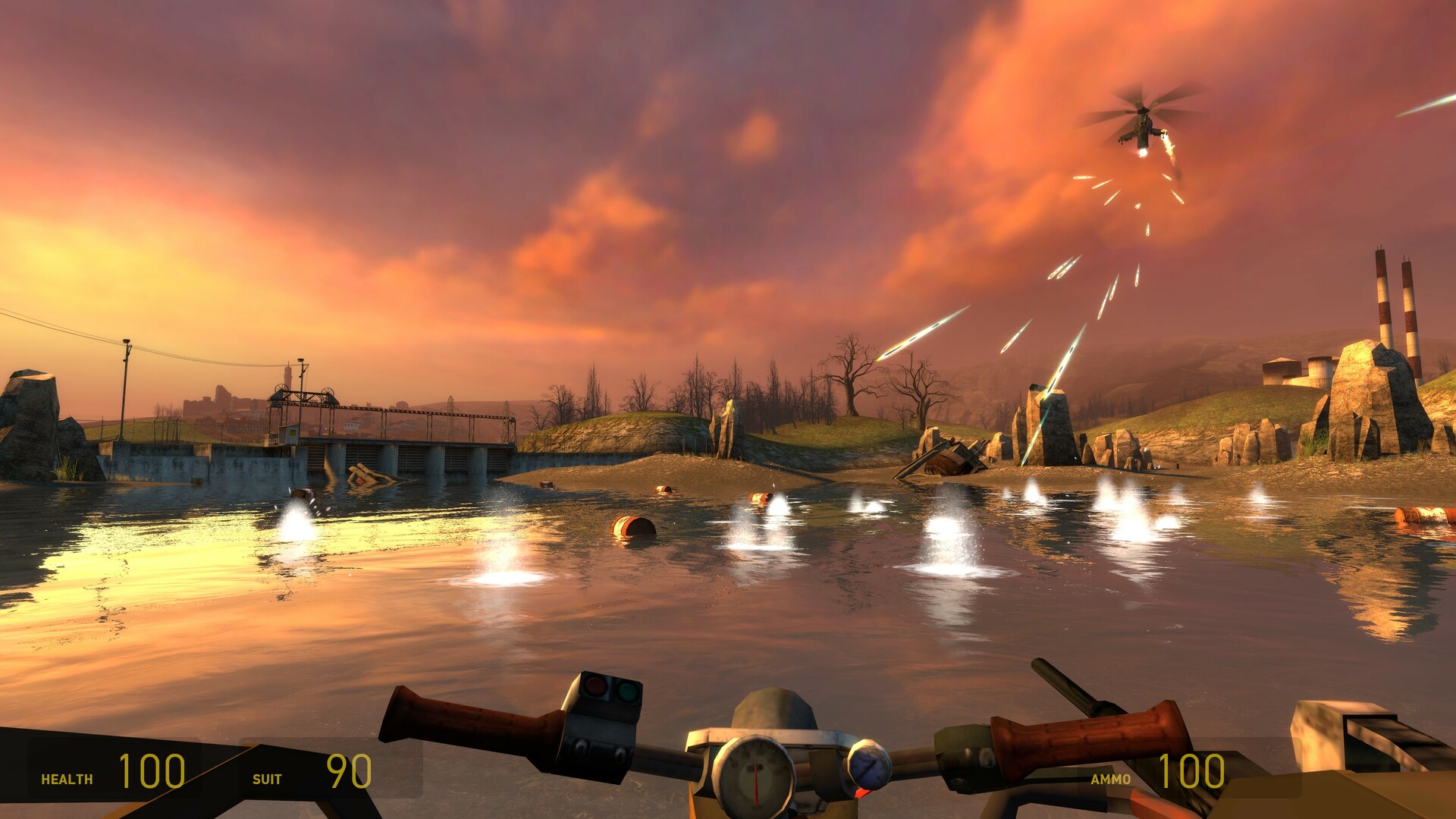
Time has not been entirely kind in the corners. The loading seams that chop the world into levels are pure 2004. The vehicle sections, thrilling then, can outstay their welcome now, and the enemy soldiers’ tactics belong to their era. But Antonov’s art direction — a real city, painted in greys and rust, rather than a realism arms race — has aged far better than most of its contemporaries, and Valve keeps tending the garden: the 20th anniversary update in November 2024 folded Episode One, Episode Two and Lost Coast into the base game, restored lost content, added developer commentary and Steam Workshop support, and made the game briefly free. The response was a new all-time peak of 64,085 concurrent players — for a single-player game old enough to drink. The modding lineage it started, from Garry’s Mod to the fan-built Black Mesa to a full VR conversion, gained a new flagship in March 2025, when Orbifold Studios released a playable demo of Half-Life 2 RTX, a ray-traced remaster built with Nvidia’s RTX Remix tools. The full version is still to come. Some things never change.
The ending we never got
For all that completeness, Half-Life 2 remains the most famous unfinished story in games. The episodic sequels began superbly — Episode One in 2006, Episode Two in 2007, ending on a cliffhanger that stopped hearts — and then the announced Episode Three simply never arrived. Valve cancelled it, and several other Half-Life projects, without ever quite saying so. Laidlaw left Valve in 2016; in August 2017 he published “Epistle 3,” a short story with the names changed that the world read, surely correctly in outline, as the ending that never shipped — though he later said he regretted publishing it, and that the real Episode Three could only ever have been written by making the game. When the series finally moved again, it was sideways and then, audaciously, backwards: Half-Life: Alyx (2020), a VR prequel, reached into Episode Two’s ending and rewrote it, leaving the story technically alive and practically frozen for nineteen years.
None of it dents the original achievement. This is the game at the heart of The Orange Box, which our review called the greatest deal gaming ever offered. Half-Life 2 took the best PC game of 1998 and produced the defining PC game of 2004: 96 on Metacritic, a perfect 10 from Edge — only the fifth game ever to earn one — six BAFTAs in a single night, and a shelf of “game of the decade” honours collected long after the decade ended. It changed what physics means in a shooter, what a face can do in a cutscene that never cuts, and what a box on a shelf actually contains. Twenty-two years on, City 17 is still the place every story-driven shooter is quietly measured against. Most of them are still trying to be safer there.
— Chip
For more launches from this date, see This Day in Gaming History: November 16.