
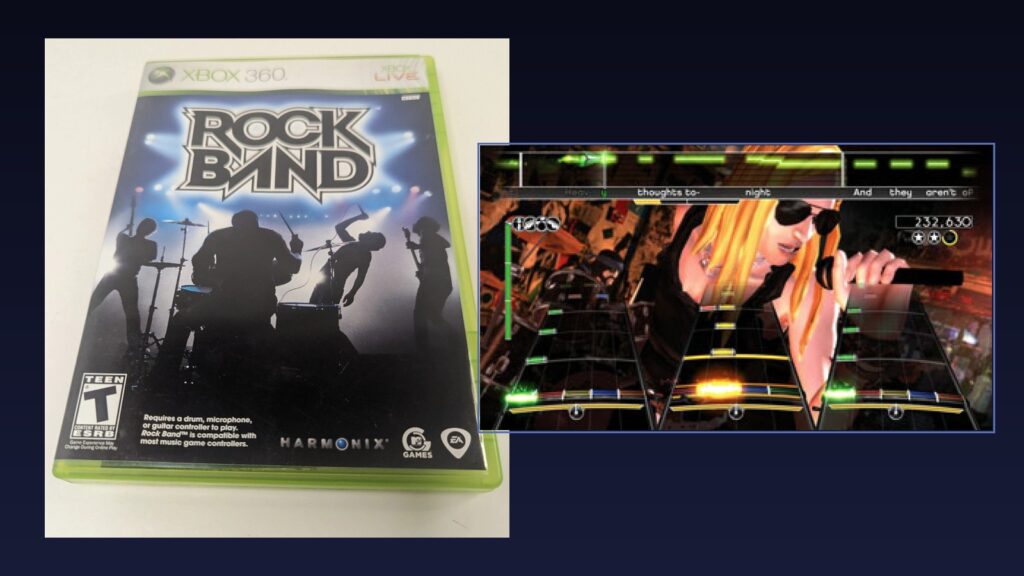
Game: Rock Band
Developer: Harmonix
Publisher: MTV Games (distributed by Electronic Arts)
Original release: November 20, 2007 (North America)
Original platforms: Xbox 360, PlayStation 3 (PlayStation 2 followed December 18, 2007)
Genre: Rhythm
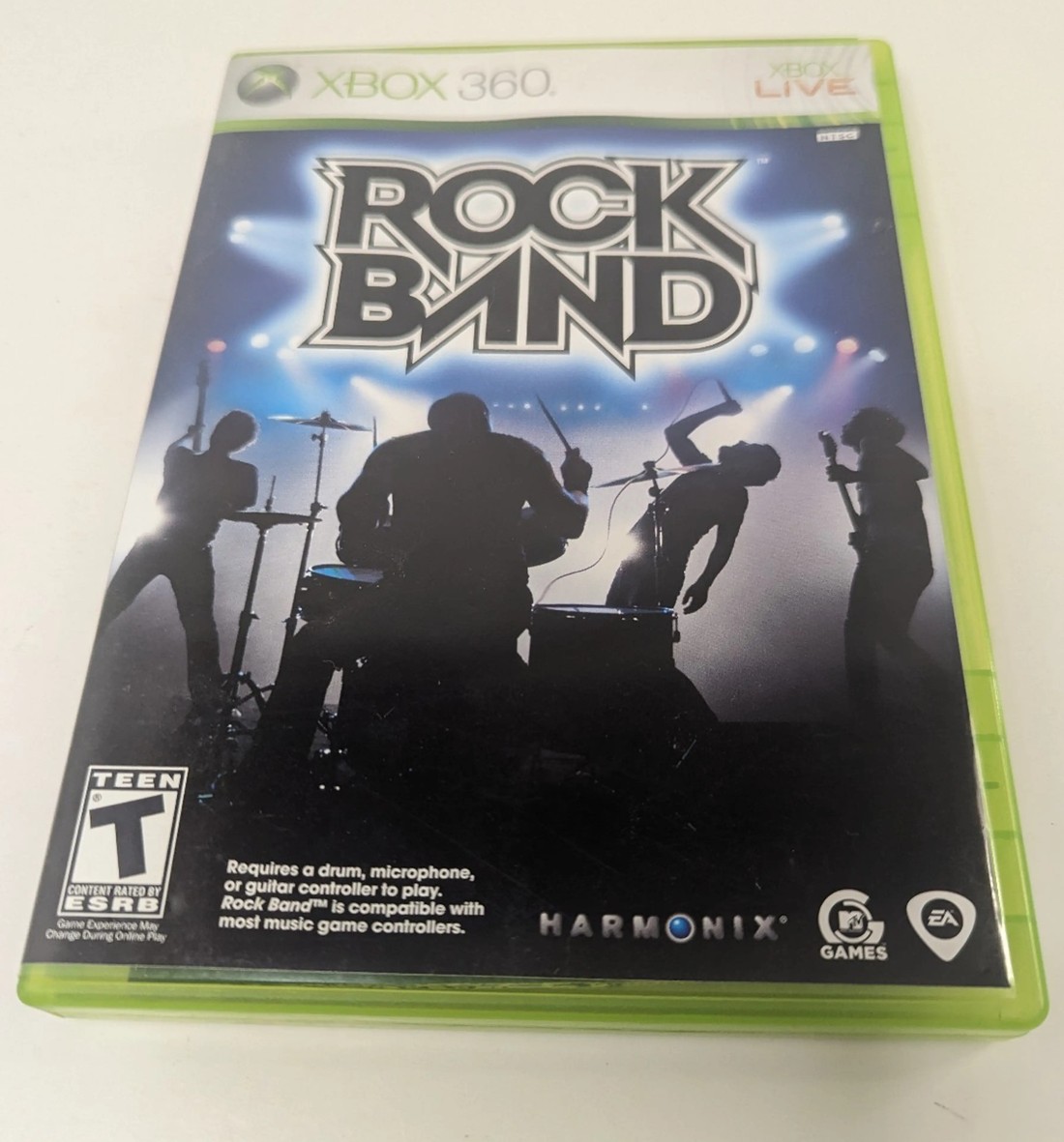
The biggest box in the games aisle, nineteen years ago this week, was not a console. It was a band in a carton. Rock Band launched in North America on November 20, 2007, and the Special Edition was big enough to embarrass whoever carried it out of the shop: a game disc, a Fender Stratocaster guitar controller, a four-pad drum kit with a kick pedal, and a microphone. One purchase. Four jobs. And a living room that would never quite be tidy again.
Plenty of games have sold more copies. Very few changed the furniture. Harmonix had started the plastic-guitar idea itself, with Guitar Hero. Rock Band multiplied it by four players and turned a solo high-score chase into the defining party game of its generation. At 19 the song store is closed, the sequel is delisted and the developer is making a music mode inside Fortnite. Which makes it a good moment to remember how big the bet was — and how much of modern gaming it quietly rehearsed first.
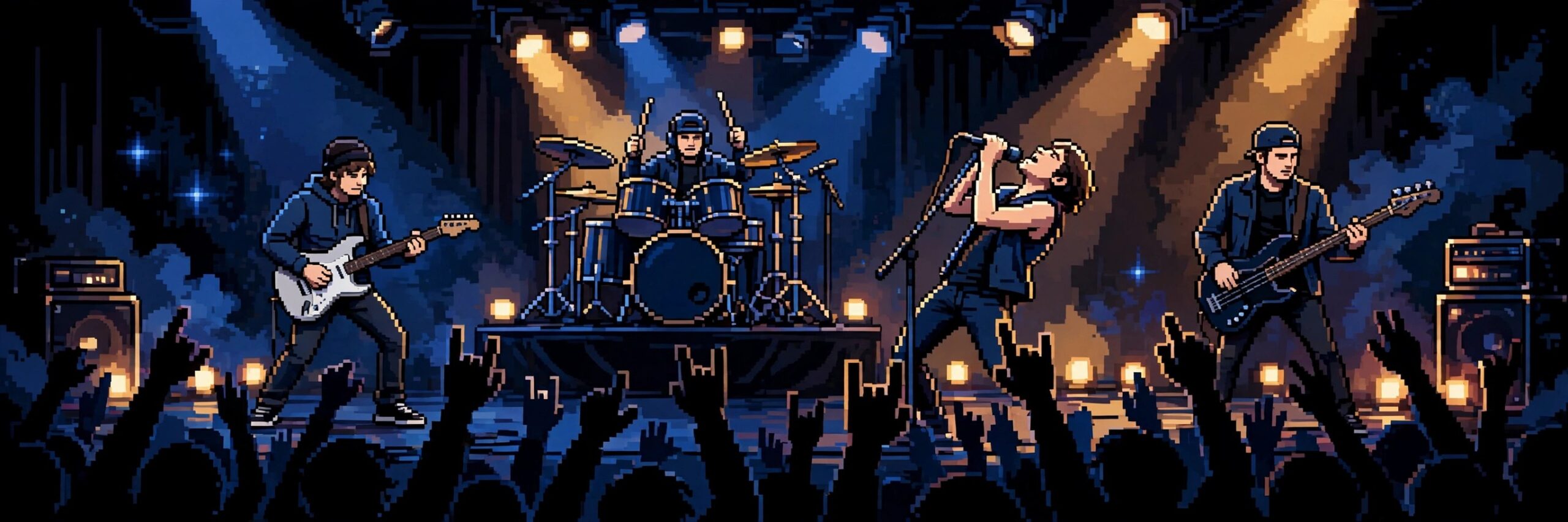
Rock Band Turned One Guitar Into a Whole Band
It sounds obvious now. That is rather the point. Guitar Hero had already taught millions of people to read a scrolling note highway on a guitar-shaped controller, and Harmonix had also made the Karaoke Revolution singing games. So they asked the simple question nobody else had shipped: why is only one person playing?
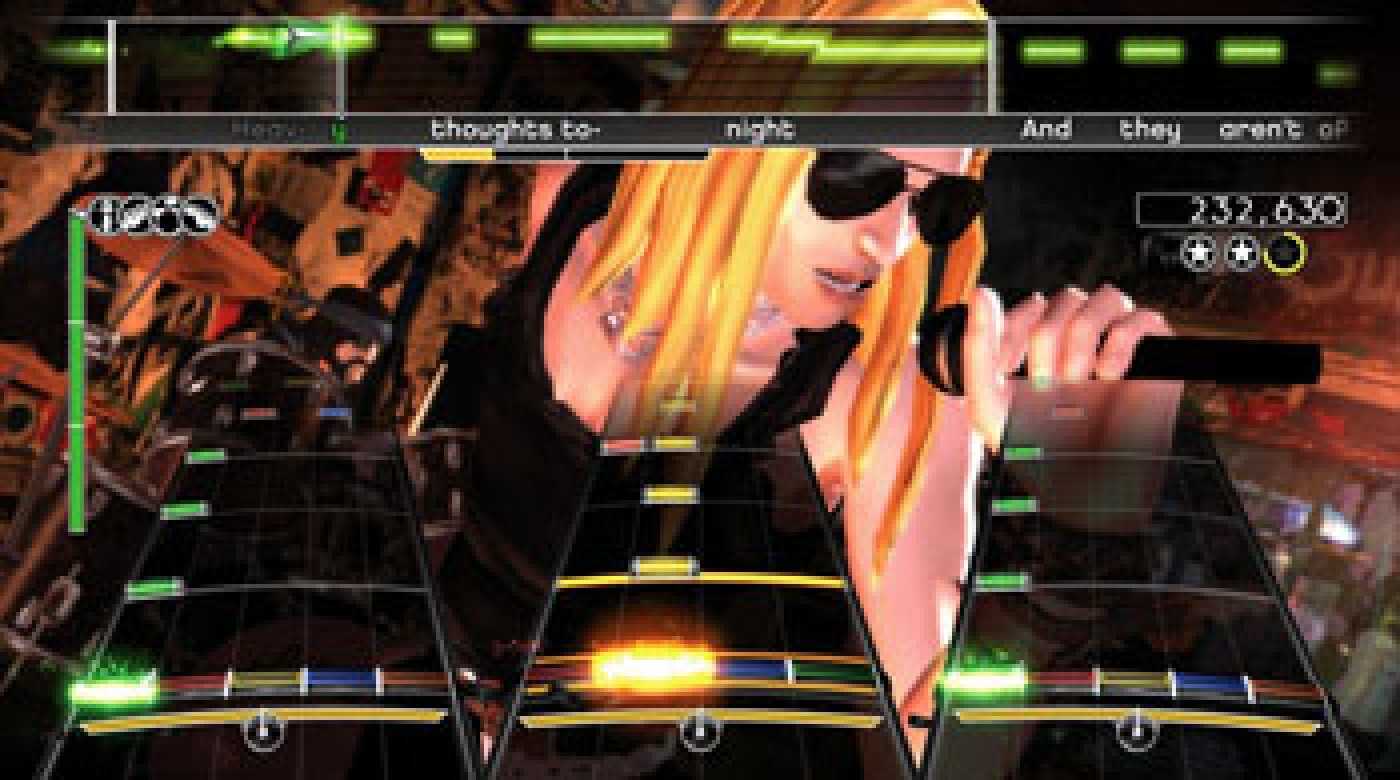
The answer put three note highways side by side — lead guitar on the left, drums in the middle, bass on the right — and ran the vocal line across the top of the screen, lyrics and pitch laid out for whoever drew the microphone. Four players. Four difficulties. One shared performance. An expert drummer could play alongside a friend on easy guitar and the song held together for both of them.
What made it a band game, rather than four solo games stapled together, was the mercy in the design. Fail out, and a bandmate could spend their Overdrive — the game’s stored-up star power — to haul you back in. Twice, anyway. Fail a third time and you watched the rest of the song from the wings while the Band Meter sagged. Unison phrases paid the whole group for nailing the same section together. The Big Rock Ending let everyone flail gloriously for bonus points. Failing was communal. So was the rescue.
Band World Tour, the main multiplayer mode on Xbox 360 and PlayStation 3, wrapped all of that in a career fantasy that still holds up. You created your characters, named the band, designed the logo, then played your way out of small hometown rooms into vans, tour buses and private jets across 41 venues in 17 cities. The character building mattered more than it sounds: on those two versions you made your own rocker — hair, build, clothes, tattoos, even face paint assembled in the art maker — and spent the band’s gig money dressing them in the Rock Shop. The four avatars on stage actually felt like your band, not stock characters.
The PlayStation 2 version, built by Pi Studios, was a stripped-back run through set tiers. Europe had to wait, too — the Xbox 360 version reached Europe on May 23, 2008, with the other versions following that September. But the core promise travelled intact. This was not a game about being the best player in the room. It was a game about the room.
A $169.99 Box and the Plastic-Instrument Era
None of it came cheap, and Harmonix and MTV Games never pretended otherwise. The Special Edition bundle launched at $169.99 in North America. The standalone game was $59.99, for anyone who already owned a compatible guitar or a USB microphone. The PlayStation 2 bundle followed on December 18, 2007 at $159.99. In 2007 money the big box cost nearly three games — and EA still warned before launch that it would not be able to make enough of them to meet demand through the holidays.
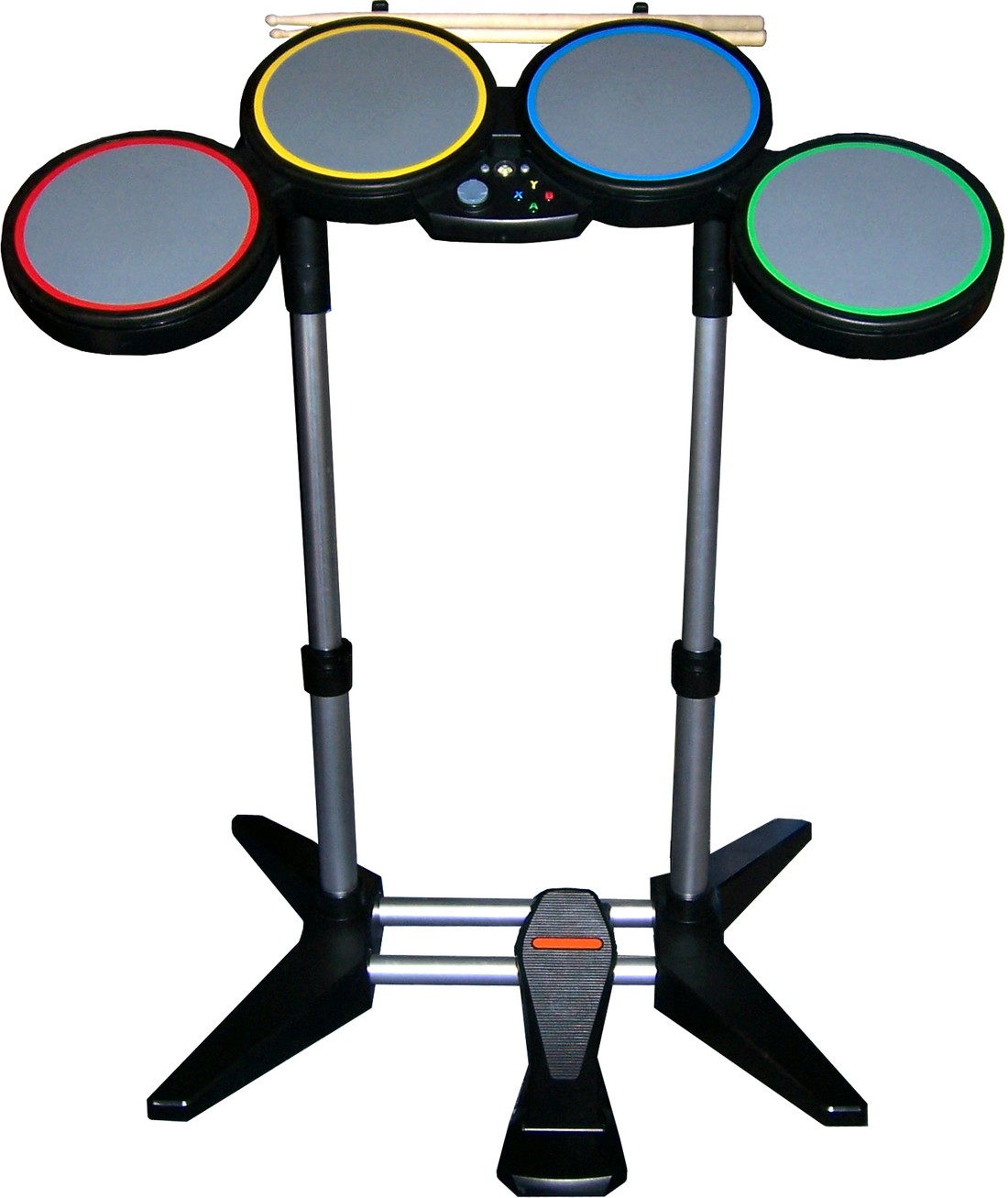
The hardware earned its shelf space. The Stratocaster controller added a second set of smaller fret buttons up near the body for solos, plus an effects switch. The Xbox 360 bundle’s guitar was wired; the PlayStation 3 bundle’s was wireless — a licencing quirk that caused real arguments at the time. But the drum kit was the revelation, and the risk. Four colour-ringed pads, a kick pedal marked by an orange line in the note track, and a pair of real drumsticks in the box. Harmonix’s line was that if you could play the drum parts on Hard, you could pretty much play the drums. Plenty of us tested that claim at parties. The drums were usually the first seat fought over, and the first instrument to wake the neighbours.
That box also started an arms race of plastic. Instruments multiplied across franchises and sequels until spare rooms, closets and eventually charity shops filled with guitars nobody could store. Rock Band did not invent that problem. But its big, brilliant bundle is where the era’s scale — and its eventual storage crisis — truly began.
The Rivalry: Harmonix Against Its Own Creation
Here is the strange part of the Rock Band versus Guitar Hero rivalry: both sides were Harmonix games. Harmonix and RedOctane created Guitar Hero in 2005. Then the music stopped. Activision bought RedOctane in 2006; MTV Networks bought Harmonix that same year; and development of Guitar Hero passed to Neversoft. Harmonix, now owned by MTV, set about building the game that would out-band its own invention.
The heavyweights landed within weeks of each other. Neversoft’s Guitar Hero III: Legends of Rock arrived on October 28, 2007. Rock Band followed on November 20. Harmonix had announced its game back on April 1, 2007, with chief executive Alex Rigopulos promising that Rock Band “takes the core premise of Guitar Hero and expands it tenfold. It lets you create a complete collaborative band.” That word — collaborative — was the whole pitch, and the shot across Activision’s bow.
Guitar Hero III was the bigger single-player phenomenon. Rock Band had the argument that mattered at parties: your friends are the content. Activision answered the following year by expanding Guitar Hero: World Tour into a full-band game of its own — drums, vocals and all — which tells you who won the design argument, even while the sales war raged on.
For a couple of years the rivalry was good for players. Setlists got bolder. Master recordings replaced the cover versions of the early Guitar Hero days. Each side chased the bands the other had not signed. It could not last at that pace, and it didn’t. But the peak was real, and Rock Band’s four-million-unit, $600-million first run was the sound of a genre going mainstream all at once.
A Record Store That Never Closed: The Downloadable-Song Platform
Ask Harmonix what Rock Band was and the boldest answer was never “a game.” It was a platform — a place where music would be released week after week, like a record store that restocked every Tuesday. The disc itself carried 58 songs: 45 in the main setlist, 13 unlockable bonus tracks, 51 of them master recordings. The verified staples still read like a pub jukebox in the best way: Metallica’s “Enter Sandman,” Bon Jovi’s “Wanted Dead or Alive,” The Who’s “Won’t Get Fooled Again,” Deep Purple’s “Highway Star,” Foo Fighters’ “Learn to Fly,” David Bowie’s “Suffragette City” and Blue Öyster Cult’s “(Don’t Fear) The Reaper.”
Then the downloads started. Fifteen songs were available on launch day, individual tracks at $1.99, packs and full albums after that. Players on PlayStation 2 and Wii, whose versions had no download store, were not entirely left out: Harmonix sold them retail Track Packs, standalone discs of songs drawn from the download catalogue, including a pack built entirely from AC/DC’s Live at Donington concert in November 2008.
Most of the disc’s songs could later be exported forward into Rock Band 2. An early, consumer-friendly answer to a question the industry still fumbles: what happens to the library you paid for when the sequel arrives?
The weekly releases ran, uninterrupted, for years. When Harmonix finally ended the regular schedule on April 2, 2013, the last song was Don McLean’s “American Pie” — because of course it was — closing a streak Harmonix counted at 281 consecutive weeks. By then the wider Rock Band catalogue, across discs and downloads, had passed 4,000 songs, and players had made more than 130 million downloadable song purchases. Live-service games are ordinary now. In 2007, a console game that behaved like a subscription to rock music was genuinely new, and Rock Band’s store is where a lot of us learned the habit.
The Crash Came for the Whole Genre
The fall was as fast as the rise. Music-game sales, which NPD figures put at more than $1.6 billion in 2008, dropped under $900 million in 2009. The causes piled up like guitars in a hallway: too many sequels and spin-offs chasing the same families, expensive instruments nobody needed twice, song libraries locked to rival franchises, and casual players drifting to the next novelty just as money got tight.
Rock Band 3 arrived in 2010 with a keyboard and ambitious pro-instrument modes, and was admired more than it was bought. Activision shut down its Guitar Hero business in February 2011. Harmonix survived the wreck as a smaller independent studio, and the weekly DLC kept flowing for two more years — a loyal afterlife the sales charts had stopped measuring. The genre had not failed, exactly. It had done a decade’s worth of business in about four years, and the bill arrived all at once.
What Rock Band Left Behind
The afterlife kept going. Harmonix brought the series back with Rock Band 4 on October 6, 2015, published by Harmonix itself, and — crucially — let players bring most of their old downloadable libraries with them. Weekly DLC for Rock Band 4 ran until January 25, 2024. Epic Games had acquired Harmonix in 2021, and the studio’s next act, Fortnite Festival, launched inside Fortnite in December 2023 carrying Rock Band’s DNA in its note highways. The story has a sadder recent chapter, too: as we covered in our report on Rock Band 4’s delisting, the game’s ten-year music licences began expiring in October 2025, a reminder that a library built on licensed songs is always partly rented.
And yet the original game’s legacy is sitting in living rooms, not servers. Rock Band normalised the idea that a game could be a platform for music, that your purchases should follow you between sequels, and that the best multiplayer is sometimes four friends in one room making a glorious noise. If you want the full story of the machine so many of those first tours were played on, start with our Xbox 360 hub. The drum kits are quieter now, the plastic is yellowing, and the store is dark. But put “Enter Sandman” on in a room with three friends and a working kit, and the 19-year-old game still does the thing it was built to do. The band gets back together. It always does.
— Chip
Rock Band launched on November 20 — you can see it in its place on our November 20 in Gaming History page, alongside everything else that shares its day.