
There are games you remember playing, and games you remember seeing. Shadow of the Beast is the second kind first. I can still picture the exact moment: a friend’s Amiga 500, a borrowed monitor glowing in a dark bedroom, and a sky that would not sit still. Mountains slid past at one speed, trees at another, fences at a third, and somewhere in front of all of it a strange, shackled beast-man ran and ran, as if the whole world was scrolling out from under his feet. Nothing on a home computer was supposed to look like that in 1989. For a lot of us, that running figure is not just a game. He is the Amiga itself.
This is the full Shadow of the Beast Amiga history — how a tiny British team built a technical showpiece so far ahead of its rivals that it sold computers, why Roger Dean’s cover art and David Whittaker’s music turned a brutally hard platform game into a legend, and why, thirty-seven years on, this remains the first title people name when the Amiga comes up.
At a glance: Developer: Reflections (Martin Edmondson and Paul Howarth) · Publisher: Psygnosis · Released: 1989, Amiga first · Genre: action platformer · Composer: David Whittaker · Cover art: Roger Dean · Sequels: Shadow of the Beast II (1990), Shadow of the Beast III (1992) · Reimagining: PlayStation 4, 2016, by Heavy Spectrum
Two men, a technical manual, and nine months
Shadow of the Beast began at Reflections, the small Newcastle studio founded around Martin Edmondson and Paul Howarth. Beast was only their second 16-bit game, after the futuristic sports title Ballistix, and Edmondson has never hidden what drove it. He has described the book that most inspired the game not as any work of fiction, but as the Amiga Technical Reference Manual. The pair wanted to find out, in public, exactly what Commodore’s custom hardware could do.
They designed and built the game over the course of nine months, and they made one decision that shaped everything: the Amiga version was written first. That sounds obvious now, but in 1989 most games were built to the lowest common denominator and ported up. Edmondson and Howarth did the opposite. They aimed the game squarely at the Amiga’s hardware sprites and scrolling, used sprite multiplexing to push more moving objects onto the screen than the machine was meant to show, and described the result, without much modesty, as their most ambitious project to date. Publisher Psygnosis — the Liverpool label with the owl logo and the most striking boxes in the business — knew exactly what it had. This was not just a game. It was a demonstration.
Shadow of the Beast Amiga owners showed their friends: the parallax trick
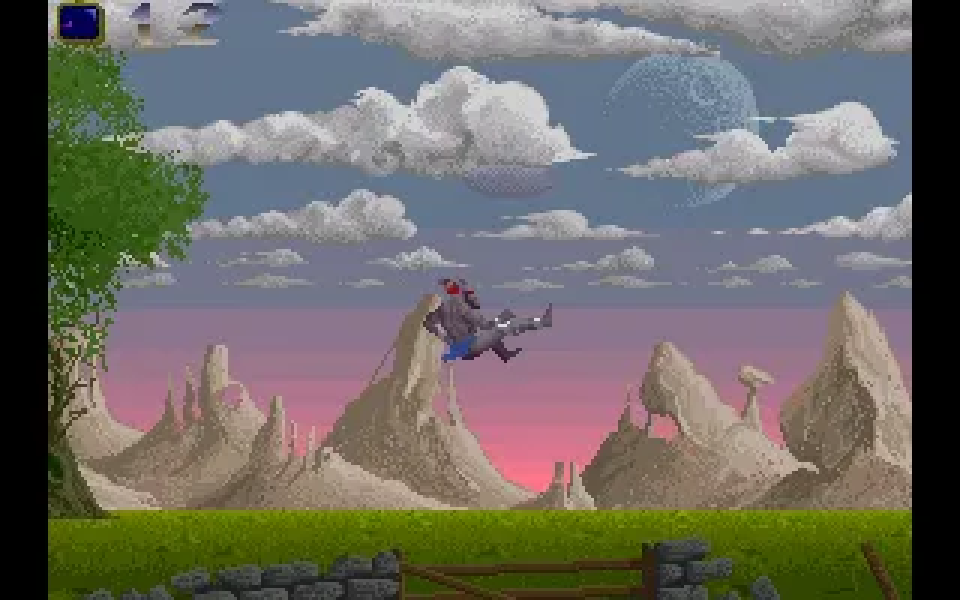
Every legend about this game starts with the opening run, and the numbers behind it still impress. Shadow of the Beast pushes up to twelve levels of parallax scrolling — backdrop layers moving independently to fake depth — with up to 128 colours on screen at once, at a smooth 50 frames per second on a European Amiga. Edmondson later explained that the look was inspired by staring sideways out of a speeding train: foreground trees and pylons whip past while distant mountains barely move. Stack a dozen of those layers behind a huge, smoothly animated sprite, under a gradient sky that melts from orange into violet, and a flat 2D screen suddenly had weather, distance and mood.
Context is what makes it remarkable. The Atari ST, the Amiga’s great rival, could not do hardware scrolling like this. Arcade boards could, but they cost more than a house deposit. In 1989, if you wanted to show a sceptical friend why the Amiga mattered — why it was worth more than an ST, more than a console, more than the family PC — you did not show them a spreadsheet. You loaded Beast, turned the monitor up, and watched their face during the first thirty seconds. Retailers knew it. The game became a shop-window demo, the disc that lived in display machines, because nothing else on the shelf made the hardware look that good.
Aarbron’s long walk: plains above, hell below
Underneath the spectacle there is a story, told mostly in the manual and in images rather than words. You play Aarbron, kidnapped as a child by the priests of the Beast Lord Maletoth and twisted by magic and drugs into the Beast Messenger — a creature built to serve. His buried human memory returns when he watches a sacrifice and recognises the victim’s face: his own father. What follows is a revenge walk across the land of Karamoon to break Maletoth’s hold and win back his human form.
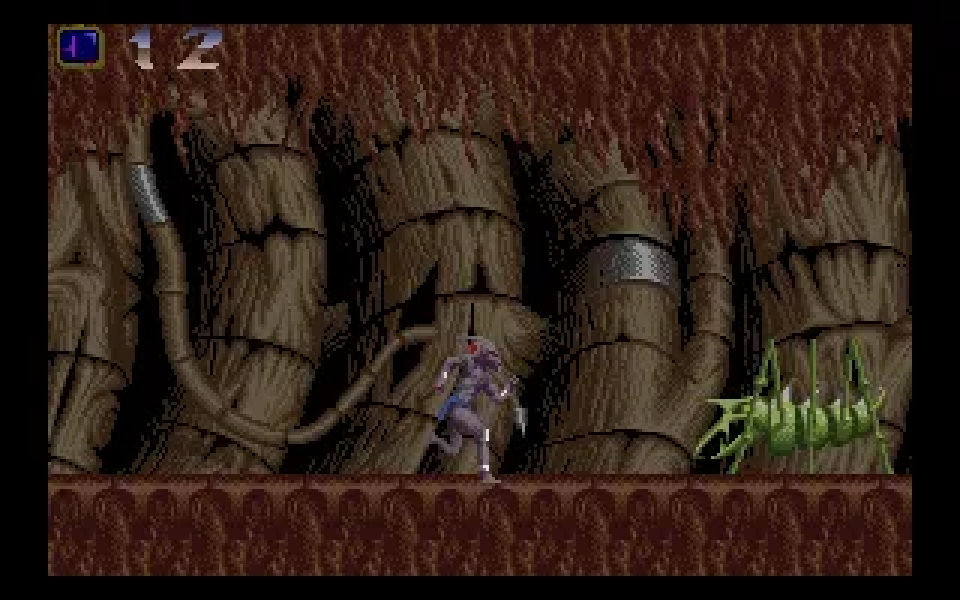
The structure is a tale of two games. Above ground, Beast is a running gauntlet across plains and the Eerie Forest — wide, flat, fast, built to show off the scrolling — punctuated by creatures that erupt from the earth, swoop from the sky or simply charge. At fixed points you descend: down a well, into a hollow tree, and the game changes character completely. Underground, and later inside the castle, it becomes a ladder-climbing, trap-dodging dungeon crawl full of switches, potions, power orbs and locked routes, where the order you do things in matters and a wrong turn costs health you cannot spare. Aarbron starts with his fists, and slowly earns better weapons — a power punch, fireballs, eventually even a laser gun and a jetpack section that turns the game briefly into a shooter. It is a strange, lopsided, atmospheric design, and that strangeness is part of why it stuck in people’s heads when a hundred tidier platformers did not.
The sound of the Beast: David Whittaker’s otherworldly score
If the graphics were the shop window, the music was the thing you took home in your head. David Whittaker, one of the most prolific game composers of the era, was given something composers rarely got: memory. Because Beast was a showcase, he could use high-quality instrument samples, created on a Korg M1 synthesiser and sampled at 20 kHz, and he wrote six main pieces, each with its own sub-theme, to follow the changing scenes of the game.
The result — pan pipes, deep synth pads, sudden percussion — sounded like nothing else on a home computer. It was eerie, lonely and faintly ethnic in a way that matched Dean’s alien landscapes perfectly, and it became a template: for years afterwards, moody sampled soundtracks on the Amiga were chasing the Beast sound. Whittaker’s themes were still being celebrated decades later — arranged on the Immortal Amiga music compilation in 1999, and included as an unlockable original soundtrack in the 2016 remake. Ask an Amiga owner to hum one game tune from 1989 and there is a fair chance you get the Beast title theme.
A £35 game in an oversized box, with a T-shirt inside
Psygnosis priced Shadow of the Beast like it believed its own hype. The game launched at £35 — an unheard-of price for a computer game in 1989, when £24.95 was already premium — and retrospectives that quote the exact tag usually put it at £34.95. For your money you got an oversized long box and, folded inside, a black T-shirt printed with the cover art. One Psygnosis insider later joked that the “free” T-shirt in effect cost you a tenner of that price. Nobody who was there remembers feeling cheated. The box felt like an event: heavy, black, beautiful, and sized like a vinyl record sleeve in a market of flimsy cardboard.
It worked. Beast was a commercial as well as a critical success, the kind of release that justified the machine it ran on. Dragon magazine would give both of the first two Beast games five stars out of five, and in 1996 Computer Gaming World placed the original at number 76 in its list of the best computer games ever released. But the honest verdict of history is more specific than the review scores: plenty of better-playing games came and went. Very few became the reason people bought the hardware.
The box that became a poster: Roger Dean’s cover
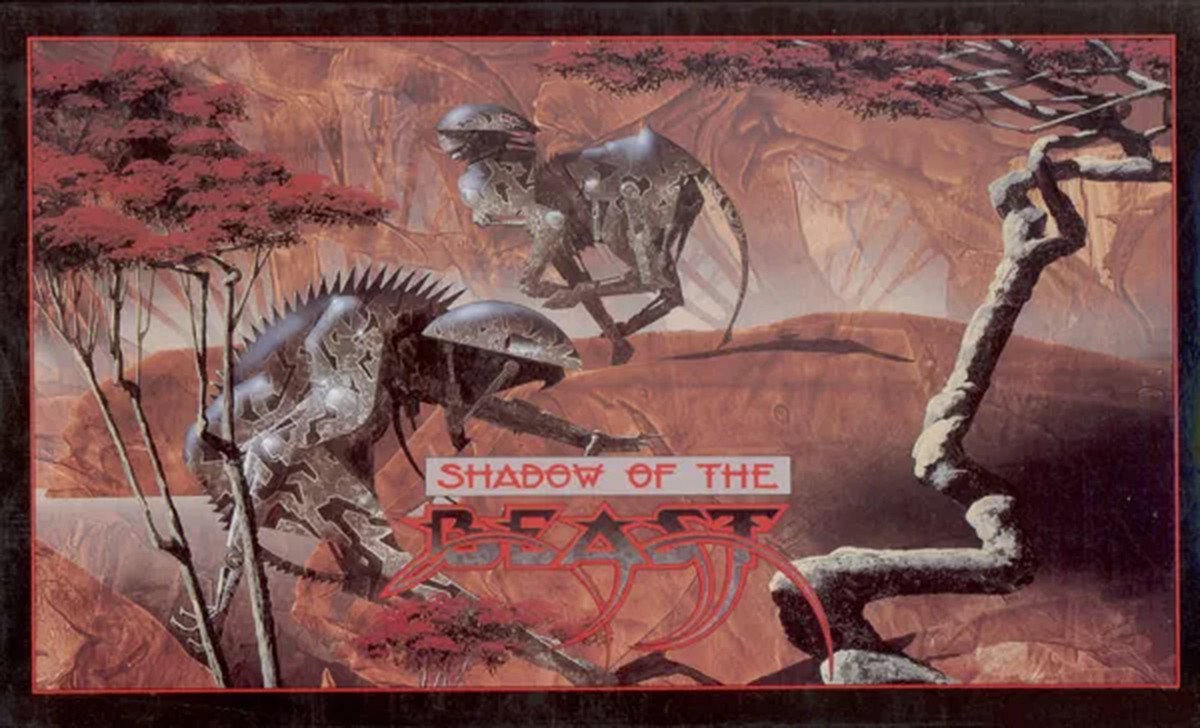
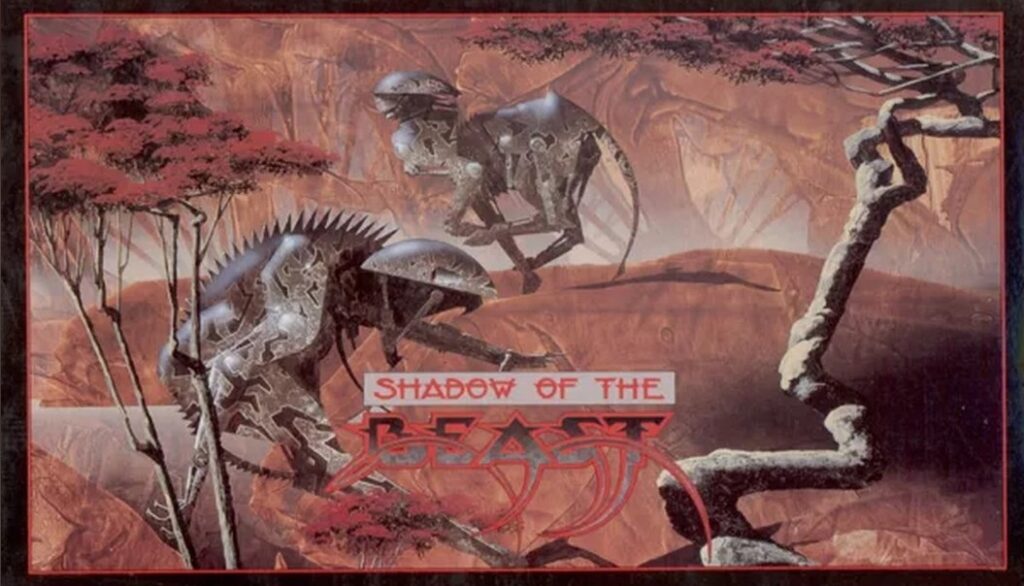
Before anyone saw a screenshot, they saw the box. Roger Dean, the artist famous for Yes album sleeves and floating islands, painted the Beast cover: strange reptilian machine-creatures striding through a sunburnt alien landscape, framed by jagged trees, with a ghostly forest teasing in the distance. Dean painted covers for several Psygnosis titles, but Beast is the one that became iconic — the image that was printed on the bundled T-shirt, pinned to bedroom walls, and reused, in a super-high-resolution scan Dean himself provided, as an unlockable in the 2016 remake.
Dean’s art did something screenshots could not: it promised a world. The game inside was a hard, sometimes sparse action platformer, but the cover told you it was a prog-rock odyssey, a place with history and dread in it. That gap between promise and product is usually a criticism. With Beast it became the brand. When Thomas picked a single image to represent this game in our social feeds this week, it was not a screenshot. It was Dean’s painting. Thirty-seven years later, it still does the selling.
Beautiful, brutal, and proud of it
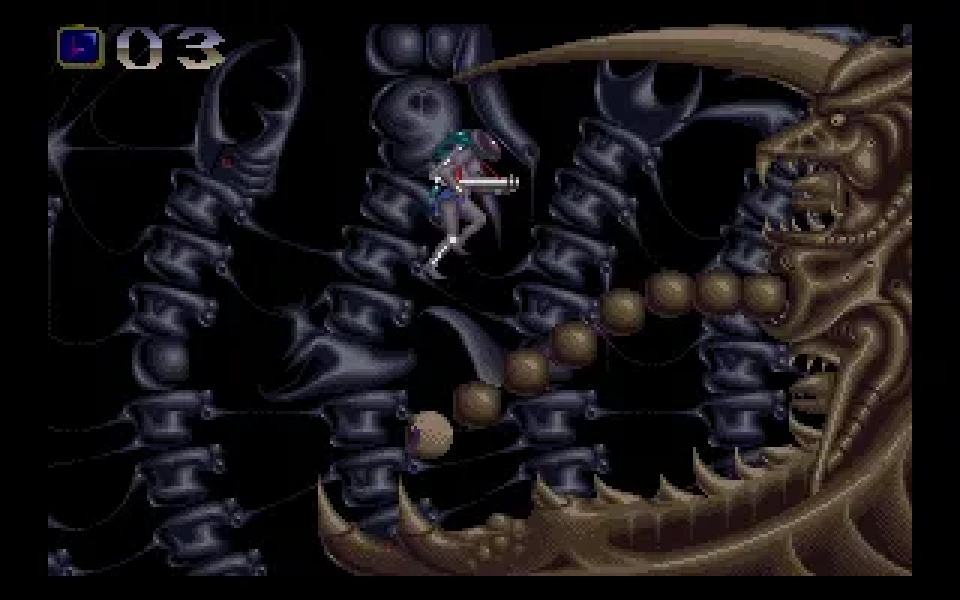
Now the confession every Beast veteran makes: the game is brutally, deliberately hard. Edmondson designed it that way on purpose — he liked difficult games and got frustrated if one was too easy. You have one life and twelve hit points. Enemies arrive in memorised patterns, traps are placed exactly where a first-time player will blunder into them, and progress depends on learning routes the hard way: which orb to smash, which potion to save, which boss needs which weapon. The hydra cannot be beaten without finding the gun first. The final reckoning is with a gargantuan minion of Maletoth of which you only ever see a hand and a foot.
Modern players bounce off it, and honestly, some of us did in 1989 too. But the difficulty is inseparable from the myth. Beast was not a game you rented and finished on a Saturday. It was a game you lived with for months, swapping route knowledge in playgrounds and magazines, while the music burrowed in. A skilled run can be finished in under half an hour — which only underlines the point: this was a game about mastery of a short, dense, hostile world, years before that design bargain had a name.
The Beast walks everywhere: the ports
Success that loud gets ported, and Beast went almost everywhere: Atari ST, Mega Drive/Genesis, Master System, Atari Lynx, FM Towns, PC Engine CD (Super CD-ROM²), Commodore 64, ZX Spectrum and Amstrad CPC. The conversions are a history of the era in miniature. DMA Design handled the C64 and PC Engine CD versions; Gremlin Graphics did the Spectrum and CPC; WJS Design the Mega Drive; TecMagik the Master System; Digital Developments the Lynx; and the FM Towns version was programmed by Tim Ansell of Creative Assembly, of all people. The CD-based versions — FM Towns and PC Engine CD — are the collectors’ favourites, with arranged CD soundtracks, and IGN’s Travis Fahs later called the FM Towns port a superior version of the game.
Two footnotes deserve honesty. The Mega Drive version, converted from the 50 Hz Amiga original, ran faster than intended on North American Genesis hardware, which turned an unforgiving game into a near-impossible one — a flaw retrospectives still flag. And the SNES version, Super Shadow of the Beast, was shown at the 1992 Summer Consumer Electronics Show and then never released at all. An Atari 8-bit version also died in development. Beast conquered a lot of machines. Even it had limits.
Two sequels, a long silence, and a resurrection
Shadow of the Beast II arrived in 1990: Aarbron, still half-beast, crossing Karamoon to rescue his kidnapped sister from the Beast Mage Zelek. Tim Wright — later of Lemmings and WipEout fame, working as CoLD SToRAGE — took over the music, Roger Dean painted the cover again, and the box again contained a T-shirt. If anything it was darker and more cryptic than the original. Shadow of the Beast III followed in 1992, Amiga-only, with a more thoughtful puzzle-and-action structure, no T-shirt this time — a pin badge instead — and it closed the trilogy with the series’ best-regarded actual game design, even if the moment had passed.
The long silence ended at Gamescom 2013, when a reimagining was announced for PlayStation 4. Heavy Spectrum Entertainment Labs, led by Matt Birch — who had first played the original as a 16-year-old at a sleepover in 1989 and called it “like seeing Star Wars for the first time” — released their Shadow of the Beast in May 2016. It is a bloodier, combo-driven take on Aarbron’s story, scored by Ian Livingstone, and it treats the original with open reverence: Dean contributed a new creature design, Whittaker’s original score is unlockable, Dean’s original cover painting can be unlocked in high resolution, and the full Amiga original itself is included as an unlockable emulation — by the developer’s account, the first published Amiga emulation on a Sony console. Even the Lemmings connection came full circle in spirit: the original Lemmings had already paid tribute with its special levels “A Beast of a Level” and “A Beast II of a Level,” music and all.
Why the Beast still defines the Amiga
So why this game, above Sensible Soccer, above Lemmings, above a dozen objectively finer designs? Because Shadow of the Beast is the purest expression of what the Amiga promised in 1989: that a home computer could deliver arcade spectacle, album-cover art and sampled music that sounded like the future, all at once, in your bedroom. Edmondson himself, looking back during Beast III’s development, called the original simply a “graphics showcase” and a case of right place, right time. He meant it as deflation. History took it as a definition.
Every era of gaming has a title that is less a game than a proof — the disc you load to justify the machine. The Amiga’s proof is a beast-man running under a melting sky, twelve layers deep, while pan pipes play. We have better platformers now. We have kinder ones, cleverer ones, longer ones. We do not have another moment quite like the first time that sky started to move. That is why Shadow of the Beast still defines the Amiga for a generation — and why, if you grew up with one, you just heard the music again.