
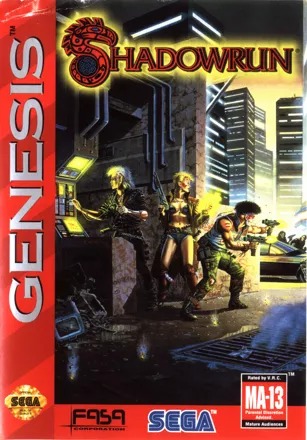
At a glance: Shadowrun · Genesis · developed by BlueSky Software · published by Sega · 1994, North America only · open-world action role-playing game · three character classes · single player
In 1994 the name Shadowrun meant two completely unrelated cartridges. Beam Software’s Super Nintendo version was a moody, linear adventure about an amnesiac named Jake Armitage. BlueSky Software’s Genesis game — released only in North America — is something else entirely: an open, systems-heavy role-playing game adapted directly from FASA’s tabletop original, and routinely described by those who know the source books as the most faithful Shadowrun ever coded. You are Joshua, newly arrived in a Seattle where magic returned to the world decades ago. Your brother Michael is dead, cut down with his whole team on a run in the Salish-Shidhe wilderness — an ambush somebody filmed, and the footage was broadcast. You have a name to clear up and a question to answer: who sent Michael out there, and why? Everything the game does grows out of that investigation, and almost none of it is fenced off.
Seattle Does Not Care About You Yet
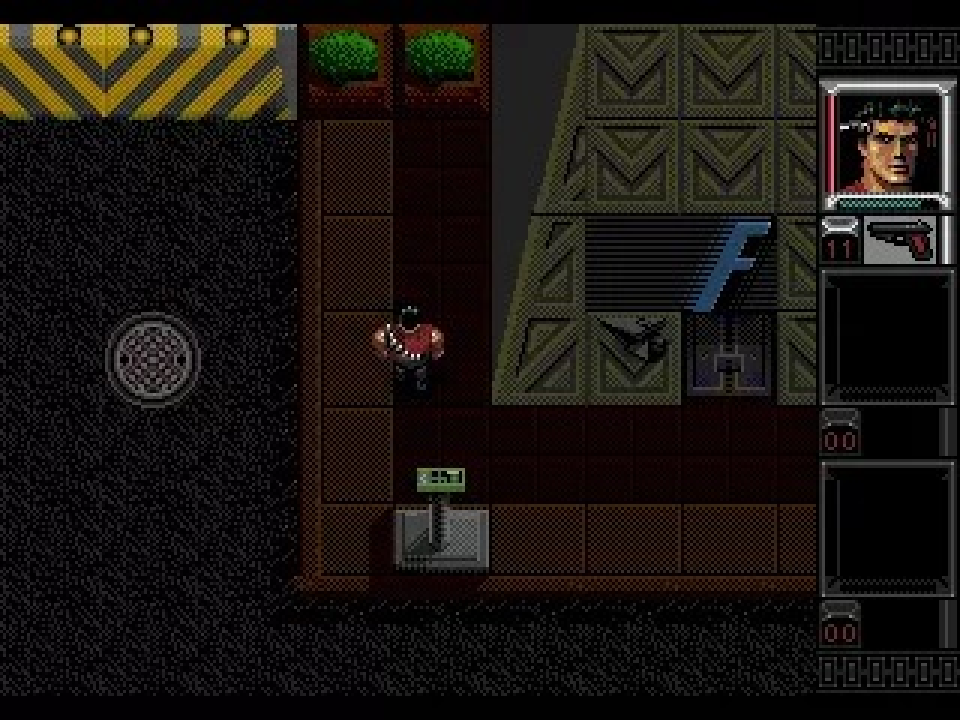
The opening hours are famously unkind, and it is worth warning about them properly. Joshua begins as the softest target in any district he enters: a pair of unarmed street toughs is a life-threatening encounter, he cannot outrun trouble he cannot fight, and while any enemy shares the screen he cannot slip through a doorway to safety — early sessions involve a lot of circling blocks, hunting for the moment the coast clears. This is not cruelty for its own sake. It is the game’s thesis statement: in this Seattle, survival is a profession, and you have not learned it yet. The way up is work. Fixers styling themselves Mr. Johnson hire runners out of bars and back rooms, each Johnson favouring a line of business — courier jobs moving packages across town, acquisition runs that break into corporate offices for whatever sits in the safe, Matrix heists that steal data or shut a system down entirely. Completed runs pay in nuyen and, more importantly, karma, the game’s experience currency, which you spend directly on the attributes and skills you choose. There is no level ladder and no grinding quota; your brother’s killers wait at the end of a career you build job by job.
Choice of class bends rather than binds. A Street Samurai starts built for gunplay, a Decker for the Matrix, a Gator Shaman for magic — and only the shaman will ever cast, which is the one hard wall in the design. Samurai can learn to hack; deckers can learn to shoot. Around Joshua you hire help, by the run or permanently at a steeper price, and permanent runners earn karma and grow alongside you, until the lone investigator of the first hour is leading a small firm. One runner, earned through a side quest, joins for free and is worth the detour on principle. Conversations run on bump-and-choose simplicity — walk into somebody, pick from lettered responses — with random encounters folded into the same system: strangers begging help, dealers offering hardware that fell off a corporate truck. The portraits in these exchanges are the best-drawn faces on the Genesis, detailed enough to make you suspicious of exactly the people you should be suspicious of.
Getting around the investigation is its own small pleasure. Seattle is a taxi ride between districts — call a cab and a route map appears, neighbourhoods unlocking as your business and reputation spread — and Joshua’s Pocket Secretary keeps an electronic notebook of every lead, name and half-heard rumour, so the detective work never collapses into the era’s usual notebook-and-pencil homework. Corporate enclaves like the Renraku Arcology answer to their own security state, Lone Star patrols the streets, and the further the plot walks you from downtown, the stranger the jurisdictions get, until the wilderness where Michael died is on the itinerary and the game trusts you to go back there equipped like somebody who intends to return. That structure — hub, work, reputation, new district — is now the standard skeleton of the open RPG. In 1994, on a cartridge, it was close to sorcery.
The Matrix Is a Second Game
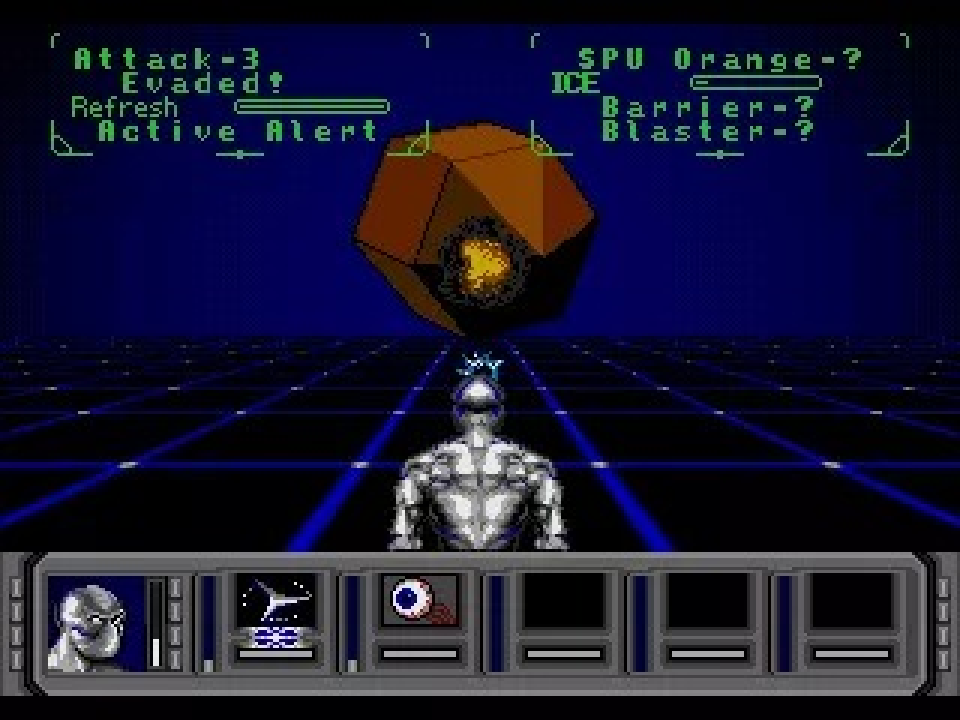
Jack in, and the game changes genre. Corporate systems are rendered as node-and-path networks patrolled by Intrusion Countermeasures — ICE — each guarding a function: cameras to blind, locks to release, files to steal, alarms to strangle before they wake the building. Your decker avatar fights ICE with an arsenal of purchased programs, and two breeds of ICE still inspire genuine dread in anyone who played this in 1994. Black ICE ignores your avatar and attacks the meat body slumped at the terminal; Tar Pit doesn’t attack your programs, it deletes them — permanently, including the top-tier attack software you saved fifty thousand nuyen to buy. Systems you have cracked stay cracked, reachable later from any terminal, so a good decker progressively unwires the city’s security for the rest of the team. On the street side of the ledger, gunplay runs on shared ammunition clips that feed every weapon in the party — a bookkeeping mercy — while shamans manage spell drain with expendable fetishes and a shelf of talismans, invisibility and healing among the working magics. However a problem is shaped, the game usually accepts two or three different professions as the answer.
Plain Looks, Dense World
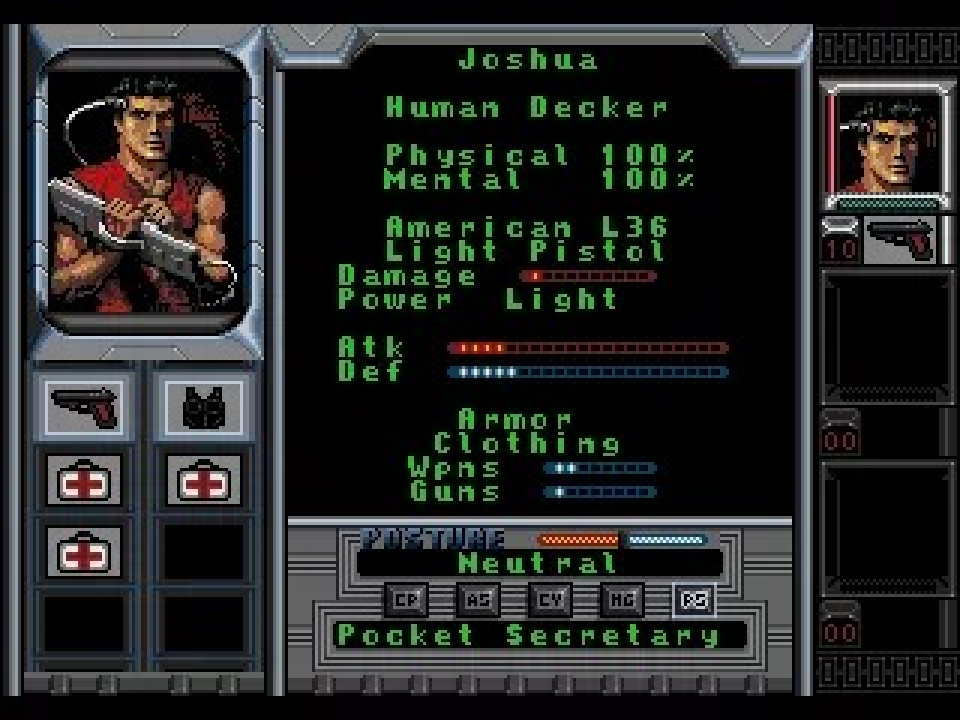
Nobody will mistake this for a pretty cartridge. The top-down figures are blocky, walk cycles are stiff, and every death in Seattle is commemorated by the same one-frame chalk-outline collapse. What the art lacks in frames it returns in place: the Redmond Barrens rot convincingly, the Renraku Arcology gleams with corporate hygiene, and the Salish-Shidhe offers a green contrast with dangers of its own. Sound is squelchy Genesis fare — a shotgun at least out-grunts a pistol — and the music changes often enough, district to district, never to outstay its welcome. Judge the package by density instead: a full career’s worth of procedurally varied work, an investigation that respects your intelligence, and a city that opens as your reputation does. It is no accident that this cartridge is the one BioWare’s founders have cited as a formative influence; you can feel the open-RPG blueprint being drafted in real time.
“The rare licensed RPG that trusts its source material and its player equally: an open Seattle, a dead brother, and a hundred ways to earn the truth.”
The Verdict
Come through the brutal first hours and this becomes the deepest role-playing game on the Genesis — save early, save often, because karma is generous and Lone Star is not — deeper than its famous SNES namesake by an order of magnitude, and truer to FASA’s world than anything before the modern trilogy. The presentation creaks, the difficulty curve opens with a wall, and magic’s exclusivity will irk some builds. The rest is landmark stuff: work that matters, systems that interlock, a murder that pulls you through all of it. If this shelf has a masterpiece, you’re reading about it.
Verdict: the Genesis’s most ambitious RPG — an open, faithful, quietly pioneering Shadowrun that rewards every hour it demands — 8.5.
Keep reading: the Genesis system archive