
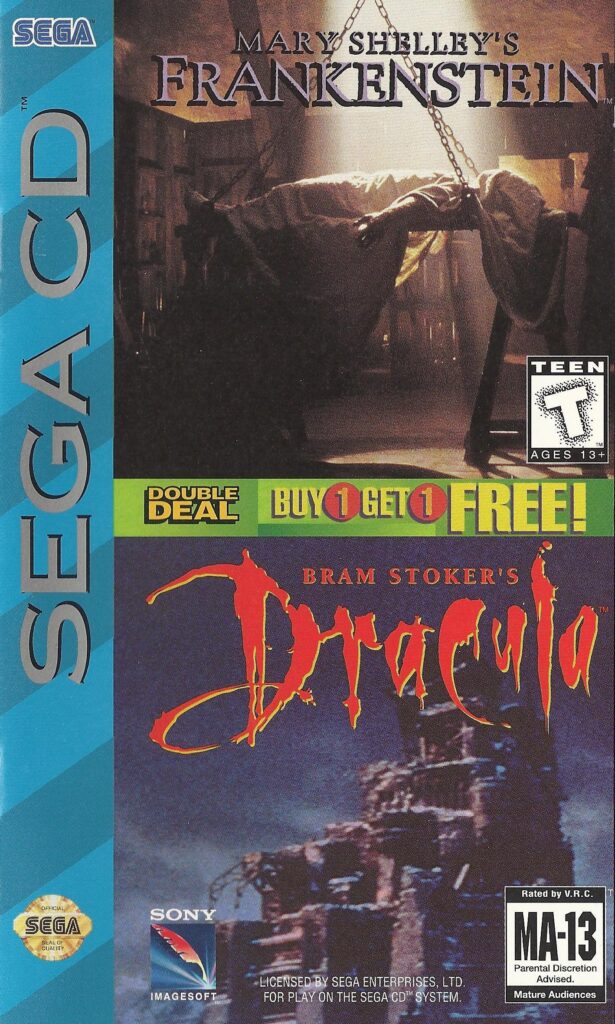
At a glance: Mary Shelley’s Frankenstein · Sega CD · developed by Psygnosis · published by Sony Imagesoft · December 1994 (US), only in the Double Deal pack with Bram Stoker’s Dracula · adventure/fighting hybrid · about an hour · 1 player
Kenneth Branagh’s 1994 film was Hollywood returning to a classic with a big budget and a point to prove: Robert De Niro as the Creature, no neck bolts, no groaning — Mary Shelley’s novel taken seriously at last. The game tie-ins followed the era’s usual split. On cartridge, Bits Studios made a conventional platformer. On Sega CD, Psygnosis tried something stranger and more ambitious: a graphic adventure in the point-and-click spirit, interrupted at intervals by one-on-one fighting. It is a patchwork of genres sewn into one shambling whole, which is either the most appropriate design a Frankenstein game could have, or an accident the developers would have preferred phrased differently. Probably both.
Three Games Sewn into One Skin
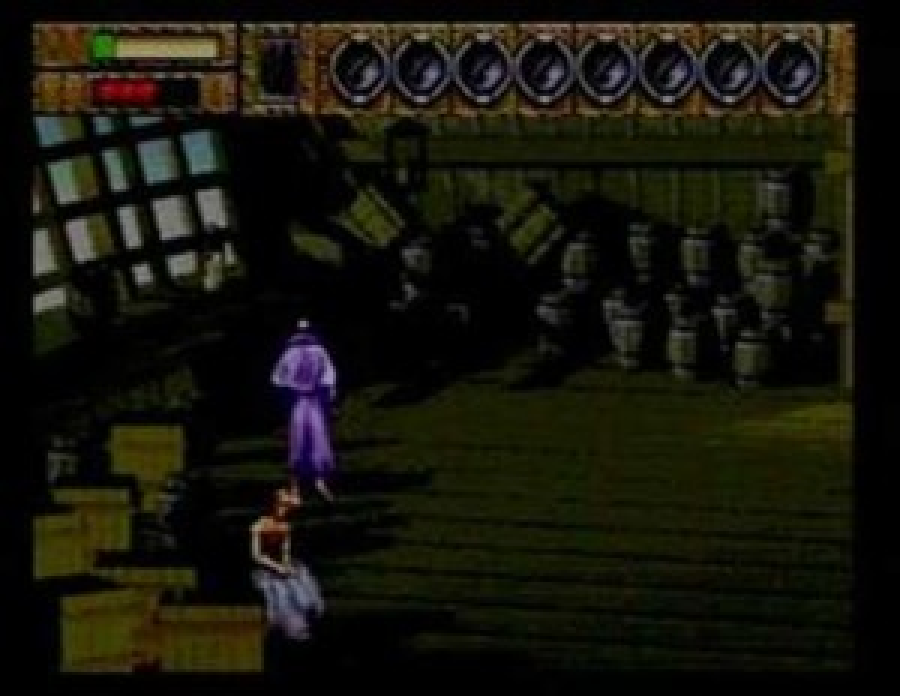
You are the Creature, waking on the slab to find Victor already gone — he thinks the experiment failed and has gone for a lie-down, which gives you the run of the laboratory and a gentle introduction to the game’s three interlocking modes. Indoors, it is a side-view adventure. A pool of electric eels blocks your exit; a shelf holds acid that will dissolve them; captions carry the Creature’s thoughts and nudge you towards the next action. One button picks things up, one reviews your inventory against a set of still renders, one uses what you are holding. The puzzles are plain, the solutions mostly announce themselves, and the fun is in the occasional flash of character: this Creature solves problems the way the novel’s Creature would, including at least one piece of cheerful arson against an obstructive shopkeeper.
Between buildings, the view pulls back to an isometric overworld in the role-playing style, and you wander Ingolstadt, the German woods and Geneva looking for doors worth entering. It is serviceable, unhurried and — once the forest arrives — actively padded, because the forest is a maze, and the maze exists for the oldest reason in game design: without it, and without a few return trips to familiar streets after dark, the whole journey would be shorter than it already is. Which is saying something, as we will come to.
The interface deserves a small defence, because it was doing something genuinely unusual for a console adventure of the period. Rather than icons or verbs, the game gives you the Creature’s own inner voice, laid across the screen as captions whenever curiosity strikes — examine a door, a book, a window, and the response arrives as his tentative, newly awakened reasoning. It is a neat solution to the perennial problem of making a silent protagonist expressive on hardware without a mouse, and it keeps the literary tone even in cupboard-searching. When it works, rifling through Victor’s laboratory feels like thinking in somebody else’s borrowed brain.
Every Argument Settled with Fisticuffs
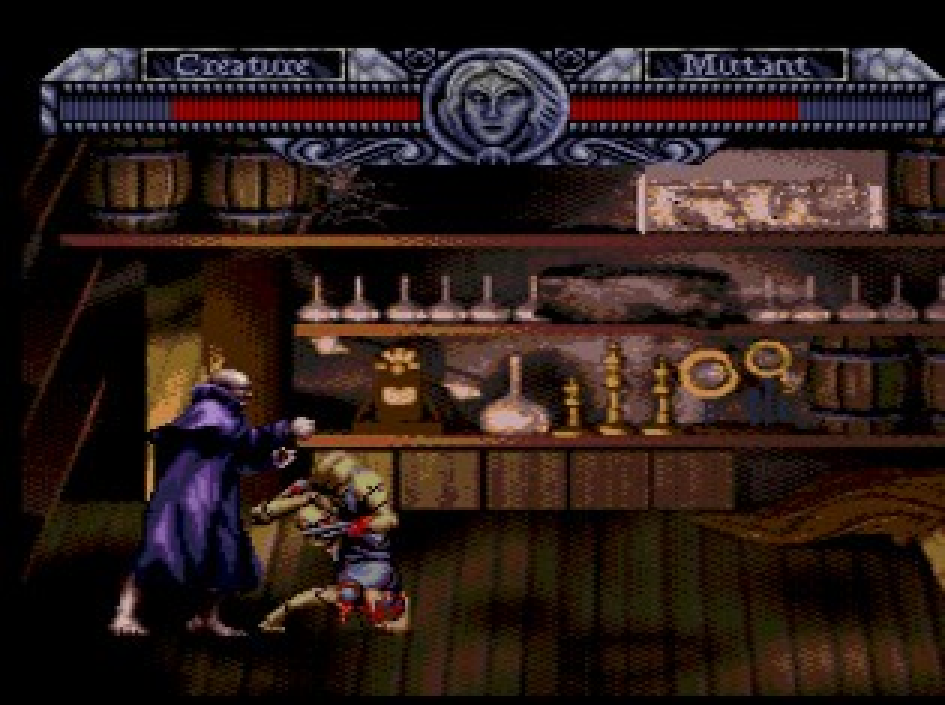
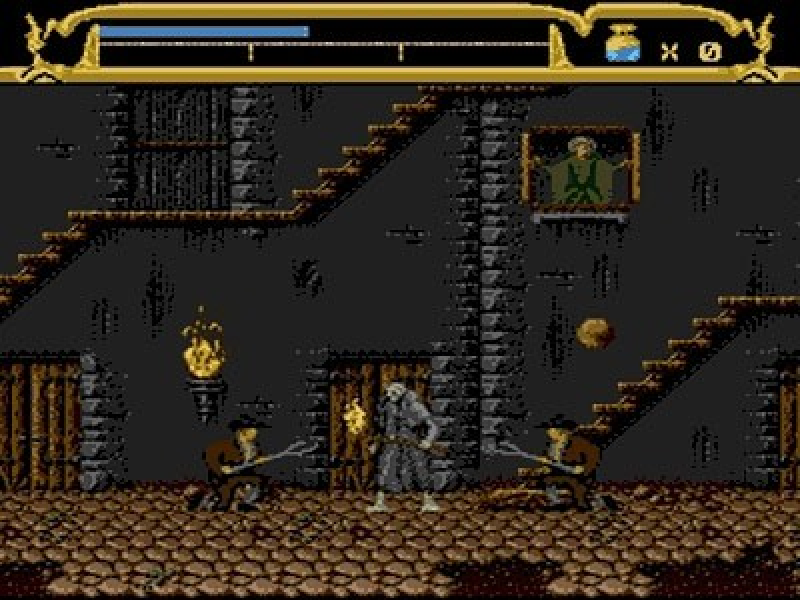
The third mode is where the design loses its composure entirely. Wander into the wrong company — a failed experiment in a supply closet, a wolf, a ship’s captain, eventually Victor himself, who turns out to have trained in taekwondo — and conversation is cancelled in favour of a two-dimensional fighting game, complete with health bars. Punch, kick, block; directional taps bend those into headbutts and sweeps of varying reliability. In the abstract it is a defensible idea — the Creature’s story is full of violence — but in practice it translates every moral confrontation in one of literature’s great arguments into a bout, and the bouts themselves are the weakest thing here. Your moveset never grows, there is no difficulty setting, and opponents come at you relentlessly from the first bell, leaping and rolling in a way that encourages the cheapest available response: crouch in a corner and punch, or lean on one rushing special move until the problem stops. A game about the tragedy of a thinking creature, solved repeatedly by hitting people until they fall over, has perhaps missed a memo from its source material.
To be fair to the stitching, the adventure portions it interrupts are perfectly pleasant — logical, mostly fair, with few hidden-object cruelties — and the whole package looks considerably better than it plays. Interiors mix hand-drawn scenery with computer-generated backdrops and cutscene renders, the two styles blending more happily than they have any right to, and the Creature himself moves with a flowing, near-rotoscoped quality, his robes swinging as he goes. It is a handsome production, which only sharpens the question of why its centrepiece mechanic feels like it wandered in from a different meeting.
“A handsome, faithful little adventure that keeps stopping, without warning, to have a fistfight with the nineteenth century.”
Handsome, Faithful — and Over in an Hour
For all its liberties with method, the game treats its story with respect. The frame of Shelley’s plot survives — Ingolstadt, the woods, Geneva, the Arctic ice — the Creature’s grievance drives events rather than random villainy, and the ending, unusually, deals him a kinder hand than the novel does. There is no footage from the film, unlike its pack-mate Dracula (the subject of the companion post in this set); instead, choppy, largely silent rendered sequences carry the major beats, and they do their job well enough. What no amount of fidelity can disguise is the scale. Four locations, a short chain of simple puzzles, fights and a maze providing most of the resistance: a player who knows the route is done in about an hour. There are no saves, which the length almost excuses, and nothing waiting on a second run. Played today, it is the hour that defines it — a curiosity short enough that its oddities charm before they can truly irritate.
Context finishes the judgement. This was never offered for sale on its own. Sony Imagesoft bundled it with Bram Stoker’s Dracula in a two-disc Double Deal pack, a decision that reads, in hindsight, like a publisher grading its own homework: interesting, handsome, not quite a standalone proposition. As one half of a double bill it made a certain sense — two literary monsters, two very different CD experiments — and paired with Dracula it remains a curious, collectable artefact of the moment when film licences briefly tried to be adventure games.
The Verdict
Taken piece by piece, there is plenty to like: atmospheric art in two styles that somehow harmonise, an adventure side that behaves itself, a story that honours its source more than most tie-ins bother to, and an ending with a heart. Taken as a whole, the pieces fight each other — sometimes literally — and the fighting sections are so ill-judged, so mechanically thin, that they drag the gentler game around them down with every bout. Add the maze padding and the one-hour running time, and what remains is an experiment you are glad somebody tried, once, in somebody else’s double pack.
Frankenstein’s Creature deserved an adventure game. For about half of this disc, he got one.
Verdict: a pretty, faithful adventure sewn to a ridiculous fighter — 5.0, and best experienced as Dracula’s strange other half.
Keep reading: Beautiful Nightmare, Lead Boots: Bram Stoker’s Dracula Walks the Sega CD at a Funeral Pace · the Sega CD system archive