
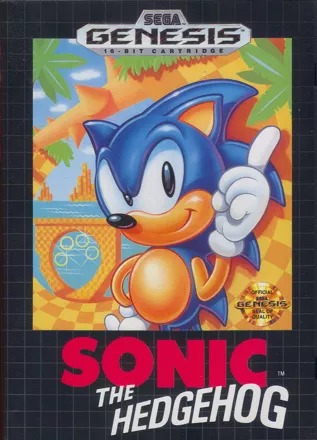
At a glance: Sonic the Hedgehog · Genesis · developed by Sonic Team · published by Sega · 1991 · momentum platformer · six zones, three acts each, plus a final zone · single player
Every console needs the game that explains why it exists, and for two years the Genesis was still waiting for its explanation. Sonic the Hedgehog, released in June 1991, was that explanation arriving at a sprint: a mascot built to embarrass Mario by comparison, a world that scrolled faster than anything a home machine had shown, and a marketing slogan — Blast Processing — that meant nothing whatsoever and sold millions of consoles anyway. Strip the advertising away, though, and a more interesting game remains than the one the commercials promised. This is not really a racing game wearing platform shoes. It is a platformer that hands you speed as equipment, then spends six zones teaching you where equipment like that helps and where it gets you killed.
Momentum Is a Tool, Not the Point
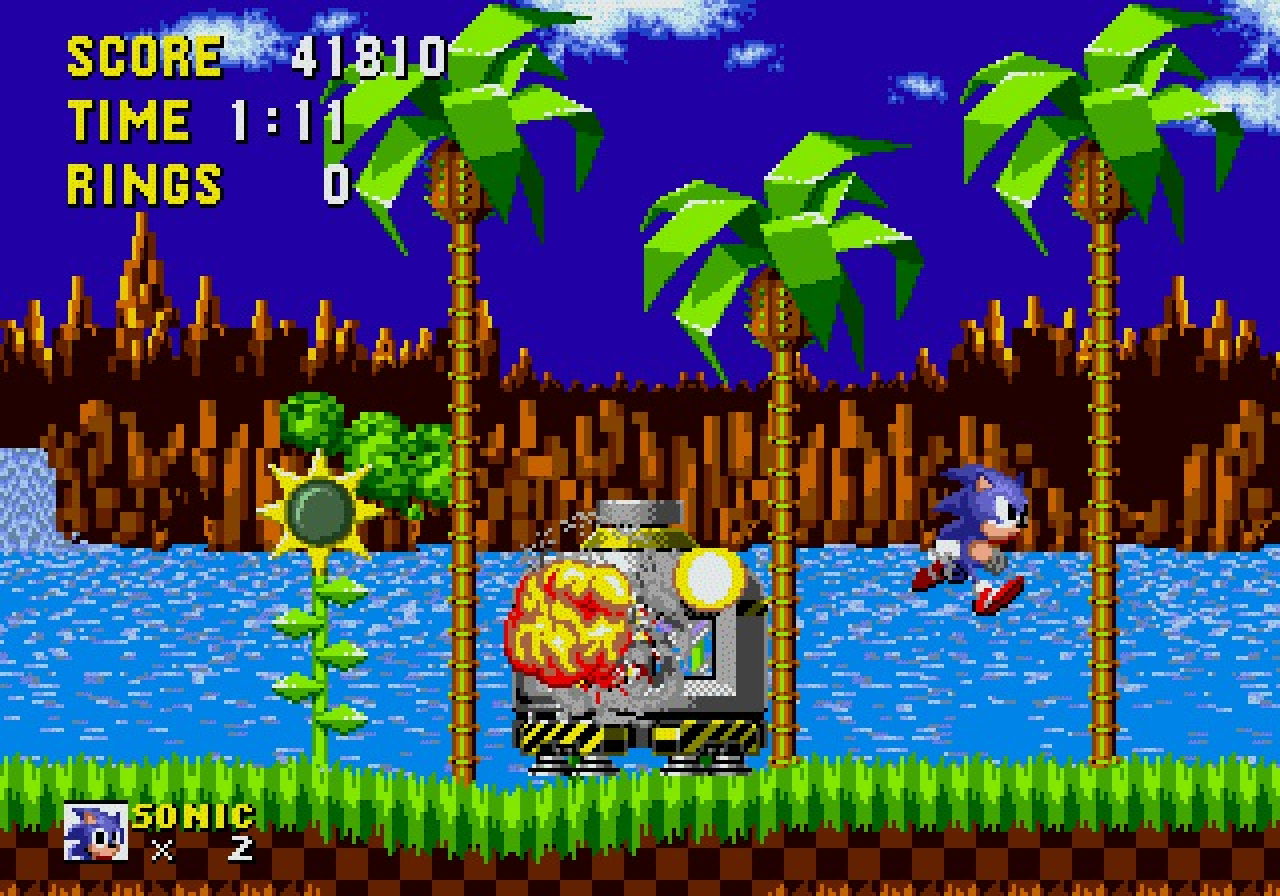
The controls could be written on a stamp. One button jumps; the D-pad does everything else. Hold a direction and Sonic builds pace the way a downhill cyclist does, gravity and gradient deciding how much of it you keep; press down while moving and he tucks into a ball that smashes through badniks and crumbles certain walls without bleeding speed. There is no spin dash in this first outing — that arrived with the sequel — so every burst of velocity is earned from the terrain, and the terrain is designed like a half-pipe with ambitions. Levels are stacked with parallel routes: a high road of springs and narrow ledges, a low road of tunnels and hazards, and the freedom to drop between them or double back when you overshoot something shiny.
Which is just as well, because velocity on its own is a trap. The opening minutes of Green Hill invite you to floor it, and the game immediately demonstrates the cost — a crab’s claw, a spike pit, a chasm, and your ring collection scattered in a golden fountain. Rings are the cleverest idea here: they are simultaneously currency and armour. Take a hit while carrying any and they spray everywhere, with a few seconds of invulnerability to grab a handful back; take one empty-handed and you lose a life. A hundred collected earns another life outright. Finish an act still holding fifty and a giant ring at the goal whisks you to a rotating special stage, where one of six Chaos Emeralds waits at the maze’s heart. The system rewards the bold and forgives them in the same breath, which is exactly the temperament the mascot was advertising.
Six Zones, Six Different Arguments
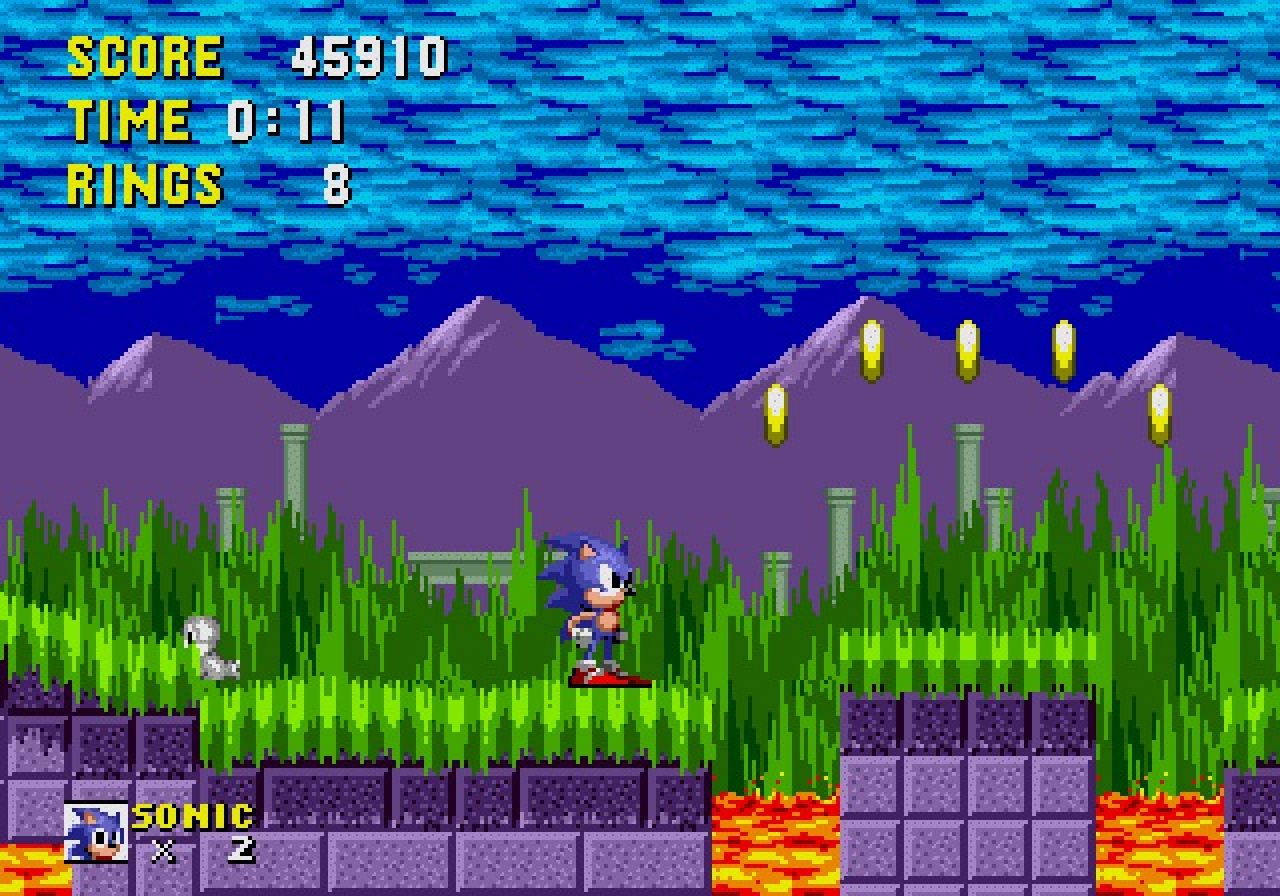
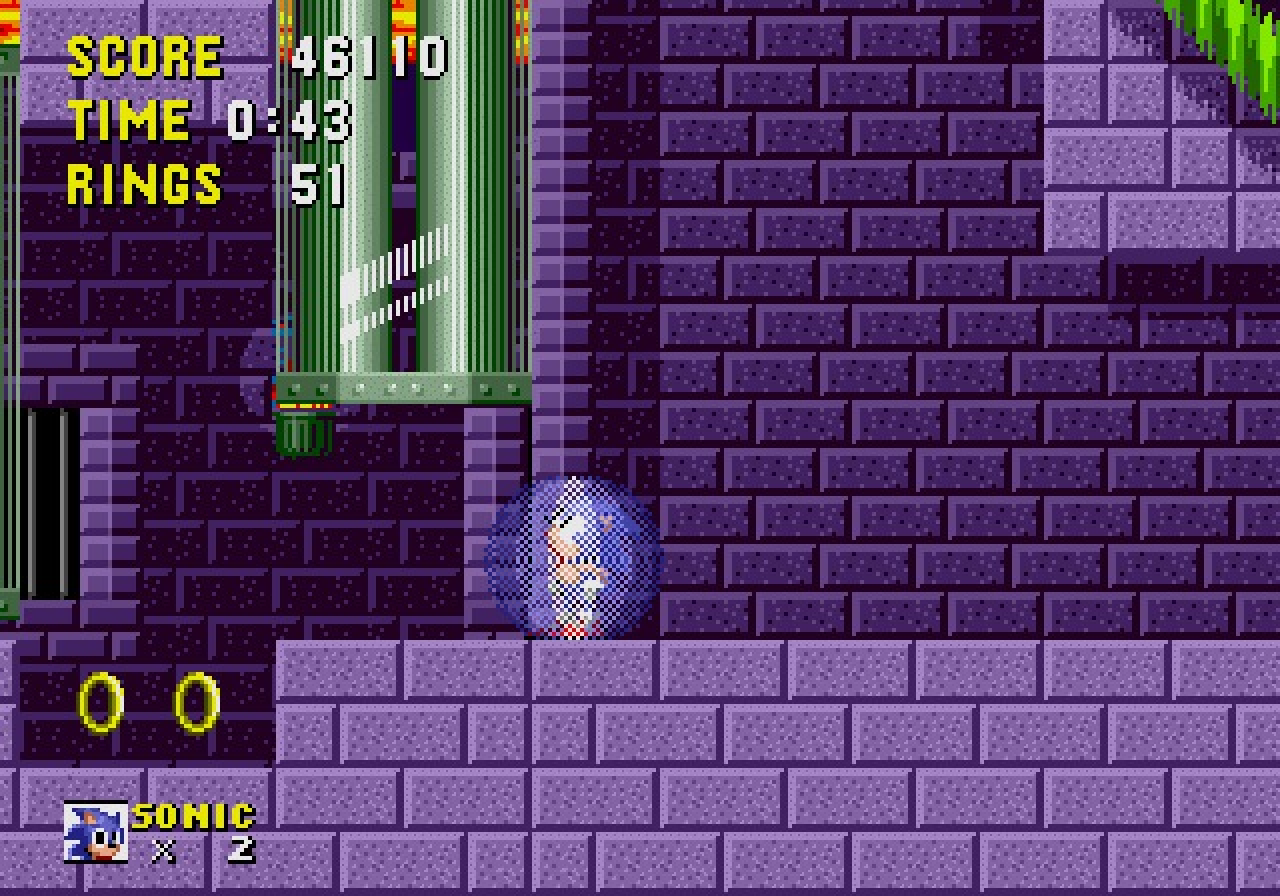
Variety is the quiet triumph. Green Hill is the postcard — chequered earth, waterfalls, three layers of parallax scenery sliding at different speeds to fake a depth the hardware was not supposed to manage. Then Marble Zone slams the brakes: lava lakes, chained platforms, a deliberate archaeological plod that makes the speed-obsessed marketing look like a different game’s. Spring Yard reimagines the platformer as a pinball table, all bumpers and spring-loaded humiliation. Labyrinth Zone goes underwater, where Sonic moves like he’s running through soup and survival depends on harvesting air from bubble vents before the drowning countdown finishes its little musical threat. Star Light is a breezy night-time glide over fans and seesaws; Scrap Brain is the industrial finale, all conveyor belts, buzzsaws and traps stacked in bad faith. At the close of every third act Dr Robotnik — Eggman in Japan — turns up inside some new contraption, from the wrecking ball that still defines him to the piston room of the boss-only Final Zone, and eight hits send each machine to the scrapyard.
The presentation holds the zones together. Sprites are big, the palette is defiantly saturated, and the whole thing moves at a smoothness 8-bit owners simply had not seen at home. Masato Nakamura’s soundtrack — he of Dreams Come True, a working J-pop star moonlighting in game music — gives every zone a melody people still hum three decades later. Sonic himself is pure character animation: the impatient foot-tap when you leave him standing, the terrified arm-windmilling on a ledge edge, the lie-down exhaustion of a character who would rather be moving. Nakamura’s melodies complete the identity: Green Hill’s theme is so structurally a pop song that it later acquired lyrics and a wedding arrangement, and the score as a whole treats each zone as a single with its own hooks rather than wallpaper. Character, melody, momentum — by the time the Sega choir chant fires on boot-up, the cartridge has made its case before a single button is pressed.
The Grudge Worth Keeping
One complaint survives every replay, and it is structural: there is no save system and no password. A full run means eighteen acts and a finale in a single sitting, and while continues and extra lives soften that, a newcomer will spend their first evenings re-running Green Hill until its loops are muscle memory. It was a common enough economy measure in 1991, but for a game whose later zones are its most inventive, locking them behind endurance rather than skill remains its one genuinely dated decision. The special stages deserve a footnote of their own — charming, disorienting, and noticeably harder to steer than the main game, so that collecting all six emeralds feels like passing a separate, slightly unfair examination bolted onto a fair one.
The emerald hunt matters because the game remembers it. Beat Robotnik with the set incomplete and he juggles the missing stones at you in the ending, a small, perfect piece of villainy; collect all six and the closing scene turns gracious. It is the sole long-term goal the cartridge offers beyond survival, and it reshapes how you play the acts in front of it — fifty rings becomes a quota to defend rather than a bonus to stumble into, and routes get chosen for their ring density as much as their spectacle. That a 1991 mascot platformer bothers with a conditional ending at all, let alone one that taunts you, says something about Sonic Team’s confidence in players coming back. They were right to be confident. They just declined to give those players a password for the return trip.
“Play it as a platformer that lends you speed, not a race that interrupts it, and the most famous hedgehog in the world turns out to be a genuinely great game.”
The Verdict
Judged cold, this is a beautifully built momentum platformer: routes layered for explorers and show-offs alike, a health system with real wit, six zones that each argue a different design case, and presentation that shifted what home consoles were expected to do. The missing save still stings, the special stages wobble, and the purest speed runs remain a beginner’s mirage. But the core lesson the game teaches — that pace is a resource to spend wisely — was new in 1991 and is not exhausted now. This is the cartridge that defined the Genesis, and it earns the honour on design, not just nostalgia.
Verdict: the Genesis-defining platformer — momentum used with intelligence, and only the absent save dates it — 8.0.
Keep reading: Twice the Hedgehog: Sonic Mania Plus Is the Encore This Revival Deserved · the Genesis system archive