

At a glance: SSX Tricky · EA Canada / EA Sports BIG · PlayStation 2 (6 November 2001, North America), GameCube and Xbox followed within weeks · Snowboarding (Race and Showoff) · Metacritic (PS2): 92
There is a sound that lives in the head of anyone who owned a PlayStation 2 in the winter of 2001, and it is not a console startup chime. It is a voice — part ring announcer, part hype man — barking one word as a sample of Run-DMC’s “It’s Tricky” tears in underneath: “Tricky!” Twenty-five years ago today, on 6 November 2001, EA Canada released SSX Tricky in North America, and snowboarding games were never quiet again. This is our SSX Tricky retrospective review: a quarter-century later, does the loudest game on the mountain still deserve its crown?
It’s Tricky: The Moment SSX Tricky Took Over
The original SSX had been the PlayStation 2’s surprise launch-window hero in 2000 — the game that proved Sony’s new machine could do speed, scale and style all at once. Tricky began life as something humbler: an enhanced remix, at one point called SSX: DVD, intended to spruce up the original’s courses with new shortcuts, redesigned riders and behind-the-scenes DVD content. Somewhere along the way EA Canada realised they were building a sequel, renamed it, and aimed it squarely at becoming the defining title of the EA Sports BIG label — the imprint that took real sports and removed every trace of restraint.
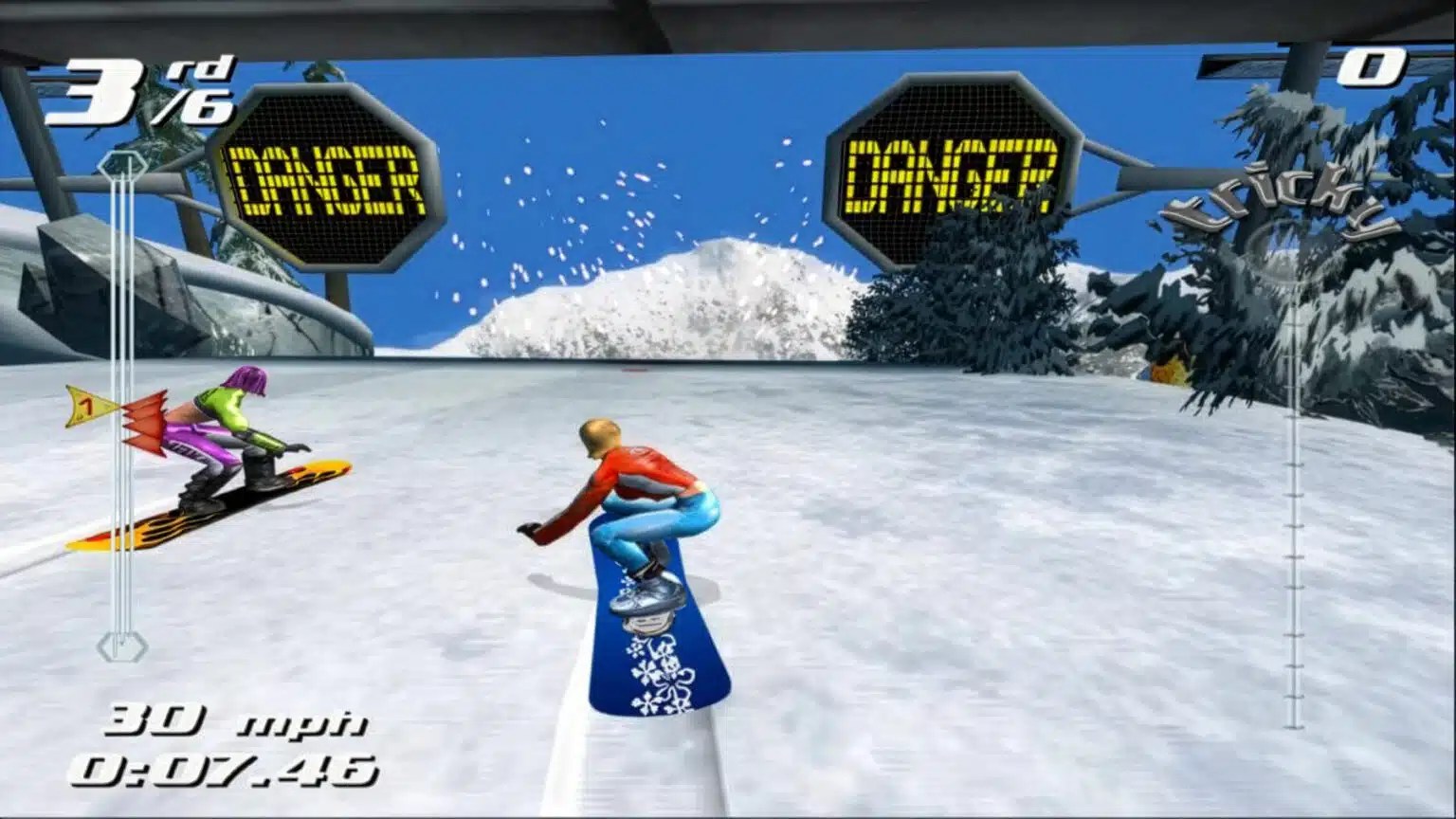
The timing was perfect. Tricky launched first on PlayStation 2, then arrived on GameCube on 27 November 2001 and Xbox on 11 December 2001 — the first multi-platform SSX, landing within weeks of both new consoles’ debuts and giving early adopters of all three machines the same essential game. It sold over 800,000 copies on PS2 alone on its way to Platinum status, and reviewers fell over themselves: a 92 on Metacritic for the PS2 version, 9.4 scores from both GameSpot and IGN, and GameSpot’s verdict that this was, quite simply, the best snowboarding game ever made.
The soundtrack deserves its own paragraph in any history of this game. Beyond the Run-DMC title track, Tricky’s licensed lineup — Mix Master Mike of the Beastie Boys, BT, Aphrodite and the Plump DJs among them — was stitched directly into the racing: each course carried its own musical pairing, the mix surged when you hit maximum boost and fell away when you crashed, so your riding literally conducted the record. In an era when sports-game music meant a menu loop, Tricky’s reactive soundtrack felt like a glimpse of the future, and critics singled it out as one of the game’s defining achievements.
Uber Tricks Changed Everything
Plenty of sequels add content. Tricky added a philosophy. Tricks in the original SSX were mostly a means to fill your boost meter; in SSX Tricky, tricks are the game. Land enough of them and your adrenaline bar fills, unlocking Uber tricks — gloriously impossible manoeuvres in which riders take their feet clean off the board, spin it, surf it, breakdance on it in mid-air. Every character had five, including a signature Uber matched to their board style, and each one landed spelled out a letter: T-R-I-C-K-Y. Complete the word and the game hands you unlimited boost for the rest of the race, the announcer loses his mind, and Run-DMC kicks in like a victory lap.
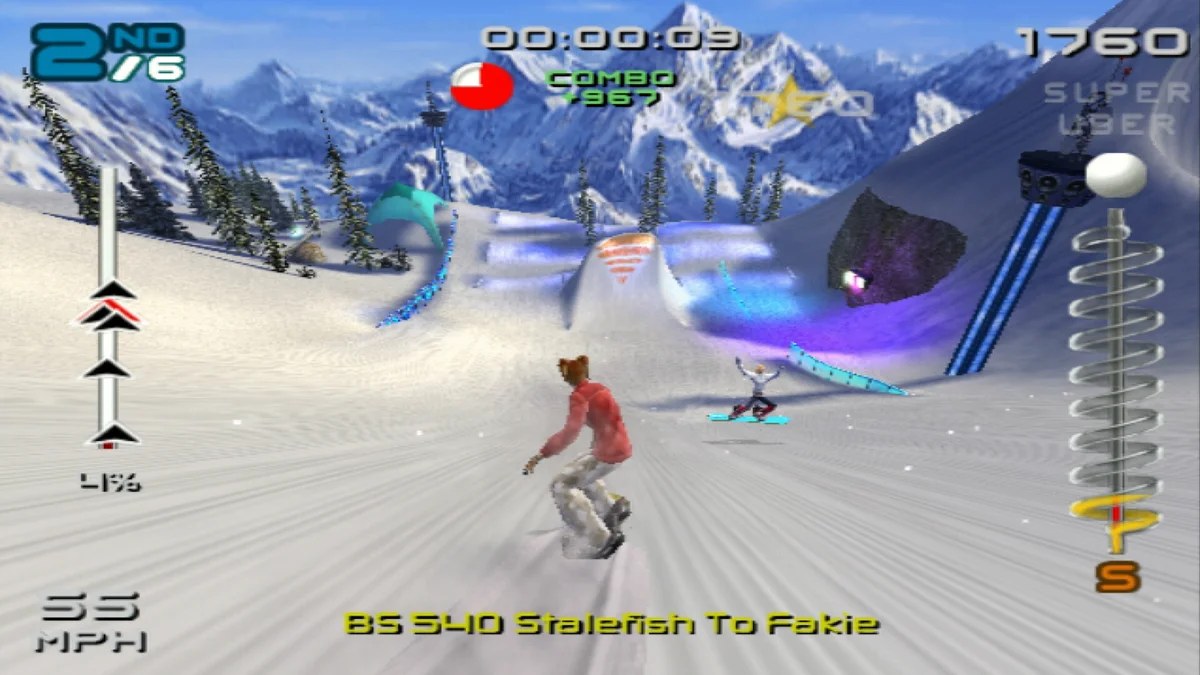
Layered on top was a rivalry system that gave the World Circuit a memory. Shove a rival off their line to fill your bar and they would remember it — friendly riders would race you clean, wronged ones would come looking for payback in the next event. It was a small system with an outsized effect: races stopped feeling like time trials with traffic and started feeling like grudges with snowboards.
Twelve Boarders With More Personality Than Most RPG Parties
Tricky doubled down on cast. Twelve riders made the roster: returning favourites Elise Riggs, Mac Fraser, Kaori Nishidake, Zoe Payne, Moby Jones and JP Arsenault, joined by newcomers who instantly became icons — Eddie Wachowski and his gravity-defying afro, the unhinged Psymon Stark, surfer philosopher Brodi Ford, party starter Marisol Diez Delgado, Seeiah Owens and the magnificently awful Luther-Dwayne Grady. (PAL players got Marty Stieber in place of Mac; the Korean release swapped in Kim Yuri for Kaori.)
What sealed them into memory was the voice work. EA hired a celebrity cast — Lucy Liu, David Arquette, Macy Gray, Billy Zane and Oliver Platt among them — and let them bicker, boast and trash-talk through pre- and post-race cutscenes. In 2001, sports games had announcers; Tricky had a cast. Completing each rider’s trick book of thirty tricks unlocked new outfits, medals unlocked boards across three families — trick-happy Freestyle, all-round BX and straight-line Alpine — and the whole package made a snowboarding game feel like a Saturday-morning cartoon you could play.
Eight Courses, Two New Mountains, One Giant Pinball Machine
The track list remains one of the great course selections in racing games. Two were brand new: Garibaldi, a friendly, jump-stuffed opener in British Columbia that taught you the game at full grin, and Alaska, a brutal endgame of collapsing ice and drops that punished anyone who had coasted this far. The other six were remixes of the original’s courses, reworked so thoroughly that veterans had to relearn them: Merqury City’s downtown rooftops, Elysium Alps’ endless downhill, Mesablanca at sunset, Snowdream, Aloha Ice Jam — and above all, Tokyo Megaplex.
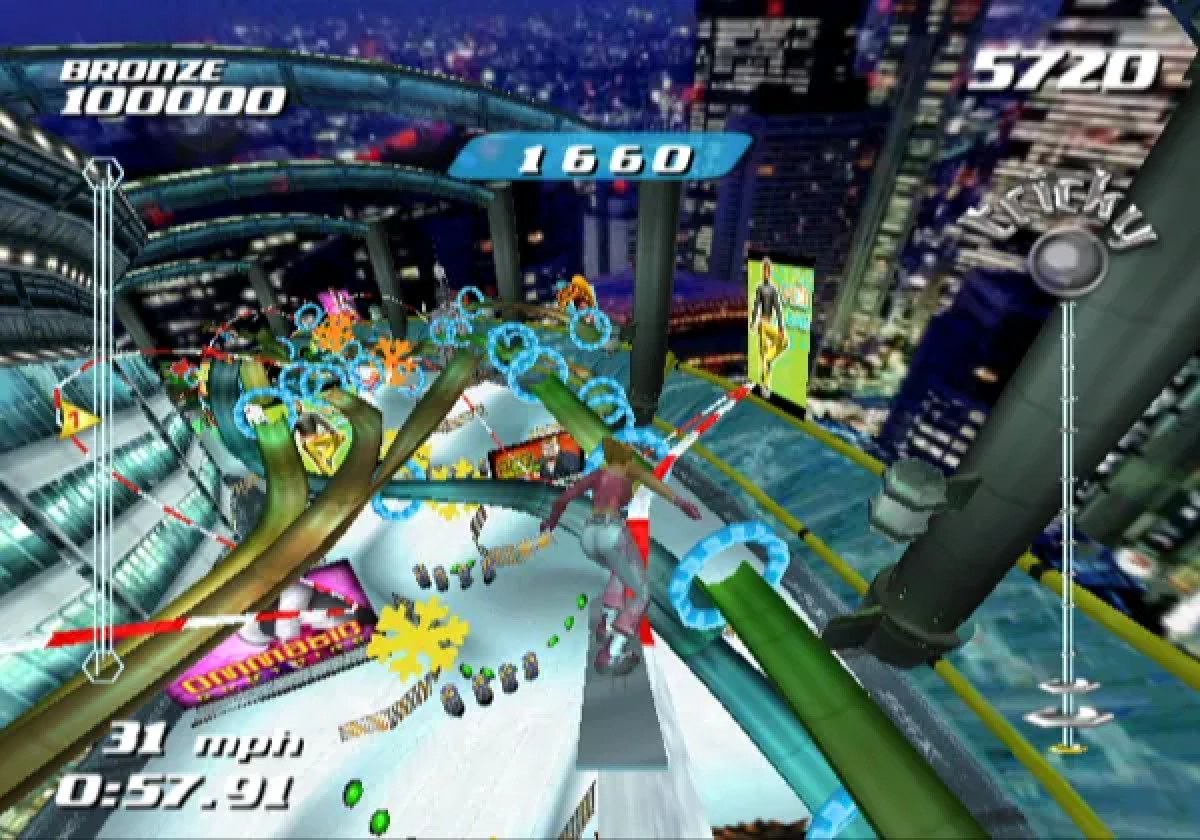
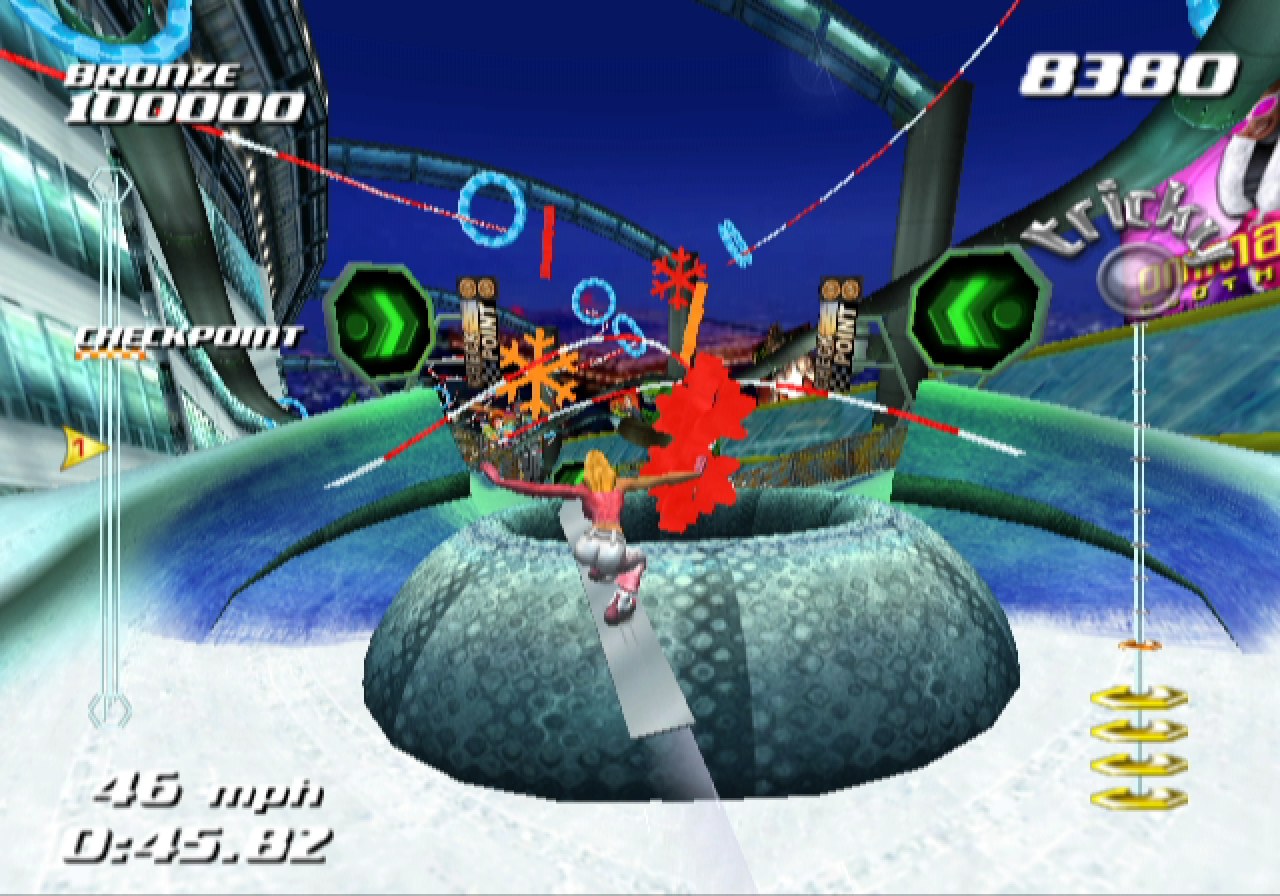
Tokyo Megaplex is the course people describe to friends who never played it, usually with hand gestures. An indoor arena built like a giant pinball table — bumpers, flippers, glass tubes, rails looping over a neon city — it was less a racetrack than a toy box with a finish line, and in Showoff mode, where extra ramps and snowflakes turned it into a score-attack playground, it was close to perfect. Win a medal on every course and the game still had secrets left: Untracked, a pure freeride mountain with no timers and no rivals, and Pipedream, a Showoff-only fever dream of a course.
How SSX Tricky Holds Up at 25
Remarkably well — with caveats worn openly. The core loop has not aged a day: the sense of speed, the weight of a carve, the risk-reward arithmetic of one more rotation before the landing, all of it still sings, and the adaptive soundtrack — which swells at maximum boost and drops out when you eat snow — still feels like the future. The PS2 original was the version reviewers scored highest and the one most players remember; IGN’s launch-era take still holds as buying advice, calling the PS2 pad setup the best for returning players while tipping the Xbox version as the best-looking and best-sounding of the three.
Part of that staying power is structural. The World Circuit splits cleanly between Race — quarter-finals, semi-finals and a final, with a top-three finish required to medal — and Showoff, a pure score attack down the same courses with extra ramps laid on. Freeride and Practice modes let you learn a mountain without a clock, Single Event packages everything for one-off runs and Time Challenges, and two-player split-screen turned all of it into a couch rivalry machine. It is a complete package in a way modern live-service sports games, for all their budgets, rarely manage: everything Tricky has is on the disc, unlockable by playing well, forever.
The honest frictions are the camera, which can lose an argument with a half-pipe wall, controls that predate the twin-stick era’s refinements, and the sad fact that there is still no official modern re-release. SSX 3 found its way to modern Xbox backward compatibility; Tricky, the better-loved game, never did. Series producer Steven Rechtschaffner said in 2020 that he would love to see a remake and believed it could work — the decision, as ever, sits with EA. Until then, the mountain is reached the old way: original hardware, a PS2 disc, and a television that does not mind 480i.
“Tricky didn’t just improve on SSX — it turned a great launch title into a personality, a soundtrack and a catchphrase. Twenty-five years on, nothing on a snowboard has ever been this much fun this loudly.”
The Legacy: The Peak of SSX Tricky’s Mountain
What came after tells you how high Tricky set the bar. SSX 3 (2003) took the series open-mountain and is a masterpiece of a different kind; On Tour and Blur chased new audiences; the 2012 reboot, simply titled SSX, brought “It’s Tricky” back as its signature anthem — an admission that the song, the word and the feeling were the franchise’s beating heart. The series has been quiet since, but Tricky’s influence leaks everywhere arcade sports games still prize style over simulation, from its Uber system echoing through extreme-sports titles to its permanent residence on best-of-PS2 lists — IGN ranked it the 95th greatest PlayStation 2 game of all time, in a library of thousands.
So, the verdict at twenty-five. SSX Tricky is not merely the best snowboarding game of its generation; it is the rare sequel-by-remix that understood exactly what made its predecessor good and turned every dial — speed, style, cast, courses, soundtrack — until the needle bent. The camera shows its age and we are still waiting on that remake, but minute for minute, letter for letter, no extreme-sports game before or since has delivered joy this concentrated. It’s tricky? No. It’s essential.
Review score: 9.2 / 10 — The Uber system, the courses and the cast still define arcade snowboarding twenty-five years on; only the period camera and controls keep it from a 9.5.