
At a glance — Game: Super Mario 64 DS · Developer: Nintendo EAD · Publisher: Nintendo · Original release: November 21, 2004 (North America) · Original platforms: Nintendo DS · Genre: Platform, action-adventure · Director: Shinichi Ikematsu
It starts with Yoshi. Not Mario — Yoshi, waking up outside a castle where Mario, Luigi and Wario have all vanished, in a remake of the game that defined 3D platforming, rebuilt for a handheld with no analog stick, two screens and a stylus nobody yet knew what to do with. Launch games are supposed to show off the machine. Super Mario 64 DS had a stranger job: show off the machine by rebuilding that game, and hide a substantially new one inside it — four playable characters instead of one, thirty extra Power Stars, a pile of touchscreen minigames — then ship it as the only title standing next to the Nintendo DS on its first day. Twenty-two years on, it remains the boldest kind of remake. The kind that assumes you have already finished the original.
The demo called Super Mario 64 ×4
The game began as a technology demonstration with a joke in its title. At E3 in May 2004, Nintendo unveiled the DS and showed a multiplayer demo called Super Mario 64 ×4: the four characters, competing for Power Stars, on the show floor the day after the press conference. It was proof the little handheld could do real 3D, and for months that was all it was known to be. Only at the Nintendo DS conference on October 7, 2004 did the fuller picture land. The name was now Super Mario 64 DS. The four characters would share the single-player adventure. The game was reported 90 per cent complete, and it would be a launch title in North America and Japan. As the launch schedule thinned around it, it ended up the only game scheduled to arrive with the system itself on November 21, carrying the “Touching is good” campaign on its shoulders.
Producer Shigeru Miyamoto, who oversaw development, was candid about the problem at the centre of it. The DS had no analog stick, and Miyamoto wanted to improve on the original precisely to compensate for what he considered an incomplete 3D Mario experience. The planning happened in late-night meetings after his administrative duties were done: a few hours of discussion, then designers immediately writing up documents for the artists and programmers. Extra stages, extra characters and Yoshi’s flutter-jump — included to soften the difficulty of jumping in 3D — all came out of that ethos. The remake would earn its place by addition.
Super Mario 64 DS starts with Yoshi
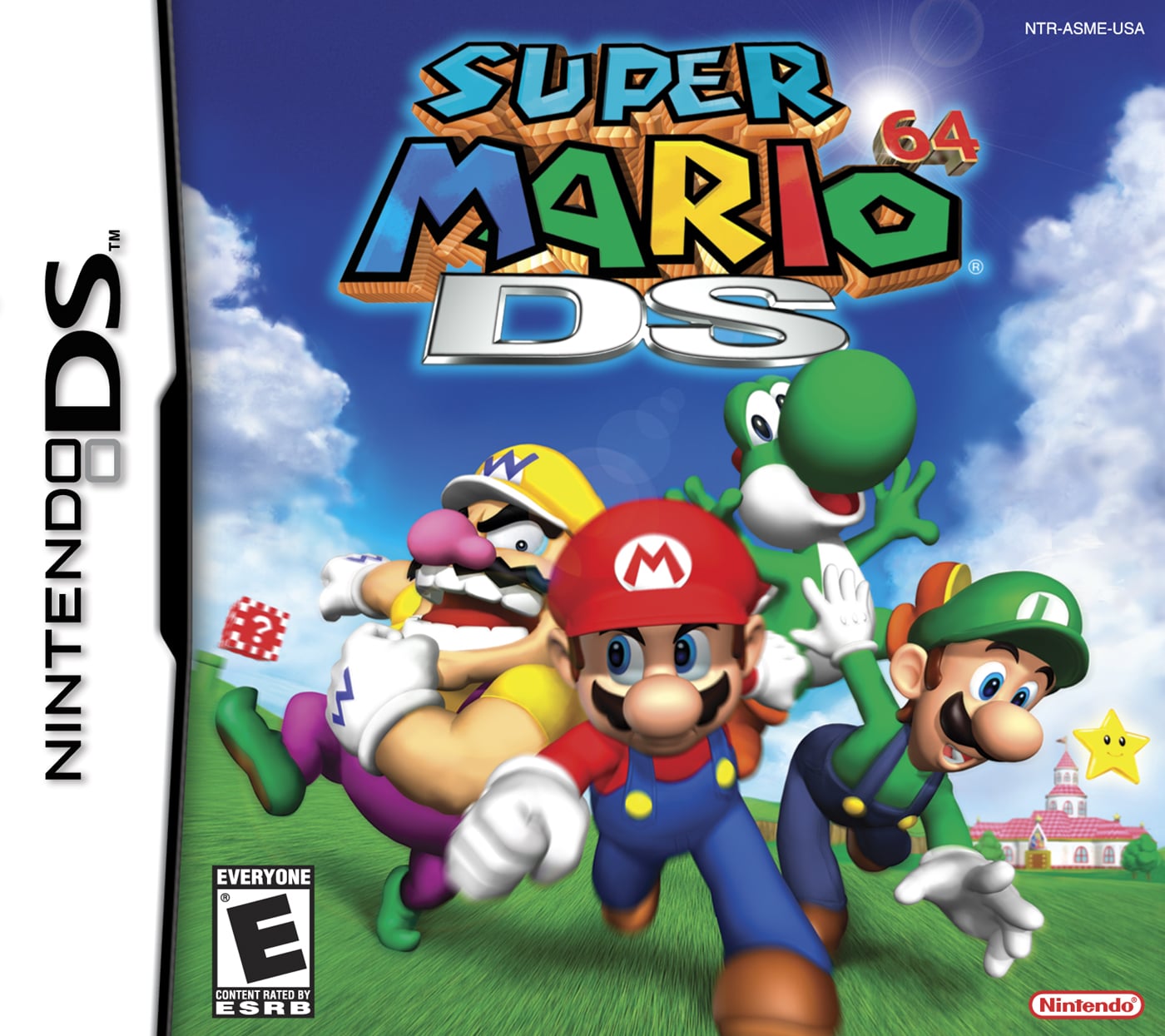
The first surprise is who you play. Mario receives Peach’s invitation and arrives at the castle with Luigi and Wario in tow — and all three promptly vanish. It is Yoshi who wakes up, Yoshi who explores the castle, and Yoshi who rescues the others one by one from behind locked doors. Each of the four plays differently, and the design keeps all of them necessary. Caps scattered through the courses transform whoever wears them, so a level can demand Mario’s balance, Luigi’s floatier jump, Wario’s brute strength or Yoshi’s egg-throwing and flutter in turn. The Power Flower replaces the old cap powers with character-specific twists: Mario inflates and floats, Luigi turns intangible, Wario coats himself in metal, and Yoshi breathes fire.
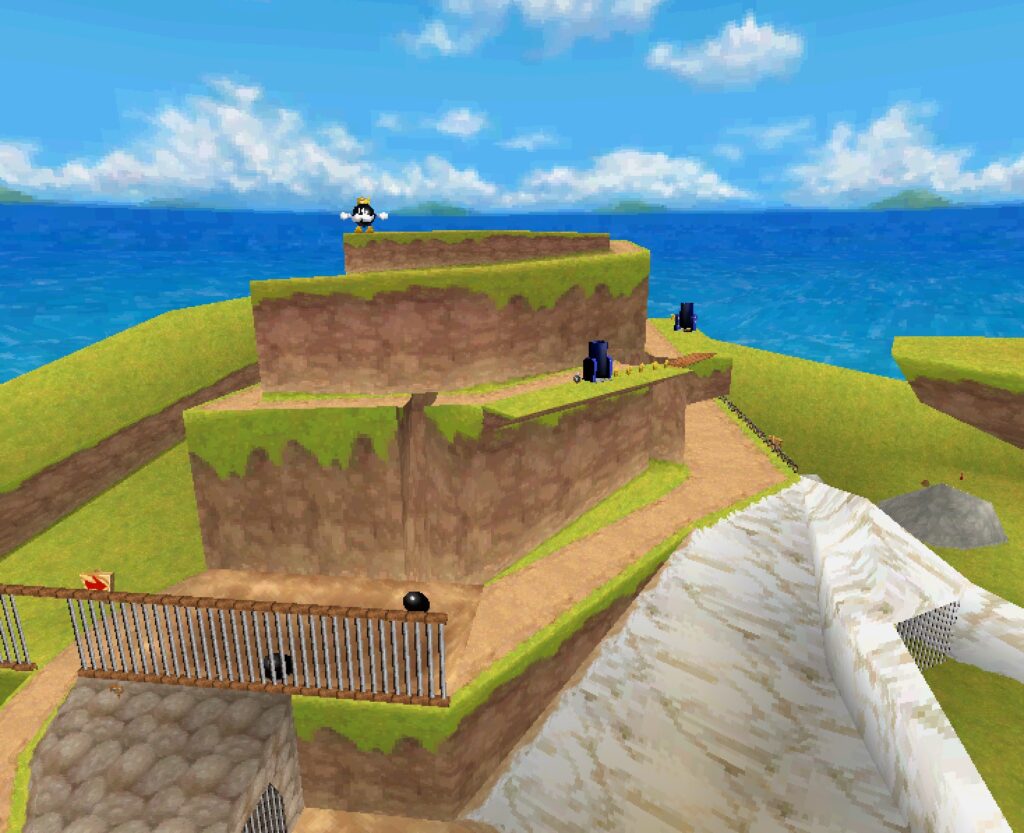
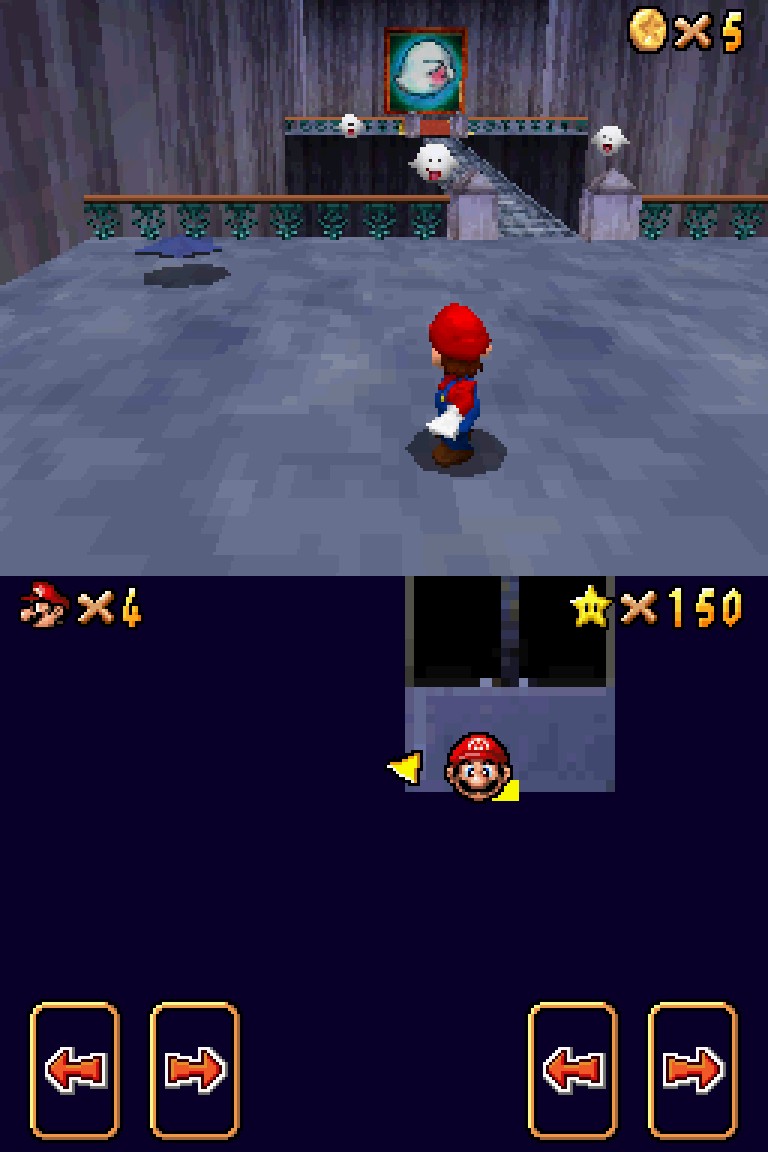
The castle itself has grown. There are 150 Power Stars here, thirty more than the Nintendo 64 original, with new courses such as the Sunshine Isles and new bosses such as the Goomboss folded into the familiar painting-hopping structure. The models carry more polygons than their 1996 counterparts and the texture filtering is gone, giving the game a sharper, slightly different face — close enough to trigger memory, different enough that returning players could not simply run their old routes on instinct.
Two screens, a stylus and the analog stick that wasn’t there
The DS hardware shapes everything. The top screen carries the action. The bottom screen holds a live overhead map marking where you are and where the important things are, and doubles as a control surface: camera buttons, and a virtual analog scheme worked with the stylus or with a thumb on the wrist strap. Reviewers were divided then, and history has kept the argument alive. The recreation was praised as faithful and the new content as generous, but the lack of true analog control was the standing complaint, with critics calling the digital and touch alternatives tricky and in need of practice. It is the one respect in which the remake could not match its source. Everyone involved appears to have known it.
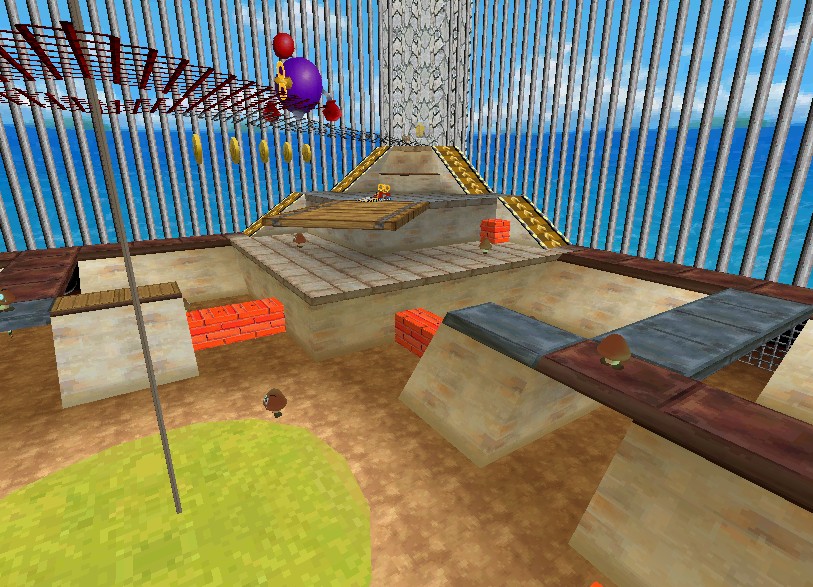
What the touchscreen did brilliantly was everything else. Catching rabbits around the castle unlocks 36 minigames, designed under Motoi Okamoto, who researched Flash games and point-and-click design and built titles like “Wanted” and “Which Wiggler?” around spotting one different face in a crowd — experiments in cognition disguised as diversions. The multiplayer mode, grown from that E3 demo, uses DS Download Play so up to four players can compete from a single copy. Neither feature was decoration. Both were Nintendo learning, in public, what its new machine was for.
Eleven million copies of a second first impression
The game sold like a launch title should. It debuted at number ten on NPD’s best-selling console titles for November 2004 and stayed there into January. In Japan it sold 241,000 copies by December 19 and kept climbing. In the United States it had sold 1.4 million copies and earned $42 million by August 2006, and the long tail ran for years: 4.34 million in the US alone by May 2011, and 11.06 million worldwide by March 2018, making it the tenth best-selling Nintendo DS game of all. The awards matched the numbers — Wireless Game of the Year at the Interactive Achievement Awards, Best Handheld Game at the 2005 Golden Joystick Awards, and a Metacritic average of 85 built on praise for the single-player mode, the graphics and the scale of the changes.
Its influence travelled quietly. The next DS Mario, New Super Mario Bros., carried a minigame collection in the same spirit, many of them descended from these. Okamoto later repurposed the “Wanted” design into “Find Mii” for Wii Play. The game itself returned on the Wii U Virtual Console across 2015 and 2016, where the GamePad’s second screen made it, at last, a remake at home on twin displays again.
The critical argument, for the record, was never about whether the port was good. GameSpot’s Jeff Gerstmann called it a “great update of a classic game” and scored it 8.4. IGN’s Craig Harris, who had worried in preview that a remake was a disappointing choice of launch Mario, came around to 8.9 and an Editor’s Choice. The dissent that stuck came from 1UP’s Jeremy Parish, who liked the extra characters as a “nice twist” but still judged the package a “poorly-conceived port” best played on the original system. Two decades of distance have mostly settled it in Nintendo’s favour: the additions were real, the compromises were the hardware’s, and the game underneath both was Super Mario 64.
Why Super Mario 64 DS at 22 still matters
Remakes usually promise fidelity. Super Mario 64 DS promised something riskier: that a sacred game could be opened up, rearranged and added to without breaking what made it sacred, and that a new machine could prove itself by re-hosting a classic rather than replacing it. It did not get everything right. The analog question never went away. But as a statement of intent on November 21, 2004 — four heroes, 150 stars, two screens and a stylus — it told DS owners exactly what kind of library they were buying into. Twenty-two years later, it still reads as the moment the remake grew ambitions of its own.
— Chip
For more launches from this date, see This Day in Gaming History: November 21.