
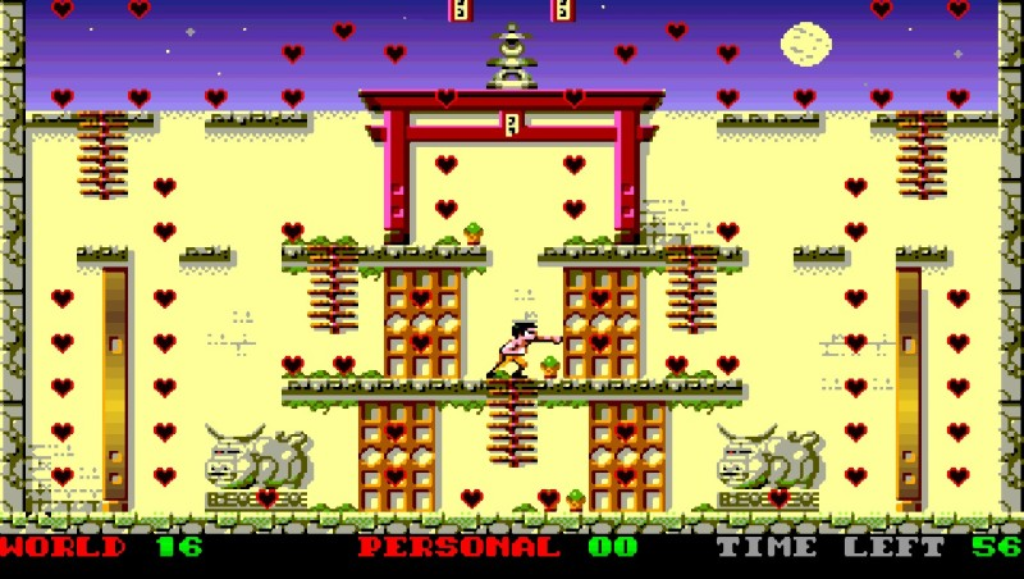
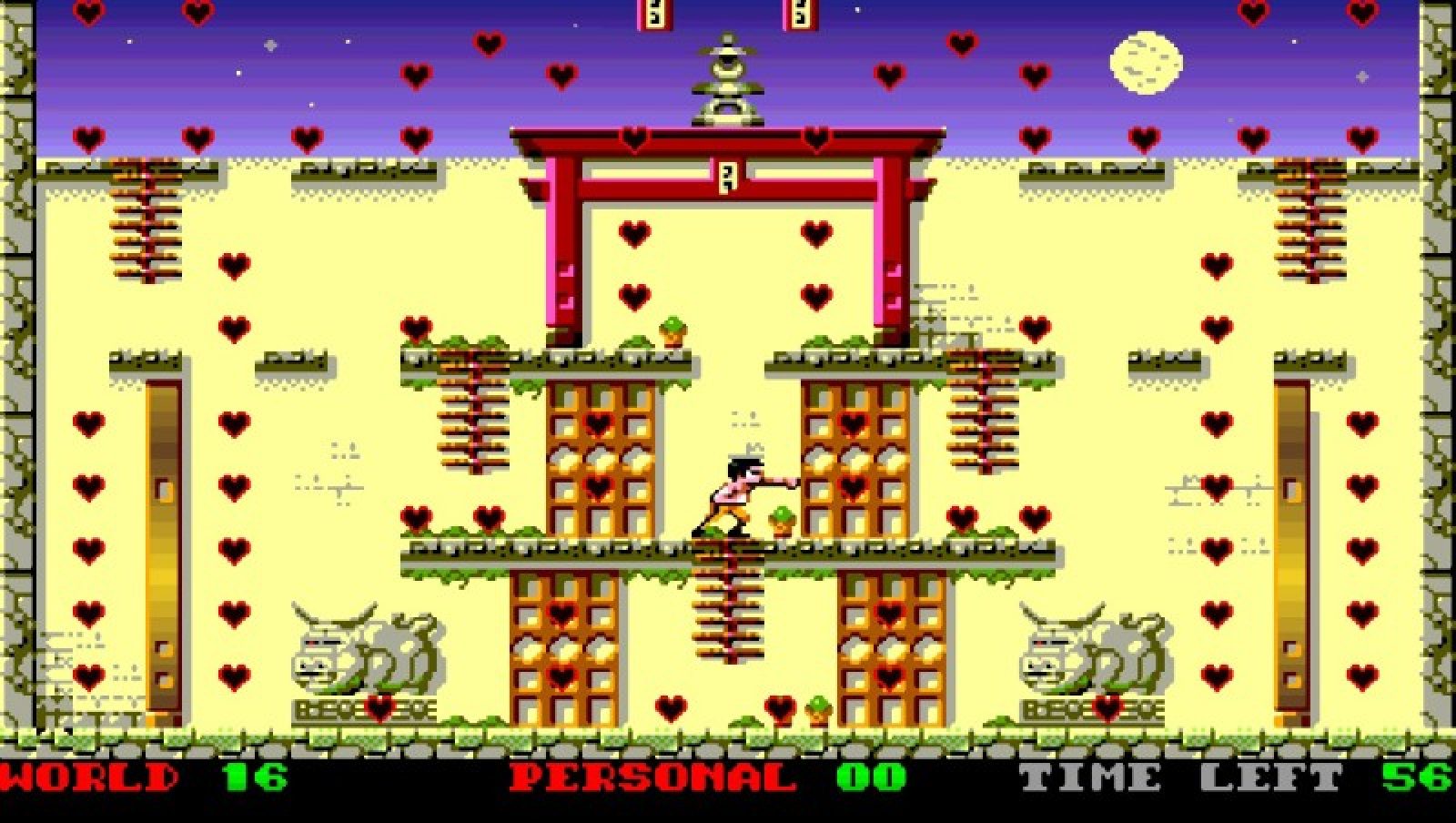
Five days before Christmas 2014, while most of the games industry was busy discounting the year’s big releases, the English Amiga Board quietly received a present of a very different kind: a brand new game for the Commodore Amiga. Love Dungeon arrived as a single floppy disk image, written in one hundred percent machine code, small enough to fit inside 64 kilobytes, and built from scratch in under a month by a programmer who had not touched 68000 assembler in more than twenty years. It was a love letter twice over — to the machine it ran on, and to the 1984 classic it reimagined.
The game it salutes: Bruce Lee, 1984
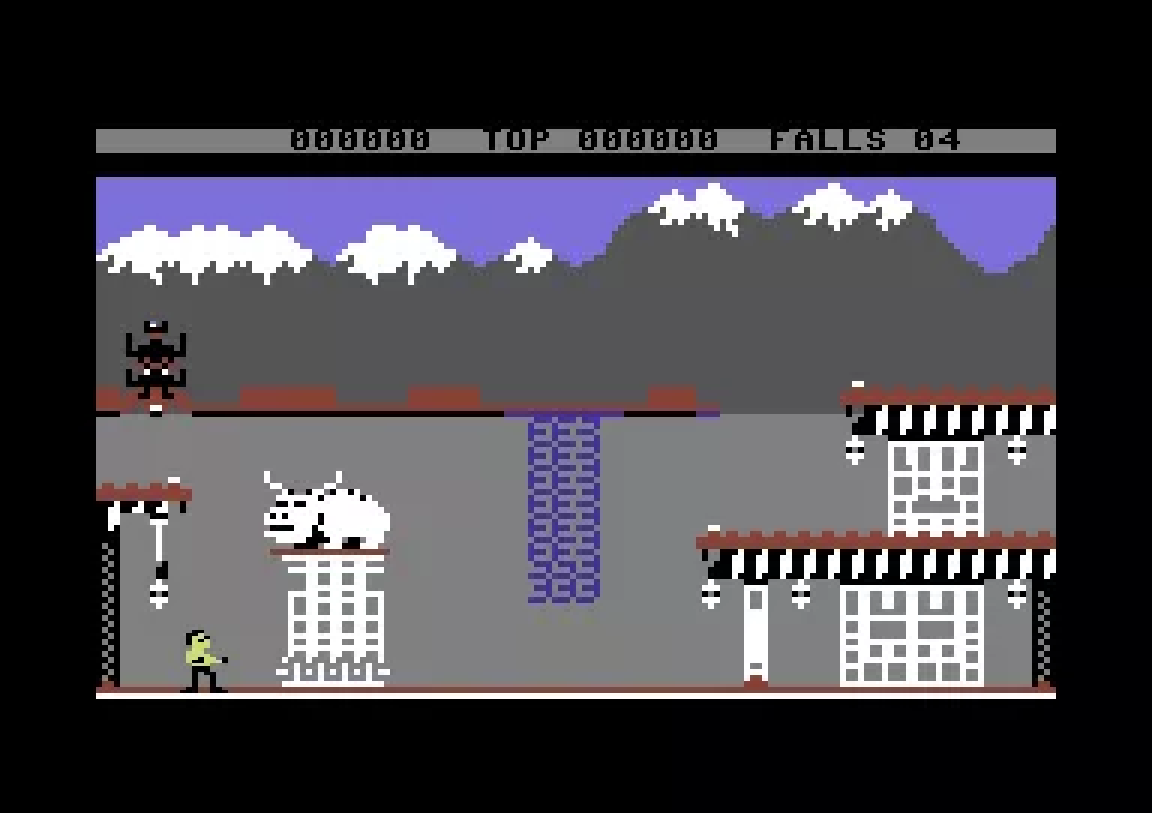
To understand Love Dungeon you first have to visit a wizard’s fortress in 1984. Datasoft’s Bruce Lee, written by Ron J. Fortier with graphics by Kelly Day and music by John A. Fitzpatrick, was one of the defining platform games of the 8-bit era. Playing as Lee himself, you fought through twenty single-screen chambers in search of infinite wealth and the secret of immortality, gathering the lanterns hung around each room so that hidden passages would open and let you press deeper into the fortress.
What made it sing was the company you kept. Every chamber was patrolled by two tireless enemies: a black-clad ninja swinging his bokken, and the Green Yamo, a vast sumo-style bruiser who attacked with punches and crushing kicks. Both could be knocked out with a chop, a flying kick or a well-timed drop onto their heads — and both were back on their feet seconds later, forever. They were as vulnerable to the fortress’s traps as you were, which turned every screen into a small slapstick theatre of electrified floors and exploding bushes. A second player could even take control of Yamo, an idea decades ahead of its time, and on the twentieth screen the Fire Wizard waited. It was simple, funny, ferociously replayable — and, for thirty years, it never received the full Amiga treatment it deserved.
A spin-off from a bigger dream
Jay Aldred, known on the English Amiga Board as jimmy2x2x, intended to fix that. His main project was nothing less than a reimagining of Bruce Lee itself for the Amiga. But after two decades away from the machine, diving straight into a full remake was a tall order, so he set himself a smaller warm-up: a spin-off mini-game that would let him relearn the hardware, rebuild his toolchain and prove he could still ship something. That warm-up became Love Dungeon.
The concept keeps the skeleton of the 1984 game and changes its heart — literally. Where Bruce collected lanterns, Aldred’s hero collects glowing red hearts scattered through chambers of ladders, platforms and pagoda rooftops. The catch is the clock: every last heart on a screen has to be gathered before the time runs out, and leaving even one behind means failure. Yamo, who very nearly did not make the cut at all — Aldred describes him as a late addition who was not going to be in the game — lumbers through the screens as a hardware sprite, doing his best to interrupt your collecting, and the whole adventure is dressed in Kagesan’s rich tile and sprite work, fleshed out by Aldred himself, with sound effects and their driver by Mike Clarke.
Hearts against the clock
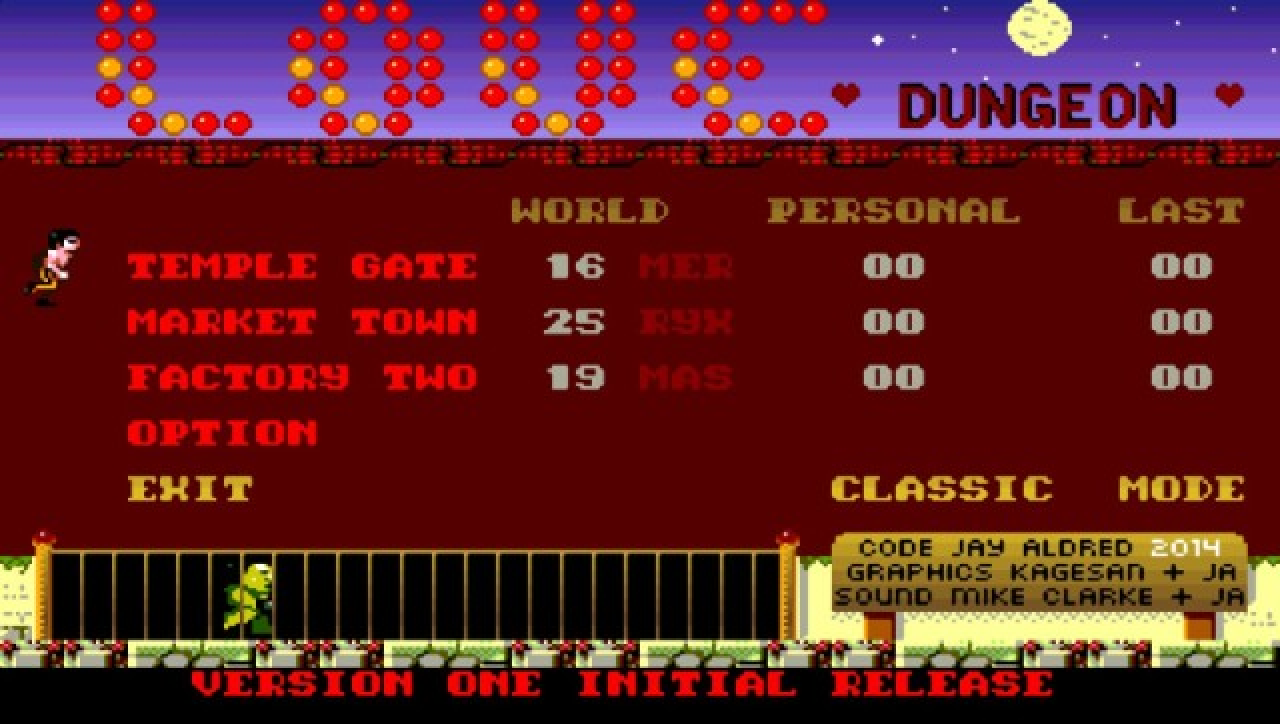
The original Bruce Lee was a game about exploration at your own pace; Love Dungeon is a game about speed under pressure, and that single change transforms the flavour completely. Routes have to be planned like a racing line. Do you clear the top of the screen first and drop down the ladders, or sweep the floor and climb? Every route is a small optimisation puzzle, and the world records baked into the game — across its three settings of Temple Gate, Market Town and Factory Two — dare you to shave off another second.
Beneath that simple loop sits a surprising amount of structure. There are four game modes, each keeping its own high-score table, and beating the built-in world records unlocks the game in stages: the first record opens a sound test, the second unlocks Monster Mode, and the third adds two further ways to play, Hide and Seek and Heart Attack. There are hidden features and Easter eggs besides, including a Party Mode switched on by holding down the left mouse button as a game starts, and even the records themselves can be wiped by anyone who discovers the trick of resetting them twice. Contemporary players praised the presentation lavishly — the detail in the ladders, backdrops and the hero’s animation drew particular comment — while finding the all-or-nothing time limits stern, even unforgiving. One missed heart really does end the run. But that strictness is the point: this is an arcade game in the old coin-op sense, built to be mastered a second at a time.
Four weeks, one man, under 64K
The development story is half the charm. Aldred wrote his first line of 68k assembler in over twenty years on 23 November 2014 and released the finished game on 19 December — a schedule he had set himself deliberately, along with the under-64K size limit, and hit both. “Phew, its done and its less than 64K,” begins the release notes, and the exhaustion is earned. He did not even own an Amiga: the game was built entirely under the WinUAE emulator with the VASM assembler, graphics edited in Grafx2, maps laid out in MappyWin32 and sprites ripped with PicCon, with technical support from EAB regulars PHX, Stingray and Chaos, and playtesting by Lonewolf10 and PHX.
The technical choices are as old-school as the deadline. The game runs in a 320×200, sixteen-colour display built from 256 eight-by-eight tiles, with the maps stored at a single byte per cell. There is no double buffering — one copper list, one frame buffer — a deliberate decision that gives the movement its raw arcade feel. Bruce and Yamo are hardware sprites, pre-mirrored at load time because flipping them in real time would have cost too much processing power, and the blitter is used for almost nothing else. Even the hearts carry a fingerprint of the engine: stored as map tiles and masked with the tile beside them, they can never sit directly next to each other horizontally. And in a nod to the game’s 8-bit roots, the font comes straight from the Commodore 64 version of Bomb Jack.
A Christmas present for a living scene
Love Dungeon was released into the wild on 20 December 2014, free and in the public domain, distributed as an ADF through the English Amiga Board’s Zone for anyone to run on real hardware or emulation, PAL or NTSC. Its reach quickly grew beyond one forum thread: Earok included it among the fifty titles on his CD32 Amiga Community Compilation for 2014, the Polish magazine Komoda & Amiga Plus described it as a Christmas gift for Amiga fans, and the release notes found a permanent home on Aminet, the Amiga’s great public archive.
Aldred was candid about what the deadline left behind — saved progress, more maps, fuller music and a Workbench icon all sat on his missed-features list — and Love Dungeon remains what it was designed to be: the rehearsal, not the headline act, with the full Bruce Lee reimagining as the main project it was spinning off from. But as a calling card it is hard to beat. In four weeks, with hand-written assembler, borrowed sprites and a borrowed font, one returning coder demonstrated everything that made the 2014 Amiga scene worth watching: the skills were still out there, the community still rallied round, and a thirty-year-old game design could still make hearts race — this time against the clock.