
At a glance — Game: Mezase! Senkyu-Oh (arcade: Senkyu / Battle Balls) · Developer: Seibu Kaihatsu · Publisher: Seibu Kaihatsu (PlayStation, Japan); Fabtek (arcade, North America) · Original release: October 1995 (arcade, Japan); April 19, 1996 (PlayStation, Japan) · Original platforms: Arcade, PlayStation · Genre: Puzzle · Players: 1–2
Thirty years is a long time for a game to wait for its second chance. This one spent most of them in the wrong country.
Yesterday, November 26, Hamster released Console Archives Mezase! Senkyu-Oh on PlayStation 5 and Nintendo Switch 2 for $11.99. It is the PlayStation version of Seibu Kaihatsu’s falling-ball puzzler — a game that came home to Japanese living rooms in 1996 and then, officially, never left. The arcade original did travel: as Battle Balls, it reached North American arcades in January 1996. The home version never followed it. Until this week, if you wanted to play the PlayStation game outside Japan, you imported it, you paid collector money for it, or you did without.
Battle Balls: a shooter studio makes a puzzle game
Seibu Kaihatsu was not a puzzle studio. This is the house of Raiden — vertical shooters, dense bullet patterns, the works. Which makes Senkyu a stranger and more interesting object than its simple rules suggest. A team fluent in pressure and pattern recognition built a game about coloured balls and gravity, and the shooter instincts show. Everything in it moves like it is on a timer, because it is.
The rules fit on an index card. Balls fall from the top of the screen in clusters of three. You rotate the cluster as it drops — clockwise, anti-clockwise — and steer it onto the pile building at the bottom. Connect four or more balls of the same colour and they clear. That is the whole game. Except it isn’t, because of what happens next: the balls above the cleared ones fall. Gravity is the real mechanic. A clear is never just a clear. It is a rearrangement, and if you have set the pile up properly, the rearrangement connects four more, and those fall, and connect four more. Chains are not a bonus in Senkyu. They are the point.
It arrived in a crowded room. The mid-nineties falling puzzler was a knife fight — Puyo Puyo owned the versus format, Columns and Tetris owned everything else — and Senkyu‘s answer was physicality. Blocks sit still. Balls roll. The pile in Senkyu behaves like a pile, slumping and settling, and reading that slump a half-second early is the skill the game is actually testing.
The tournament is the game
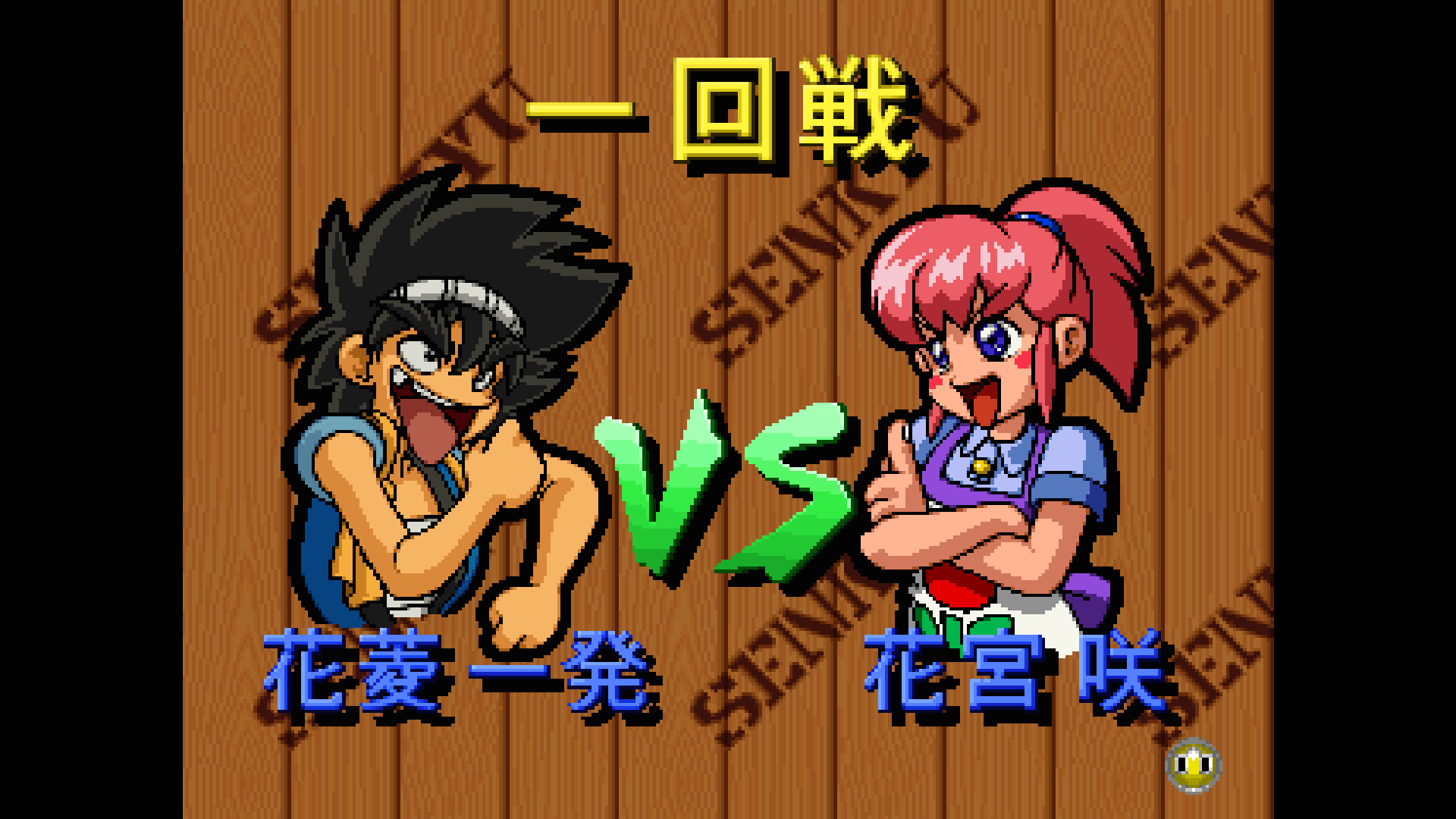
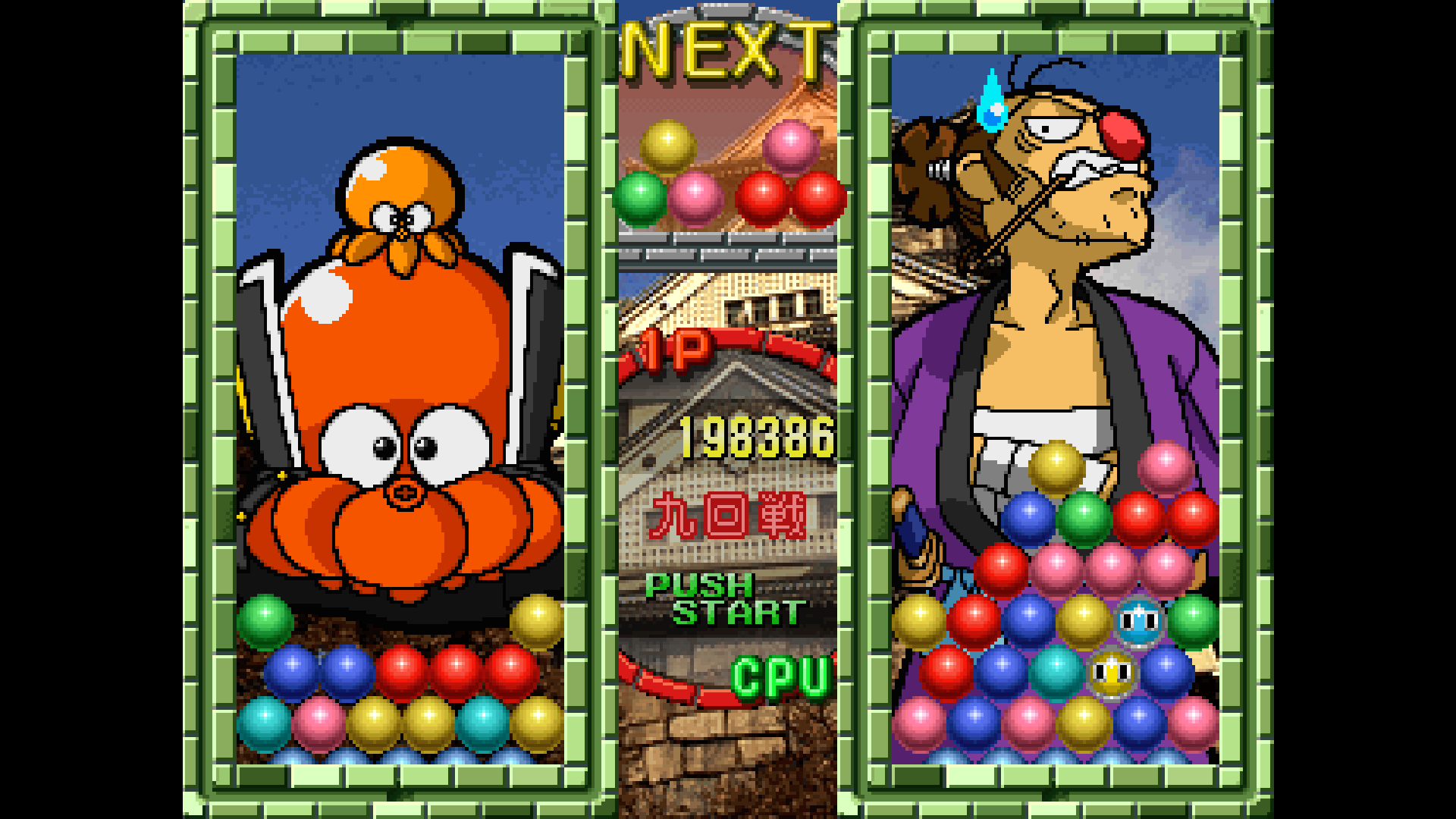
Solo score-chasing exists here — Hamster’s own description calls out the Skill Tester mode — but the heart of the PlayStation version is the SENKYU tournament, the Normal mode: a run of one-on-one battles against a cast of rivals, each with a portrait, a personality and a pile of their own. Versus puzzling changes the maths completely. You are no longer clearing your own board for points. You are clearing it to bury somebody else, and every chain you land is time stolen from the player on the other side of the screen. Two human players can do this to each other locally, which is where the game has always been at its loudest.
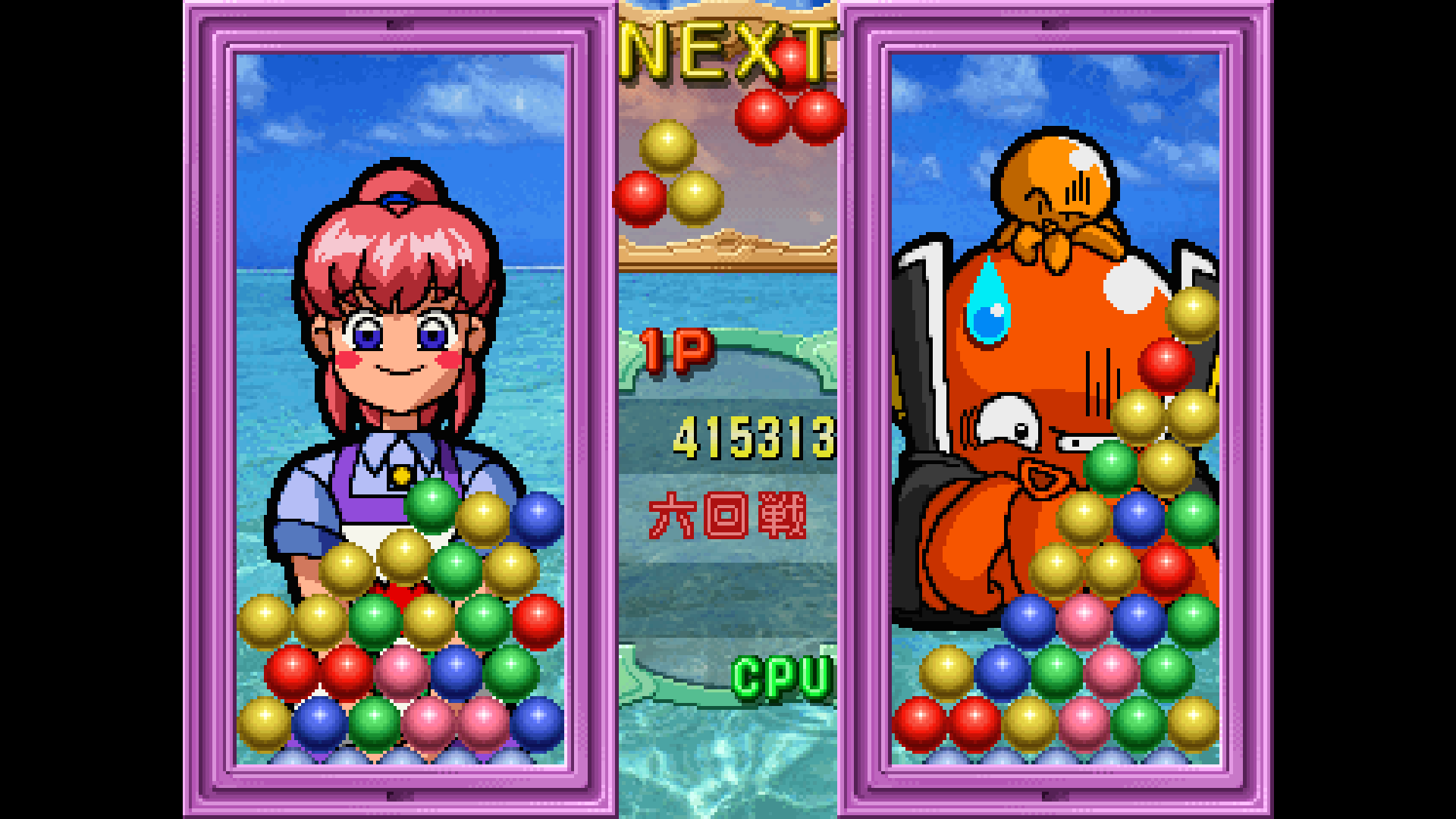
The presentation helps more than a puzzle game strictly needs. The characters mug for the camera. The backdrops are bright seaside colour. A demo of the game was even tucked into the PlayStation release of Raiden DX, which tells you how Seibu saw it: not as a side project, but as a game worth putting in front of the shooter faithful. It still did not travel. The PlayStation version was released in limited quantities in Japan in April 1996, with a reprint following on August 5, 1999 — and limited Japanese quantities of a puzzle game are a recipe for exactly what happened: scarcity, then silence, then a sealed-copy price that recently sat near $148 on the collector market.
Thirty years, two homecomings
The strange part of this story is that it has already happened once. In March 2025, Hamster brought the 1995 arcade original west as Arcade Archives Senkyu on PlayStation 4 and Nintendo Switch — the first official Western release the game had ever had in any form since those 1996 arcade boards. So the arcade game got its homecoming first, and the home version — the one with the tournament, the one Japanese players actually kept — had to wait another twenty months for its own.
That order of events says something honest about how this era gets preserved. The arcade version is the document. The home version is the memory. Documents get archived first; memories take longer, cost more, and arrive with their rough edges intact. Hamster is upfront about the biggest one: this release includes only the Japanese version, and all in-game text is in Japanese. For a puzzle game, that is a smaller wall than it sounds — the balls do not care what language you read — but menus and mode names will ask a little patience of a first-time Western player. Thirty years of patience, arguably, has been practice.
It even had an afterlife most players never saw. In 2001, Seibu returned to the formula twice — Gravure Collection and Pakkun Ball TV — Japan-only follow-ups that kept the falling balls and swapped the framing. They are footnotes now, and they prove the same point the reprint did in 1999: at home, in Japan, this little puzzler from the Raiden studio had a real audience. It was never a failure. It was a local success that the rest of the world simply never got sent, the way a letter sits in the wrong out-tray for three decades.
How to play it today
The easy route is the new one. Console Archives Mezase! Senkyu-Oh is on the PlayStation Store and the Nintendo eShop now for PlayStation 5 and Nintendo Switch 2 at $11.99, checked November 26, 2026 — the PlayStation home version, officially outside Japan for the first time, with 1–2 player local battles intact.
The arcade original is the other official route: Arcade Archives Senkyu has been on PlayStation 4 and Nintendo Switch since March 2025, and it is the version to pick if the 1995 coin-op game itself is what you are after. And for readers who already own the Japanese PlayStation disc — all dozen of you, at those prices — it still plays exactly as it did in 1996, tournament and all. What there is not, and never has been, is a Western PlayStation disc. This week is the first time the home game has had a Western door to walk through at all.
That is the whole appeal, in the end. Not a lost masterpiece — Senkyu is a good, sharp, characterful puzzler, not a buried Tetris-killer — but a complete one, with its tournament, its rivals and its rolling, slumping piles, finally priced like a normal game instead of a collector’s rumour. Twelve dollars, thirty years late. Most of us have waited longer for less.
— Sal
For more launches from this date, see This Day in Gaming History: November 26. More from this system: our Arcade hub.