

Every spy story I loved as a kid started the same way: a man alone, at night, somewhere he was not supposed to be. James Bond had a tuxedo and a casino. Our guy had a pistol, a jump-kick, and thirty floors of bad intentions between him and the street. His name — well, his codename — was Otto. Agent 17. And in the summer of 1983, Taito lowered him onto the roof of a building full of enemy agents and simply pointed him at the ground floor and said: go get the papers, son. Try not to die on the way down.
I still remember the first time I watched somebody good play this game. Not play it well, exactly — nobody played it well, not at first — but play it with patience. That was the revelation. The arcades of 1983 were loud rooms full of reflexes: shoot fast, move fast, die fast, feed the machine another quarter. And here was a game that rewarded a kid for waiting. For watching an elevator. For counting floors the way you’d count the beats before a door opens in a heist movie. I fell for it on the spot, and I have never quite fallen out.
This week the old building opened its doors again. On November 5, Hamster brought the NES edition to its new Console Archives line on PlayStation 5 and Nintendo Switch 2, and the arcade original arrived in Arcade Archives 2 form on Switch 2, PlayStation 5 and Xbox Series X|S. So it feels like the right moment to ride the whole thirty floors once more, slowly, the way the game always wanted — and to ask the honest question a game this simple has to answer in 2026: why does this still work?
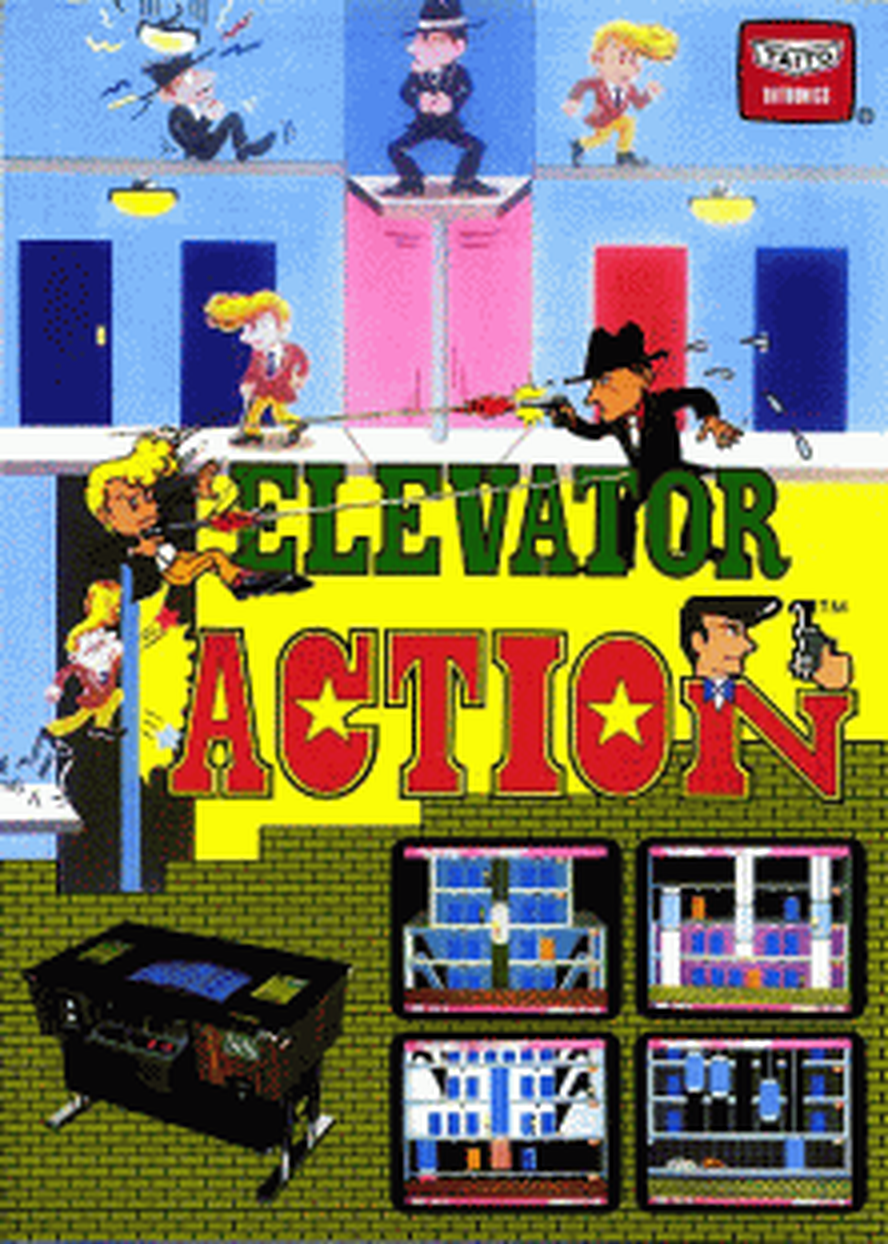
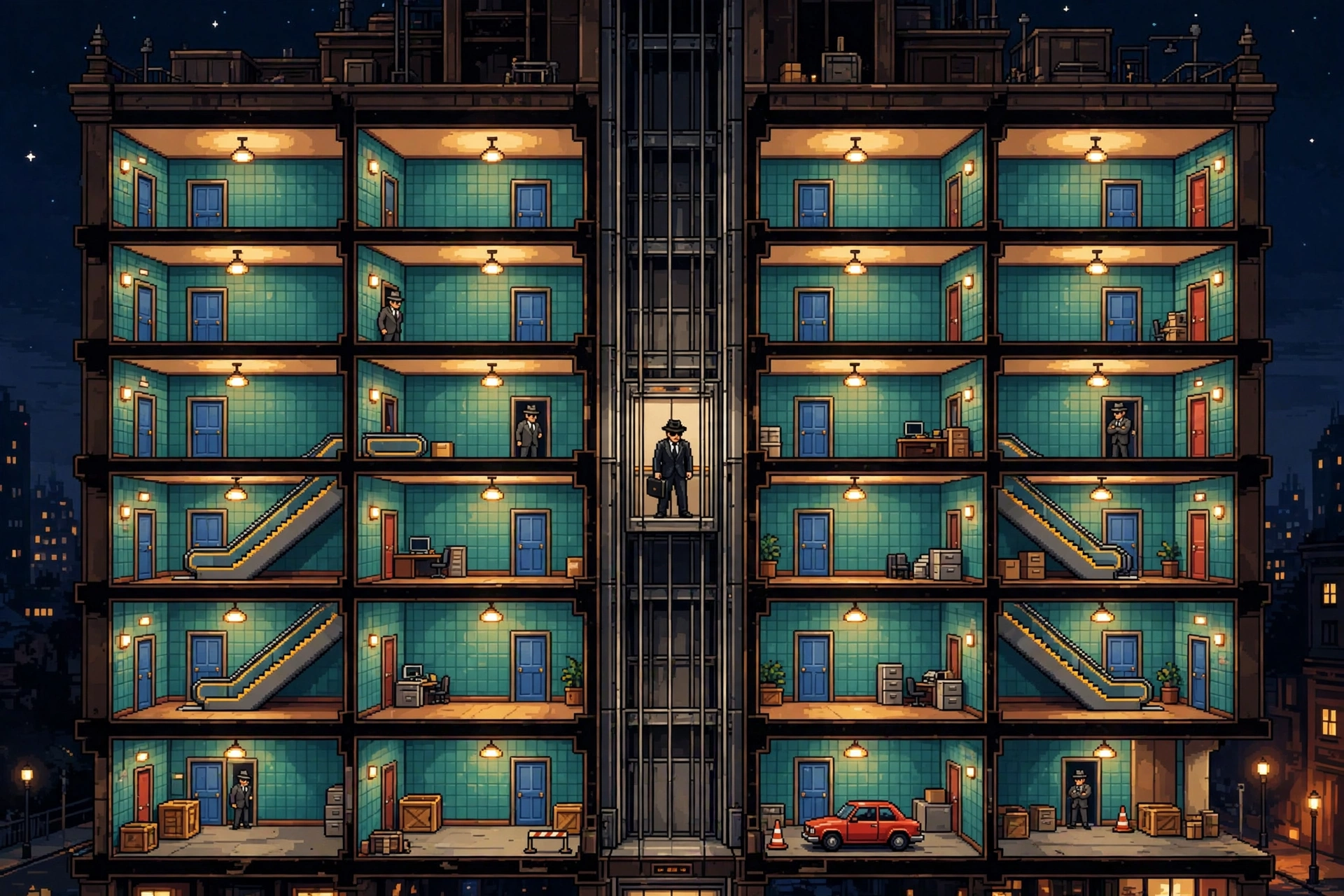
Going Down: How Elevator Action Actually Plays
The mission could fit on an index card, and I mean that as praise. Otto comes in from the roof of a 30-storey building. Somewhere in that building, behind doors painted red, are the secret documents he has come to steal. He has to visit every red door, collect every document, and reach the basement, where a car is waiting to carry him away. In his way stand enemy agents who pour out of the ordinary doors, draw fast, duck, drop flat, and get meaner the longer he takes — dawdle long enough and an alarm sounds, the agents turn aggressive, and even the elevators stop answering the controls promptly, which is the game’s polite way of saying the building has noticed you.
The tools are humble. A pistol that fires a few shots at a time. A jump-kick for close work. Elevators he can ride and, once inside, command — up, down, stop, and, if an enemy is careless enough to stand in the wrong place, crush. Escalators for the short hops between split floors. And my favourite detail in the whole game, the one that told you in 1983 that this machine had a sense of humour: you can shoot out the ceiling lights. The fixture falls. If an agent is standing under it, the fixture does your work for you, and the floor goes dark for a while, which makes everybody harder to see — them, and you.
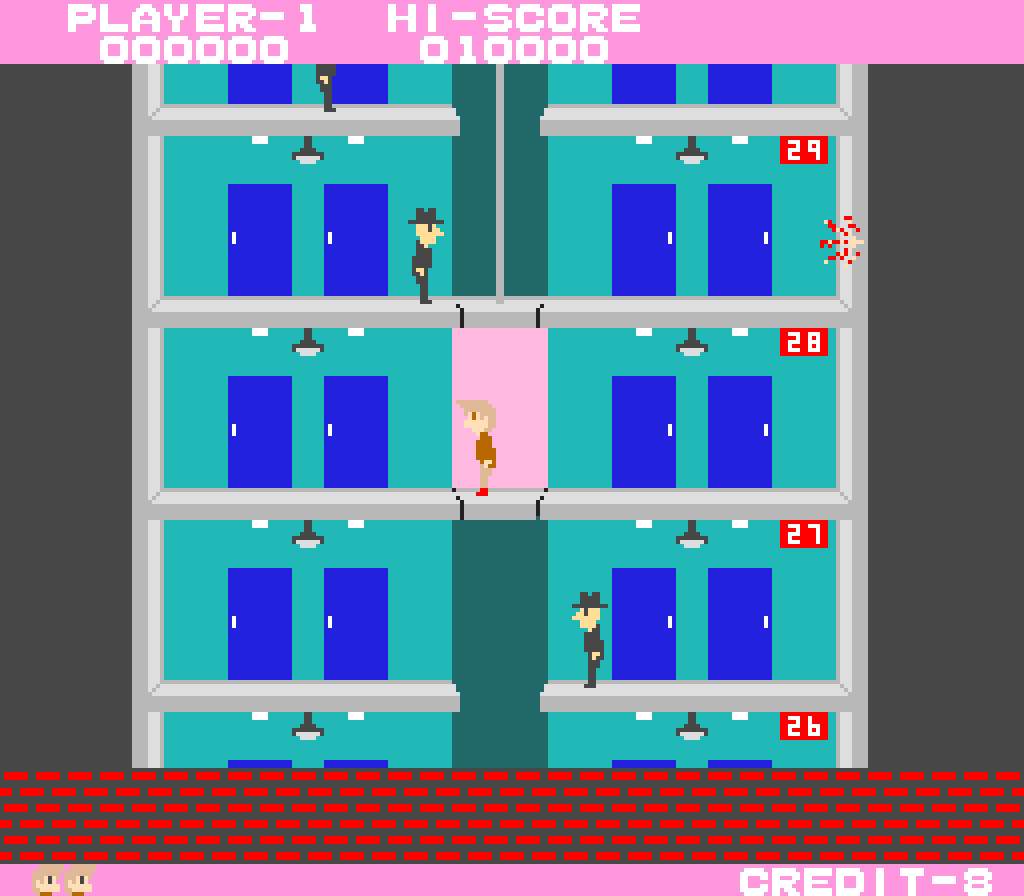
That is the entire machine, and it is enough, because the building itself is the real opponent. The elevators do not belong to you. Enemies ride them too, and nothing rearranges your plans like watching the car you needed slide away with a gunman in it. You learn to read the shafts the way you read traffic — which car is coming, which floor it will stop at, whether you can jump the gap or ride the roof of a passing car and surrender control for a few nerve-shredding seconds. Miss a red door on your way down and the game will not let you leave: reach the basement incomplete and it hauls you back up to the highest floor still holding a document you skipped. No shortcuts. The building keeps the receipts.
- Shoot them. The honest way, and the riskiest once the agents learn to duck and drop flat.
- Jump-kick them. Close, quiet-ish, and deeply satisfying when a door opens at exactly the wrong moment.
- Crush them with an elevator. Hard to arrange, impossible to forget the first time you manage it.
- Drop a light fixture on them. Shoot the lamp from the lift, let gravity do the spying’s dirty work, and enjoy the dark.
Plenty of arcade games asked how fast your hands were. This one asked how well you could wait — and then punished you, deliciously, for waiting in the wrong place.
It was a hit, and not a small one. In Japan it sat at the top of the arcade charts for three months in late 1983, in an era when Taito’s name already meant quality and the laserdisc machines were busy trying to convince everyone that the future looked like a cartoon you watched more than played. Otto out-earned the future for a while, one careful descent at a time. I have always loved that about its story: while the industry chased spectacle, the spy in the plain building just kept riding down, floor after floor, quarter after quarter.
The Long Ride Home: The NES Years
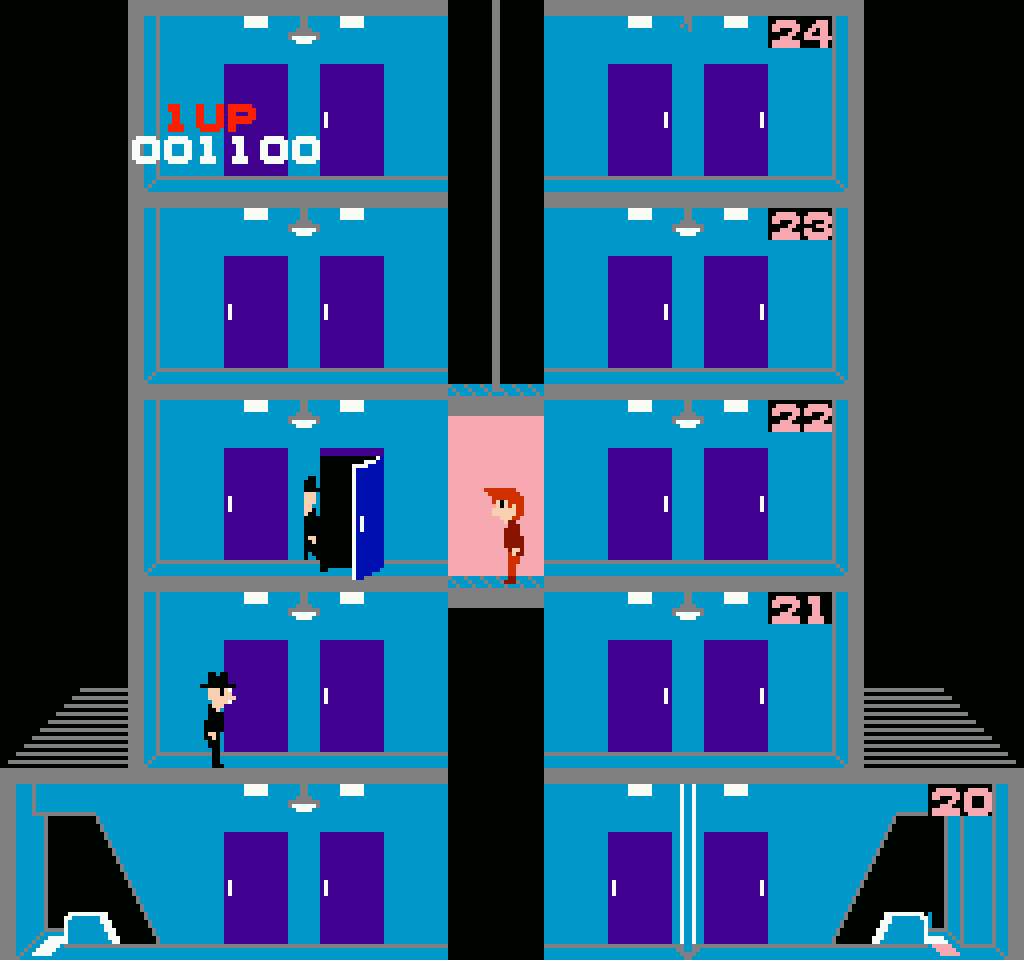
For a lot of us, though, the building we grew up in was not the arcade one. The Famicom port arrived in Japan in 1985 — it reached the Nintendo Entertainment System in North America in 1987 — and that home version is where Elevator Action became a living-room ritual instead of an arcade dare. It kept the mission, the red doors, the lifts and the lights, and it traded the arcade’s edge for something warmer: a game you could learn a floor at a time, with a brother or a friend on the couch calling out warnings like a lookout in a caper film. Watch the shaft. He’s coming up. No — wait. Wait. Now.
That is why this week’s Console Archives release matters more than its size suggests. The NES edition is the version a generation actually owned, argued over, and learned by heart, and Hamster has put it on PlayStation 5 and Nintendo Switch 2 for $7.99. That is a fair price for a time capsule, and I will be honest with you: it is also a fair price to test whether your patience has survived everything the modern world has done to it. Mine mostly has. Mostly. There was one incident on floor twelve involving an escalator, a dropped light and my own overconfidence that we will not be discussing further.
Returns: The Sequel That Went Away and Came Back Louder
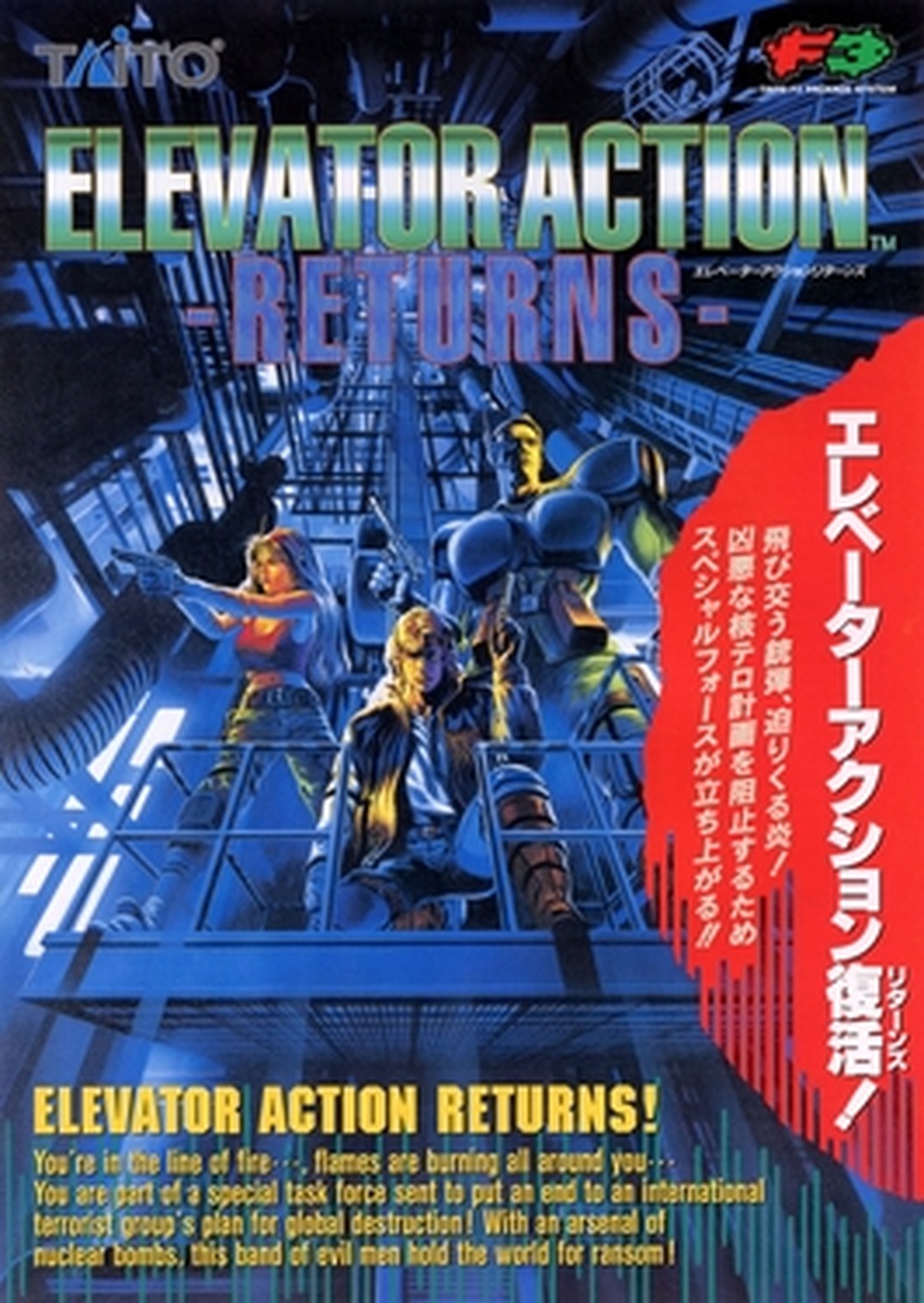
Eleven years after Otto’s first descent, Taito sent a whole team back into the building. Elevator Action Returns hit arcades in 1994 — reaching the Sega Saturn in Japan in 1997 — and it is the original idea after a decade of push-ups: three playable agents instead of one spy, a two-player co-operative mode, health gauges instead of one-hit fragility, heavier weapons waiting behind blue doors, and buildings that scroll in every direction and fall apart around you while you work. Where the 1983 game is a whispered caper, Returns is the same caper with the fire alarm pulled — bigger, faster, gloriously punchier.
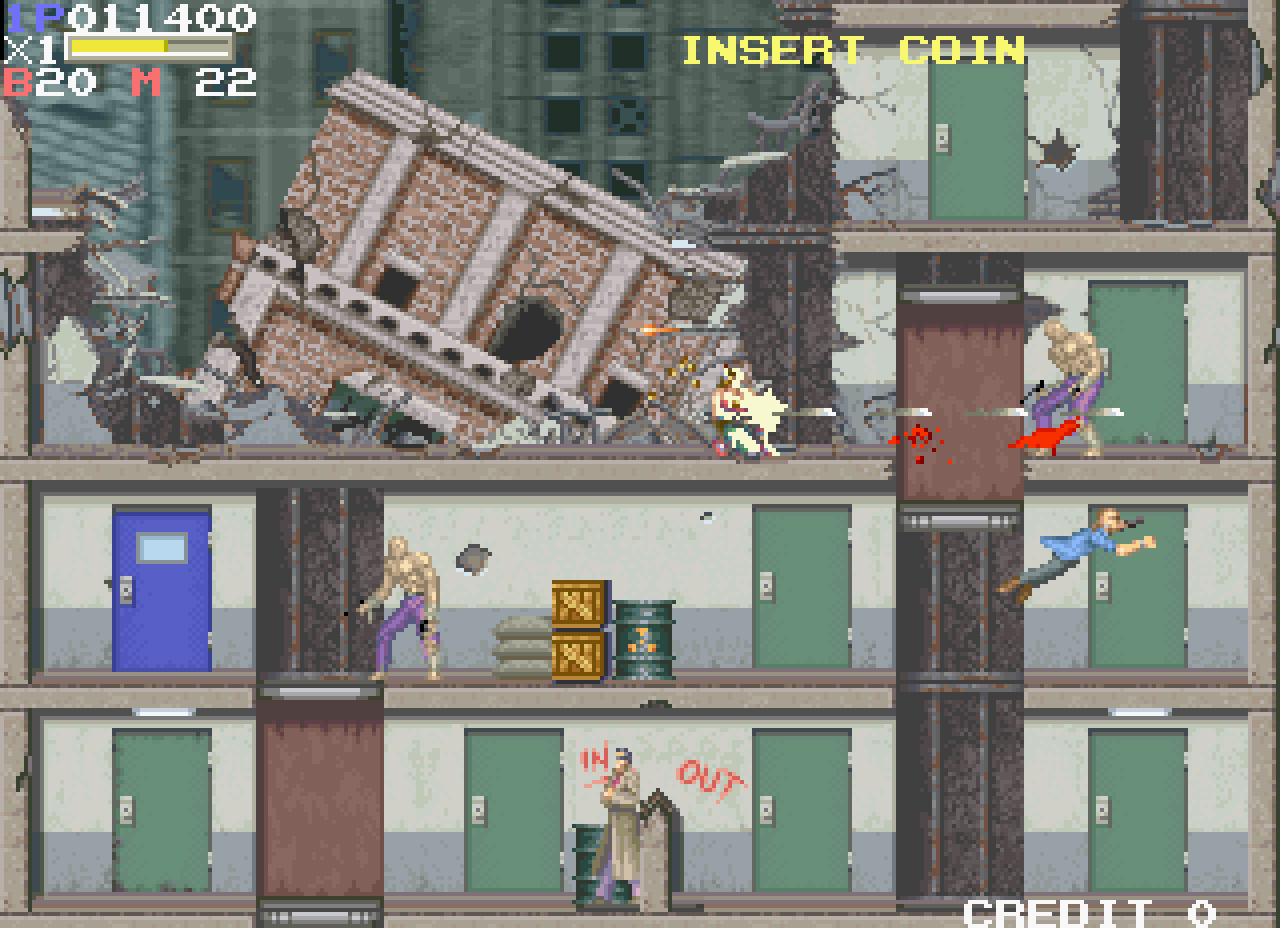
I love Returns, and I recommend it to anyone who finds the original almost too plain. But I want to be straight about something, because a Vault piece should tell you the truth about its subject: the sequel does not replace the original. It answers it. Returns is what the idea becomes when you add everything. The 1983 game is what the idea is when you take everything away — and standing in front of that bare version, you can see the bones, and the bones are beautiful. One building. One spy. Thirty floors of doors, and every single one of them might be the one that ends your run.
Why Elevator Action Still Works — and Why It Is Back This Week
Let me say the unsayable part out loud, because you deserve honesty over salesmanship: by modern standards, Elevator Action is extremely simple. There is no other honest way to describe it. The graphics are plain, the moveset is tiny, the whole concept fits in one sentence, and the game has been reissued so constantly over the past twenty years — compilations, Virtual Console, the first Arcade Archives run — that even sympathetic reviewers have wondered whether this particular well needed another visit. It is a fair question. Here is my answer, after all these years of riding that lift: the simplicity is not the limitation. It is the design.
Everything in this game is legible. You can always see what killed you, and it was always fair, and it was always, in some small way, your fault — you rode one floor too far, you trusted a doorway, you waited when you should have kicked. Modern games bury that clarity under systems. Otto’s building never does. And because the rules never change, your own improvement becomes the content: the descent you fumbled in 1983 is the descent you conduct like an orchestra in 2026, calling elevators the way a conductor calls in the strings. Few games that old still hand you that feeling for the price of a sandwich.
Which brings us to this week’s two doors back in. The Arcade Archives 2 edition of the arcade original — on Nintendo Switch 2, PlayStation 5 and Xbox Series X|S for $9.99, with a $2.99 upgrade path for owners of the earlier release — is the connoisseur’s ticket: the real 1983 machine, the way the charts in Japan first met it. The Console Archives NES edition, $7.99 on PlayStation 5 and Switch 2, is the memory ticket: the living-room building, the couch, the lookout on the sofa beside you. If you have never played it, start with the arcade original and learn the building properly. If you grew up with it, you already know which one is yours.
As for me, I will be on the roof again this week, where I have been, on and off, for over forty years. Down past the dark floors where somebody shot the lights out long ago. Down past the red doors, one document at a time. The car is waiting at the bottom. It has always been waiting at the bottom. All Otto ever asked of any of us is that we get there — carefully, patiently, and in one piece. Going down?