
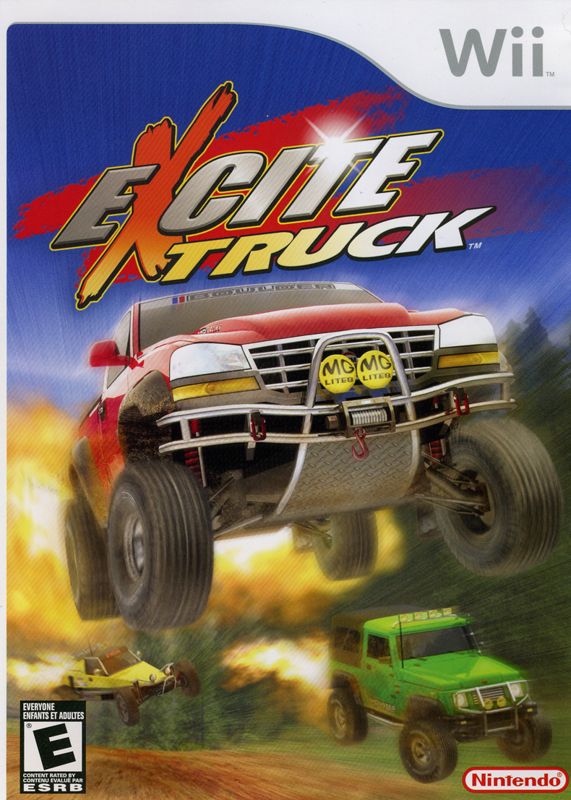
At a glance — Game: Excite Truck · Developer: Monster Games · Publisher: Nintendo · Original release: November 19, 2006 (North America) · Original platforms: Wii · Genre: Racing · Director: Richard Garcia · Music: Kenji Yamamoto, Masaru Tajima
On the morning of November 19, 2006, the Wii launched with a pack-in about bowling and a Zelda about wolves — and, sitting between them on the shelf, a racing game that did not care whether you finished first. Excite Truck asked a stranger question than any launch title had a right to ask: what if winning the race was only one way to win the race? Twenty years on, it remains the purest expression of what Monster Games and Nintendo thought motion control was for — not precision, but joy, thrown sideways at sixty miles an hour.
Hold the remote sideways and tilt
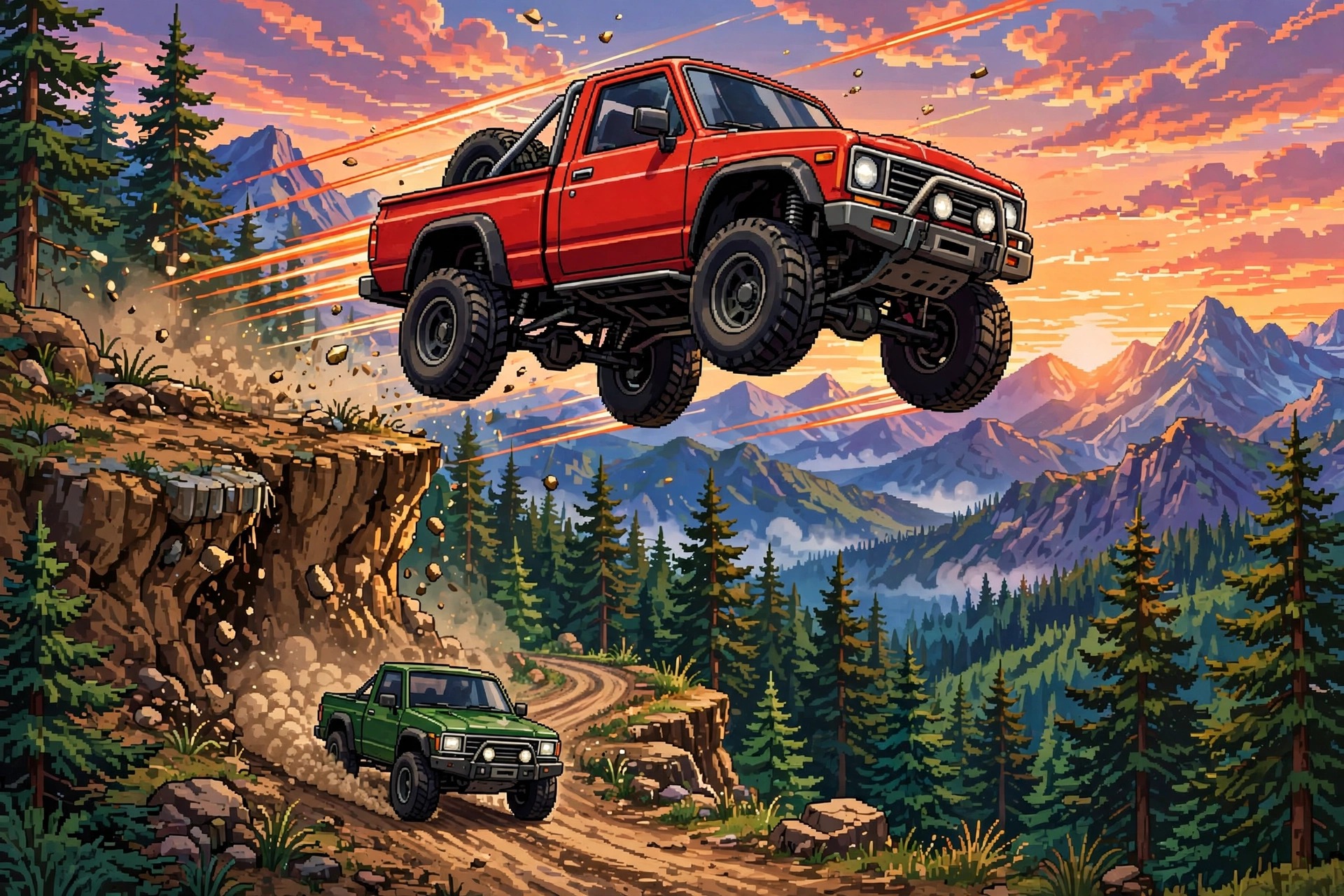
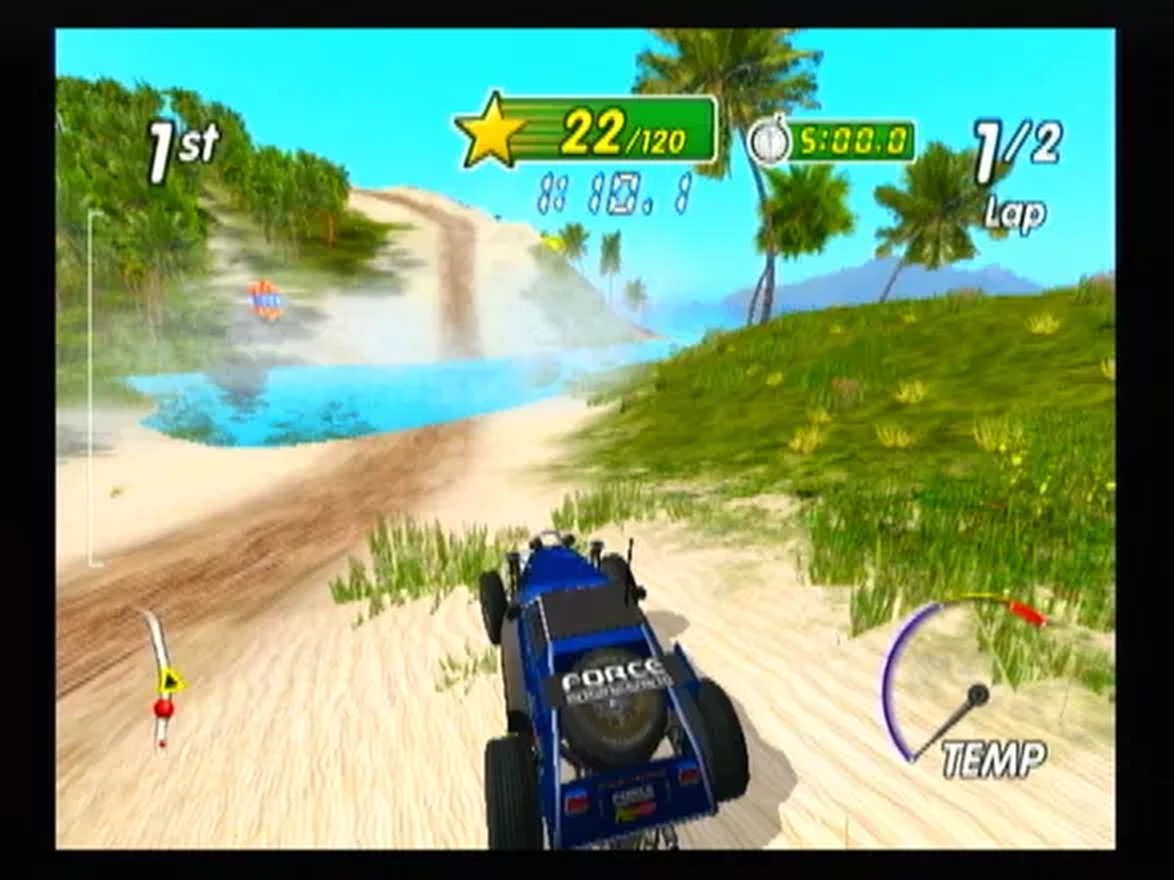
Excite Truck uses no Nunchuk. You hold the Wii Remote horizontally, like a steering wheel, and tilt it to steer — and, crucially, tilt it in the air to angle your truck’s landing. That second part is the inheritance: the game is the third entry in the Excite series, after 1984’s Excitebike and 2000’s Excitebike 64, and the series’ oldest law still applies. Land with your wheels parallel to the slope and the game pays you in turbo boost; land wrong and you pay in time. Around that law Monster Games built a boost economy inherited from the bikes — boost too greedily and the engine overheats, unless you cool it in shallow water or in mid-air, where the engine recovers while you fly. It was playable at E3 2006, where it won the Game Critics Award for Best Racing Game, and it was one of the first titles running on Wii kiosks before launch, alongside Wii Sports and Twilight Princess.
In Excite Truck, first place is just another stunt
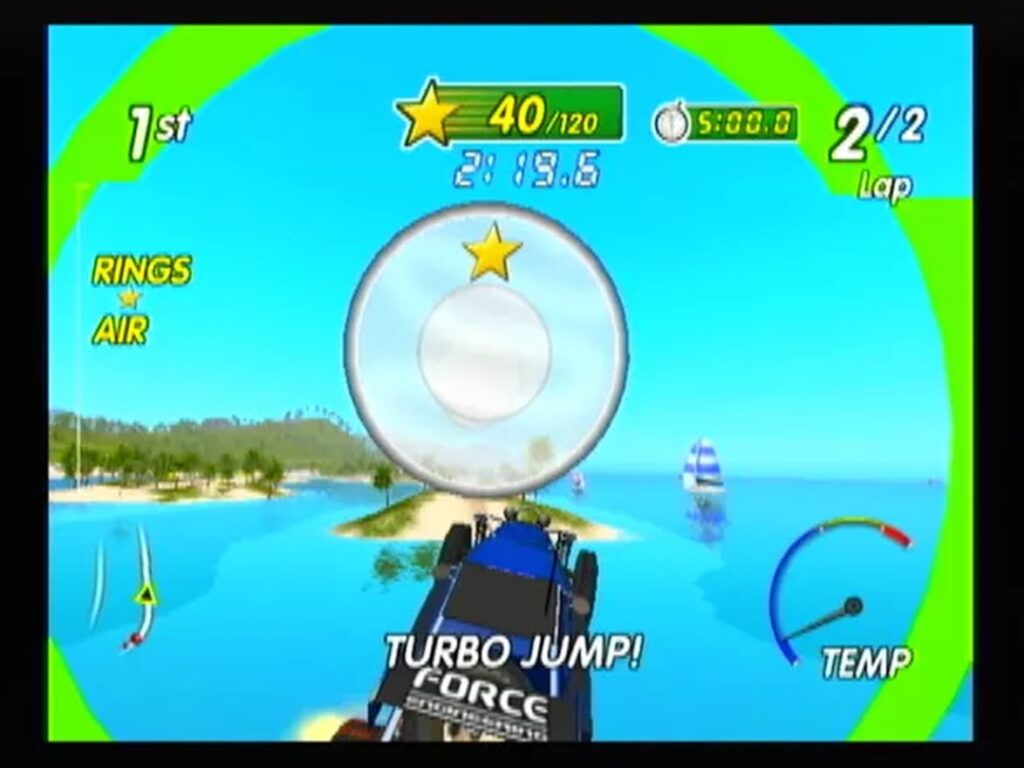
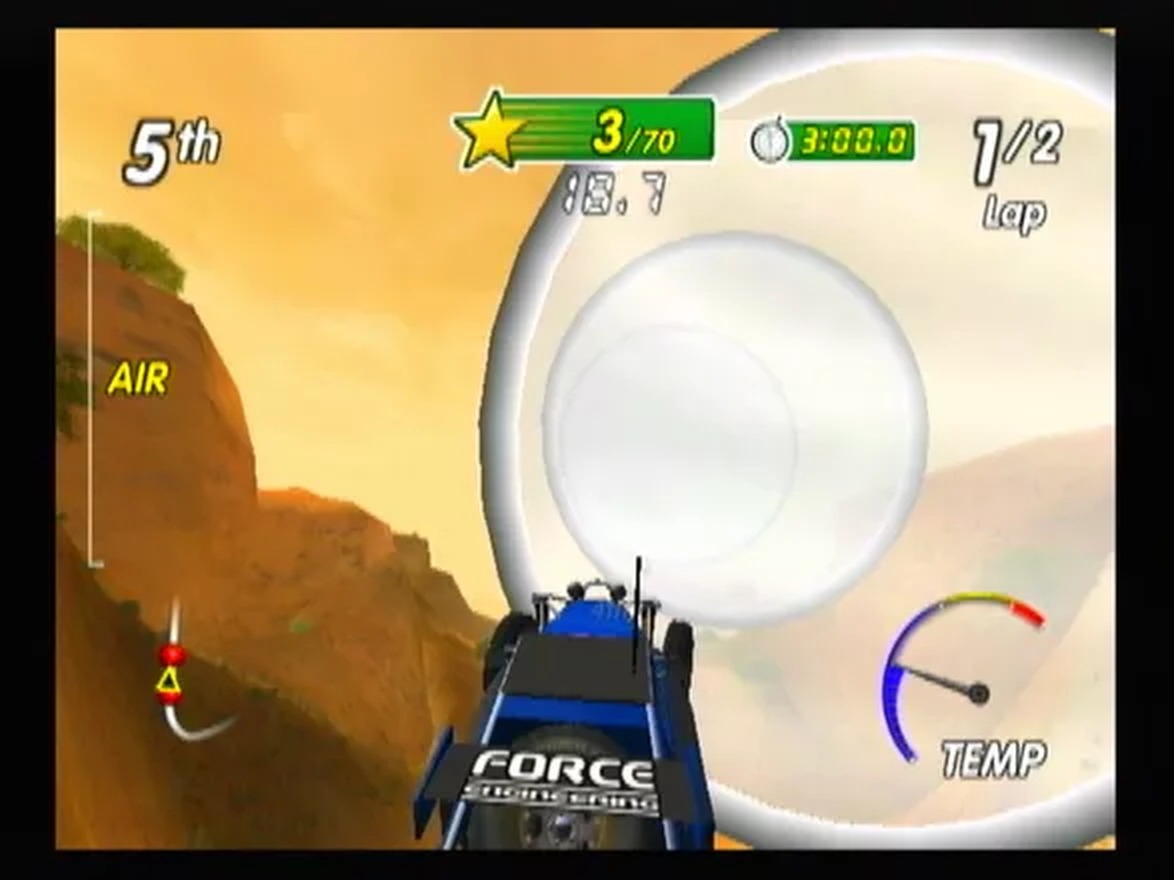
The scoring system is the design’s real argument. Stars are awarded for everything — drifts, near misses, tree runs, airtime, rings threaded in flight, opponents smashed — and each course sets a star quota you must hit to advance, whether you finish first or fifth. Letter grades run up to the S rank, and S-ranking every course unlocks the harder Super Excite mode, whose completion unlocks Mirror Mode in turn. A POW item deforms the terrain itself, raising or sinking the ground ahead of you to manufacture jumps where none existed — the land-deformation idea carried forward from the earlier Excite games, now weaponised. The courses tour real places — China, Scotland, Mexico, Fiji, Finland, Canada — plus one fantasy crystal mountain called Nebula, and the whole thing runs to a feature no Wii game had offered before: your own music, MP3s loaded from an SD card, a first for the console that Endless Ocean would later borrow.
The structure around the racing is pure unlock-chasing. You start with three trucks and earn more by hitting benchmarks; S ranks on the standard Excite difficulty open Super Excite, with more stars demanded, rings spaced wider and one track that exists nowhere else, and a full set of Super Excite S ranks opens Mirror Mode, with every course flipped and the rings shrunk. Alongside the cups sit the Challenge series — Gate, Ring and Crush events that isolate the game’s skills — and a two-player split-screen Versus mode with its own spiteful arithmetic: the first finisher banks a 15-star bonus, after which a 30-second countdown starts for the trailing player, who surrenders a star to the winner for every second they fail to finish, and scores nothing at all if the clock runs out. Even the tutorials are mandatory, a launch-window courtesy for an audience that had literally never held the controller before.
A launch-day hit that history filed under “also-ran”
The reviews were warmer than the game’s later reputation suggests: IGN scored it 8.0, Nintendo Power 85, and it settled at 72 on Metacritic across 57 reviews — “mixed or average” by the aggregator’s label, but with the caveat that critics were grading a control scheme nobody had ever used before, on a console nobody owned yet. The Academy of Interactive Arts & Sciences nominated it for Racing Game of the Year. Commercially it did its job: the ninth-bestselling Wii game of November 2006, in the most contested launch month in Nintendo’s history. A sequel, Excitebots: Trick Racing, followed in 2009 with the same engine and stranger ideas, and the trucks turned up as trophies and stickers in Super Smash Bros. Brawl. But the series stopped there, and Excite Truck settled into the odd afterlife of launch titles that demonstrated a philosophy their console later abandoned.
Nintendo marketed it like a launch title should be marketed — an Excite Truck toy rode along in Wendy’s Kids Meals — and the game kept a small foothold in the catalogue for years: one of its trucks became a trophy in Super Smash Bros. Brawl, others became stickers, and its results-screen music turned up as a selectable track on Brawl’s Mario Circuit stage, a placement repeated in Smash for Wii U and Ultimate. The sequel’s engine and ranking ideas also fed the WiiWare revival Excitebike: World Rally. It is a strange, scattered legacy for a game this coherent — which is rather the story of the Wii’s first year in miniature.
The split in the scores tells the story of that winter. Game Informer gave it a 7, GameSpot a 6.8 and GameTrailers a 6.5, while IGN’s 8.0 and Official Nintendo Magazine’s 84 sat at the other end of the table — a spread wide enough to map exactly onto how each reviewer took to steering with a television remote. Nothing about the disagreement was really about the racing, which everyone conceded was fast and funny; it was about whether tilt control was a gimmick or a language. Twenty years later, with gyro steering a standard option in the genre, the language side of the argument looks to have won — it just took the rest of the industry a while to learn to speak it.
Why Excite Truck at 20 still flies
Because the philosophy was right. Excite Truck understood, on day one, that motion control’s gift was not accuracy but theatre — the lean of your whole body into a landing, the star counter climbing for style instead of position. Modern arcade racers that score your flair as richly as your finishing place are walking a road this game graded with a tilt of the wrists in 2006. At 20, it is still the most fun you can have coming third.
— Chip
For more launches from this date, see This Day in Gaming History: November 19.