
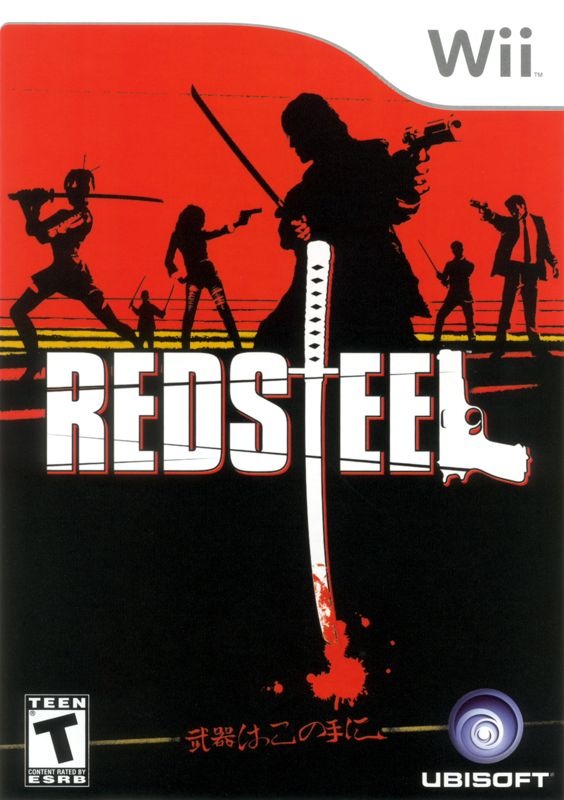
At a glance — Game: Red Steel · Developer: Ubisoft Paris · Publisher: Ubisoft · Original release: November 19, 2006 (North America) · Original platforms: Wii · Genre: First-person shooter · Director: Nicolas Eypert · Music: Tom Salta
Every console launch makes promises, but the Wii made a physical one: your hands would finally do what your thumbs had only described. No launch title sold that promise harder than Red Steel. Unveiled in the May 2006 issue of Game Informer months before the console had a price, Ubisoft’s yakuza shooter asked players to imagine aiming a gun by pointing at the screen and settling arguments with a katana by swinging one. Twenty years on, Red Steel is the most honest artefact of that November morning — the game that showed, in a single cartridge slot’s worth of ambition, both why motion control conquered the world and why it could not stay.
A launch title with something to prove
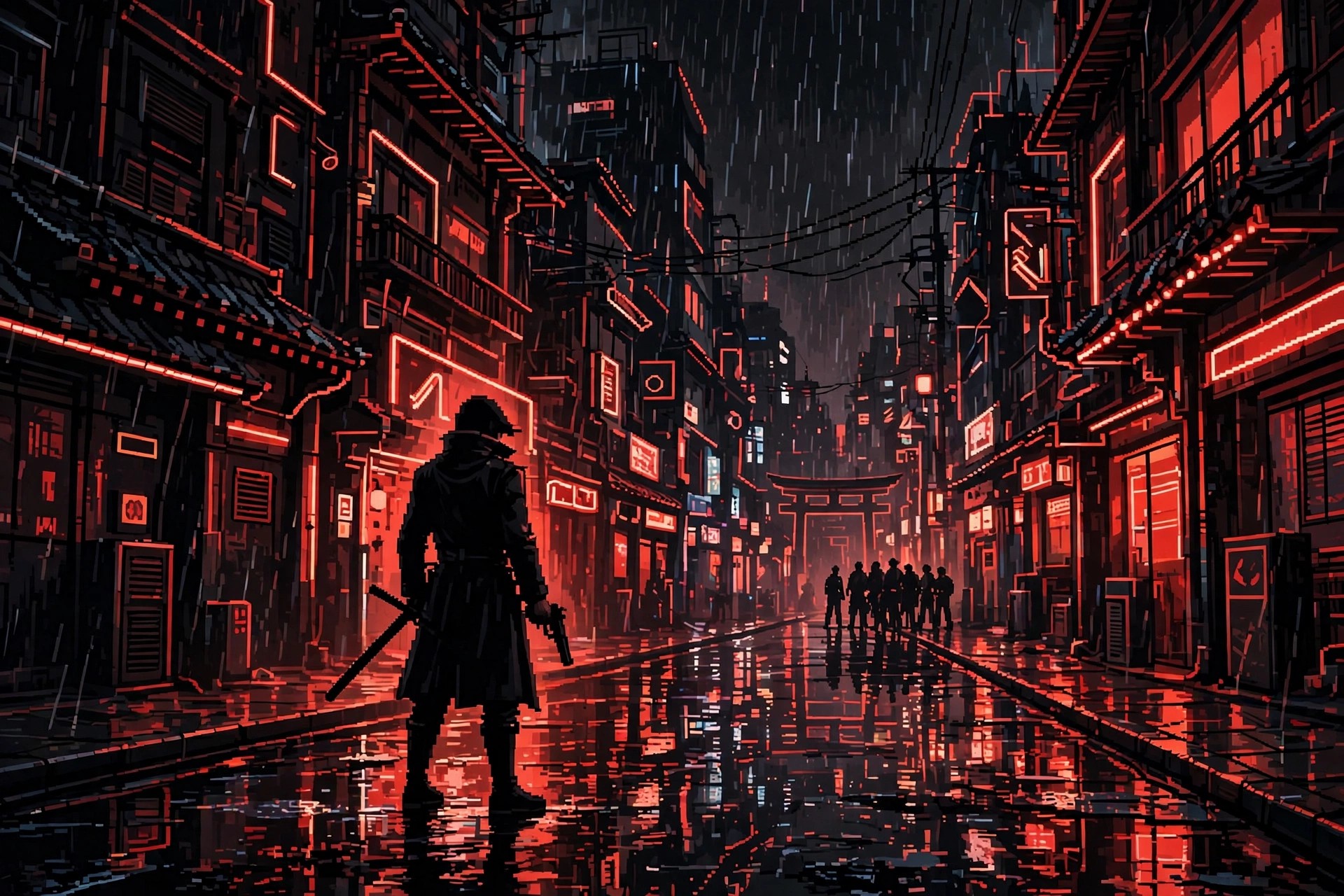
Red Steel was not a port or a mascot piece. It was a third-party original built exclusively for a console whose controller nobody outside Nintendo had fully reckoned with, developed by Ubisoft Paris on a modified Unreal Engine 2.5 — an engine the team knew intimately, bent toward a defining artistic style rather than photorealism. The pitch was pure 2006: an American bodyguard, Scott Monroe, is about to meet Isao Sato, father of his fiancée Miyu, when gunmen disguised as hotel staff open fire. Sato is revealed as the Oyabun of one of the largest yakuza families, Miyu is kidnapped by the traitor Ryuichi, and the ransom demanded is the Katana Giri, a sword once used to execute dishonourable godfathers. The chase runs from Los Angeles to Tokyo, through spas, car workshops, airports and the four Tokyo districts seized by the usurper Tokai, who wants the Giri to avenge his own father. It is pulp, unapologetically — a season of crime television compressed into a launch game.
What mattered was not the plot but the posture. Nintendo’s own launch software pointed at bowling pins and fishing ponds. Red Steel pointed at people, and asked the player to decide, again and again, whether to shoot them. That decision system, not the graphics, is the game’s real design legacy.
The back half earns its pulp. In Tokyo, Scott is taken in by Otori, a former samurai who shelters the Katana Giri, and betrayed by Harry Tanner, the American nightclub owner who had been guiding him — Harry’s basement, a henchman named Dozan and a sword grabbed off the floor are the game’s most memorable set piece. The finale returns to choice: Tokai, defeated, reveals that only he holds the antidote to the Komori poison working through Otori and his daughter Mariko. Defend Tokai from Otori’s vengeance and the Katana Giri itself breaks in the duel — the sword the whole war was fought over, snapped in the act of sparing the man who stole it — and everyone lives. Stand aside, and Tokai dies, the antidote dies with him, and Scott and Miyu walk out of the estate alone. Two endings, decided not by a menu but by where you point yourself in the last thirty seconds. For a launch game, that is genuine nerve.
Guns in one hand, Red Steel’s katana in the other
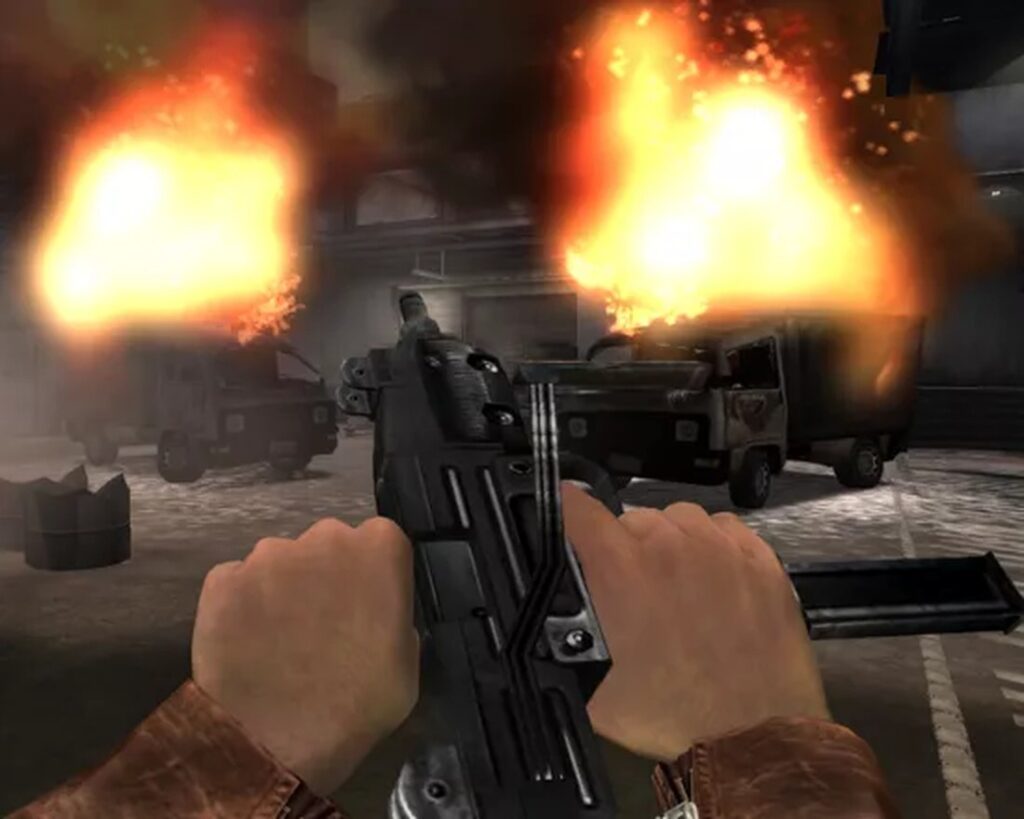
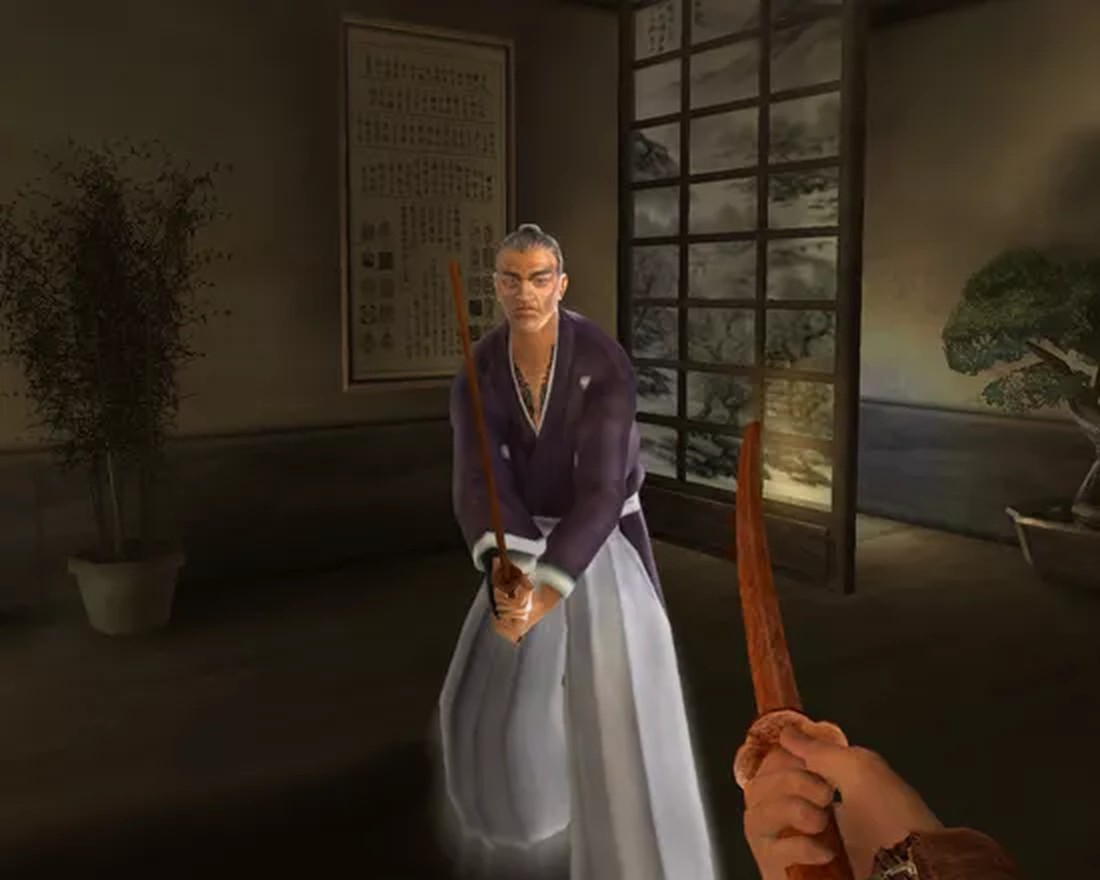
The gunplay translates the Wii Remote into a hand. The on-screen hand points where the Remote points; you push the controller forward to shove objects into cover, shake the Nunchuk or tap right on the D-Pad to reload, and mime underhand or overhand throws to lob grenades. Accuracy is banked: efficient shooting earns “freeze points”, and a full meter lets you momentarily freeze time and place your shots. Then, without warning, the guns go away. Sword fights lock you into duels where the Remote becomes the blade — parrying, striking, managing a life bar for both man and weapon — and the same mercy logic applies at the end of a duel as at the end of a gunfight.
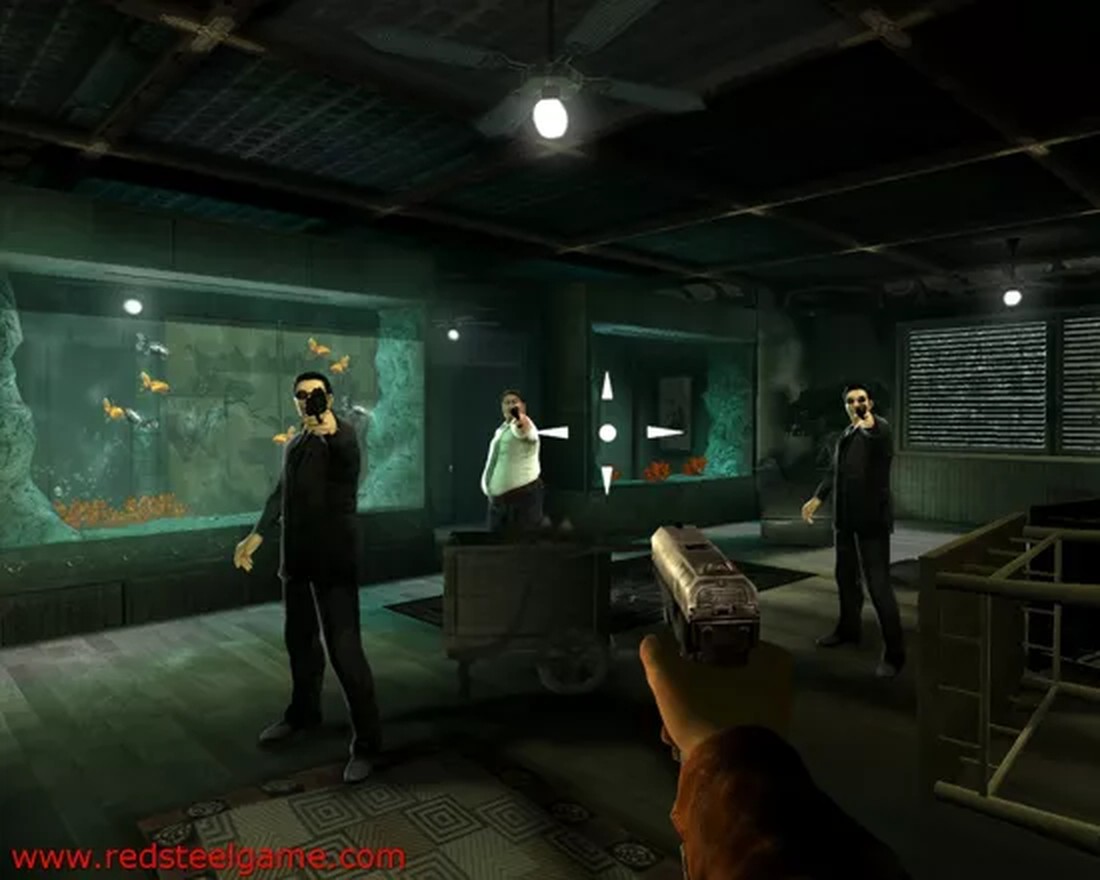
The surrender system is the part history should keep. Enemies are aggressive, moving around cover and leaping onto tables rather than queuing to be shot. But shoot the weapon out of a man’s hands and he raises them. Disarm a mob’s leader and the whole mob surrenders. A waved gun directs a prisoner to kneel; a won duel leaves your opponent on his knees awaiting your choice. Spare him and he is out of the fight and you are paid in respect points. Kill a man who has surrendered and the game gives you nothing at all — no points, no benefit, just the shot. In 2006, in a launch shooter sold on violence, that was a quietly radical piece of design: mercy as the optimal strategy.
The telephone in your hand
Multiplayer shows the same inventive streak. Four players share four maps — Dojo, Restaurant, Games and Docks — across Deathmatch and Team Deathmatch, plus a mode called Killer that only works with a full room: at the start of each round, every player’s Wii Remote rings like a telephone, and the player lifts it to their ear to hear a secret objective through the Remote’s speaker that nobody else in the room can hear. Before play, each player also picks a bonus — More Damage, More Life or Unlimited Ammunition — charged by kills and triggered with the “1” button. Split-screen shrinks the picture but not the gestures; the developers noted you could still swing as wildly as you liked without invading another player’s quadrant. It is a party game wearing a crime saga’s clothes, which is perhaps the most Wii sentence ever written about a yakuza shooter.
There is also the matter of how it looked and sounded doing all this. The artistic-style-over-photorealism brief produced a game that swings between moody neon interiors and flat corridors — the variance reviewers kept remarking on — but the presentation had one unqualified triumph: Tom Salta’s score, all taiko weight and electronic pulse, which did more than any texture to sell Tokyo at 3 a.m. The soundtrack was the single point of critical unanimity in a launch title that agreed on nothing else, and it is the element that has aged best: play Red Steel today and the controls argue with you, the textures plead their era, and the music simply wins.
A million copies and a critical split
The reviews split down the middle and stayed there: 63 on Metacritic, with Nintendo Power at 8/10 and GameTrailers at 7.8 against IGN’s 6/10, GameSpot’s 5.5 and Edge‘s 5/10. Japan’s Famitsu panel, notably, landed high at 34/40, and Game Informer gave it 7.5 — the spread of a game whose ideas graded better than its execution. Critics could not even agree on what they were disagreeing about — IGN found the controls prone to glitching while GameSpot found them fine outside the sword sections; the graphics were called technically impressive and inexcusably below par, sometimes in adjacent paragraphs of the same argument. The one unanimous verdict was Tom Salta’s soundtrack, praised by nearly every outlet that touched the game. The market was less divided: Red Steel sold over one million copies worldwide and took an ELSPA Gold award for 200,000-plus sales in the United Kingdom alone. A stand-alone sequel, Red Steel 2, arrived in 2010 and rebuilt the swordplay around Wii MotionPlus — an implicit admission of what the original’s duels had been reaching for.
Why Red Steel at 20 still cuts
Because it is the launch day fossil with the ambition still visible in the rock. Red Steel promised that a controller could be a gun and a sword in the same minute, and that a shooter could reward the shot you chose not to take. The technology of 2006 could only half-deliver on the first promise, and the industry mostly declined the second. But stand in a Tokyo street in this game, freeze time with a banked meter, and talk a room full of gunmen onto their knees without firing — and you can still feel the future the Wii was selling, twenty years ago today.
— Chip
For more launches from this date, see This Day in Gaming History: November 19.