
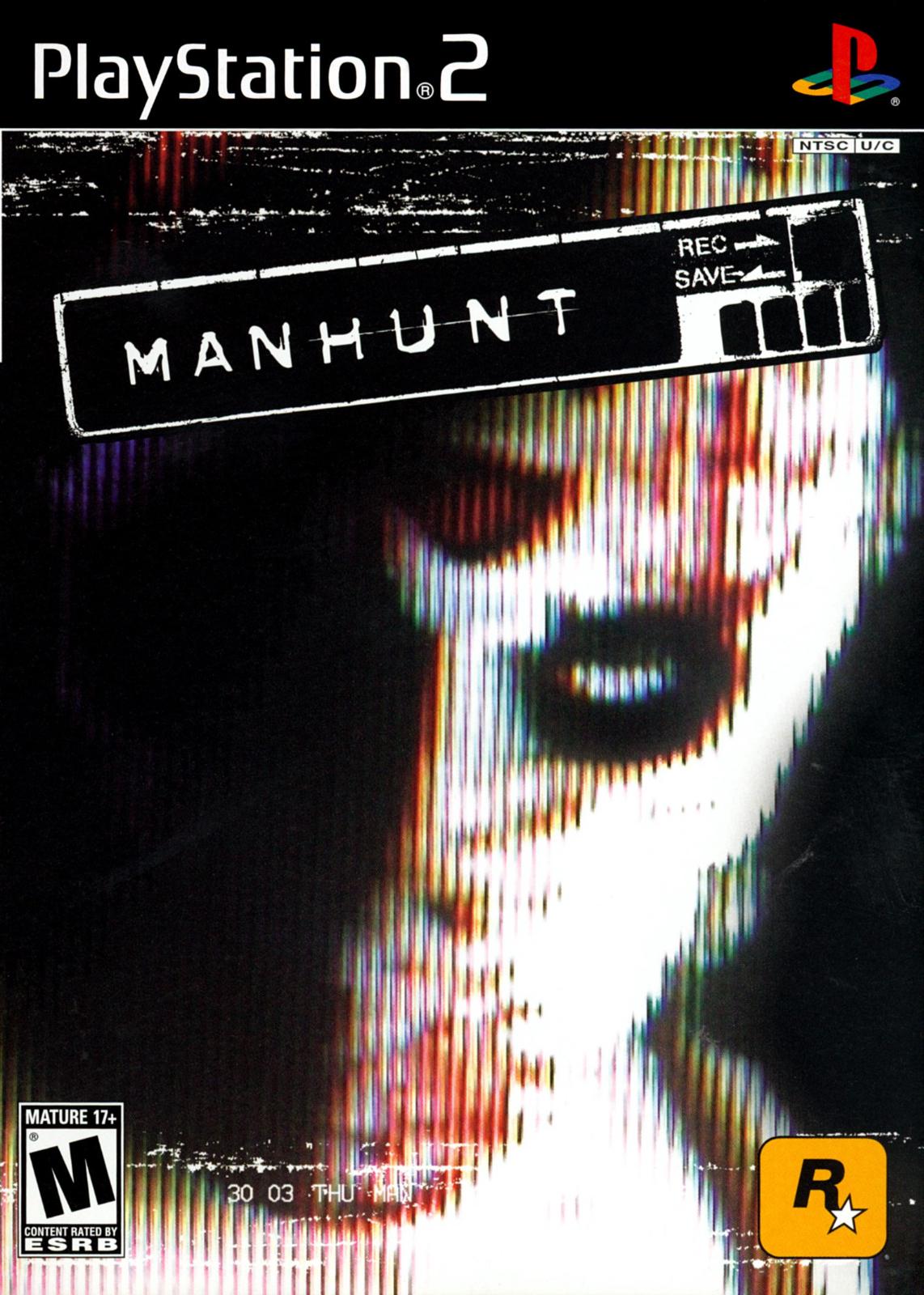
At a glance — Game: Manhunt · Developer: Rockstar North · Publisher: Rockstar Games · Original release: November 19, 2003 (North America) · Original platforms: PlayStation 2 · Genre: Stealth · Metacritic (PS2): 76
Twenty-two years ago today, Rockstar North released the least Rockstar game Rockstar has ever made. No open world, no sunshine, no radio stations, no jokes — or almost none, and the ones in Manhunt curdle in your throat. Instead there is a condemned man, a voice in his ear, and a dying industrial city that wants him dead for entertainment. It shares a birthday with Half-Life, which turned 28 today; of the two games released on November 19, Manhunt is not the respectable one. It sold 75,000 copies in its first month in the United States, a rounding error next to Vice City, and then spent two decades being banned, blamed and quietly revered. The reverence is the part worth explaining, because underneath the headlines sits one of the purest stealth games of its generation.
A Death Sentence, an Earpiece and the Director
James Earl Cash has been executed. That is where the game starts: the lethal injection, the flat report of his death in Carcer City, and then the rude surprise of waking up alive. The injection was a sedative. Cash — voiced by Stephen Wilfong, and close to silent for most of the game — has been spared by a man who calls himself the Director, who speaks to him through an earpiece and makes a simple offer: your freedom, earned on camera. Carcer City is a rust-belt husk of shuttered factories, dead malls and abandoned neighbourhoods, and the Director has wired it for sound and pictures. Cash’s job is to survive twenty “scenes,” each one filmed, each one stocked with Hunters — gang members sent to kill him while the cameras roll.
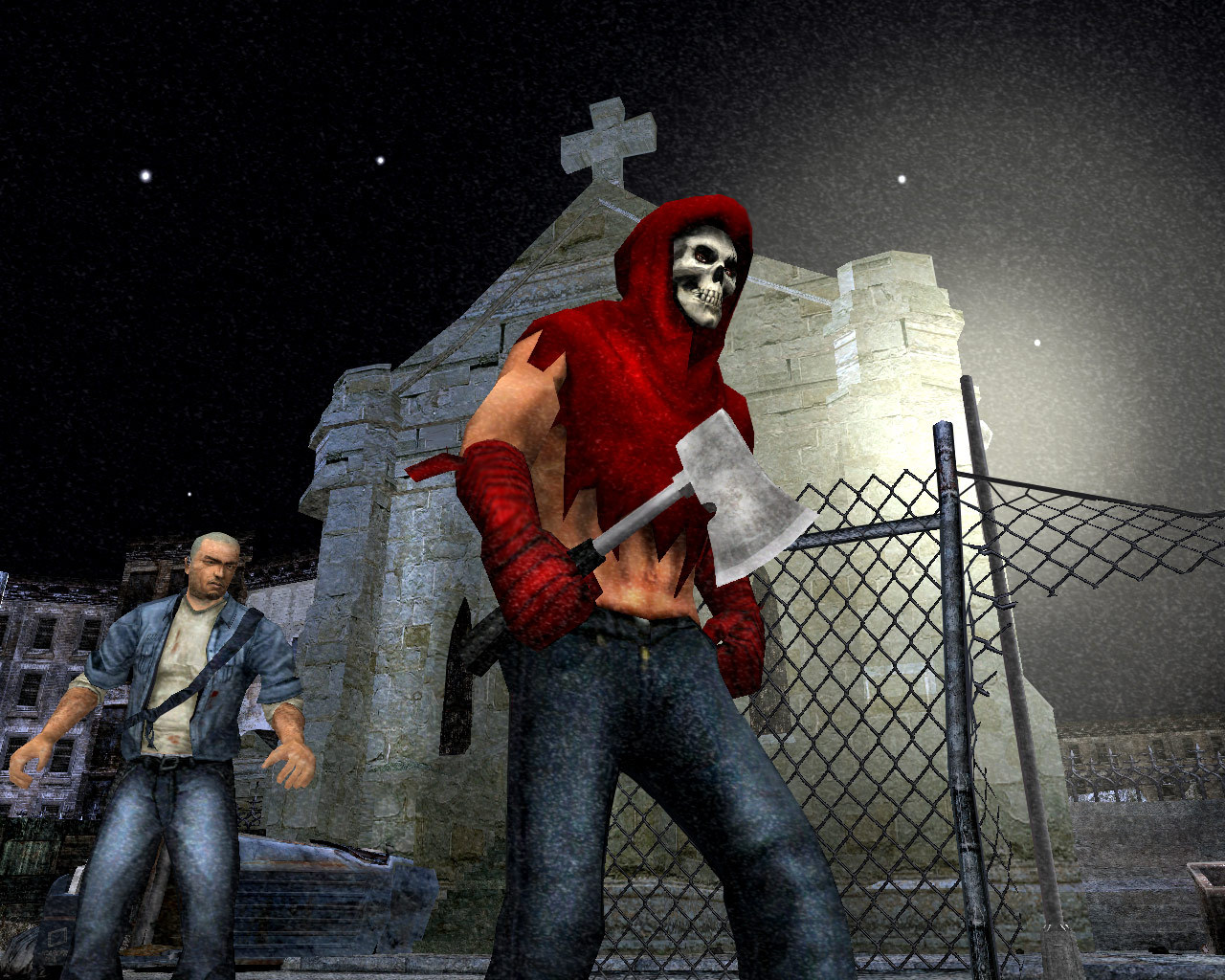
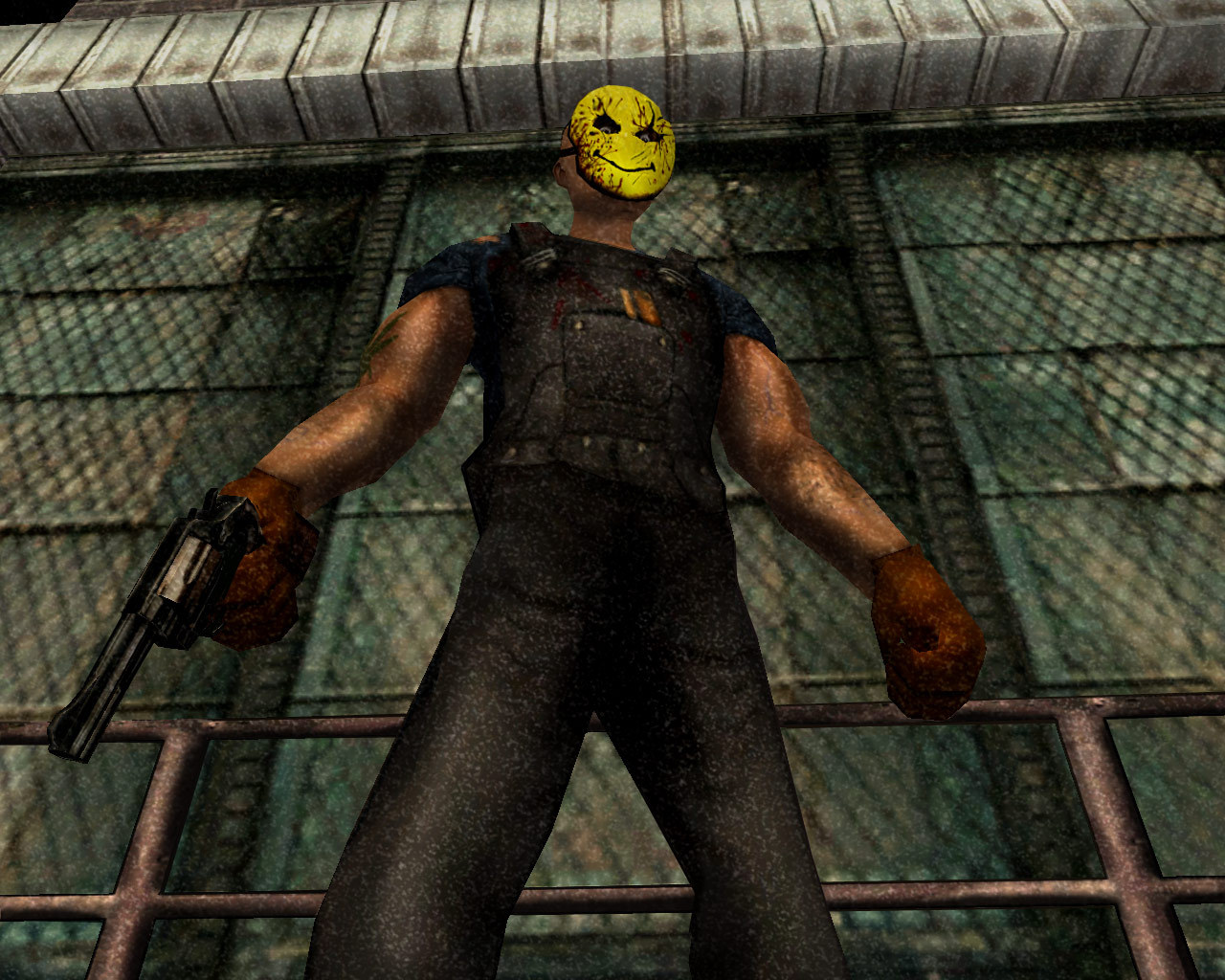
The Director is the game’s great creation. He is Lionel Starkweather, a washed-up film producer from Los Santos who reinvented himself as a snuff-film auteur, and he is voiced by Brian Cox with a warmth that makes your skin crawl. Cox never shouts. He encourages. He compliments Cash’s work the way a director compliments a take, and the horror of Manhunt is largely the horror of being appreciated by this man. The gangs he casts against Cash are grotesques, each with their own territory and temperament: the Hoods, a mix of criminals and corrupt police; the Skinz; the Wardogs, a sadistic paramilitary outfit run by Starkweather’s right hand, Ramirez; the Innocentz; the Smileys, former asylum inmates; and the Cerberus, Starkweather’s private security, who move Cash between scenes and clean up after him.
The story tightens the way good thrillers do. Starkweather betrays Cash, targets his family, and plans to kill his star in the climax of the film. A journalist investigating the snuff ring — the same reporter whose voice opens the game, announcing Cash’s execution — has the evidence to bury Starkweather but needs Cash to get her to it. And waiting at the end, in Starkweather’s mansion, is Piggsy: a chainsaw-wielding maniac Starkweather kept chained in his attic like a prop he was saving for the finale. Cash survives all of it, confronts Starkweather in his office, and vanishes. The journalist’s exposé brings down the city’s corrupt police chief. Cash is nowhere to be found. It is a lean, mean piece of pulp, and Cox’s performance holds every frame of it together.
Manhunt PS2 Is a Stealth Game First
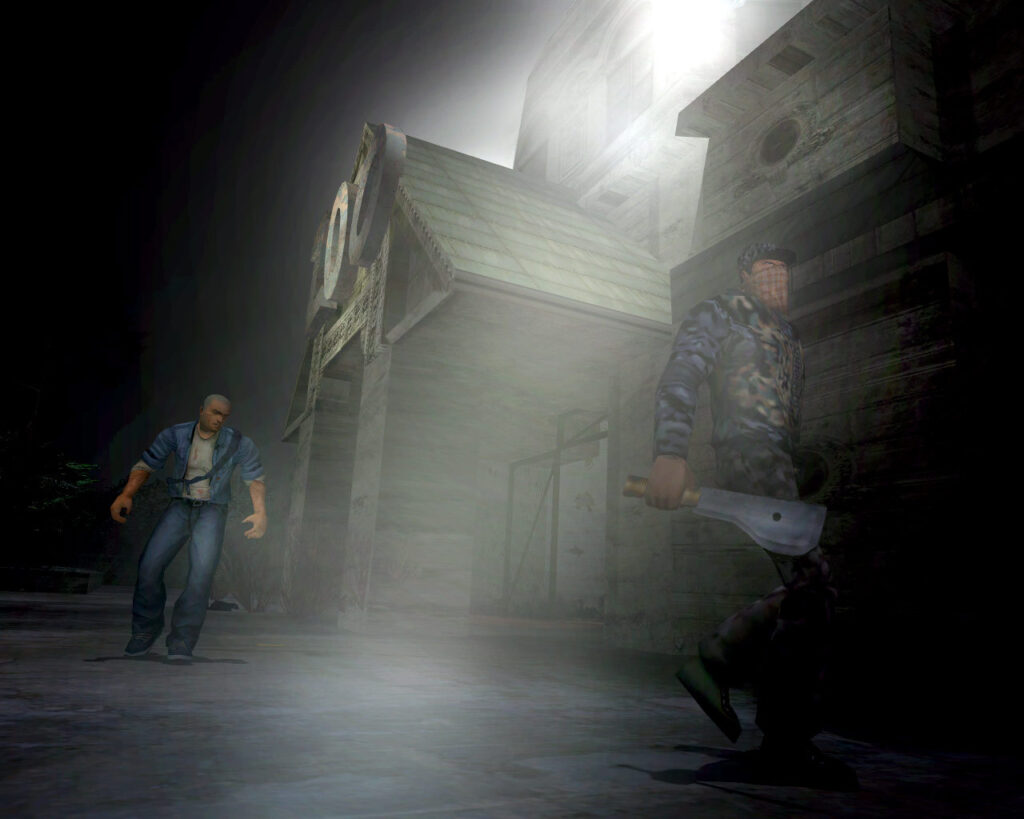
Strip away the reputation and what remains is a stealth game of unusual discipline. Cash is fragile and permanently outnumbered, and face-to-face fighting is a habit the game beats out of you early. The core skill is the shadow. Every scene is full of dark spots where Hunters simply cannot see you, and the standard Manhunt kill is an exercise in patience: hide, tap a wall to draw a Hunter over, wait for him to turn away, and close in from behind. Executions come in three grades — hasty, violent and gruesome — and you choose between them by holding the lock-on and watching the reticule change colour, white to yellow to red, the longer you are willing to wait with a Hunter’s back turned and your own nerve holding. Take too long over it and he turns around.
Then there is the scoring, which is where the game shows its teeth. At the end of each scene you are graded in stars, and the stars for style are awarded for the brutality of your executions. The Director wants a show, and the game quietly arranges for you to want to give him one. That complicity is the whole design in miniature: Manhunt does not force its worst content on you, it incentivises it, and lets you sit with what you did for the rating. On the PlayStation 2, an optional USB microphone pushed the idea further still — the sound of your own voice could draw Hunters to you, and the Director’s instructions came through the headset, into your ear only. In 2003, that felt less like a feature than a haunting.
Firearms arrive late, and they change the temperature without changing the game: Manhunt stays a knife-in-the-dark exercise to the end, twenty scenes of alleys, a zoo, a mall, an asylum. Critics at the time largely saw past the outrage to the craft. GameSpot scored it 8.4 and IGN 8.5 on PlayStation 2, praising the tension and the tone; its Metacritic average settled at 76, dragged down by reviewers who found the combat and level design repetitive. Both readings are defensible. Nobody called it boring.
The Censors Came Calling
The bans began within weeks. On December 11, 2003, New Zealand’s Chief Censor, Bill Hastings, declared Manhunt objectionable — banned outright, with possession itself an offence. In Ontario, Canada, the game became the first computer game classified as a film and restricted to adults, in February 2004. Germany followed in July 2004, when a Munich court ordered all versions confiscated under section 131 of the criminal code, the law against depictions of violence. Australia managed the strangest path of all: the game had been on sale there since October 2003 with an MA15+ rating, but after an appeal by the federal Attorney-General, the Classification Review Board refused it classification on September 28, 2004 — nearly a year after release, Manhunt became illegal to sell in Australia. In Britain, the BBFC had examined the game and passed it at 18. The British storm, when it came, was not about a certificate. It was about a crime.
The Murder Manhunt Didn’t Commit
Stefan Pakeerah was fourteen. In February 2004 he was murdered in Leicester by Warren Leblanc, seventeen, and everything written about this game since has to stand behind that fact and behave accordingly. The connection to Manhunt was made in July 2004, after Leblanc pleaded guilty, when Stefan’s mother Giselle said her son’s killer had been obsessed with the game. Newspapers ran with it. Retailers including Dixons and Game pulled Manhunt from their shelves. The family announced a claim against Sony and Rockstar, represented by the American campaigner Jack Thompson, and for a summer the story was settled in the headlines: the game did it.
The record says otherwise, and the record is not ambiguous. Leicestershire Police stated that the motive for the murder was drug-related robbery. The copy of Manhunt that police had seized — the detail that launched a hundred headlines — had been found in Stefan’s bedroom, not Leblanc’s. The trial judge placed sole responsibility for the murder on Leblanc, who was sentenced to life. The claim against Sony and Rockstar was dropped. The industry body ELSPA made one dry, factual point throughout: Manhunt was an 18-rated game that was never supposed to be in either boy’s hands. None of this repaired the game’s reputation, and it is worth being plain about why this section exists in every Manhunt retrospective, this one included: a boy was killed, a grieving family looked for a reason, and the reason they were handed did not survive contact with the police investigation. The accurate version deserves at least the column inches the wrong one got.
What Survives at 22
Commercially, Manhunt was a cult that thought it was a controversy. The first-month American sales were modest, the game earned a Gold sales award in the UK for passing 200,000 copies, and by March 2008 the two-game Manhunt series had sold 1.7 million copies worldwide — respectable, and a fraction of what Grand Theft Auto did in a month. Inside Rockstar, it left a mark of a different kind: a former developer, looking back, wrote that the game almost caused a mutiny at the company. The studio had weathered the GTA storms with the defence that its violence was parody and its worlds avoidable. Manhunt offered no such cover, and knew it. A sequel followed in 2007 and walked straight into a BBFC refusal and a court fight of its own; the original, meanwhile, kept quietly resurfacing — on the PlayStation Store for PS3 in 2013 and PS4 in 2016, on Steam since 2008, and through Xbox backwards compatibility in 2021.
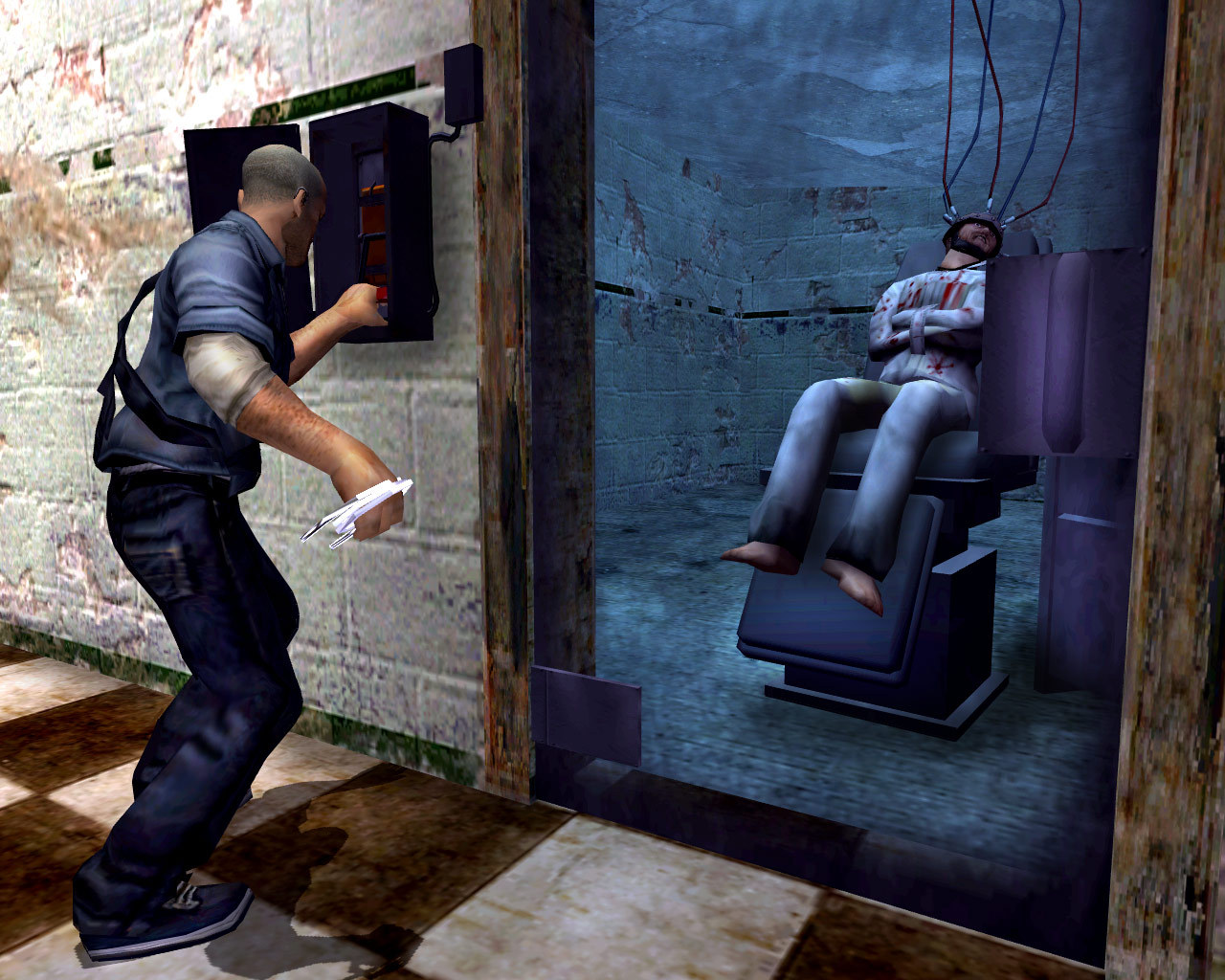
What lasts, twenty-two years on, is the discipline underneath the notoriety. Manhunt is a stealth game about being watched, built by a studio at the peak of its powers choosing to make something small, airless and cruel on purpose — and then framing the cruelty so that the player holds the camera. Brian Cox purring encouragement in your ear. A reticule slowly turning red. A city that is really a film set, and a star who never asked to be one. Plenty of games have been more violent since. Very few have been this honest about who the violence is for.
— Sal
For more launches from this date, see This Day in Gaming History: November 19.