

At a glance — Game: Half-Life · Developer: Valve · Publisher: Sierra Studios · Original release: November 19, 1998 · Original platforms: Windows · Genre: First-person shooter
The first thing Half-Life does is nothing. No explosion, no briefing screen, no gravel-voiced commander telling you the world needs saving. You sit in a tram. It rolls through a vast underground facility while a recorded voice tells you the time, the temperature, and that protective clothing must be worn beyond this point. Scientists wave. A security guard knocks on the glass. It takes minutes, and in November 1998 those minutes were a statement: this shooter trusted you to look around before it let you shoot anything.
Twenty-eight years on, that tram ride is the most imitated opening in the genre’s history, and the game behind it still reads like a challenge issued to everyone who came after. Half-Life was the first game Valve ever shipped. It won more than fifty PC Game of the Year awards, sold more than nine million copies by 2008, and quietly rewired what a first-person shooter was allowed to be. This is the story of how a team of ex-Microsoft staffers, horror fans and hired modders nearly threw their first game away — and then rebuilt it into the one that changed everything.
A First Game That Nearly Got Thrown Away
Valve was founded in Kirkland, Washington, in 1996 by Gabe Newell and Mike Harrington, two Microsoft employees who had watched id Software’s games sell from inside the Windows empire and decided they wanted to make them instead. For their first product they settled on a horror first-person shooter. They did not build an engine from scratch. They licensed id’s Quake technology — the Quake and Quake II engines combined with their own code — and Newell later estimated that around 75 percent of the finished engine, which Valve called GoldSrc, was theirs.
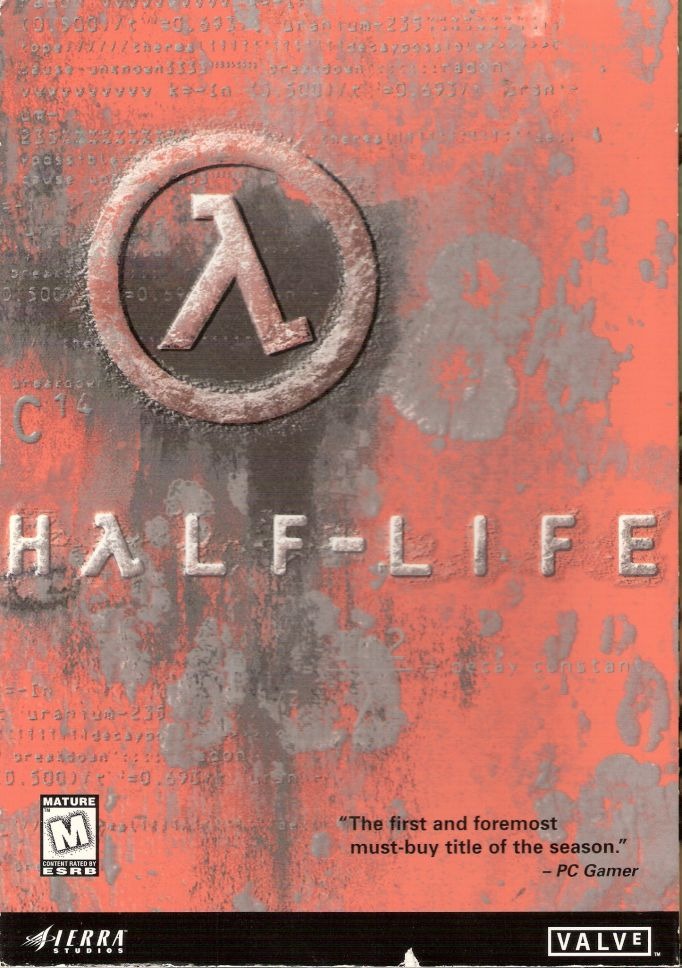
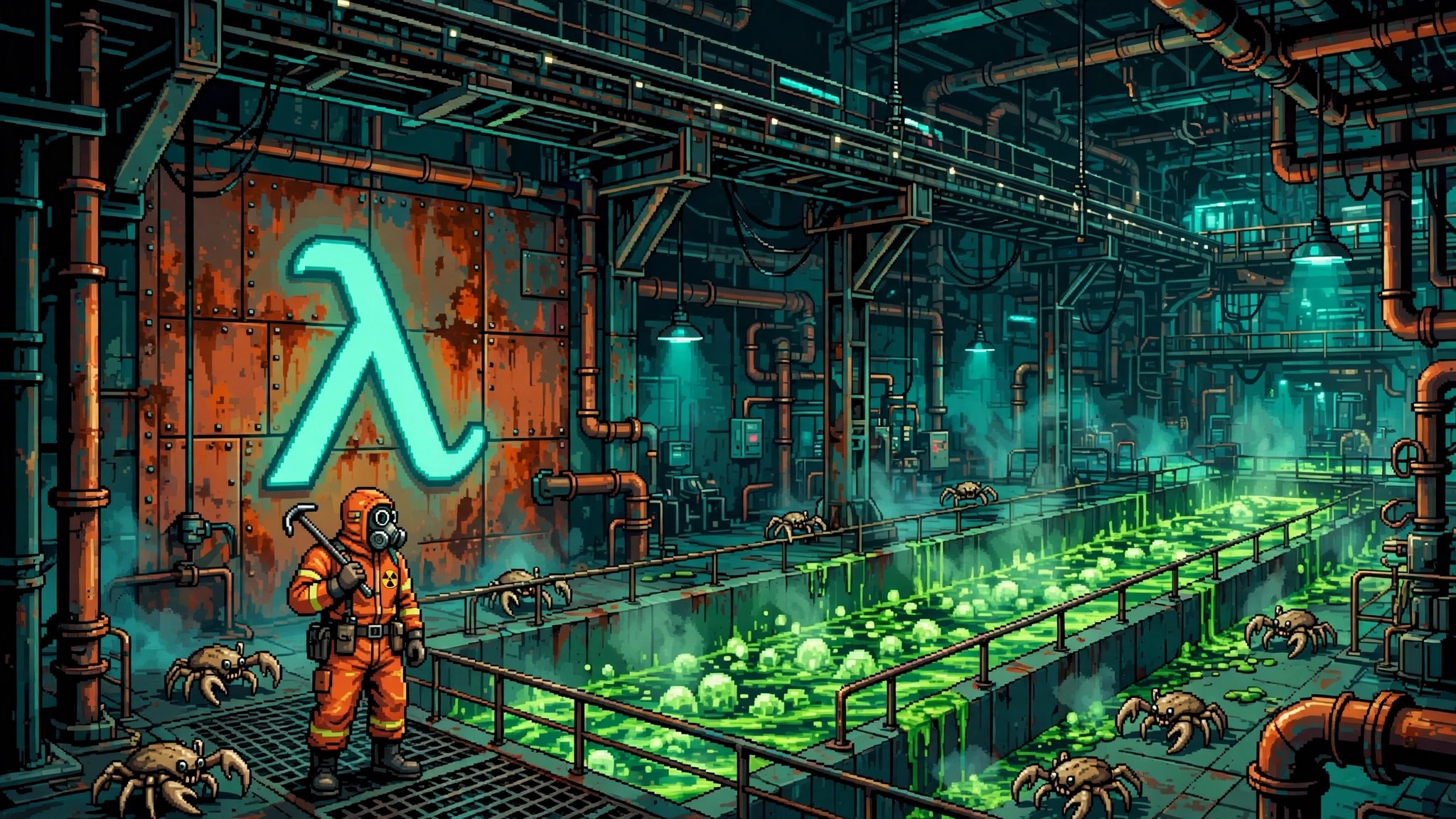
Publishers were not queuing up. A first-time studio promising this much ambition looked like a bad bet, until Sierra On-Line signed a one-game deal. Sierra wanted a 3D action game built on Quake tech; it advanced Valve roughly $1 million for 30 percent of the revenue and, remarkably, all of the intellectual property. The rest of the money came from Newell and Harrington themselves. The project had a working title, Quiver, borrowed from the military base in Stephen King’s The Mist, one of its stated influences alongside Doom, Quake and a 1963 episode of The Outer Limits. The name that stuck came from physics: half-life, the decay constant, the Greek letter lambda that became the series’ mark.
Valve showed the game in early 1997 and aimed to ship that November, head-to-head with Quake II. By September the team faced the truth in playtesting: pieces of it were clever, but the whole was not fun, and there was little design cohesion holding it together. Sierra would not fund more time, so Newell took out a loan and then did the bravest thing a young studio can do. They rebuilt. A small team made one prototype level containing every element the game needed, iterated on it for a month, and when the rest of the studio played it — designer Ken Birdwell called it “Die Hard meets Evil Dead” — they agreed it was the baseline everything else had to match.
Out of that rebuild came the “cabal,” a cross-discipline group that met for six-hour sessions, four days a week, for six months, and owned everything: level layouts, key events, enemy design, narrative. The cabal wrote a 200-page design document and a 30-page narrative document, and Valve hired science fiction novelist Marc Laidlaw to manage the script. Laidlaw later said the opening train ride grew out of an engineer implementing train code for something else entirely. That is the whole development in miniature: systems first, story discovered inside them, and the narrative, in his words, “baked into the corridors.”
Half-Life Never Lets Go of the Mouse
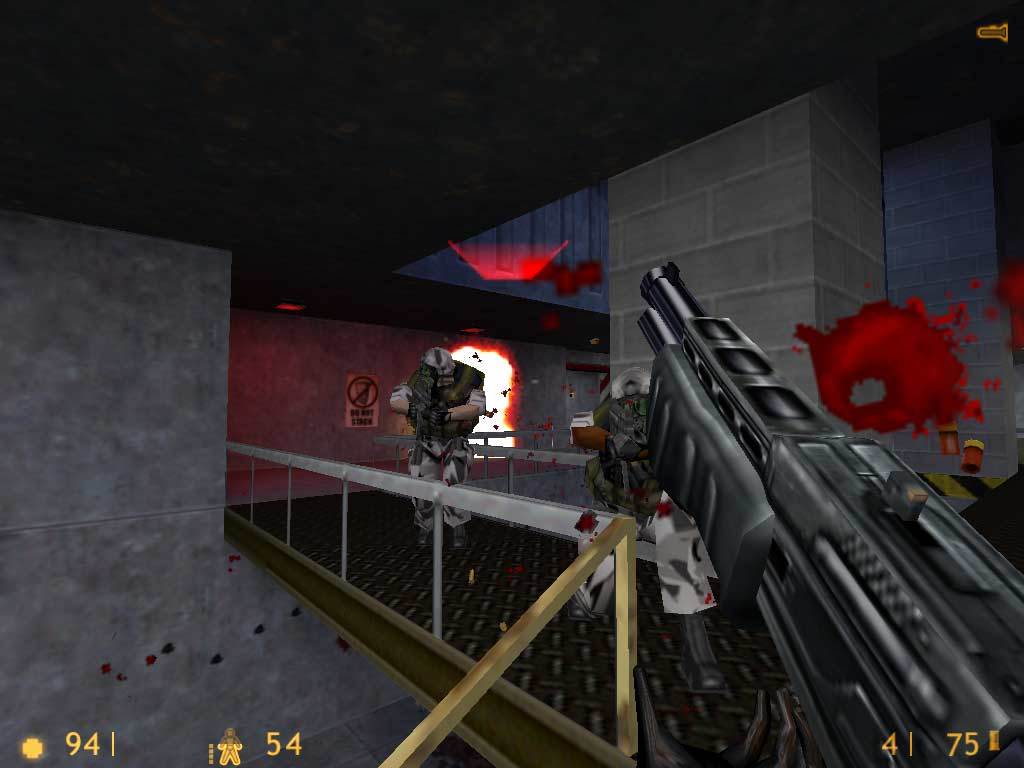
Here is the rule the game set for itself, and then for an entire genre: the player almost never loses control. Gordon Freeman never speaks. You never see him. There are no levels in the old sense, just chapters whose titles flash up as one continuous facility unspools around you — the tram ride, the experiment gone wrong, the long climb to the surface, the rocket silo, the Lambda Complex, and finally the alien border world of Xen. The story arrives through scripted sequences that play out in front of you while your hands stay on the keyboard: a scientist pounding on a door, a guard making a stand he will not survive, the G-Man adjusting his tie at the far end of a platform you cannot reach.
It sounds simple now because everyone copied it. In 1998 it was a break with how shooters worked. Cutscenes stopped the game to tell you things; Half-Life trusted architecture, voice lines and choreography instead. The puzzles grew out of the place, too — ride a conveyor line, stack crates into a staircase, kill the tentacle beast filling a blast pit by firing the rocket engine it is standing in. Even the controls left a mark: Half-Life was one of the first mainstream games to make WASD the default movement scheme, a setting your fingers probably still use today.
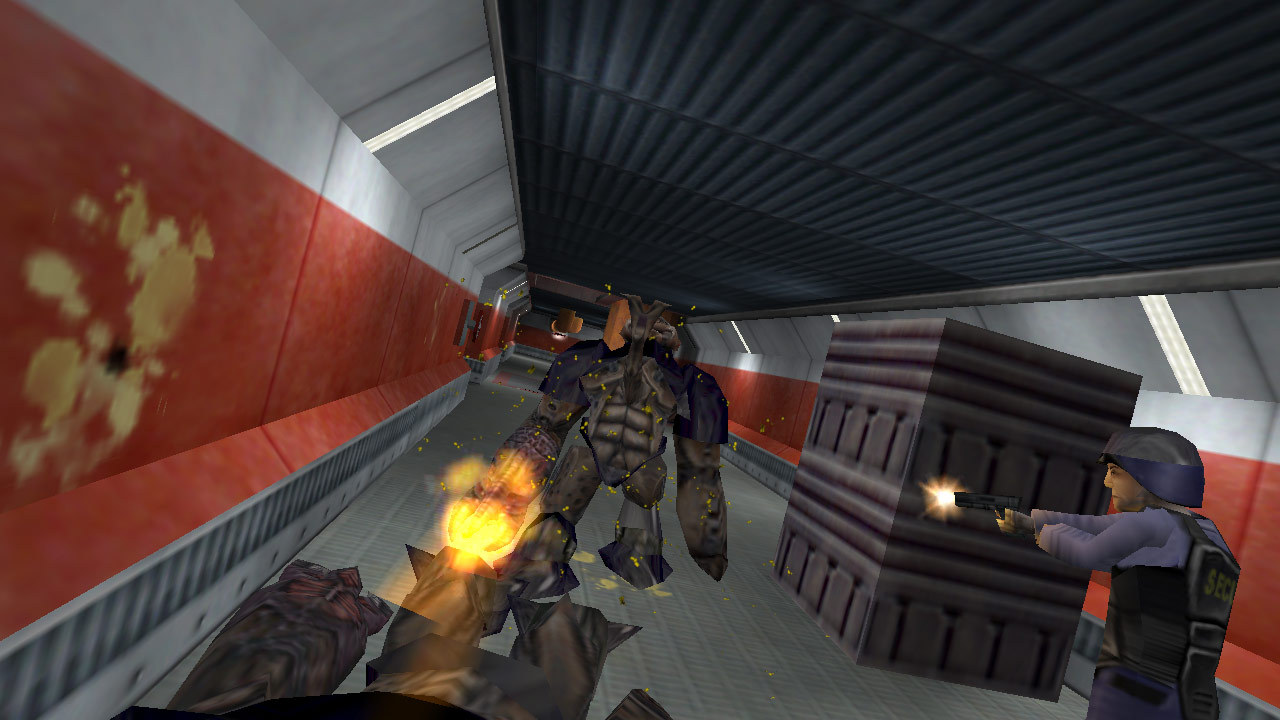
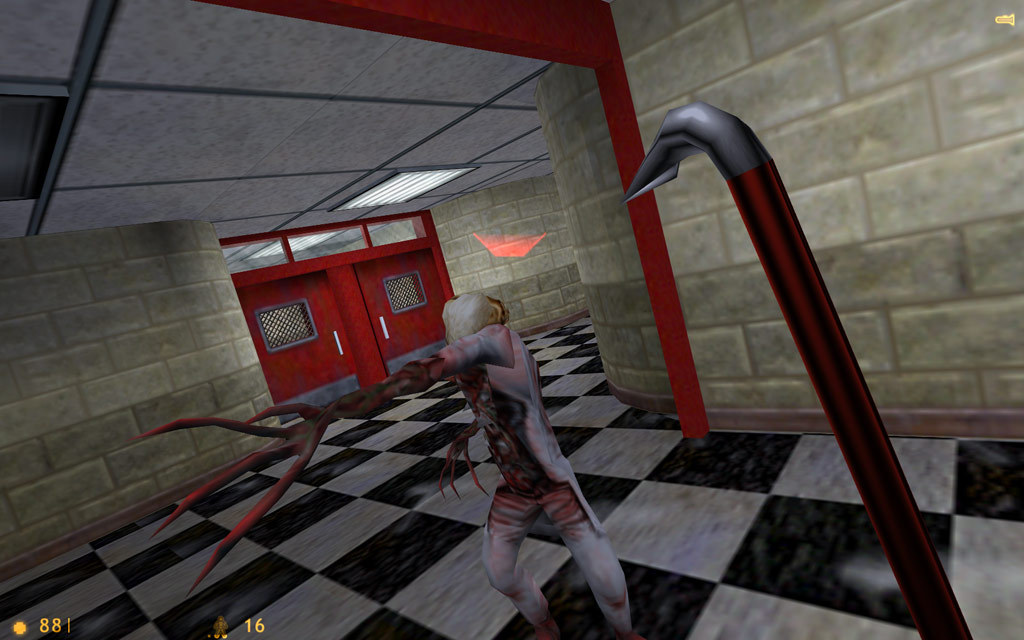
The enemies sold the illusion. Headcrabs skittered. Bullsquids spat. Vortigaunts charged up before they fired, giving you a half-second of warning the design team had deliberately built in — their levels were built to warn you of danger so you could react, rather than kill you without notice. And then the Marines arrived, and the game changed key. The Hazardous Environment Combat Unit had been sent to silence Black Mesa, witnesses included, and their squad behaviour — advancing, retreating, flushing you with grenades — made contemporary shooter AI look like targets on a rail. Late in the game you also face Black Ops assassins, and Freeman himself becomes the hunted thing in his own facility.
If the game has a wound, it is Xen. The final chapters leave Black Mesa for an alien dimension of floating islands and low-gravity jumping, and the engine’s movement was never precise enough to make that platforming feel fair. Critics noticed at the time, and players still argue about it. But notice what Xen is: a swing. Valve would rather end its game somewhere genuinely alien than in another corridor, and the argument itself has become part of the game’s biography.
The Reviews Were Not Close
Half-Life was released on November 19, 1998, after a year of delays that had the trade press wondering if it would ship at all. Valve’s own anniversary note, published twenty-five years later, puts it plainly: “We launched Half-Life on November 19th, 1998.” The reviews ended the wondering. On Metacritic the PC version holds 96 out of 100. IGN scored it 9.5 and called it “a tour de force in game design, the definitive single player game in a first-person shooter.” GameSpot gave it 9.4 and called it the closest thing to a revolutionary step the genre had ever taken. Computer Gaming World’s Jeff Green went furthest: “not just one of the best games of the year. It’s one of the best games of any year, an instant classic that is miles better than any of its immediate competition.”
The awards piled up in a way that stopped being news: more than fifty PC Game of the Year honours, the E3 1998 Game Critics Awards for Best PC Game and Best Action Game for the rebuilt version shown that summer, and Academy of Interactive Arts and Sciences wins for Computer Entertainment Title of the Year and PC Action Game of the Year. PC Gamer named it the best PC game of all time three times — in 1999, 2001 and 2005. IGN, looking back in 2013, wrote that the history of the FPS “breaks down pretty cleanly into pre-Half-Life and post-Half-Life eras.”
Commercially, it was a slow burn that never went out. Newell has said the game was budgeted expecting lifetime sales of around 180,000 copies. It passed 500,000 worldwide by January 19, 1999, reached 2.5 million by July 2001, stood at eight million by November 2004, and had sold 9.3 million copies at retail by 2008 — enough for Guinness World Records to name it the best-selling PC first-person shooter of its era. When Sierra initially planned no promotion beyond launch, Valve’s marketing chief Monica Harrington threatened to walk away and tell the industry why; Sierra responded by reissuing the game in a Game of the Year edition, which only sold more.
Mods, Expansions and a Very Long Shadow
Valve shipped Half-Life with Worldcraft, its own level editor, and a software development kit, and then did the smartest thing in its history: it hired the people who used them best. Team Fortress Classic and Deathmatch Classic came from inside. Counter-Strike and Day of Defeat began as independent mods, received Valve’s support, and became standalone products — Counter-Strike grew into one of the biggest competitive games on Earth. The tools were not a bonus feature. They were a talent pipeline and a second life for the game, and Edge noted in 2003 that a significant share of the PC version’s millions of sales were bought for exactly that potential.
The official follow-ups came from Gearbox Software: Opposing Force in 1999, which retold the disaster through a Marine’s eyes, and Blue Shift in 2001, built around Barney Calhoun, the guard from the opening chapters. The PlayStation 2 port arrived in late 2001 with a cooperative expansion, Decay, after a Dreamcast version was cancelled weeks before its scheduled release. Valve ported the game to its Source engine as Half-Life: Source in 2004, the same year Half-Life 2 rewired the PC all over again; the story of that sequel’s afterlife runs through The Orange Box review elsewhere on this site. A fan remake, Black Mesa, developed by Crowbar Collective with Valve’s blessing, reached its full release in 2020 — a twenty-year echo of the modding culture the original created.
Valve has kept faith with the original in a way few publishers bother to. Ports to OS X and Linux arrived in 2013. In November 2023, for the twenty-fifth anniversary, Valve restored the Steam version toward its 1998 state, folded in the Uplink demo content and four new multiplayer maps, added Steam Deck support and 4K fixes, and released an hour-long documentary with the original team. Two days later the game hit 33,471 concurrent players on Steam — its highest number ever, a quarter-century after launch. Not bad for a game its makers once considered scrapping.
So what are we marking at 28? Not nostalgia for chunky polygons, though the GoldSrc look has its own charm now. We are marking the moment the shooter grew up: the moment a game decided the player should stay inside the story, that a facility could be a character, that silence from a protagonist could say more than any cutscene. Every immersive sim, every walking-speed opening, every game that trusts you to watch a scene instead of skipping it is paying rent on Black Mesa land. The tram still runs. Get on.
— Chip
For more launches from this date, see This Day in Gaming History: November 19.