
At a glance — Game: Mario Kart DS · Developer: Nintendo EAD · Publisher: Nintendo · Original release: November 14, 2005 (North America) · Original platforms: Nintendo DS · Genre: Kart racing · Producer: Hideki Konno · Metacritic: 91/100
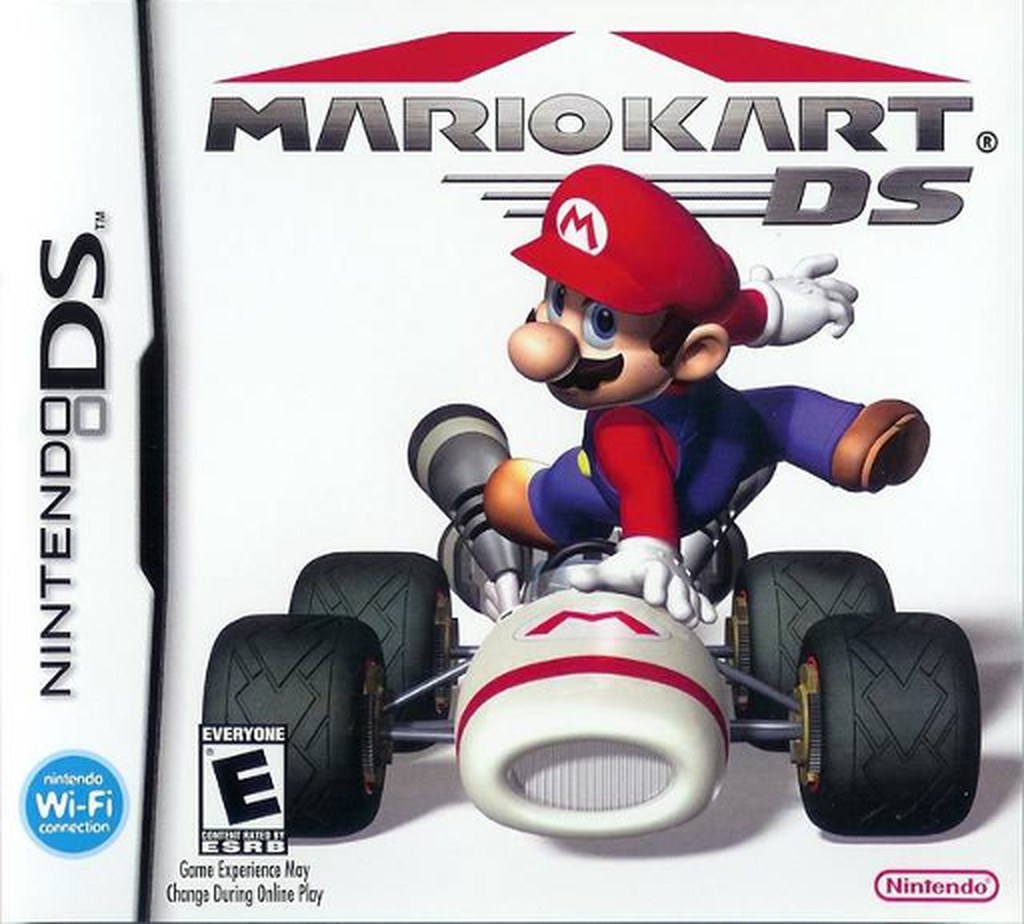
Twenty-one years ago this week, the most consequential race Nintendo ever ran did not happen on a television. It happened on school buses and aeroplanes, in break rooms and bedrooms, on a squat silver handheld with two small screens — and, for the first time in the company’s history, it happened over the internet. Mario Kart DS arrived on November 14, 2005 carrying a little blue badge on its box that no Nintendo game had ever worn: Nintendo Wi-Fi Connection. The karting underneath was superb — it usually is — but the badge was the revolution. This was the game that taught Nintendo’s audience to race the world, and taught Nintendo what that audience would expect from every game that followed.
A Full-Sized Mario Kart, Shrunk Without Apology
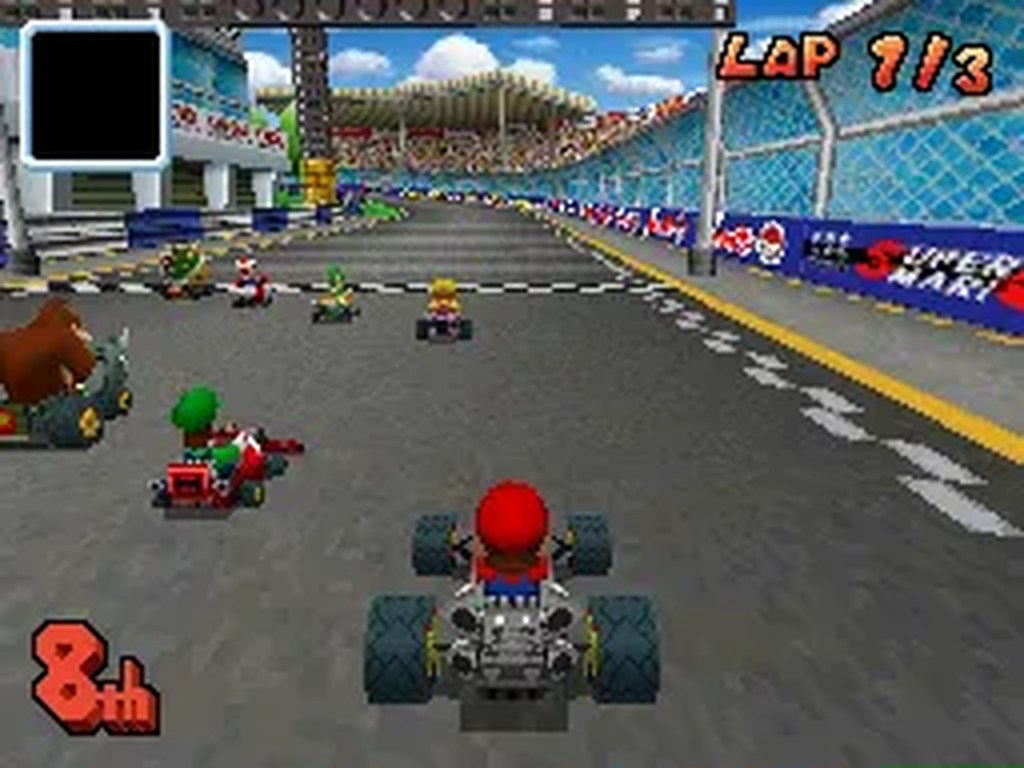
The first surprise, in November 2005, was simply that nothing was missing. Handheld Mario Kart had meant compromise before: Super Circuit on the Game Boy Advance was lovely, but it was a Mode 7 tribute act. Mario Kart DS was the real thing in miniature — full 3D karts and courses running at a consistent 60 frames per second on a machine whose screens measured 256 by 192 pixels, with eight racers on track and not a whiff of slowdown. Nintendo EAD had spent the previous console entry, Double Dash, on a two-drivers-one-kart experiment; here the series stripped back to a single driver and the fundamentals, and the fundamentals turned out to be immaculate. Power-sliding on a D-pad, hopping into drifts, slipstreaming the kart ahead for a boost — reviewers reached for words like “pixel-perfect,” and the phrase stuck because it was accurate. (We took the handling apart in our Mario Kart DS review; it has not aged a day.)
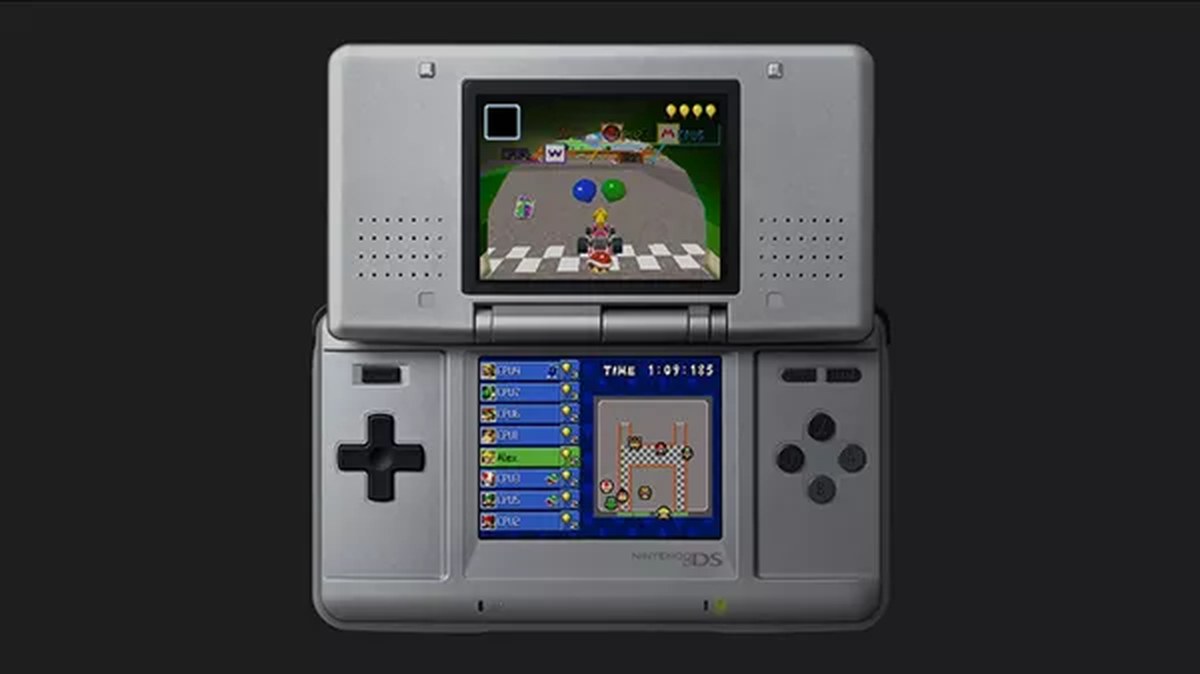
The second screen earned its keep, too. The bottom panel carried a live course map with every racer’s position and — crucially — the items they were holding. Information became part of the driving: you could see the shell coming before it came, plan a defensive banana around a rival’s red shell, watch a shortcut gamble unfold two corners away. Add a personal emblem editor, so your kart wore a badge of your own drawing, and the package felt less like a port than a manifesto: this odd two-screen machine had ideas no television console could copy.
Mario Kart DS Took Nintendo Online
And then there was the badge. Nintendo had kept the internet at arm’s length for a decade — a modem here, a satellite service there, always somebody else’s experiment. The Nintendo Wi-Fi Connection was the company finally committing, and Mario Kart DS was its launch game. Producer Hideki Konno told interviewers at the time that the people using online play in games like Halo were “hardcore gamers”; with Mario Kart DS, he said, he wanted everyone to go online, because the technology and the time were right. The numbers said he read the moment exactly. Of the roughly 112,000 copies sold in the United States in the game’s first week, some 52,000 buyers — nearly half — had already logged on and raced a stranger. In 2005. On a handheld. Nintendo has never reported a number quite like it since, because it never had to: after that week, online play was simply what Nintendo games did. We told the service’s own story in Nintendo Wi-Fi Connection: The Night Nintendo Went Online.
It was not the online mode a modern player would design. Four racers to a field, not eight. Twenty of the thirty-two courses made the online rotation. Battle mode stayed stubbornly offline, friend codes stood between you and anyone you actually knew, and a brilliant stranger you had just raced was gone forever the moment the results screen faded — there was no way to add them. But the races themselves were smooth, the matchmaking was three taps deep, and the important thing had happened: the world’s most conservative games company had put its flagship series on the open internet, at no charge, and nearly half its audience had followed it there within seven days.
And if the internet was out of reach, the cartridge brought its own crowd. Local wireless play put eight DS systems in a room together, and Download Play meant only one of them needed the game — friends without a copy joined a reduced rotation of courses as Shy Guy, a racer the cartridge’s owners could not even select. It sounds like a footnote; in 2005 it was a superpower, turning one purchase into an eight-player party on the bus ride home. GameSpy’s Bryn Williams called the local eight-player matches “pure gaming nirvana,” and for a generation of schoolkids that is not remembered as a feature. It is remembered as childhood.
Thirty-Two Courses, Six Boss Fights and a Robot
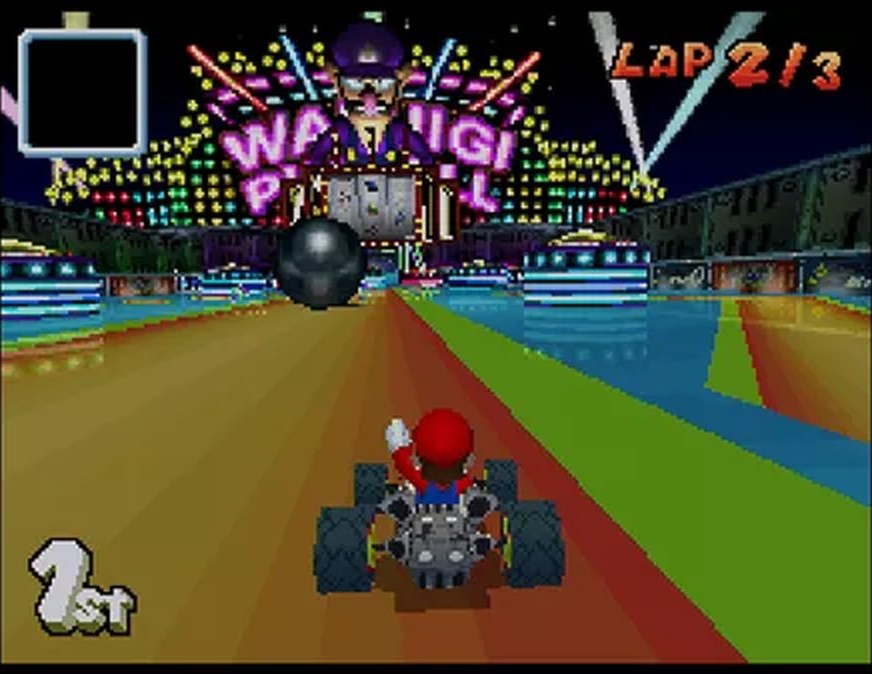
If the online mode made history, the cartridge’s sheer bulk made the argument. Thirty-two courses, split evenly between sixteen new designs and sixteen Retro tracks drawn from every previous Mario Kart — the first time the series had raided its own back catalogue, a habit it has never since broken. Konno’s reasoning was disarming: he wanted the players who had grown up with Super Mario Kart on the SNES to feel immediately at home. The new half, meanwhile, produced some of the finest courses the series has ever fielded. Waluigi Pinball hurled karts around the inside of a giant pinball table, a steel ball the size of a house permanently inbound. Airship Fortress stormed a flying battleship under Bullet Bill fire. Tick-Tock Clock raced through the gears of a grandfather clock, and Delfino Square turned a sunlit harbour town into a street circuit years before the series made a habit of it.
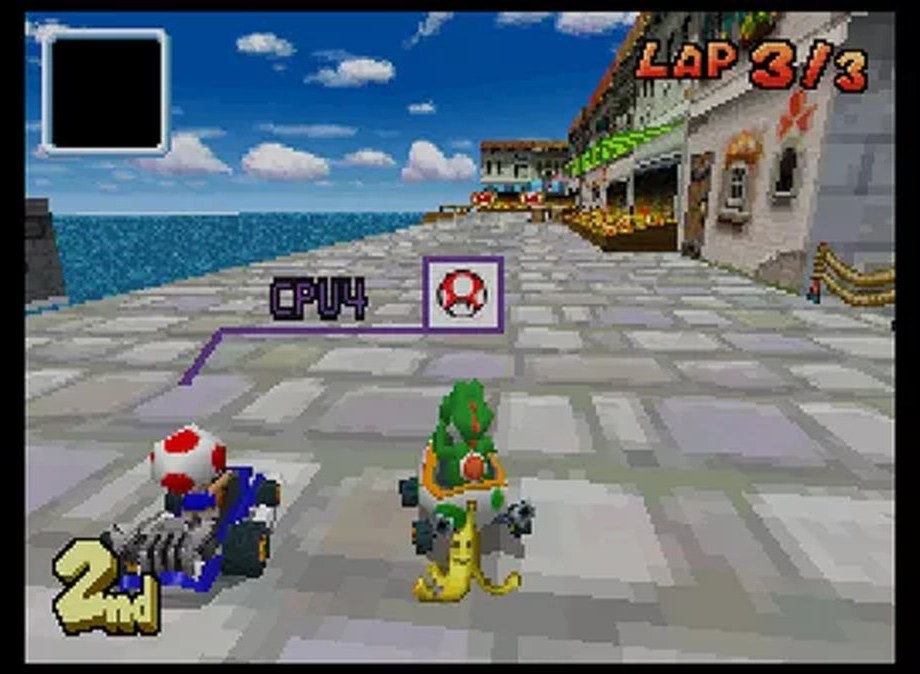
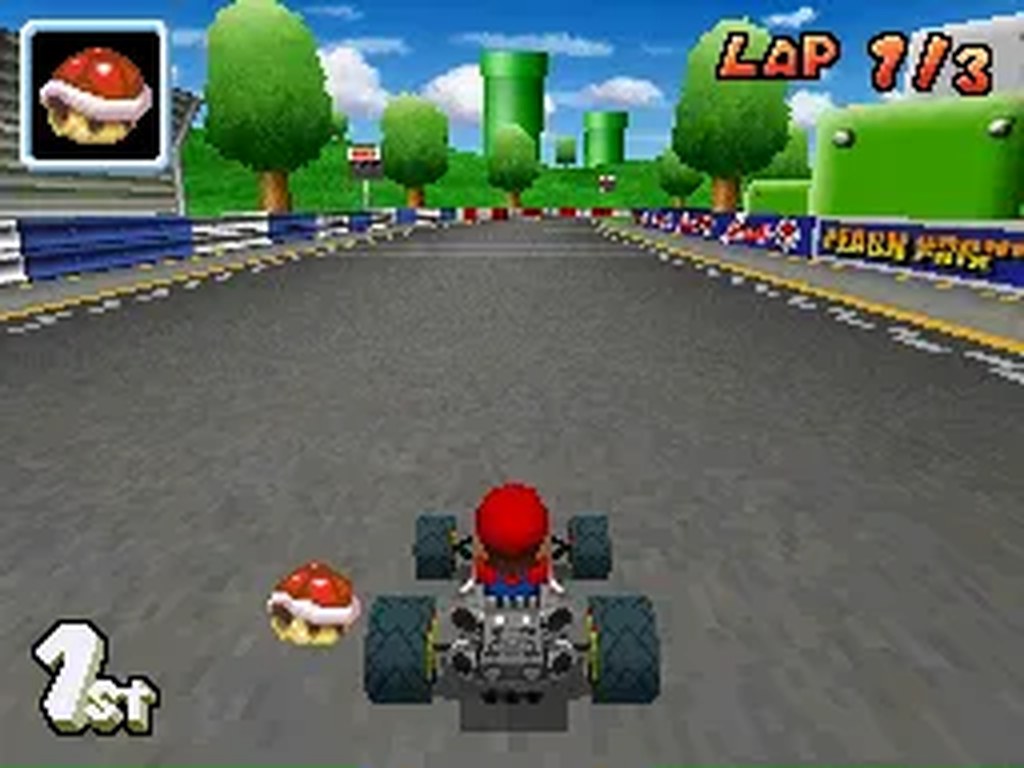
The single-player package went further than any Mario Kart before it. Mission mode — a series first, and, oddly, a series one-off — set seven missions across each of six levels, every level capped by a boss fight against the likes of Big Bully, King Boo, Petey Piranha and Wiggler: drive backwards through checkpoints, smash item boxes, race a pack of Goombas to the line. The roster ran to twelve, the familiar eight joined by Daisy, Dry Bones, Waluigi and, gloriously, R.O.B. — the NES’s old robot peripheral, dusted off and given a kart. Thirty-six karts, three per driver. Two series fixtures debuted in the item roulette: the Blooper, which inked your rivals’ screens, and the Bullet Bill, which simply turned you into the fastest thing on the track. And for the truly committed there was snaking — chaining drift boosts down every straight until the kart wove like a sidewinder. Masters were untouchable; lobbies argued for years about whether it was the game’s highest skill or its cheapest exploit. It was, of course, both.
What the Critics Made of It in 2005
The reviews read like a coronation. Mario Kart DS settled at 91 on Metacritic — the third-highest score ever recorded by a Nintendo DS game. IGN’s Craig Harris gave it 9.5 and declared it the best kart racing game ever made. GameSpot scored it 9.2, hung an Editors’ Choice on it and later named it the best DS game of 2005 outright. Nintendo World Report went the full distance with a 10; GameSpy awarded five stars and praised the “pixel-perfect” controls. The Academy of Interactive Arts and Sciences nominated it for Racing Game of the Year and, fittingly, Outstanding Achievement in Online Gameplay. The complaints were real but small bore: a rubber-band AI that could make 150cc feel like arguing with the kart ahead’s lawyer, the friend-code friction, a few retro courses that had clearly been chosen with the heart rather than the head. GamesRadar would later go further than any of them and name Mario Kart DS the best Nintendo DS game of all time, full stop.
The Servers Went Dark; the Race Never Stopped
The market agreed with the critics, loudly and for years. Mario Kart DS was the best-selling handheld game in America in its debut month, sold 224,000 copies in its first week in Japan, and simply never left the charts — when Nintendo introduced a flame-red DS bundle a fortnight after launch, checkered-flag wrist strap and racing decals included, it was feeding a fire already burning. By March 2016 the game had sold 23.6 million copies worldwide, making it the third-best-selling title on the best-selling handheld Nintendo has ever made. A Wii U Virtual Console re-release in 2015 put it back on a shop shelf for a new audience, stylus not required.
The one part of Mario Kart DS that could die, did. Nintendo shut down the Wi-Fi Connection on May 20, 2014, and the first online Mario Kart went dark with it — officially. Unofficially, the story rhymes with the Wii’s: the same fan-run Wiimmfi servers that refused to let Mario Kart Wii die, which we wrote about here, also carry DS racers, and Mario Kart DS lobbies still fill on community infrastructure two decades after Konno’s experiment. That is the game’s real legacy. Every Mario Kart since — Wii, 7, 8, World — has shipped with online play as a headline feature rather than a gamble, because a two-screen handheld proved in one week of 2005 that Nintendo’s audience had been waiting for exactly that. Twenty-one years on, the handling is still the series’ handheld benchmark and the package has never been bettered for depth. The blue shell still ruins friendships. Mario Kart DS is why it can ruin them worldwide.
Review score: 9.2 / 10 — the purest portable Mario Kart ever made: the tightest handling of its era, the deepest single-player package the series had seen, and the night Nintendo went online.
— Sal
For more launches from this date, see This Day in Gaming History: November 14.