
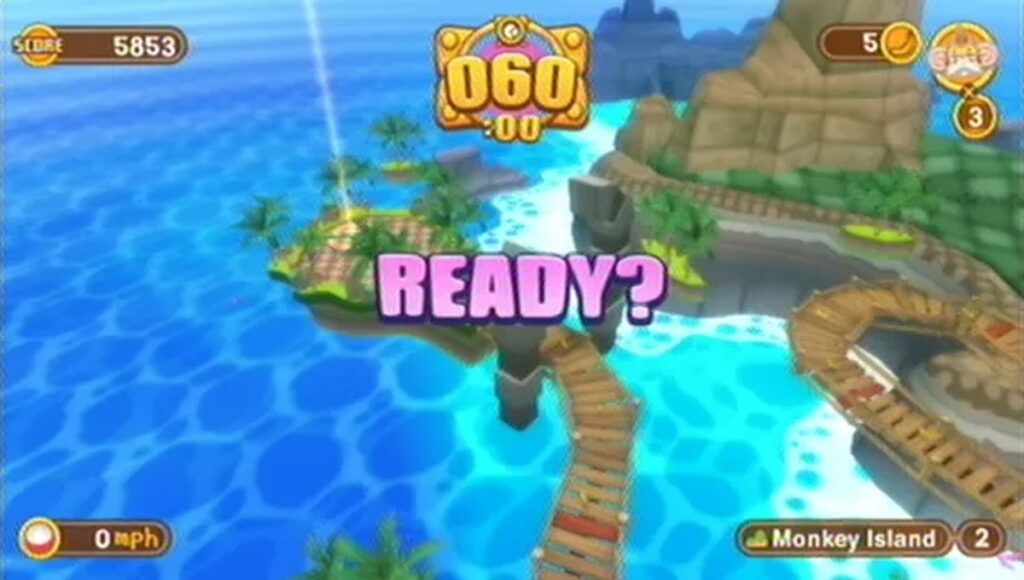
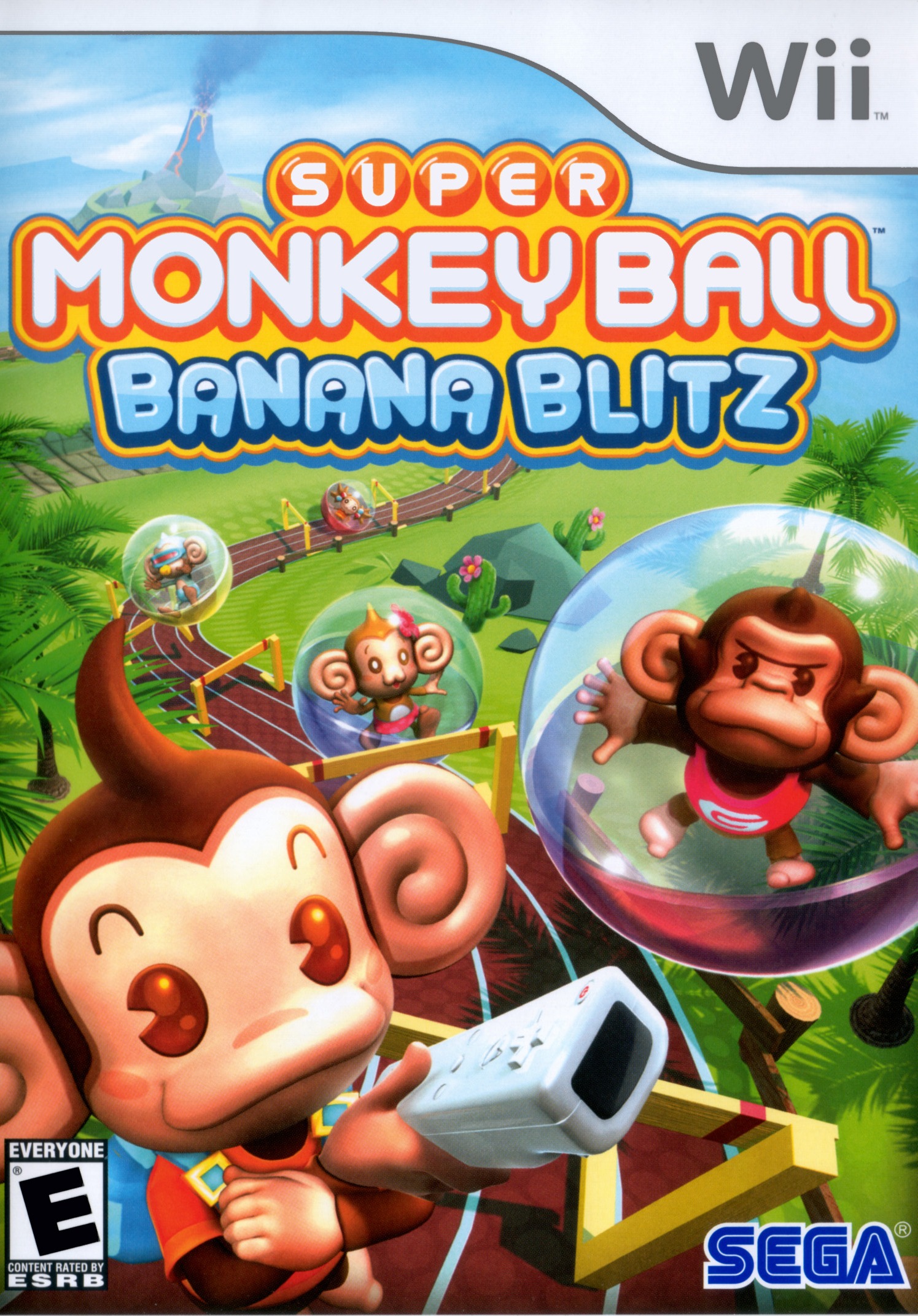
At a glance — Game: Super Monkey Ball: Banana Blitz · Developer: New Entertainment R&D Dept. · Publisher: Sega · Original release: November 19, 2006 (North America) · Original platforms: Wii · Genre: Platform, party · Director: Toshihiro Nagoshi
Of all the things the Wii asked of its first owners — bowl, fish, box, conduct — the strangest was also the simplest: tilt the world and trust a monkey in a ball not to fall off it. Super Monkey Ball: Banana Blitz arrived on launch day carrying one of Sega’s purest arcade ideas into a control scheme nobody had ever used, and it changed the series to do it: new jump, new bosses, new characters, fifty party games, and a tilt that replaced the most precise analogue stick in the business. Twenty years on, Banana Blitz is the launch title that best understood what the Wii Remote actually was — not a pointer, but a table you held in your hands.
Tilt the world, not the monkey
The series had always been a game of indirect control: you never steered the monkey, you tilted the stage and let gravity do the driving. On GameCube that meant the most sensitive analogue stick ever fitted to a controller. Banana Blitz, the seventh title in the series, moved the whole table into the Wii Remote, held parallel to the ground, with the monkey rolling in direct correspondence to your tilt. It sounds like a small translation. It was a rebuild of the player’s body — wrists instead of thumbs, balance instead of pressure — and critics argued about it for months: EGM found the new scheme made the game excessively difficult, while IGN countered that once the learning curve was climbed, the tilt was superior to a stick. Both were describing the same sensation. Banana Blitz asked you to learn your favourite game again, on launch day, in public.
One hundred stages, and Super Monkey Ball: Banana Blitz learns to jump
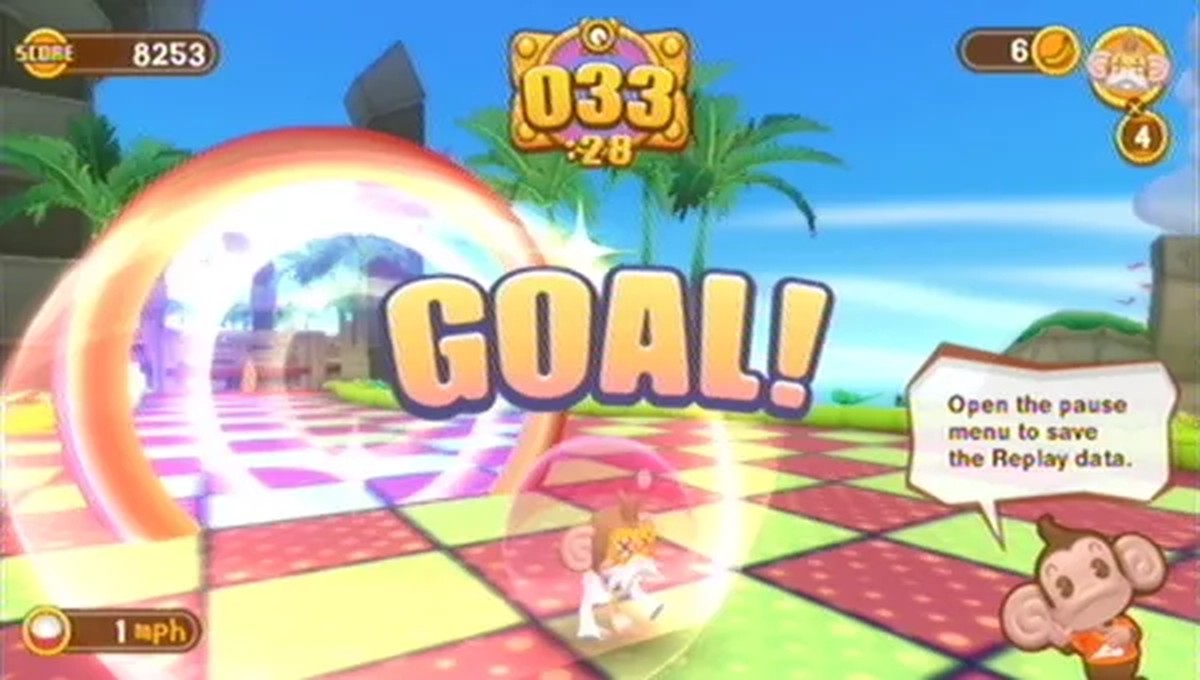
The changes go deeper than the tilt. The main game spans 100 levels, and for the first time in the series the monkey can jump — a quick flick of the controller upward while holding B, or a press of the A button — a heresy in a series whose entire grammar had been momentum and edges. Character-specific abilities and stats arrived for the puzzle stages, another series first, across a cast of AiAi, MeeMee, Baby and GonGon plus two newcomers, YanYan and Doctor. And for the first time the franchise staged boss battles, eight of them, one closing each world. The excuse for it all is the series’ lightest plot: a pirate villain named Captain Crabuchin — long confused with Dr. Bad-Boon — has stolen the Golden Banana Bunch, and AiAi and friends roll out to recover its scattered pieces, world by world, boss by boss.
Fifty party games deep
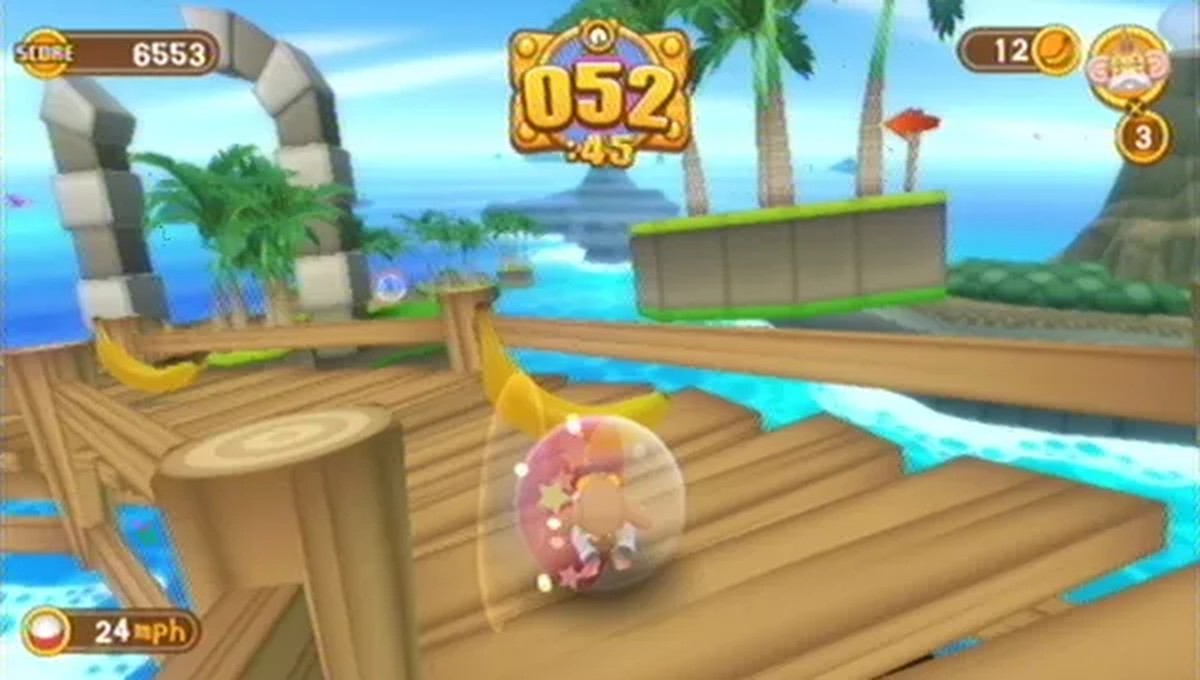
The structure underneath is the series’ most generous. Eight colourful worlds carry the hundred stages — the box copy promised worlds “filled with surprises around every sharp turn”, and for once the copy undersold it, because the bonus stages and the boss gates keep interrupting the rhythm the series had run on since the arcade. The character stats matter more than they first appear: a heavier monkey holds a line differently, a lighter one takes the new jump further, and stages that were walls with one character become puzzles with another. Banana Blitz is quietly the most replayable game in the series precisely because its headline features — jump, stats, bosses — all push against the purity that made the earlier games great, and mostly win the argument.
If the main game was the argument, the party mode was the insurance policy. Banana Blitz carries 50 mini-games, each using the controller a different way — Monkey Darts has you mime a throw at the screen — gathered into a party mode with tournament play for accumulating points. The old reliables return: Monkey Target, Monkey Race, Monkey Bowling and Monkey Wars among them. Each of the fifty re-teaches the Remote as something else — a bat, a jump rope, a steering wheel, as the game’s own back cover boasted — which made Banana Blitz the disc that stayed in the console when relatives visited: the main game was for the faithful, but the party pile was the Wii’s instruction manual disguised as a night’s entertainment, four players deep. Reviewers who quarrelled with everything else conceded the pile’s value; Hyper praised the standout party games and the multiplayer even while calling some entries atrocious and the new boss battles tedious. That spread — fifty swings, some misses — is precisely what a launch library is for. Somewhere in those fifty, every Wii owner in the house found the one game that explained the controller to them.
The critics split, the remake returned
The aggregate verdict was a warm shrug: 74 on Metacritic, 72.82 per cent on GameRankings, with GameSpot’s 8.3 calling it one of the best in the series and IGN’s 8.4 and Nintendo Power‘s 8.5 close behind, against Game Informer‘s 6.75 and EGM‘s 6.2, with GameSpy at 4/5 and GameTrailers at 7.2 filling out the middle. The argument was never really about quality — it was about the tilt, and whether a series built on the finest analogue control in the business could survive being handed to your wrists. Read the reviews in sequence and a pattern emerges: the outlets that scored it highest treated the learning curve as the game, the ones that scored it lowest treated it as the obstacle. Both were reviewing the same twenty minutes every Wii owner spent that November, leaning in their chairs, rolling an invisible table toward a goal ring — and discovering, one way or the other, whether their hands believed it. The new cel-shaded visuals were found simplistic by nearly everyone and well-suited by nearly everyone, in the same reviews. It sold 350,000 copies in North America by the end of 2006 — a launch-window number most series would frame — against a quiet 38,600 in Japan. Thirteen years later Sega returned with Super Monkey Ball: Banana Blitz HD (October 29, 2019, for Switch, PlayStation 4 and Xbox One, reaching Windows that December): stick controls restored, levels adjusted where the tilt’s design would have made them too easy, the fifty party games trimmed to the ten most popular, Sonic the Hedgehog rolling in as an unlockable with rings in place of bananas, and a partly replaced soundtrack where licensing demanded it. The remake is a good game — its own Metacritic scores settled in the low-to-mid 60s and 70 on Xbox One, the shrug following the series into HD — and it is also an admission: something about the original only worked with a table in your hands.
Why Banana Blitz at 20 still rolls
Because it trusted the hardware completely and paid the price gladly. Banana Blitz could have been a safe port with pointer menus; instead Sega rebuilt its series’ controls, added a jump its purists never asked for, invented bosses it had never needed, and shipped fifty experiments in party form — all for a console that, on the morning of November 19, 2006, nobody yet owned. Twenty years on, the tilt is still the purest translation of an arcade idea the Wii ever hosted: hold the world carefully, and try not to drop the monkey.
— Chip
For more launches from this date, see This Day in Gaming History: November 19.