
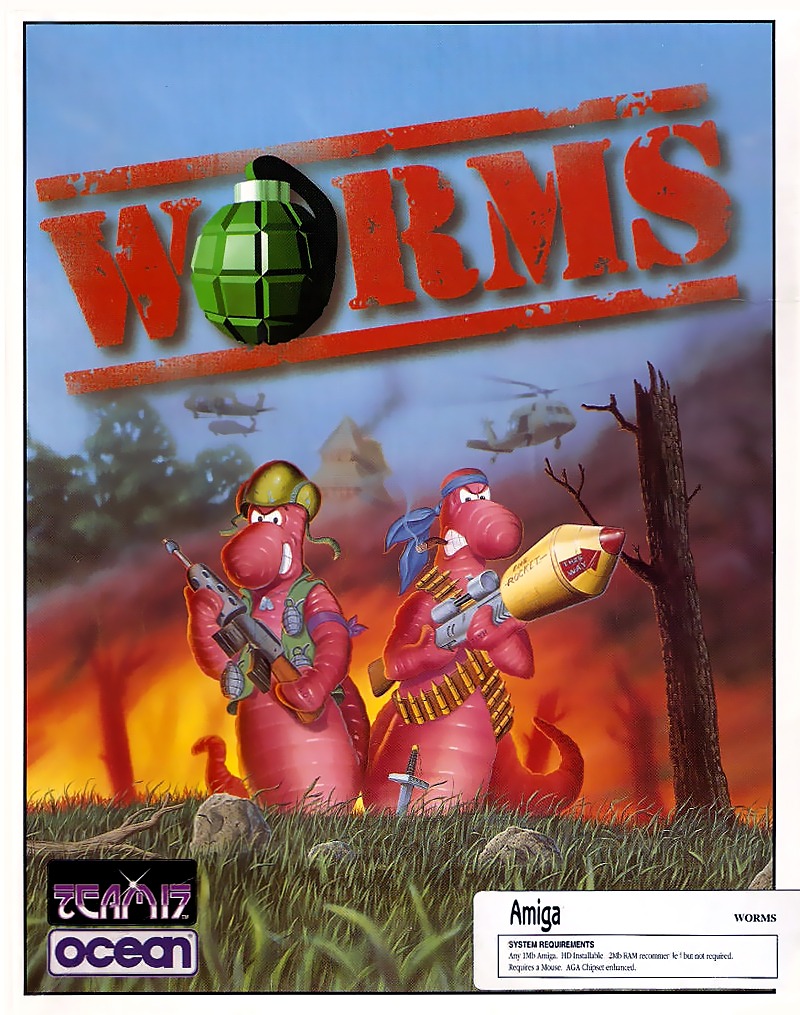
At a glance — Game: Worms · Developer: Team17 · Publisher: Ocean Software · Original release: November 17, 1995 · Original platforms: Amiga · Genre: Artillery / turn-based tactics · Designer: Andy Davidson · Music: Bjørn Lynne
Thirty-one years ago today, the Amiga was supposed to be dying. The magazines were thinning, the big publishers were drifting off to PC and PlayStation, and Commodore itself was already gone. What the machine got instead, on November 17, 1995, was the biggest game of its life — a turn-based artillery duel between squeaky-voiced pink worms, written by a computer-shop employee in his spare time, that would go on to sell in the millions, top the all-formats chart, and build an empire that is still releasing games three decades later. If you owned an Amiga in the nineties, you owned Worms. If you owned two joysticks and three friends, you owned the best multiplayer argument of the decade.
I still remember the first time the Banana Bomb came out at a crowded Amiga keyboard — the little cluster of yellow doom bouncing down a hillside, taking two worms, half a bridge and one friendship with it. Everybody who played Worms has a story like that, and most of them end with the words “one more go.” This is the story of how that game got made, why the Amiga version came first, and how a home-made artillery toy became one of the most popular games the Amiga ever had.
From a Casio calculator to the Amiga: the birth of Worms
Worms began life in 1990 as an experiment its creator ran for his own amusement. Andy Davidson, a young Amiga fan who worked in a computer shop, started with a program called Artillery on a Casio graphing calculator — the old two-tanks-on-a-hill duel, angle and power, wind and gravity, a genre that stretched back through games like Gorillas and the Amiga’s own shareware favourite Scorched Tanks. Davidson’s version was a private toy. What turned it into a life’s work was the machine he had loved since 1987.
In August 1993 he moved Artillery to the Amiga, and the Amiga let him do everything the calculator couldn’t. Experimenting in Deluxe Paint, he worked through character ideas looking for the animation quality and humour of Lemmings — and landed on worms: tiny, expressive, absurdly militant worms, squeaking their way across a battlefield. The artillery duel now had a cast, a sense of humour and a name to match. Inspired by a Blitz BASIC programming competition in Amiga Format magazine, Davidson renamed the game Total Wormage — possibly a nod to Midway’s Total Carnage — and entered it.
The competition made his game famous eventually. At the time, it did nothing at all. Amiga Format was flooded with entries, Total Wormage went virtually unnoticed, and Davidson’s entry neither won nor placed. Undeterred, he sent the game to publishers. Nobody wanted it. So in September 1994 he carried it to the European Computer Trade Show in London, loaded it up on a Team17 stand machine — telling them, as it loaded, that they wouldn’t like it because it was a bit weird — and watched co-founder Martyn Brown offer to publish it on the spot. Team17 then promptly lost his contact details and had to retrieve them through Amiga Format, which tells you everything about the scale of the operation that was about to take over the world.
Team17, Ocean, and a year of ports
Davidson finished the Amiga game at Team17’s Wakefield offices, with the studio’s talent wrapped around his code: founding member Rico Holmes on art duties, Cris Blyth building the CGI intro that shipped with the CD versions — rendered, gloriously, on an Amiga running a 40MHz processor — and Bjørn Lynne composing the music. Davidson had chosen Team17 partly because of their loyalty to the Amiga, and the feeling was mutual. But Team17 could feel the Amiga market shrinking beneath them, and Worms was planned as a multiformat release from early on — an undertaking the company had never attempted before. Two further teams worked on bringing the game to eight other formats; East Point Software, who had ported Alien Breed games to PC, handled the Mega Drive, SNES and Game Boy versions.
Team17 had no publishing reach outside the Amiga, so a partner was needed. Given the choice between Ocean Software and Virgin Interactive, they went with Ocean. It was the deal that changed everything — and nobody involved knew how big it would get. Ocean’s pre-release estimate for total sales was 60,000 copies. The game shipped millions in its first year.
Sixty seconds, one worm, total carnage: how Worms plays
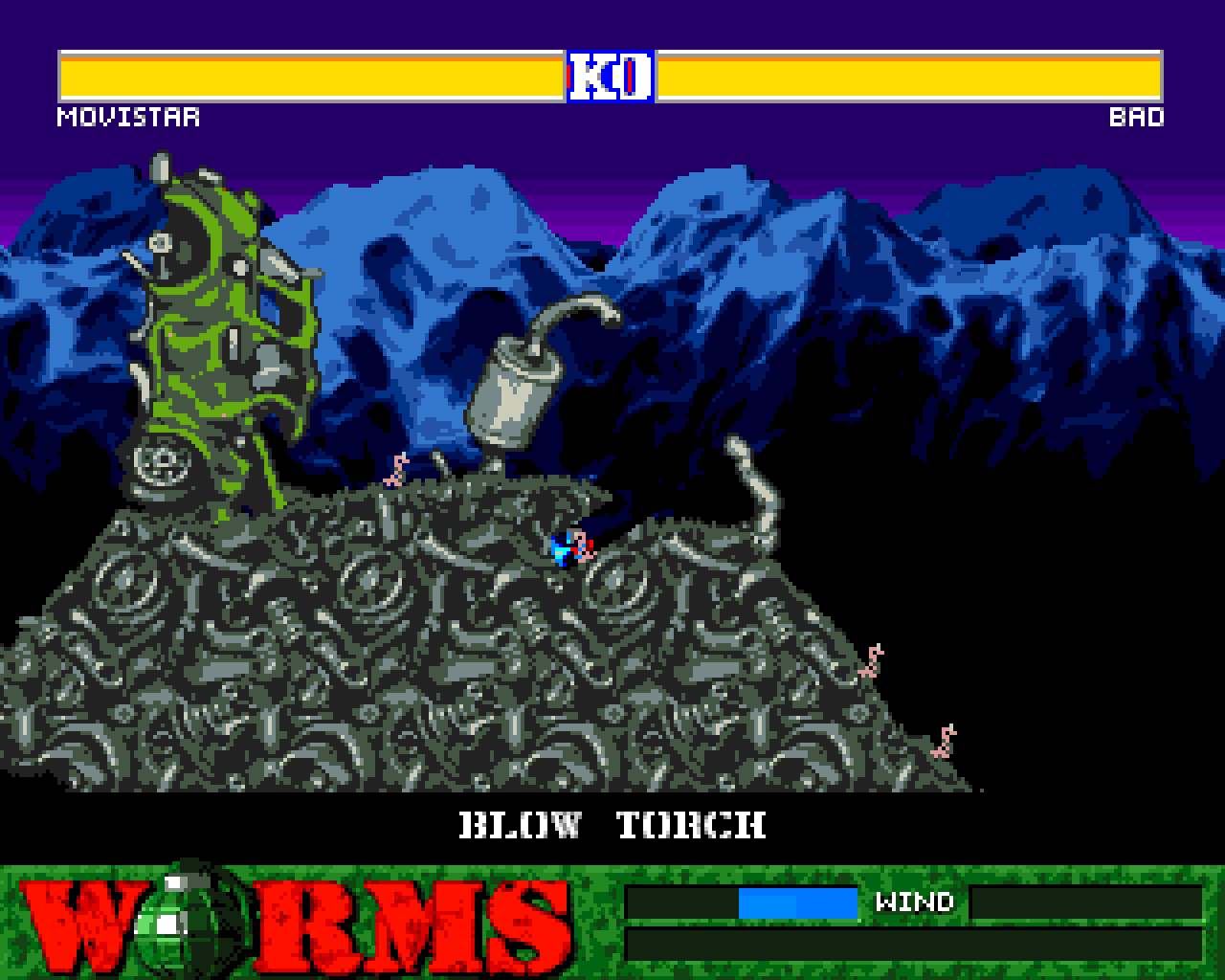
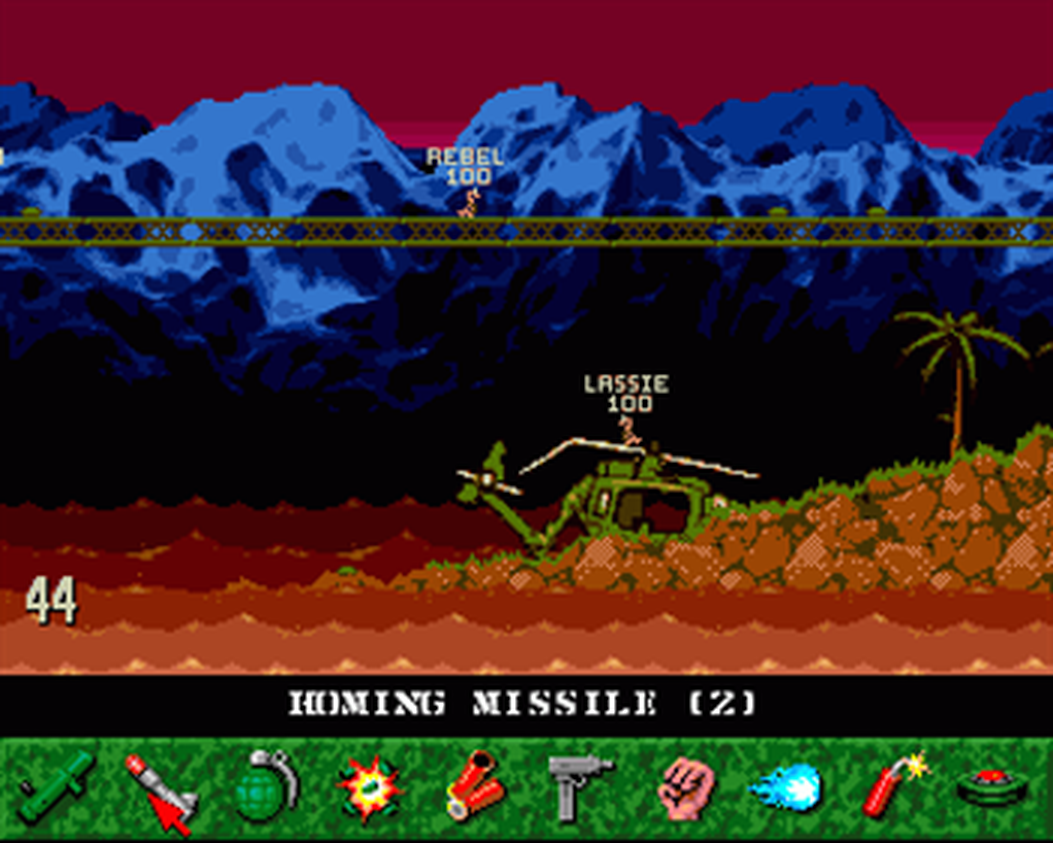
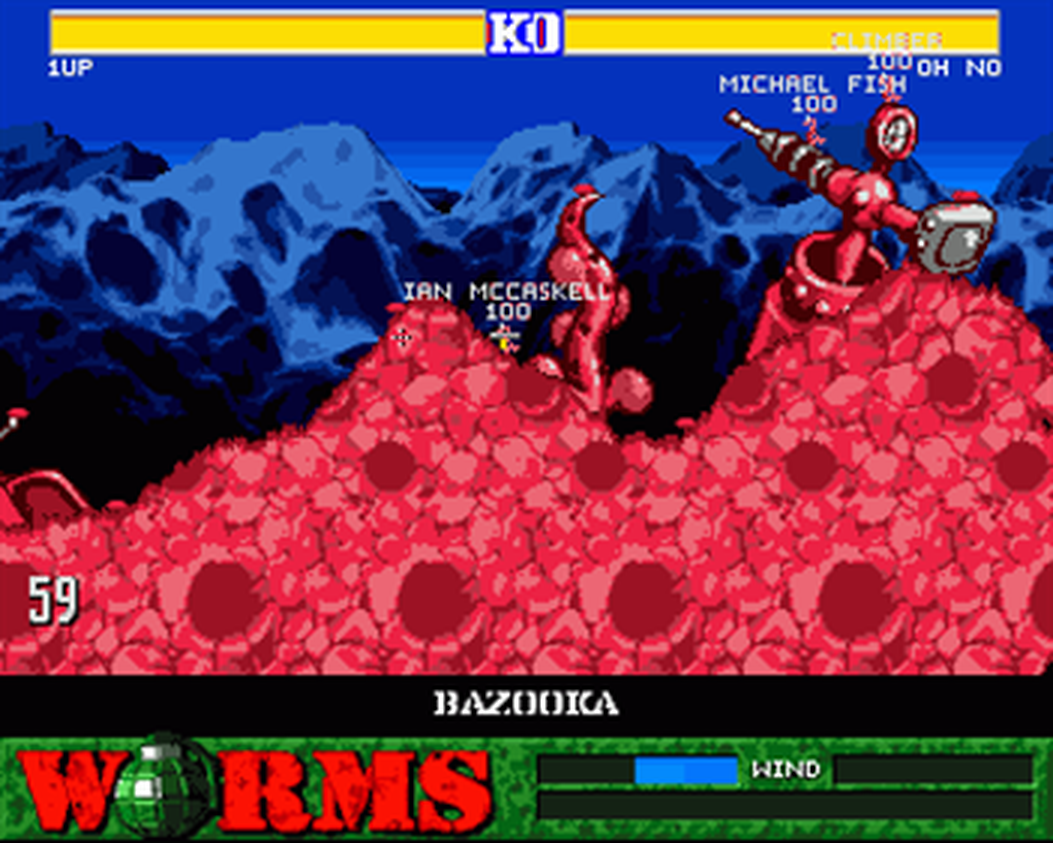
The genius of Worms is that anyone can understand it in a minute and nobody ever truly masters it. You command a team of worms, each with 100 health, scattered across a floating landscape. On your turn — against the clock, sixty seconds or so — you pick one worm, walk or jump it into position, choose from an arsenal of over twenty weapons and tools, judge the angle, the power and the wind, and let fly. Then you watch the explosion chew a crater out of the hillside, because every landscape in Worms is fully destructible, and the terrain you are standing on is only ever one good bazooka shot from becoming the hole you die in.
No two battlefields are alike. Landscapes are generated from an alphanumeric seed string — type anything, get a new world — with more than 55,000 possible creations across themed sets: forests, beaches, Martian plains, scrapyards, the fires of hell. Weapon crates parachute in. Mines and oil barrels wait to turn a good shot into a chain reaction. Let a match drag and sudden death arrives to hurry the conclusion, the water rising to drown the cautious.
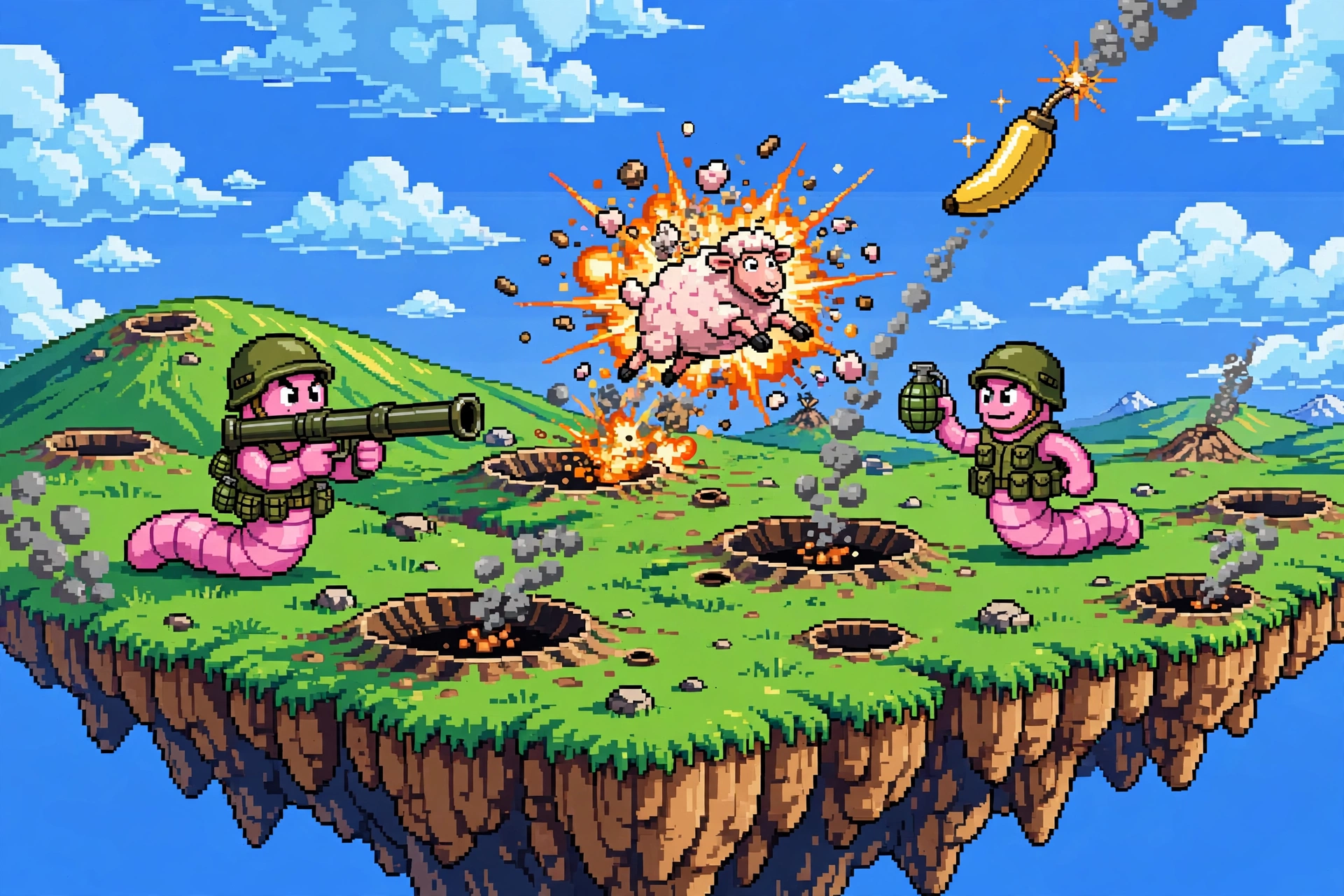
And then there is the arsenal, the part everybody remembers. The 1995 original already carried the bazooka and its wind-bent artistry, homing missiles, timed grenades and bouncing cluster bombs, the shotgun’s two shots, dynamite, the ninja rope and bungee for crossing impossible gaps, and the humble blowtorch and prod for close-quarters rudeness. Above all it carried the two weapons that became the series’ mascots from day one: the Sheep, which hops obligingly toward the enemy before detonating, and the Banana Bomb, a cluster weapon of such cheerful overkill that it could end a match — and start an argument — in a single bounce. Later games would add far more exotic hardware, and we will get to who invented what. But the soul of the series, the squeaky voices and the sheep, was all here in 1995.
It was built for company, too. Worms is a fine solo game against the computer, but its natural habitat was a room full of people: hot-seat multiplayer let as many as sixteen players pile into a single match around one machine, passing the mouse, naming their worms after each other, and holding grudges that have now lasted thirty-one years.
The Amiga’s last blockbuster
Worms launched for the Amiga on November 17, 1995, published by Ocean Software — and the Amiga press knew exactly what it had. CU Amiga scored the AGA version 94% and the CD32 version 95%. Amiga Format, the magazine whose competition had overlooked Total Wormage entirely, gave the finished game 90%. Amiga Computing awarded 91%. The one dissenting voice was Amiga Power, which gave it 60% in a review styled as a personality quiz — a score impossible to separate from the magazine’s running feud with Team17, which that same year had escalated into a lawsuit over low scores for other Team17 titles. History has not sided with the 60%.
The players certainly didn’t. By March 1996, barely four months after launch, Worms had sold almost 250,000 copies — a staggering figure for any platform in 1995, let alone a supposedly dying one. Across all its ports, the original game went on to sell more than five million units by 2006. By Team17’s own account it topped the all-formats chart, outselling giants like FIFA and Tomb Raider, and Team17’s Debbie Bestwick has credited the game with saving the company. For the Amiga specifically, the meaning was simpler and sweeter: in the machine’s twilight, its biggest hit was not a port of somebody else’s game. It was an Amiga game, born on the machine, built in Blitz BASIC by one of its own — and for a while, the whole industry was playing catch-up with the Amiga version.
Every format on Earth: the ports wave
What followed was one of the great ports waves of the nineties. Worms arrived on Amiga CD32 and PC, then PlayStation — where the North American release needed serious negotiation, because Sony Computer Entertainment of America had a policy against 2D games on its shiny new 3D console — and Sega Saturn, converted from the PlayStation version. Mega Drive and SNES editions followed in 1996, alongside Game Boy and Mac versions. Ocean even began a Virtual Boy port, cancelled within weeks when Nintendo pulled the plug on the console, and a 32X version was planned and never released. The last word belonged to the Atari Jaguar: its version of Worms, published by Telegames on May 15, 1998, was the final Atari-licensed title ever released for the machine. A game born on one dying platform outlived another.
The PC got an expansion, Worms Reinforcements, in 1996, adding a single-player campaign and custom levels and soundpacks — features Amiga owners had enjoyed from the start — later bundled with the original as Worms United. But the definitive early edition was reserved for the machine that started it all.
The Director’s Cut: one last gift to the Amiga
While Worms 2 was in development, Davidson went back to his first game and wrote Worms: The Director’s Cut, a special edition built exclusively for AGA Amigas and released in 1997. It began, in his words, as a straight AGA upgrade — a determination to give the Amiga the best version of the game he could — and then took on a life of its own: fourteen new weapons, including the Holy Hand Grenade, the Super Sheep and the Concrete Donkey, all of which debuted here rather than in the 1995 original, plus cavern landscapes and a graffiti level editor. Fans and reviewers loved it. Almost nobody could buy it: released at the extreme end of the Amiga’s commercial life, The Director’s Cut sold only around 5,000 copies, and became the last Worms the Amiga ever received. It has been treasured ever since — included on the A500 Mini in 2021, and, in August 2026, treated by Davidson himself to a free expansion pack with new levels and teams, thirty years after he first loaded Total Wormage onto a Team17 machine. We told the story of its CD32 cousin in Worms on CD32: The Director’s Cut That Never Was.
Worms at 31: the empire the worms built
The sequels began with Worms 2 in 1997, and they have never really stopped: more than twenty Worms games have followed across every platform imaginable, from Armageddon and World Party to 3D detours, golf, pinball and a battle royale. The original earned its place in the canon early — 67th in GamesMaster’s 1996 Top 100 Games of All Time, and a spot in the 2010 book 1001 Video Games You Must Play Before You Die. Its descendants still quote it: the voices, the graves, the sheep. Even the C64 got in on the act eventually, as we covered in Grubz: The Worms Clone the Commodore 64 Deserved.
But the anniversary worth celebrating today belongs to the Amiga. Worms is the rare game that was both a platform’s farewell and its finest hour — proof, delivered at the very end, of what the Amiga scene could still do: one fan, one cheap programming language, one competition entry that lost, and a game the entire world ended up playing. Thirty-one years on, the worms are still fighting. The Amiga made sure of that.
— Sal
For more launches from this date, see This Day in Gaming History: November 17. More from this system: our Amiga hub.