
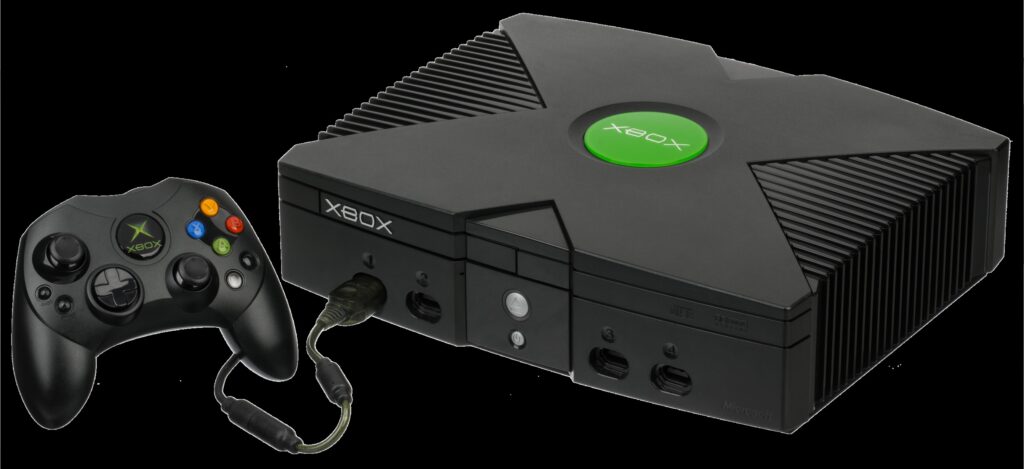
At a glance — Console: Original Xbox · Maker: Microsoft · Launched: November 15, 2001 (North America) · Launch price: $299.99 · CPU: 733MHz Intel Pentium III-based · Graphics: Nvidia NV2A at 233MHz · Memory: 64MB unified DDR · Storage: 8GB hard drive, built in · Networking: Built-in Ethernet · Lifetime sales: More than 24 million
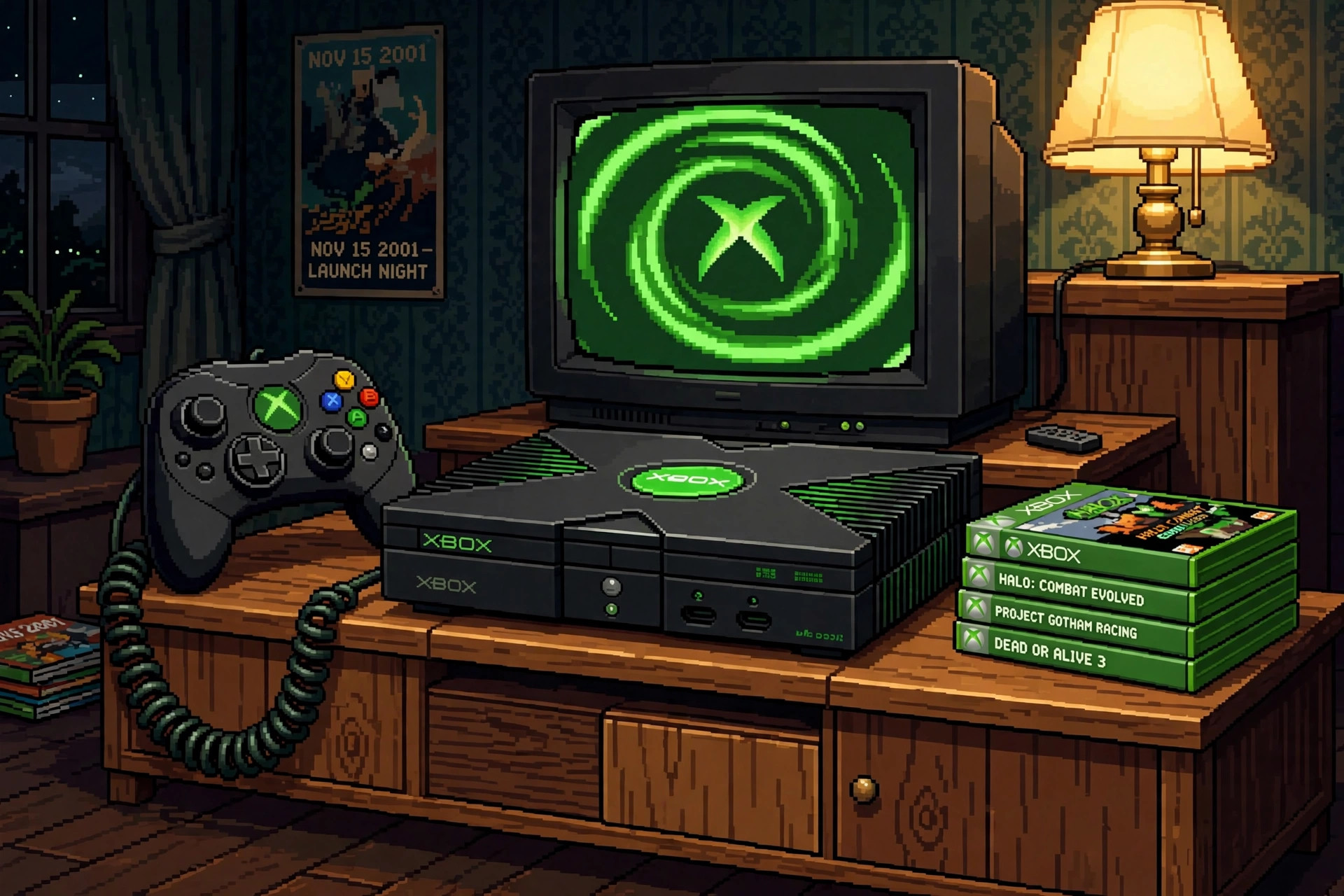
At one minute past midnight on November 15, 2001, in a Toys “R” Us in Times Square that had not even opened to the public yet, Bill Gates personally handed over the first Xbox. The store had a thousand consoles for the night. Outside, a few weeks after the worst day in the city’s modern history, hundreds of people had queued anyway. Microsoft — a company that made office software, that had never sold a games console in its life — had spent the evening shaking hands down the line, signing boxes, and playing Dead or Alive 3 with The Rock. Twenty-five years ago today. “The future of gaming starts today,” Gates said that morning, “and it starts with Xbox.” This is the complete story of the machine he was selling: the big black box that lost a fortune, finished second, and quietly rewrote the rules every console since has lived by.
The DirectX Box: a console pitched on a plane
The Xbox exists because Sony frightened Microsoft. In 1998 and 1999 the coming PlayStation 2 was being sold — by Sony, loudly — as a living-room computer that would replace the PC. Seamus Blackley, a physicist working on Microsoft’s DirectX graphics team, read that advertising on a flight home from Boston and wrote a counter-proposal on his laptop before the plane landed: if a console could threaten Windows, Microsoft should build the console itself, out of PC parts and PC technology.
Blackley was one of four. Otto Berkes ran DirectX development; Kevin Bachus was its group product manager; Ted Hase was their superior; and a fifth man, Windows architect Nat Brown, joined that November, did the Sony homework — he found PlayStation was a sliver of Sony’s headcount producing an outsized share of its profit — and was central to the naming. The group was unofficial, off the books, meeting in Building 4. Their first prototypes were Dell laptops they had taken apart. The codename was “Midway,” after the Battle of Midway: the target was Japan, and Sony. The machine itself was the “DirectX Box,” shortened from a whiteboard of joke names — DirectXXX-Box among them — to Xbox. It was only ever meant to be a codename. Nobody involved tells the origin the same way twice; Robbie Bach and Bachus both call the history Rashomon-style, and there is no single founder.
What there were, were two approvals. On May 5, 1999, Gates chose the DirectX team’s bid over a rival WebTV and Windows CE set-top proposal. Then the team concluded the one thing Gates had approved — a box running Windows — would not work, and on February 14, 2000 they had to tell him. The meeting, at 4 p.m. in the executive boardroom, is remembered as the Valentine’s Day Massacre: Gates arrived furious that Windows had been dropped and told the team, in substance, that it insulted everything he had accomplished at the company. Hours later, in the last minutes of the meeting, he and Steve Ballmer approved the custom-OS plan as asked — $500 million of marketing money included. Robbie Bach’s team shipped a console twenty months later.
A giant metal X, and a date with The Rock
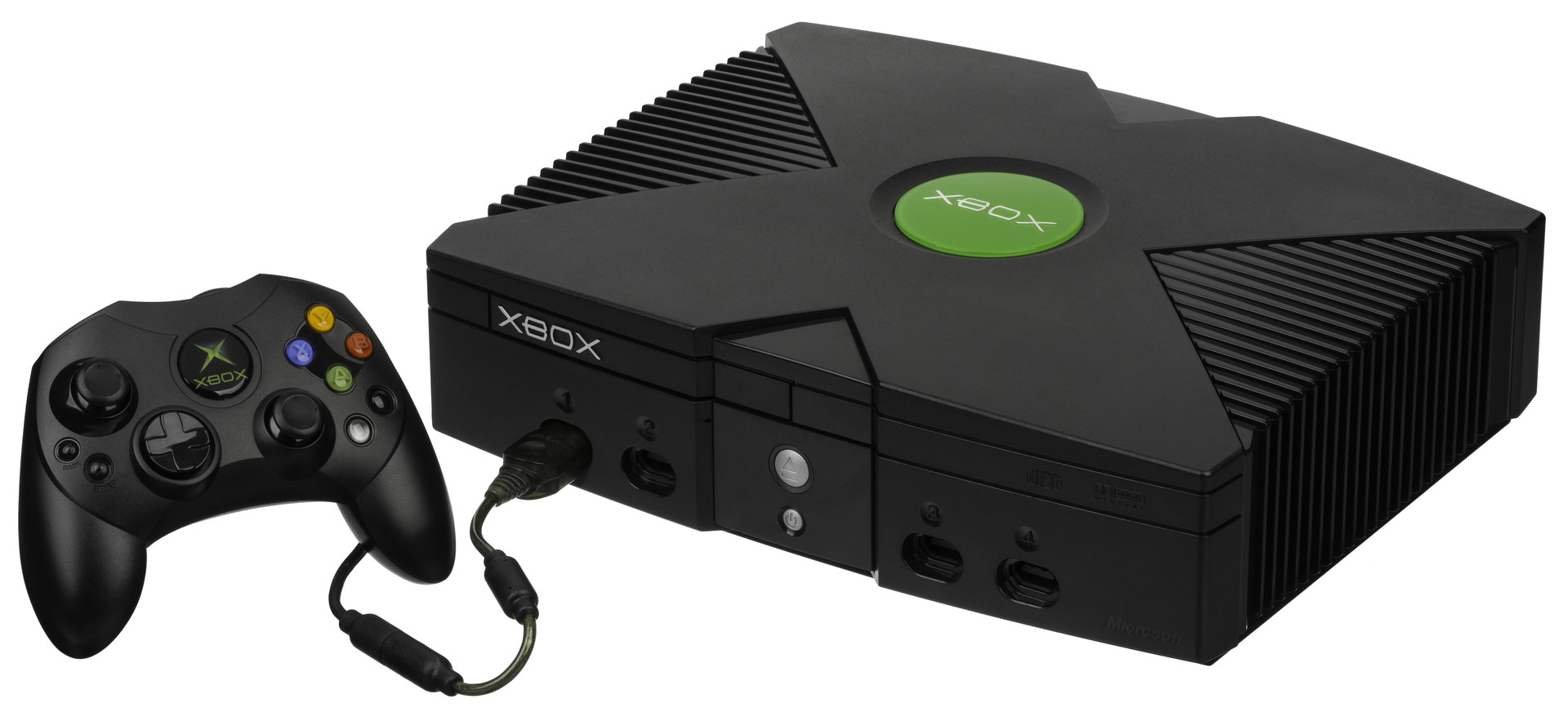
Gates announced the machine himself at the Game Developers Conference in San Jose on March 10, 2000, unveiling a prototype milled from a solid block of aluminium in the shape of a giant X, glowing green at the centre — reportedly $18,000 a unit to make. The final design waited for CES in Las Vegas on January 6, 2001: the black slab, the fins, the green jewel, revealed by Gates with help from WWF superstar The Rock, while demo machines running Oddworld: Munch’s Oddysee and Malice worked at a fifth of the final hardware’s power. “Xbox is the future of video gaming,” Gates said. The industry laughed at the size of the thing, and at the controller. It stopped laughing at the specification.
The most powerful box in the room
Microsoft’s own CES release called the 733MHz Intel processor “the most powerful CPU of any console,” and for once the boast survives scrutiny — with the honest caveat that clock speeds alone prove little across different chip designs. The PlayStation 2’s Emotion Engine ran at 294.9MHz; the GameCube’s Gekko at 485MHz. But the verdict of the generation’s hardware, then and in retrospect, rests on the whole package: the 733MHz Pentium III-based CPU, Nvidia’s NV2A graphics chip at 233MHz, and 64MB of unified memory — double the PS2’s main RAM — made the Xbox the most powerful console of its generation.
Two decisions mattered more than the numbers. The Xbox was the first console with a hard drive built in — 8GB as advertised, though some units quietly shipped with a 10GB Seagate drive formatted down to the same 8GB — while Sony and Nintendo were still selling memory cards. And it was the first console with Ethernet built in as standard, at a moment when, as Microsoft’s own 25th-anniversary letter puts it, 9 in 10 households still used dial-up. Sega’s Dreamcast had a modem and a swappable broadband adapter; Microsoft simply made the port part of the machine, and bet the online future would be broadband-only. The bet was expensive: analysts estimated the console cost around $425 to manufacture against its $299.99 price, a loss on every box before a single game was sold.
Launch day: the original Xbox arrives
The Xbox launched in North America on November 15, 2001 at $299.99 — the PS2’s launch price — in more than 15,000 stores, three days before Nintendo’s GameCube arrived on the same continent. There were 20 games on day one (Microsoft’s own count said 19 during launch week; the difference is Midway’s Arctic Thunder). The full day-one shelf: 4×4 Evo 2, AirForce Delta Storm, Arctic Thunder, Cel Damage, Dark Summit, Dead or Alive 3, Fuzion Frenzy, Halo: Combat Evolved, Mad Dash Racing, Madden NFL 2002, NASCAR Heat 2002, NASCAR Thunder 2002, NFL Fever 2002, NHL Hitz 20-02, Oddworld: Munch’s Oddysee, Project Gotham Racing, Shrek, Test Drive Off-Road: Wide Open, Tony Hawk’s Pro Skater 2X and TransWorld Surf.
One of those twenty did the heavy lifting. We have told that story separately today in Halo: Combat Evolved at 25, and our review of Halo: Combat Evolved scored it 9.5/10 — the shooter did not just sell the console, it defined what a console shooter was. The launch around it was a genuine hit: by the end of 2001, six weeks in, Microsoft had sold 1.5 million consoles in North America, and buyers were taking home more than three games per system — an attach rate Microsoft, citing the NPD Group, called the highest ever for a console launch.
The Duke, and the pad that replaced it
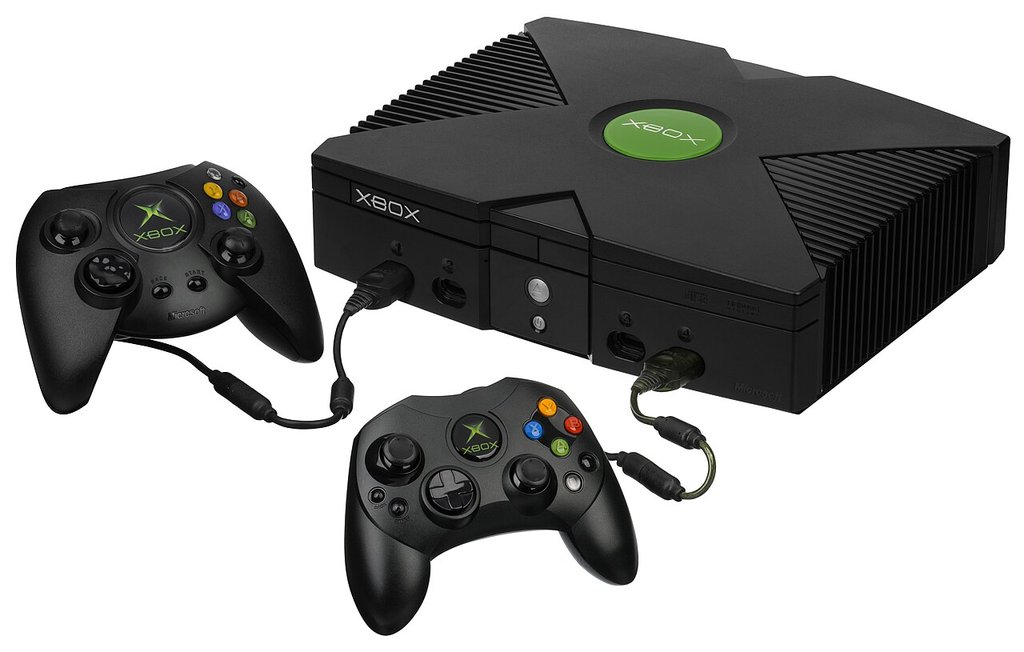
The controller, though. The Duke — named for hardware project manager Brett Schnepf’s son — was enormous because it had to be: the circuit boards inside it had already been manufactured oversized, and industrial designer Denise Chaudhari had to design the shell around them after supplier Mitsumi refused to build Microsoft the folded, two-part board that kept Sony’s DualShock slim. The finished pad was nearly three times a DualShock’s size. Game Informer named it Blunder of the Year for 2001; Guinness later certified it the biggest controller ever made; Blackley has told of audience members throwing things at him on stage.
The fix already existed. The Controller S, codename Akebono, used the two-piece board and was designed for smaller hands: it was the pack-in for the Japanese launch on February 22, 2002, went on sale in North America that April 29, and replaced the Duke in American Xbox boxes that fall, worldwide by the end of 2003. We have told the whole saga in our history of the Duke. Time has been kind to the big pad — in 2018 Hyperkin reissued it, with Blackley’s involvement, as a licensed wired controller for Xbox One and PC at $69.99.
Xbox Live: the bet that paid off
The Ethernet port sat in the back of the machine for a year, waiting. On November 15, 2002 — the console’s first birthday — Xbox Live launched in the US and Canada. The Starter Kit, at $49.99 on Microsoft’s launch-day figure, bought a year’s subscription, the Communicator headset, and trials of MotoGP and Whacked!. Nine Live-enabled games were already on shelves, and the big three — MechAssault, Unreal Championship and Tom Clancy’s Ghost Recon — each sold to more than 80 percent of kit owners, by Microsoft’s NPD-cited figures.
What Live standardised is now so normal it is hard to see: one Gamertag identity across every game and publisher, a friends list that found your people whatever they were playing, voice chat in every Live game through the headset in the box, proper matchmaking, downloadable content stored on that built-in hard drive. Rivals offered dial-up-era online play, game by game; Microsoft built one service, broadband-only, and ran it itself. The kits sold out — 150,000 in the first week, more than 200,000 players counting guests — and in July 2004 Microsoft announced the millionth member. Two years in, the proof of concept got its monument: Halo 2, released November 9, 2004 after 1.5 million US pre-orders, sold 2.4 million copies and earned up to $125 million in its first 24 hours, then the biggest opening day in entertainment history. It finished as the original Xbox’s best-selling game, at 8.46 million copies.
Second place, at a price
The war itself was never close at the top. The PlayStation 2 went on to sell more than 160 million consoles, a figure Sony confirmed in 2024 — the best-selling console of all time. The Xbox finished with more than 24 million (Microsoft’s figure, as of May 2006), ahead of the GameCube’s 21.74 million: second place in its first attempt, won against Nintendo, at a distance from Sony that was never going to close. Forbes estimated in 2005 that the Xbox division had lost $4 billion in its first four years; Microsoft’s own filings would only call the machines “negative margin consoles,” and the April 2002 price cut to $199 made every sale bleed a little more.
And then there was Japan. The Xbox launched there on February 22, 2002 at ¥34,800 with twelve games, into smaller living rooms, at a higher price than its rivals, with a library built for American tastes and a controller Japanese developers had petitioned against. Famitsu’s lifetime count is 472,992 consoles — under half a million, roughly two percent of the worldwide total. Microsoft’s home-market strength and its Japanese failure are the two facts every Xbox generation since has been planned around.
Four short years
The end came fast, and it came from the supply chain. Microsoft and Nvidia had already been to arbitration over chip pricing in 2002 — settled privately in February 2003 — and in 2005 Nvidia ended Xbox chip shipments after August 1. With no more graphics chips there were no more consoles: production ended four years after launch, retail discontinuation followed in Japan in 2005 and the rest of the world in 2006, and the Xbox 360 launched on November 22, 2005, a week past the original’s fourth birthday. The tail ran on quietly — the last game, Madden NFL 09, arrived in August 2008, and the original Xbox Live, the service the machine had pioneered, was switched off on April 15, 2010.
Twenty-five years on: the big box won’t die
What the Xbox actually won was the argument about what a console is. The hard drive is standard. The Ethernet port — now Wi-Fi and Ethernet both — is standard. The single online identity, the friends list, the subscription service: standard. And Microsoft has spent a decade making sure the games themselves survived. The Xbox 360 played 212 original Xbox games at its own launch and roughly 460 by the time its emulation list closed in November 2007. The Xbox One added original Xbox backward compatibility on October 24, 2017, opening with 13 titles. On the 20th anniversary, November 15, 2021, Microsoft added a final 76 backward-compatible games, surprise-launched Halo Infinite’s multiplayer three weeks early, and announced the Power On documentary — and every backward-compatible original Xbox game still plays on Series X|S today.
The 25th has been marked the same way: by giving the old machine new work. On November 12, Microsoft added 21 more original Xbox games to backward compatibility on PC, 25 in total — we covered the full list in the original Xbox games that just came to PC. Xbox chief Asha Sharma’s anniversary letter to the team called the 2001 machine “impossible to miss,” and noted, “We’ve built four generations of XBOX consoles, with a fifth on the way.” And today itself brought the neatest tribute of all: Microsoft announced it is “bringing back the original XBOX boot-up animation for all XBOX Series X|S and XBOX One players, along with two additional XBOX 360 boot-up animations” — the 2001 swirl and the 2005 and 2010 Xbox 360 startups, selectable in Settings, under System, then Startup, rolling out through the day. A quarter-century on, the big black box still boots first.
— Chip
For more launches from this date, see This Day in Gaming History: November 15. More from this system: our Xbox hub.
1 comment