At a glance — Game: King’s Quest VII: The Princeless Bride · Developer: Sierra On-Line · Publisher: Sierra On-Line · Original release: November 22, 1994 · Original platforms: MS-DOS, Windows, Macintosh · Genre: Adventure
The opening argument could happen in any house. Queen Valanice of Daventry wants her daughter to marry. Princess Rosella would rather have another adventure, thanks. Then a small winged thing breaks the surface of a pond, Rosella spots a castle shining under the water, and she jumps. Of course she jumps. Valanice goes in after her. The two come up in different corners of a realm called Eldritch, separated, with a volcano being readied to take the whole place apart. Thirty-two years later that first plunge still lands. Sierra took its flagship series away from its king, its castle and its painted realism, and bet it on a cartoon.
A pond, a song, and a King’s Quest VII with two heroines
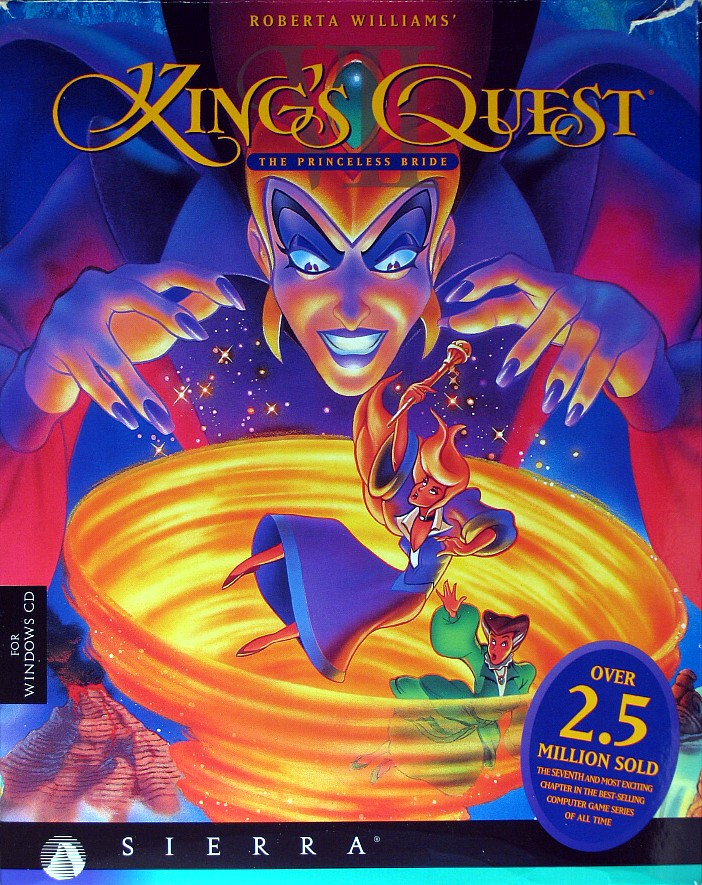
Start with the title. It riffs on The Princess Bride, and it tells the truth about the plot: a princess who is meant to become a bride and would rather fall into another world. Roberta Williams designed the game with Lorelei Shannon, and you can feel both of them in it. Williams wanted Rosella leading again, as she had in King’s Quest IV back in 1988. Shannon wanted Valanice — a queen who had spent the whole series on the throne, in the background — to get a quest of her own. They didn’t pick one idea. They built both, and the result is the only entry in the series with two protagonists.
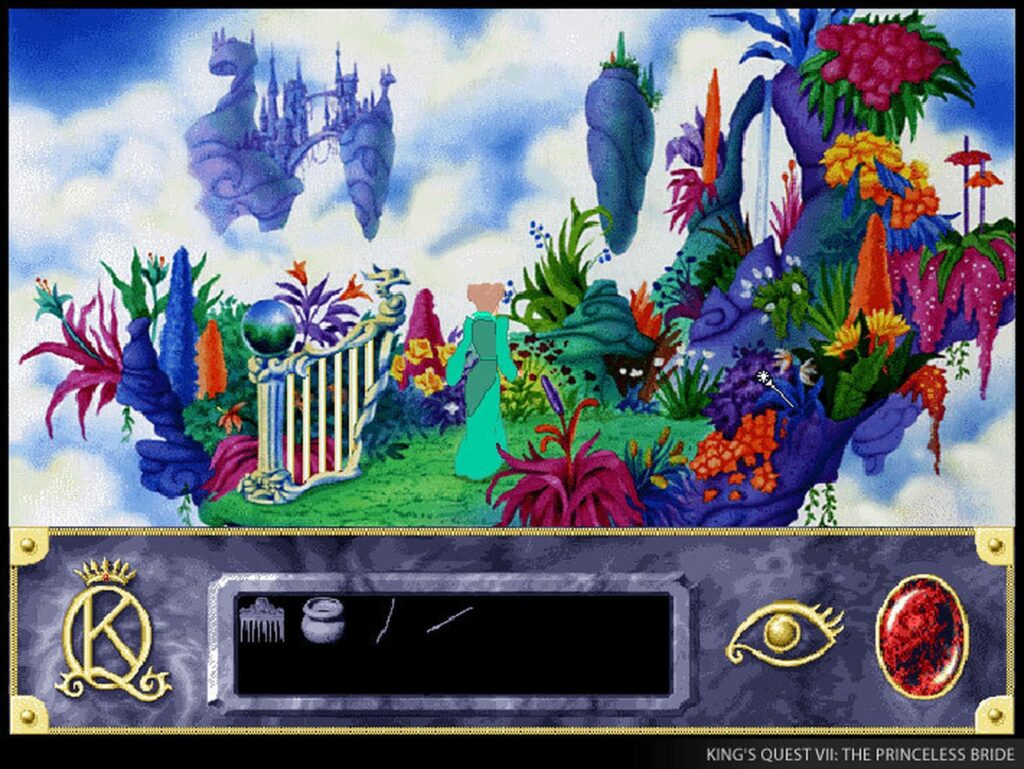
King Graham isn’t in it. Not sidelined, not cameo’d. Absent. Daventry shows up only briefly in the introduction, and then Eldritch takes over: a fairy tale with the brightness turned up and something wrong underneath. Valanice washes up in a desert holding nothing but her daughter’s comb. Rosella wakes in the Vulcanix Underground, transformed into a troll and promised in marriage to the Troll King. Between them they cross a cursed forest, the animal town of Falderal, the graveyards of Ooga Booga Land, and Etheria, the cloud kingdom of Oberon and Titania. The villain, Malicia, is Titania’s own sister. Her plan to trigger the volcano gives all that wandering a clock to run against.
Williams designed this game at the same time as Phantasmagoria, and the two productions shared people — art director Andy Hoyos and producer Mark Seibert among them. Hold those two games side by side and the split is wild. One was Sierra pushing into filmed horror for adults. The other was Sierra trying to build an animated feature you could play, pitched at families as much as at the fans the series already had.
Six chapters, told like a storybook
The structure is the quiet revolution here. King’s Quest VII runs in six chapters, alternating. Odd chapters are Valanice, searching for her daughter. Even chapters are Rosella, working to undo the troll spell and get out of a wedding she never agreed to. Chapter 1 strands Valanice under the title “Where in Blazes Am I?” Chapter 2 answers with Rosella’s “A Troll Is as a Troll Does.” The pair pass through some of the same places at different times. They meet properly only at the end, inside the volcano, for Chapter 6: “Ready, Set… BOOM!”
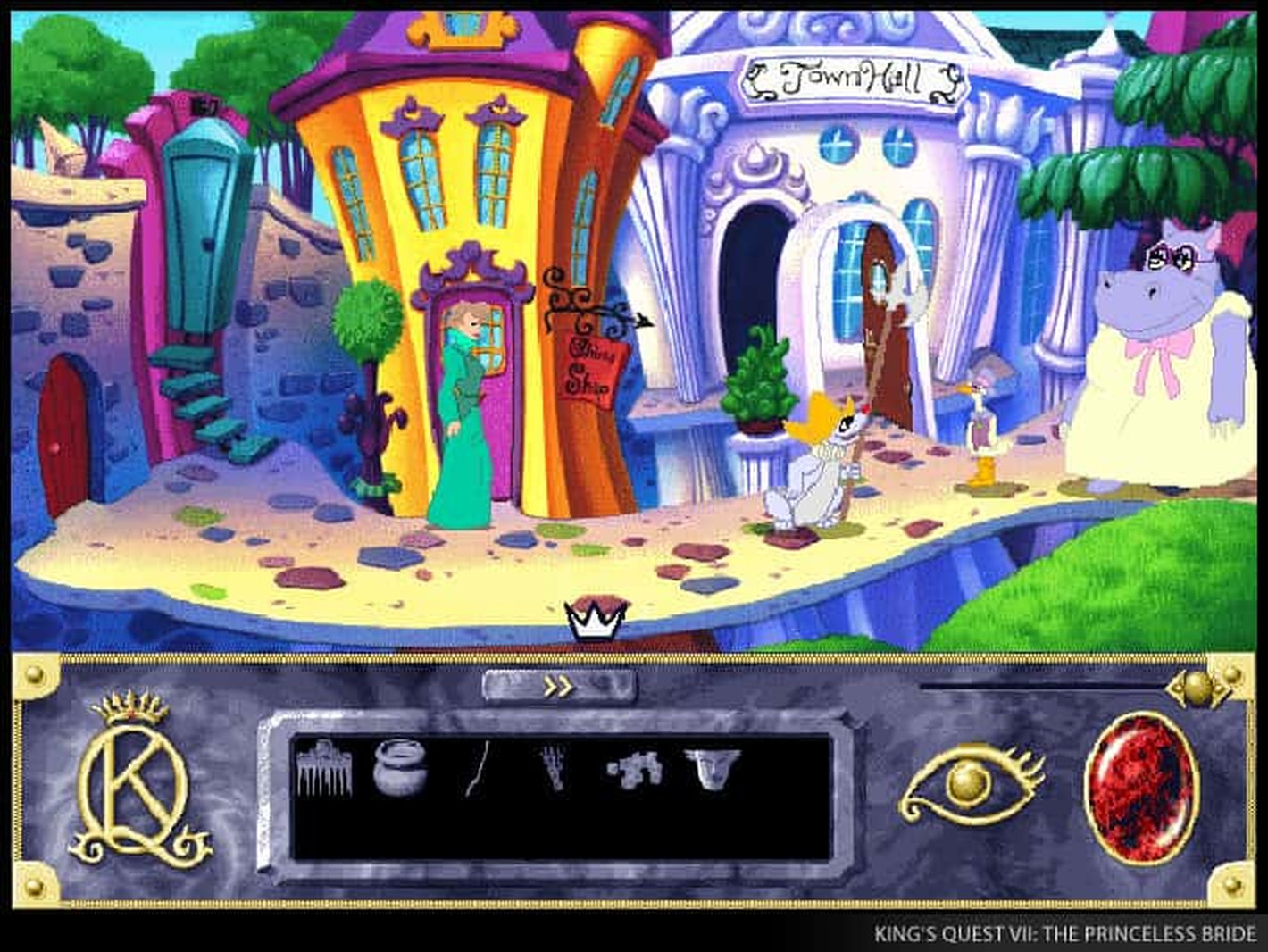
And the game treats its chapters the way a book does. You can jump to the start of any of them whenever you like, the way you’d reopen a favourite part of a story. Progress lives in a single save called a bookmark. The interface got cut down to one cursor that sparkles over anything worth touching. The earlier games gave you a row of icons — walk, look, talk, take. Here the pointer either glows or it doesn’t. Accessibility was the thinking behind it. Sierra wanted a new player to be able to start cold, and the packaging said exactly that: no previous King’s Quest experience required.
Death is still in there, because this is Sierra. Both heroines can drown, fall, or get caught by the wrong creature. But the old cruelty is softened — the game rewinds to just before the fatal move. A scare, not a lost afternoon. That single change tells you as much about the intended audience as the cartoon look does.
Painted like a film
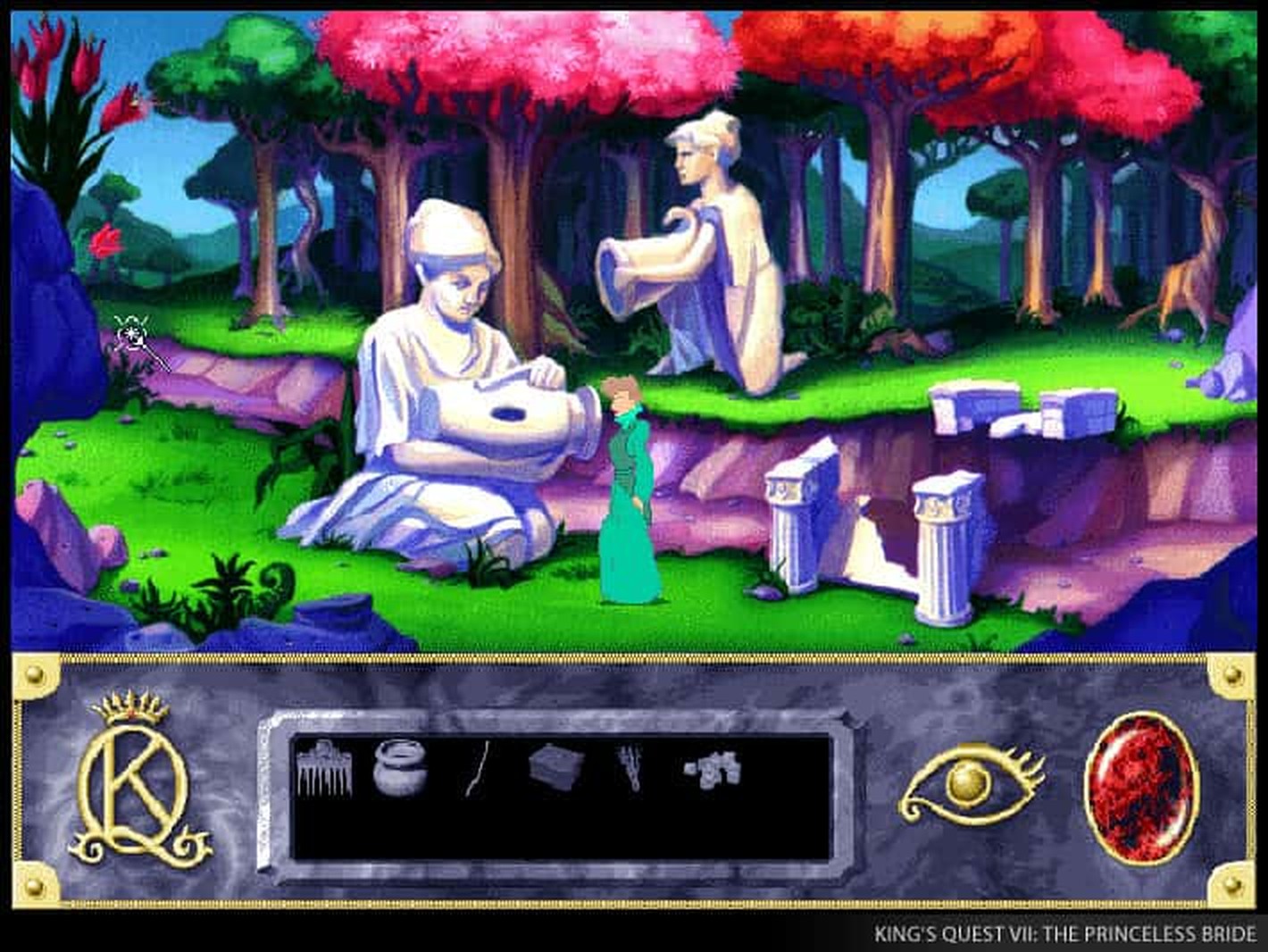
The look was the gamble. Everybody said so at the time. The art took its lead from the animated films of Walt Disney Pictures and Don Bluth, with Aladdin named as a particular influence. Nearly 100 backgrounds were hand-painted. The characters started as pencil drawings on paper, were scanned in, then inked and coloured digitally — the traditional animation process, borrowed from the studios Sierra was chasing. The game shipped on CD-ROM only, a first for the series; there was no floppy disk version at all. It needed the disc, too. The room went to the art, the voices, and around 120 pieces of music composed for the game.
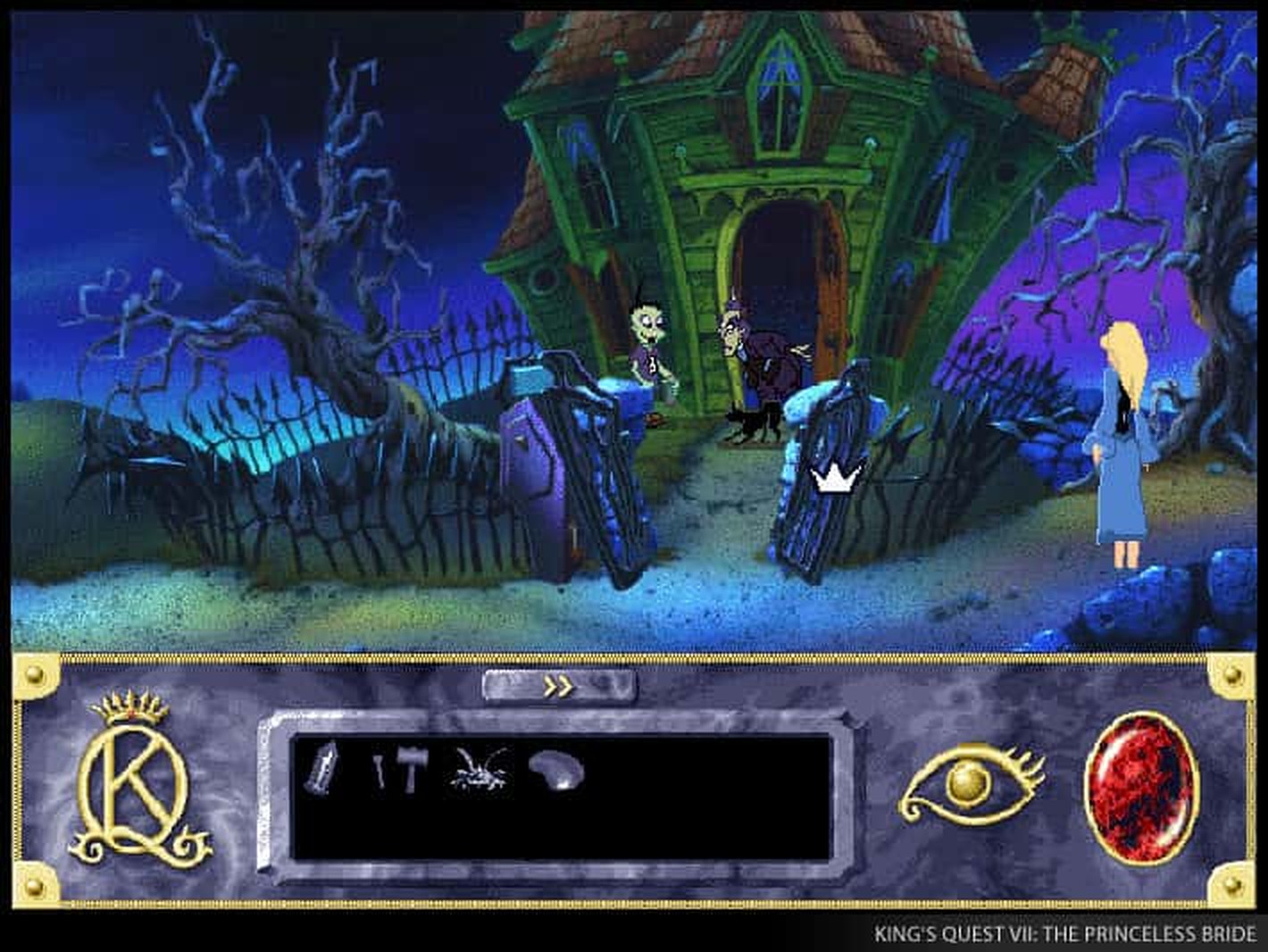
Play it now and the animation is what survives intact. The backgrounds have a storybook richness — saturated colour, curled shapes, nothing squared off. The character animation moves slower than you remember. It moved slower than players in 1994 expected, too, especially on weaker machines. But the commitment is total. Not one screen of Eldritch looks like the Daventry of the earlier games, and that was never an accident. Sierra wasn’t redecorating the old series. It was recasting it.
The story earns the recasting. The device Rosella steals from Malicia’s house, the imposter sitting on the troll throne, the young man at the centre of the plot — all of it ties back to Edgar, the fairy prince Rosella met in King’s Quest IV. Newcomers get the clean story they were promised. Players who did the homework six years earlier get paid off quietly, in the background. Both things at once. That’s craft.
The argument it started
It did not land quietly. PC Data had it as the 4th best-selling computer game of December 1994, and it held a place in the top 20 into April. US sales were later reported at between 300,000 and 400,000 copies. By the end of March 1996, Sierra put the King’s Quest series as a whole past 3.8 million units. Commercially, the cartoon worked. Full stop.
The reviews split, and they split along a line anyone who has watched a favourite series change direction will recognise. The graphics got praised nearly everywhere. Computer Gaming World gave it 4 out of 5 and called it “a visual marvel from beginning to end.” PC Zone scored it 90% and praised the attention to detail. PC Gamer in the US gave it 84% — but its reviewer found it fairly simple to get through and felt the gameplay had been shoved aside. Other critics complained the opposite way: some puzzles were too hard for the children the artwork seemed to invite. A game gets accused of being too easy and too difficult in the same month only when nobody can agree who it’s for. That argument followed The Princeless Bride for years.
Where The Princeless Bride sits now
Sierra made one more King’s Quest after this — Mask of Eternity in 1998, a very different game — and then the series rested for a long time. So The Princeless Bride sits in an odd, likeable spot. Last of the classic adventures. The only one carried by Valanice and Rosella together. The one that looks least like its own family. It’s easy to get hold of today, sold in a bundle with its sequel, and it holds up best when you meet it on its own terms: not as the harder, darker Daventry adventure that never arrived, but as a storybook two designers built so a mother and a daughter could share the cover.
Rosella got her wish. She dodged the wedding she didn’t want, took the adventure she asked for, and met Edgar again on her own terms. Valanice got something rarer in games of that era — she got to be the hero of the search instead of the reason for it. Thirty-two years after that pond first opened, that still feels like the boldest thing in the game.
— Sal
For more launches from this date, see This Day in Gaming History: November 22.