
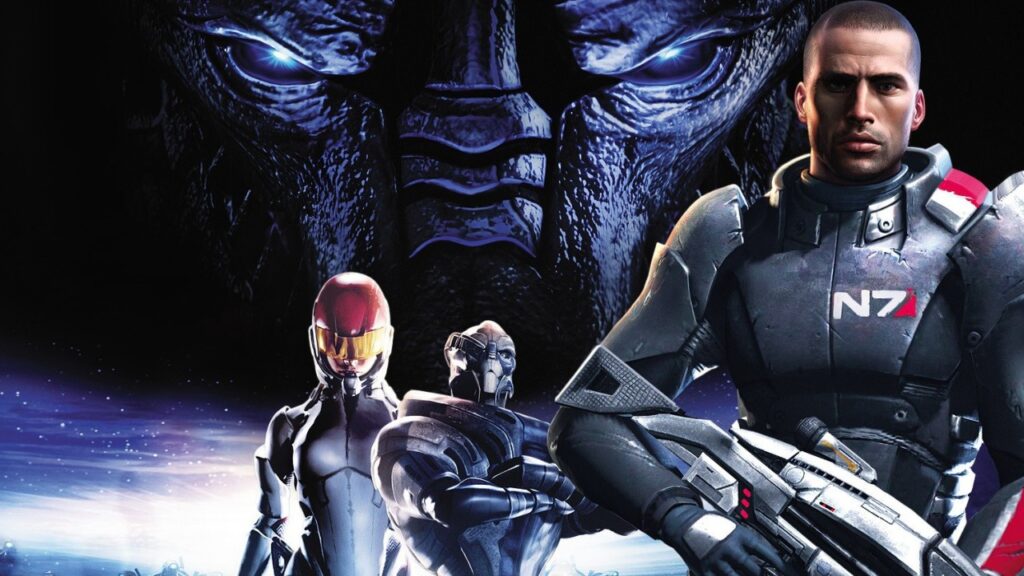
At a glance — Game: Mass Effect · Developer: BioWare · Publisher: Microsoft Game Studios · Original release: November 20, 2007 (North America) · Original platforms: Xbox 360 · Genre: Action role-playing
Here’s the part that’s easy to forget: in 2007, a game keeping your decisions for the sequel was not a feature. It was a gamble nobody had really taken. Saves stayed in their own games. Sequels started clean. BioWare looked at that and built a trilogy on the opposite bet — your Commander Shepard, your calls, carried forward for years.
Mass Effect came to the Xbox 360 on November 20, 2007. BioWare had form: Knights of the Old Republic had redefined the licensed RPG, Jade Empire proved they could build a world of their own. This one took three and a half years and around 130 people, ran on Unreal Engine 3, and carried a script of roughly 400,000 words — more than 20,000 lines of dialogue, all of it written to survive being interrupted, argued with, or talked past by the player.
It went gold on October 22, 2007. The standard edition cost $59.99, with a Limited Collector’s Edition alongside it, and the game sold more than a million copies in under three weeks. Nineteen years on, it is still the game other RPGs are measured against when they claim your choices matter. It earned that spot. It was the first one that made the claim feel true while you were playing.
Mass Effect Made the Choice the Whole Game
For a game about the end of everything, it starts small. The year is 2183. Commander Shepard — a man or a woman, your call, your face, your class — gets sent to Eden Prime, a human colony, to recover a Prothean beacon. Then the geth attack. A squadmate is dead inside the first minutes. The rogue turian Spectre behind it, Saren Arterius, activates the beacon, and Shepard touches it and sees war and death. After that, the game opens its doors: the Citadel, the ringed station where galactic politics lives, and a hunt that runs through Therum, Feros, Noveria, Virmire and Ilos, chasing a truth the Council would rather not hear. The Reapers — a machine race that wipes out organic civilization every 50,000 years — are coming back.
The plot wasn’t the point. Living with yourself was. Virmire puts Ashley Williams at one end of the facility and Kaidan Alenko at the other, and there is no version where you reach both. Whoever you don’t pick dies there — not for the level, for the whole trilogy. Wrex can be talked down over the genophage cure, or you can shoot him on the beach; plenty of players did both across different runs and felt worse about one of them for years. At the end, with the Citadel coming apart, the game asks whether the Alliance fleet saves the Council’s flagship or goes straight at Sovereign. Save the Destiny Ascension and humanity earns a seat. Let it burn and humanity takes the chair. No score pops up. No grade. The game just writes it down and moves on — which is exactly why it stayed with people.
Here’s the careful part, because it’s easy to overstate what the first game actually did. Mass Effect did not resolve its choices. It banked them. The payoffs lived in the sequels: carry a finished save into Mass Effect 2 and the people you saved, spared or sacrificed turned up again. Or did not. This game built the ledger; the sequels spent it. And that is why the choices felt heavy even in 2007, before anyone could know whether BioWare would honour them. The game behaved as if they were already permanent. In the end, they were.
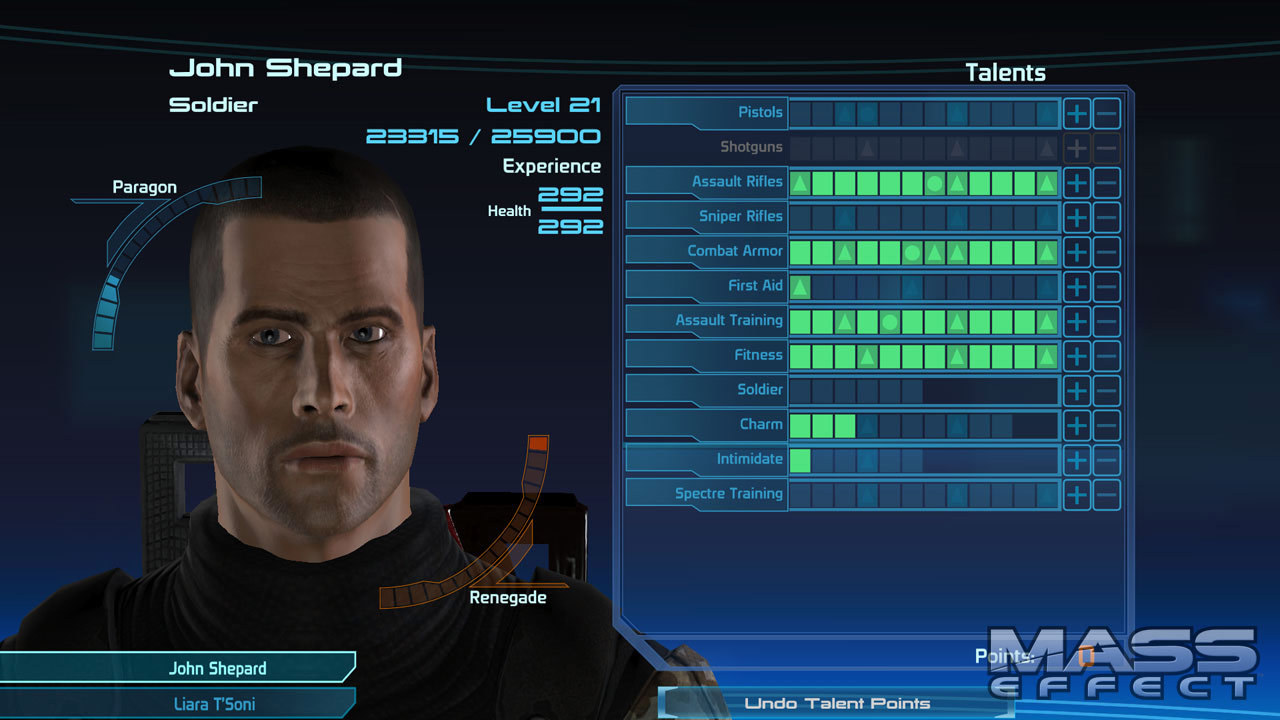
The morality system worked on the same principle. Paragon and Renegade were never good and evil. They were charm and intimidation — two ways of being the same commander — and the points you earned unlocked dialogue options that could talk somebody down or stare them down. On the talent screen, Charm and Intimidate sat right there among the weapon skills, as if persuasion were just another weapon in the rack. In Mass Effect, it was.
The Dialogue Wheel: A Conversation You Could Steer
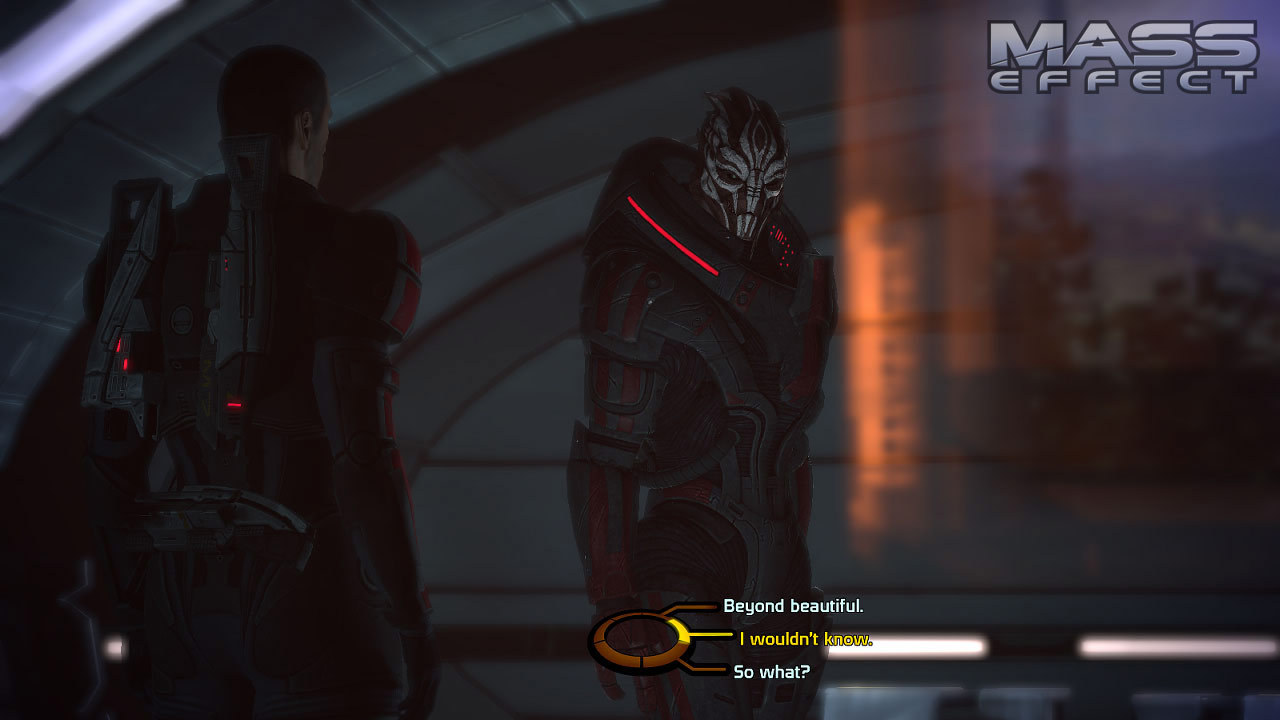
The most famous thing in Mass Effect is a circle. The dialogue wheel arranged your responses on a radial menu: the top generally more polite and selfless, the bottom more aggressive and hostile, the left side for digging deeper, the right for steering the conversation toward its end. You never picked the exact sentence Shepard would say. You picked the intent — the tone, the direction — and then watched a digital actor deliver it, in Mark Meer’s voice or Jennifer Hale’s, depending on the Shepard you had made.
It sounds minor now, because every RPG since has borrowed some version of it — which rather proves what a shift it was in 2007. Before the wheel, RPG conversations were lists: long, flat menus of full sentences, read first and clicked second. The wheel let you read the room instead of the script. You could feel the difference between investigating and committing, between asking one more question and ending the conversation. And none of that was accidental: by BioWare’s own account, the wheel was created precisely so players could identify which responses belonged to which emotions at a glance.
The voices carried it. Seth Green could have played Joker as a straight wise-cracker; instead he became the ship’s conscience. Keith David gave Captain Anderson a gravity that made the handing over of the Normandy land like a real transfer of trust. And the squad gave every conversation its own temperature — Kaidan’s steadiness, Ashley’s bluntness, Garrus’s idealism, Wrex’s anger, Tali’s curiosity, Liara’s wonder. Behind them, lead writer Drew Karpyshyn’s team gave each planet its own writer, then made them all read each other’s work. That is how the galaxy ends up feeling written by one mind with many voices.
Shepard and the Normandy Crew
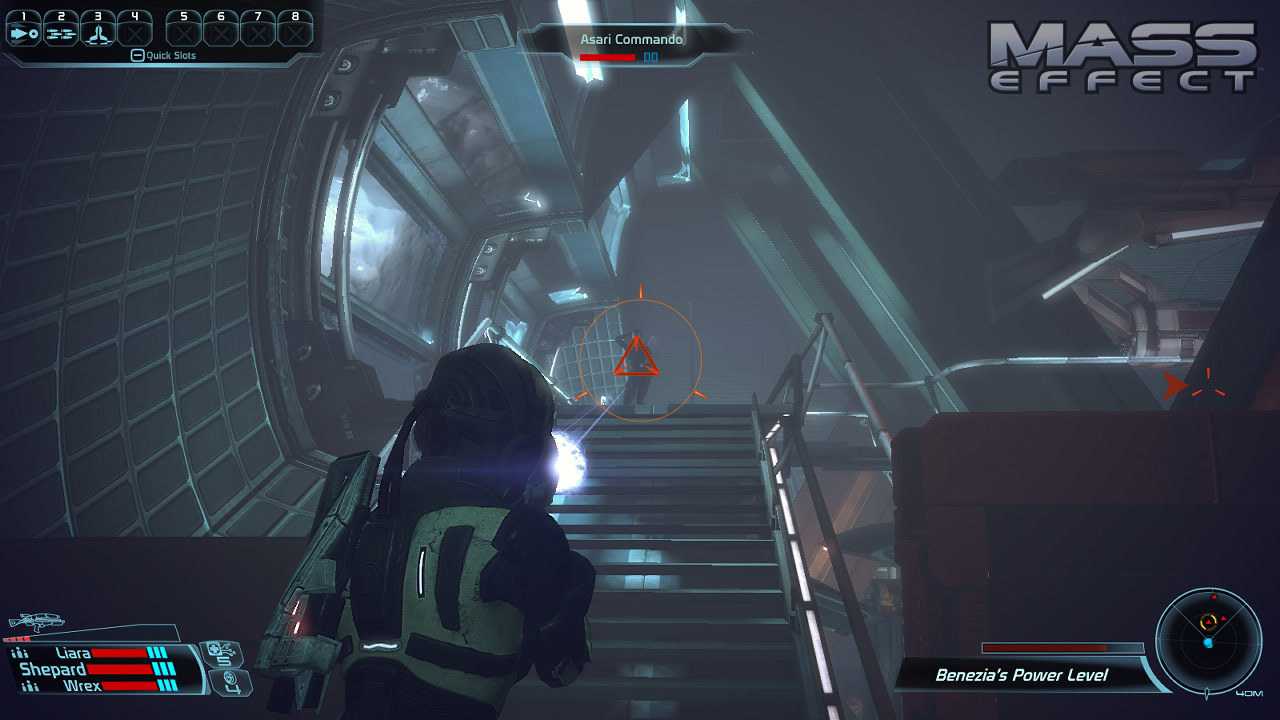
More than any planet, the Normandy is the game’s real home. It is where Garrus talks about justice. Where Wrex broods over the genophage. Where Tali tinkers with the engines, and Liara tries to understand a human carrying a dead civilization’s warning around in their head. Six squad members join over the course of the game, two at a time on the ground beside you, and Mass Effect is at its best in the quiet stretches — no quest marker, no reward, just the slow work of knowing people.
That is what the sequels inherited, and it is why the crew is the trilogy’s engine. Mass Effect 2, which followed in January 2010, is remembered as a suicide-mission masterclass largely because the first game taught players to care about the people on the ship first and the galaxy second. Our Mass Effect 2 review says as much. But the habit started here. Your most important decisions in this game were often made in a corridor, between missions, to someone who would remember what you said.
The crew carried the game’s ideas, too. Tali’s quarians asked what a people owes its past. Wrex’s krogan asked what a people owes its future after a weaponised plague. Garrus asked whether the rules still matter once they stop working. None of these were side quests. They were the game; the combat was the delivery system.
The Rough Edges Were Real, and So Was the Reception
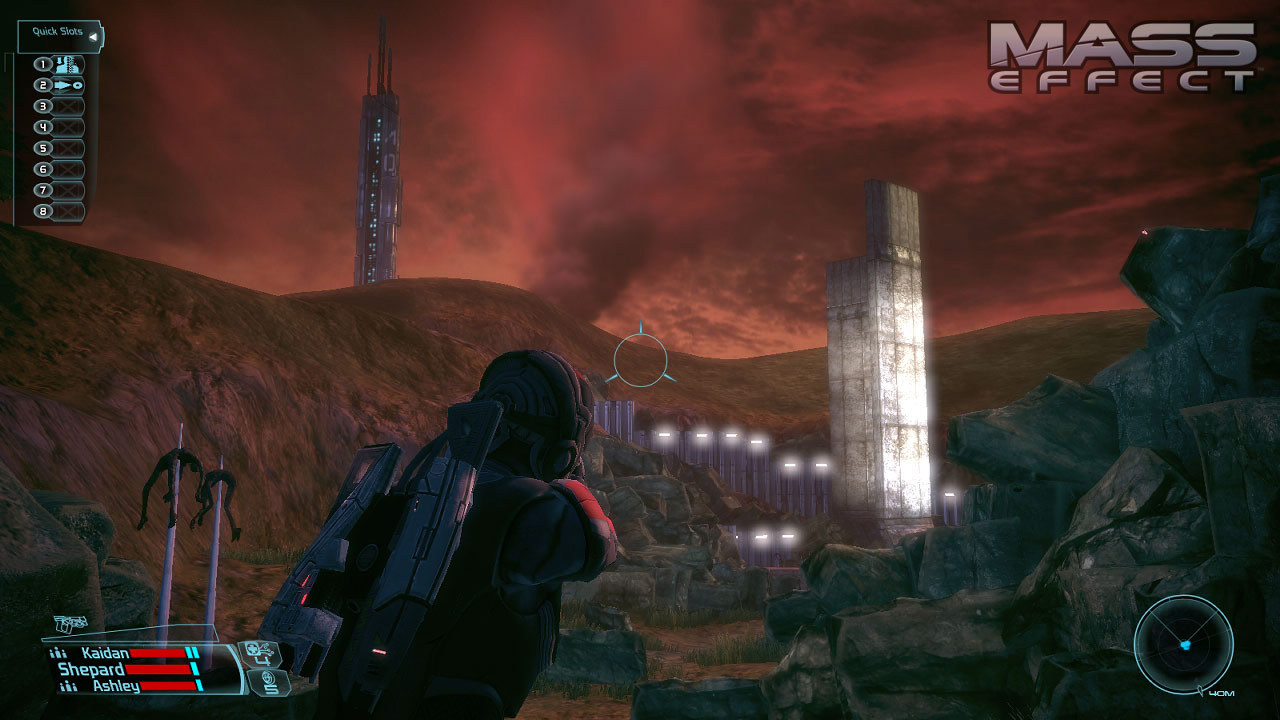
None of this makes Mass Effect flawless, and the critics of 2007 did not pretend otherwise. The combat was praised for its ambition — real-time, over-the-shoulder, pausable to issue squad orders — and criticised for its balance, and for squadmates whose artificial intelligence left them standing in the open like targets. The inventory was, in one reviewer’s words, painful and tedious: a flood of near-identical weapons and armour that turned looting into admin. The Mako, the six-wheeled vehicle for exploring uncharted worlds, was loved for the freedom it represented and mocked for its bouncing handling. The frame rate wavered. The loading times dragged.
And yet the verdict was overwhelming. Metacritic settled at 91 out of 100 for the Xbox 360 version. IGN scored it 9.4, Game Informer 9.75, Official Xbox Magazine a perfect 10, GameSpot 8.5, Edge a dissenting 7. The awards followed: Best RPG at the 2007 Spike Video Game Awards, Role-Playing Game of the Year at the Interactive Achievement Awards, and the New York Times’ Game of the Year. In the United States it debuted at number six on the NPD chart for November 2007 with 473,000 copies, and reached 1.6 million worldwide within six weeks. For a new intellectual property in a crowded holiday season — that was a statement.
BioWare fixed most of those flaws in the sequels without losing what made the first game special. The Mako went away, the inventory was rebuilt, the combat tightened. What stayed was the wheel and the crew — and the ledger underneath everything.
The Ending’s Long Shadow
It is easy to forget now, but Mass Effect’s ending is self-contained. Sovereign is destroyed. Saren is dead. The Council either lives because you saved it or dies because you chose the mission over it, and humanity’s place in the galaxy changes accordingly. Shepard walks away vowing to end the Reaper threat. Roll credits, over Faunts’ “M4 (Part II)”. That is a complete story. It is also, deliberately, an unfinished one: the Reapers are still out there, beyond the galaxy, waiting — as Sovereign itself tells you on Virmire, waiting for organic life to discover the mass relays before harvesting it at its peak.
The long shadow of that ending is not a controversy — that came later, in another game, and it belongs to that game. The shadow here is a contract. Mass Effect asked players to make choices it could not yet pay off, and to trust a studio to spend the next five years paying them off. Two downloadable packs extended the first game itself: Bring Down the Sky in March 2008, a new mission with a new alien race, the batarians; and Pinnacle Station in August 2009, a combat training facility that was left out of 2021’s Mass Effect Legendary Edition remaster because its source code had been lost. The remaster is how most new players meet the game now — but the original is the one that took the risk, in November 2007, with no guarantee the sequels would ever come.
They did come, of course. Mass Effect 2 in 2010, Mass Effect 3 in 2012, and a trilogy that is still the standard against which story-driven RPGs are judged. But the first game deserves to be remembered on its own terms, not as a prologue. It asked a studio known for licensed worlds to make conversation feel as important as combat, in a new galaxy, on a new engine. It did. Nineteen years later, players are still arguing about what they did on Virmire — which is about the best verdict a game like this can earn.
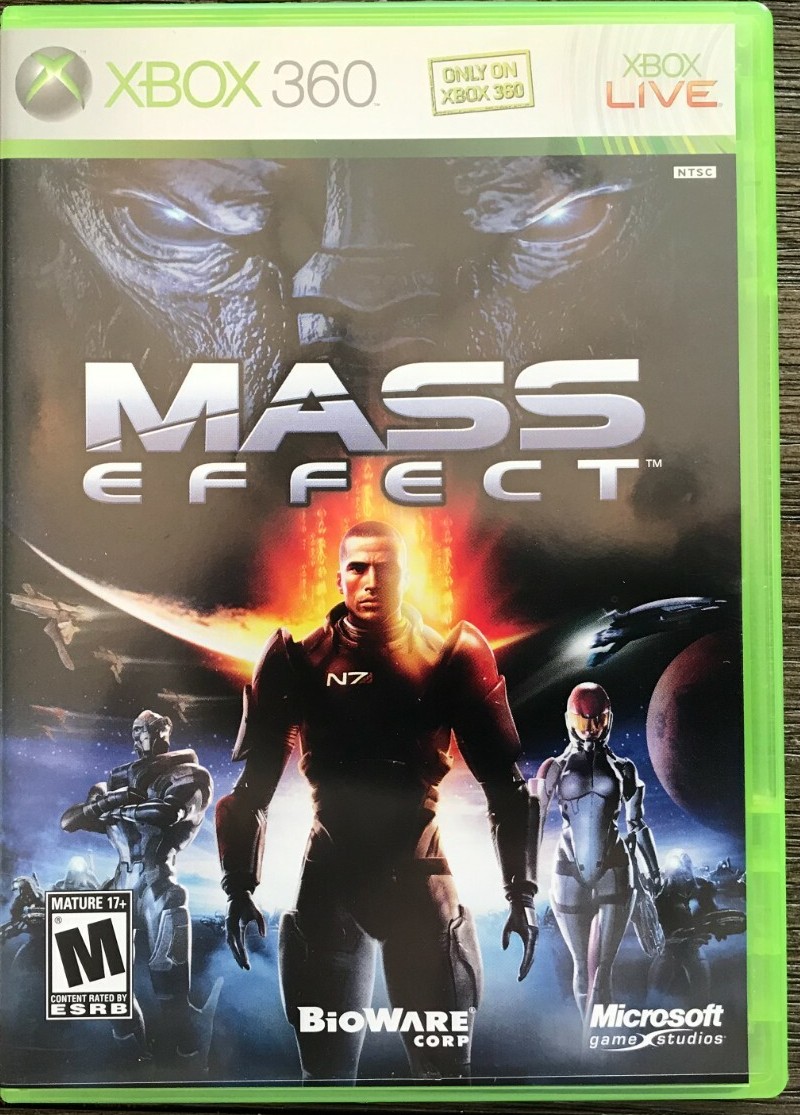
For more from the 360 era, see our Xbox 360 hub and Xbox 360 Forever. BioWare’s earlier work is worth revisiting too — our Knights of the Old Republic review and Jade Empire review cover the games that made this one possible.
— Chip
Mass Effect first launched on November 20, 2007. See what else happened on that day in This Day in Gaming History: November 20.