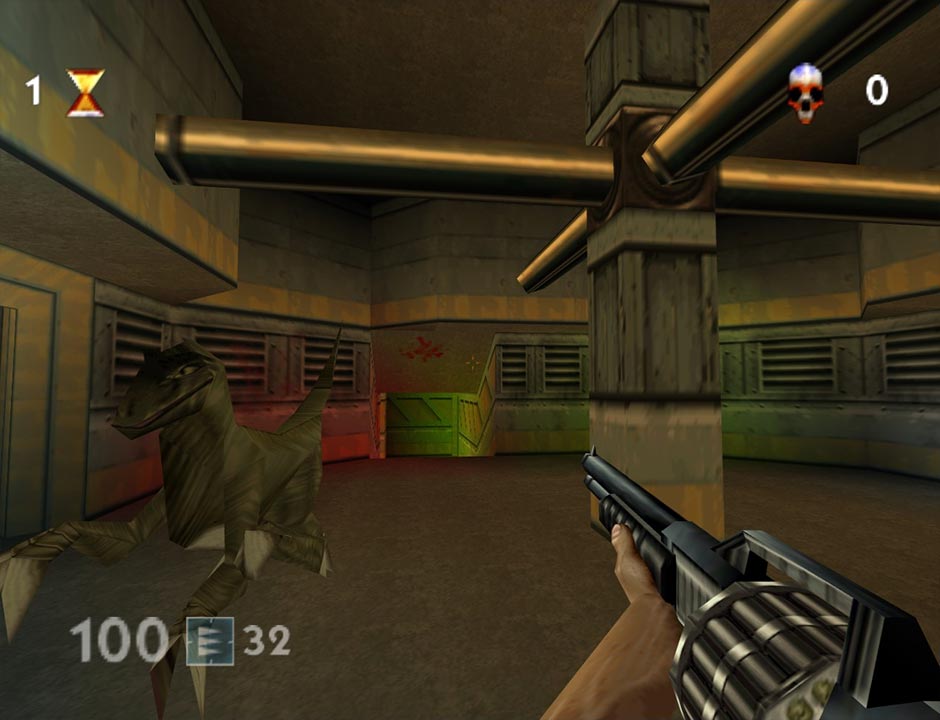
At a glance — Game: Turok: Rage Wars · Developer: Acclaim Studios Austin · Publisher: Acclaim Entertainment · Original release: November 23, 1999 (North America) · Original platforms: Nintendo 64 · Genre: First-person shooter · Players: 1–4
Every N64 household had a pecking order, and in mine it was settled with a Controller Pak and a grudge. GoldenEye owned the split-screen crown for two years, and most of us assumed it always would. Then, in the same November week that PC players got Unreal Tournament, Acclaim shipped a Turok game that threw out the jungle trek, threw out the story, and bet the whole cartridge on the arena. Rage Wars is that bet. Coming back to it with the same old couch, what’s striking is how much of that bet paid off. The parts that didn’t aren’t hard to spot either.
Born from Turok 2’s cutting-room floor
Rage Wars was conceived before Turok 2: Seeds of Evil had even shipped. Creative director Dave Dienstbier said the game “was born out of knowing that we couldn’t flesh out all our multiplayer ideas in Turok 2 in time for the holiday season,” and the finished game never lets you forget it. It runs on the Turok 2 engine, carries over its star weapons, and treats the earlier game’s deathmatch mode the way a band treats a demo tape that deserved to be the album.
Acclaim’s own launch announcement called it the first Nintendo 64 game designed specifically to maximize the multiplayer experience. That’s press-release talk, sure. But the intent was real, and it shows in the structure: there is no campaign here in the Turok sense, no keys to hunt, no fog-shrouded valleys. There is a ladder, a roster, and thirty-six rooms built for fighting in. (One housekeeping note, because it confuses collectors: a completely different game with the same name was made for the Game Boy Color by Bit Managers. This review is about the N64 cartridge only.)
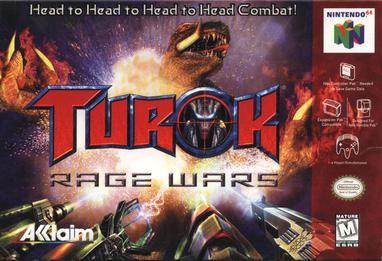
Turok: Rage Wars review — the modes are the game
Four modes carry the cartridge. Bloodlust is straight deathmatch and Team Bloodlust its squad version, spread across twenty-six arenas between them. Capture the Flag gets four maps built around a single neutral flag. And then there is Frag Tag, the mode I would rescue from a house fire. Every so often the game picks a player at random and shrinks them into something helpless — a monkey, a chicken, a baby raptor, a little robot — and their only job becomes sprinting for the change-back point while everybody else in the room hunts them for points. It is stupid, it is unfair, and it produced louder couch arguments than any flag run ever did.
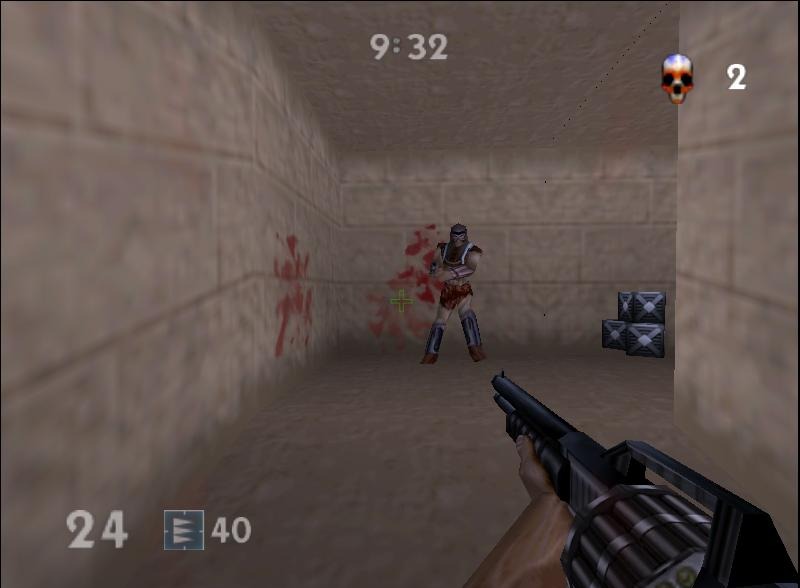
The arenas themselves are compact and readable — temples, warehouses, a cathedral, a bomb shelter — and most contain a Power Core, a pink-and-blue crystal that hands whoever grabs it fifteen to twenty seconds of some random advantage. Before the first shot you can set the match options yourself, which helps. Bots fill any empty seats, too, and that matters more than it sounds: a two-player night still gets a full match, and a solo player can at least practice against something. The pace is the point. Die, respawn, hear a weapon spin up somewhere close, go.
A toybox of seventeen fighters and some deeply silly weapons
You start with four fighters — Joshua Fireseed, the Turok himself, plus Adon, the Bio Bot Elite and the Mantid Drone — and the roster keeps growing to thirteen, with the game’s four bosses unlockable on top of that. The loadout system is the quiet genius of the thing: six slots, filled before the match. The Warhammer is always on your hip; then you choose two bullet weapons, two energy weapons and one explosive, and live with your choices.
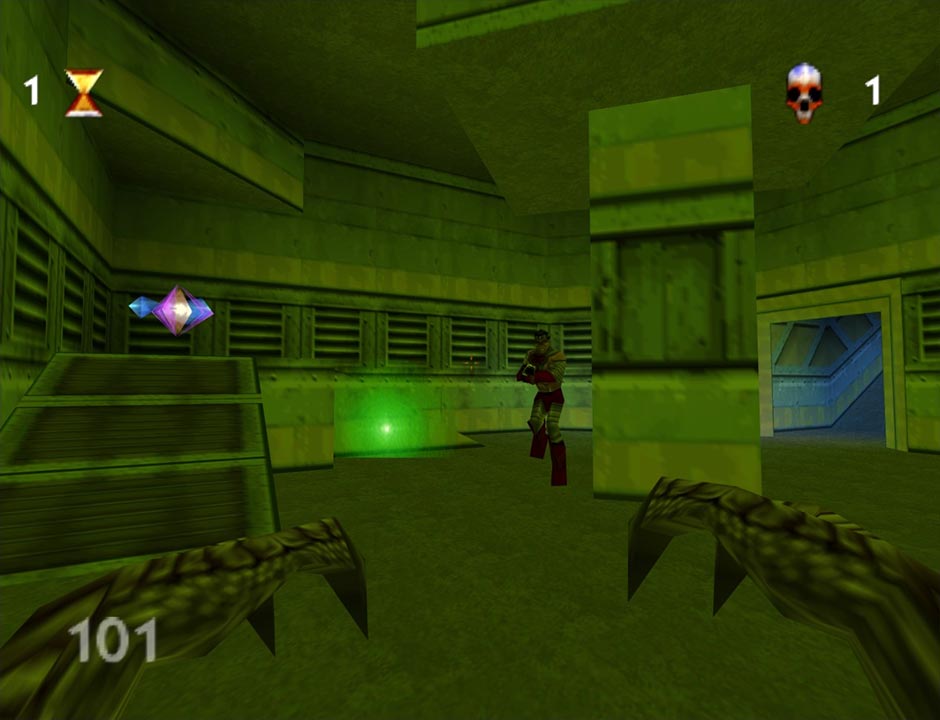
The arsenal is where the Austin team’s sense of humor lives. The Cerebral Bore returns from Turok 2, still horrible, still wonderful. The Chestburster does exactly what a certain film taught you it does. The Emaciator shrinks people; the Inflator blows them up like parade balloons; the shotgun’s alternate fire, Street Sweeper, dumps four shells at once and settles arguments. Fifty medals track everything from boss kills to suicides and unlock cheats and skins, and beating the ladder with the final boss, Tal’Set, hands you a character who can carry every weapon at once. The game always has one more small bribe ready. One more match, then.
The Trials are homework — and one early cartridge couldn’t be finished
Here is the honest part. The single-player Trials mode is a ladder of bot matches across the four mode types, with boss fights waiting at intervals — the bosses get a duel mode of their own, one life each, kill them and the match ends on the spot. It plays like what it is: a training ground with a progress bar. Edge said as much in 1999, calling the solo game little more than a limited training ground for the multiplayer. GameSpot’s Jeff Gerstmann gave the game a 5.8 and wrote that the artificial intelligence “can’t stand up to any steady-handed human player.” Next Generation went further and called the whole package a “quickie.” They weren’t wrong about the bots. The Trials exist to unlock fighters and teach you the maps, and once you know that, you can enjoy them on those terms — but nobody’s memories of this game were made alone.
The two-player version of the Trials adds co-op play and a few rewards you can only earn there, which makes what happened next sting. Early copies of the game — the black cartridges — carried a glitch in the Creature Tag trials that made one of the fifty medals impossible to earn in the US version, quietly blocking full completion of the co-op campaign. Acclaim owned the mistake properly: send in your black cartridge and they exchanged it for a fixed grey one. The exchange was never widely publicized, so most players never sent anything in — which is why the grey Rage Wars cartridge is now one of the genuinely scarce N64 carts, and why a copy deserves a second look at any game store.
One practical note for modern players: the game supports the Expansion Pak without requiring it. Play without one and the picture is noticeably softer — GameSpot called it “mushy” — while the Pak sharpens the arenas up considerably. If you’re buying a setup for this game, the Pak is part of the price.
The verdict
The critics split right down the middle in 1999, and the split tells the story. IGN’s Aaron Boulding scored it 8.9 and loved the multiplayer; GameSpot landed at 5.8; the game settled at 72% on GameRankings. Both camps were reviewing different halves of the same cartridge. Mine it for solo play and it is a ladder of dim bots. But put four people in front of it — two people and two bots will do — and it becomes one of the best reasons the N64 ever gave you to own four controllers. If your retro nights are solo affairs and you want an N64 shooter with a real campaign, our Doom 64 review is the better shelf to reach for, and GoldenEye still wears the split-screen crown for mission-based play. But for pure arena chaos on the system, Rage Wars has very few peers, and Frag Tag should be famous.
Review score: 7.5 / 10 — As a multiplayer cartridge, Rage Wars is top-shelf N64: fast arenas, a huge toybox and a mode where your friend turns into a chicken. As a solo game, it’s homework. Get three friends on the couch and it’s an eight; alone, it’s a six. Split the difference.
— Sal
For more launches from this date, see This Day in Gaming History: November 23.