

At a glance — Game: Metroid Prime · Developer: Retro Studios · Publisher: Nintendo · Original release: November 18, 2002 (North America) · Original platforms: GameCube · Genre: Action-adventure
Every sensible person expected this to fail. Metroid had been silent for eight years. The series that helped invent the explore-and-upgrade action game was being handed to a young studio in Austin, Texas, that had never shipped a game, and the plan — the plan! — was to put Samus Aran inside her own helmet and make the whole thing first-person. In 2002, first-person on a console meant shooters, and shooters meant corridors and body counts. Metroid meant something else entirely: loneliness, backtracking, doors that only open once you have earned the right tool, and a planet that slowly turns from a maze into a memory. Twenty-four years on, Metroid Prime is not the game that survived that gamble. It is the game that made the gamble look obvious.

Eight Years of Silence, Then a Studio in Texas
The wait had been long enough to become part of the series’ identity. Super Metroid arrived in 1994 and then, nothing — no Metroid on the Nintendo 64 at all. According to producer Shigeru Miyamoto, Nintendo did not make one because the company “couldn’t come out with any concrete ideas,” and Metroid co-creator Yoshio Sakamoto said he could not imagine how the N64 controller could be used to control Samus. Nintendo even approached another company about making a Nintendo 64 Metroid, and the offer was declined, supposedly because the developers did not think they could equal Super Metroid.
The answer came from an unlikely address. Retro Studios was created in 1998 by an alliance between Nintendo and Iguana Entertainment founder Jeff Spangenberg, set up in Austin to make GameCube games aimed at a more mature audience. After establishing its offices in 1999, Retro worked on four projects at once. When Miyamoto visited in 2000, he saw the prototype of a first-person shooter engine the team had built — and suggested a new Metroid game. One by one, the other projects fell away: three games were cancelled in 2000 and early 2001, and in July 2001 the role-playing game Raven Blade was terminated too, leaving Metroid Prime as the only game in development at the studio.
What followed was not a smooth coronation. The collaboration ran between Austin and Japan — Nintendo handling the music, Retro handling art and engineering, and both teams working on the overall design together, with producers including Miyamoto and Kensuke Tanabe and Sakamoto checking that Retro’s story ideas stayed consistent with the earlier games. The game was planned in third person until Miyamoto intervened and the perspective changed to first-person, at which point almost everything already developed was scrapped. During the last nine months of development, Retro’s staff worked 80- to 100-hour weeks to reach Nintendo’s deadline. The first public glimpse had been a ten-second video at Space World 2000; by February 2001 Nintendo was confirming the game and insisting, in the face of every assumption the screenshots invited, that because of its emphasis on exploration Metroid Prime would be a first-person adventure rather than a first-person shooter. The title was confirmed at E3 in May 2001. The argument about what to call it has never entirely stopped — which is rather the point of the game.

Metroid Prime Is a Metroid Game First
Strip the perspective away and the structure underneath is pure, almost stubbornly traditional Metroid. Metroid Prime is set between the original Metroid and Metroid II: Return of Samus. Samus intercepts a distress signal from the Space Pirate frigate Orpheon, fights the Parasite Queen at its core, watches the ship tear itself apart, loses a chunk of her suit’s abilities in an explosion during the escape — one of the first times the series bothered to explain why Samus starts over — and follows the escaping Meta Ridley down to the planet below: Tallon IV.
Tallon IV is the game. Fifty years before Samus lands, a meteor struck the planet and contaminated it with a corruptive, mutagenic substance the Space Pirates later named Phazon. The Chozo, who had colonised Tallon IV, sealed the meteor’s impact crater behind a containment field controlled by twelve Chozo Artifacts — and then died out. So the shape of the adventure is the shape the series had always used, scaled up into a world: explore, find a tool, unlock the doors that tool opens, and keep going until you can gather the twelve Artifacts and open the path to the crater. The Varia Suit lets you survive volcanic heat. The Morph Ball — translated into a third-person view, and by director Mark Pacini’s account one of the hardest things in the game to translate at all — lets you roll through gaps the walking game cannot reach. Beam weapons do not stack as they did in the 2D games; instead you cycle four of them, each with its own charge combo. Nothing about that list would have surprised a Super Metroid player. Everything about how it feels would have.
That was a deliberate design discipline, not an accident. Pacini said Retro tried to design the game so the only difficult parts would be the boss battles, and so players would not be afraid to explore, because “the challenge of the game was finding your way around.” Senior designer Mike Wikan said the focus on exploration is why the team worked to make platform jumping approachable and treated shooting as “a very important, though secondary, consideration.” Read those two quotes together and you have the whole design in miniature: the gun is real, the gun matters, and the gun is not the game.
A World You Read as Much as You Fight
The boldest idea in Metroid Prime is not the perspective. It is the Scan Visor. Samus’s heads-up display is the inside of her helmet — radar, map, missile count, health, a danger meter for hazardous ground — and the visors can be swapped: thermal imaging, x-ray vision, and a scanner that reads the world. Retro wrote an extensive storyline for the game, a major difference from the earlier Metroids, but most of it is not delivered in cutscenes. It is delivered in Chozo Lore carved into ruins, in Space Pirate research logs, in creature entries and computer terminals — in text you only get if you stop, aim at the world, and read it.
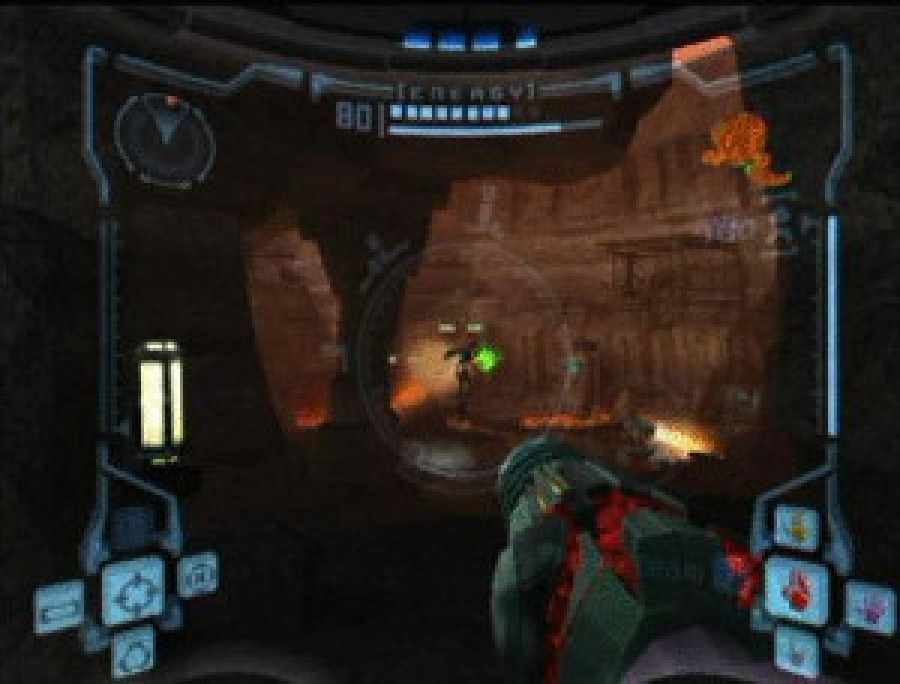
That one decision changes the temperature of everything. Exploration stops being downtime between fights and becomes the way the story is told. The Tallon Overworld’s rain, the sunken stone of the Chozo Ruins, the magma tunnels of Magmoor Caverns that serve the Pirates as a geothermal power source, the snow and abandoned research posts of the Phendrana Drifts, the wreck of the Orpheon where it crashed, and finally the Phazon Mines — each area is connected, gated, and quietly narrating. You learn what Phazon did to this planet by finding the experiments it funded. You learn what the Chozo believed by reading what they left behind for whoever came next. They left it for Samus, and the game trusts you to be the kind of player who stops to pick it up.
The music does the same work from the other side. Kenji Yamamoto, assisted by Kouichi Kyuma, composed the score in Japan, and Yamamoto deliberately threaded arrangements of earlier music through it to satisfy old fans: the first Tallon Overworld theme reinterprets the original Metroid’s Brinstar theme, Magmoor Caverns reworks the Lower Norfair music from Super Metroid, and the Meta Ridley fight runs on a fast reimagining of Ridley’s boss theme. It is a soundtrack that tells returning players, in a language older than the graphics, that this strange new perspective is still home. The game even rewards the connection literally — link Metroid Prime to Metroid Fusion with a GameCube–Game Boy Advance cable and you could unlock Samus’s Fusion Suit and an emulated version of the original Metroid. Nintendo released Fusion in North America on the same day as Prime — our Metroid Fusion review covers the other half of that remarkable launch day.

The Reviews Were Not Close
Metroid Prime launched in North America on November 18, 2002, at $49.95 with a Teen rating, and the argument ended almost immediately. It holds a 97 out of 100 on Metacritic from 70 reviews. IGN scored it 9.8 out of 10, GameSpot 9.7, and the three reviewers at Electronic Gaming Monthly gave it three straight 10s. It won Game of the Year honours from GameSpot, GameSpy, Electronic Gaming Monthly, Nintendo Power and Edge, took Game of the Year and Excellence in Level Design at the Game Developers Choice Awards, and at the 6th Annual Interactive Achievement Awards it was the most-nominated game of the ceremony, winning Console First-Person Action Game of the Year. If you want our own verdict on the game itself, it lives in our full Metroid Prime review — this piece is about the anniversary, not a second score.
It sold like a landmark, too, by Metroid standards. Metroid Prime was the second-best-selling game of November 2002 in North America, behind only Grand Theft Auto: Vice City, with 250,000 copies sold in its first week. It went on to sell 2.84 million copies worldwide — more than 1.49 million of them in the United States alone by July 2006, earning more than $50 million — and it remained the best-selling Metroid game of all time until Metroid Dread finally passed it in 2021. For a series Nintendo had left in a drawer for eight years, handed to a first-time studio in Texas, that is not a comeback. That is a coronation.
The criticisms that did land are worth keeping in the record, because they are the criticisms of people playing a new grammar for the first time: the unusual control scheme, the light touch on direct storytelling, and the backtracking — GamePro warned that inexperienced players “might find it exhausting to keep revisiting the same old places over and over and over.” Twenty-four years later the backtracking reads differently. Revisiting is the mechanic. A Metroid world is a place you are supposed to know twice: once as a stranger, and once as its master.

Echoes, Corruption, a Remaster — and Metroid Prime at 24
The sequels came quickly by Metroid standards. Metroid Prime 2: Echoes followed on GameCube in 2004 and Metroid Prime 3: Corruption on Wii in 2007, with the trilogy collected — and Prime itself re-released with Wii Remote pointer controls — in Metroid Prime: Trilogy in 2009. The GameCube that hosted the original has its own long story on this site, told in GameCube Forever. Then the long gaps returned, until February 2023, when Metroid Prime Remastered arrived on Nintendo Switch with new visuals and modern control options, and critics reached for the same words their predecessors had used in 2002. IGN’s remaster review called it “a perfect example of how to both honor a lauded classic and bring it up to code.” Metroid Prime 4: Beyond finally followed in 2025 — a sequel announced so long ago that its arrival felt like the closing of a loop Prime itself had opened.
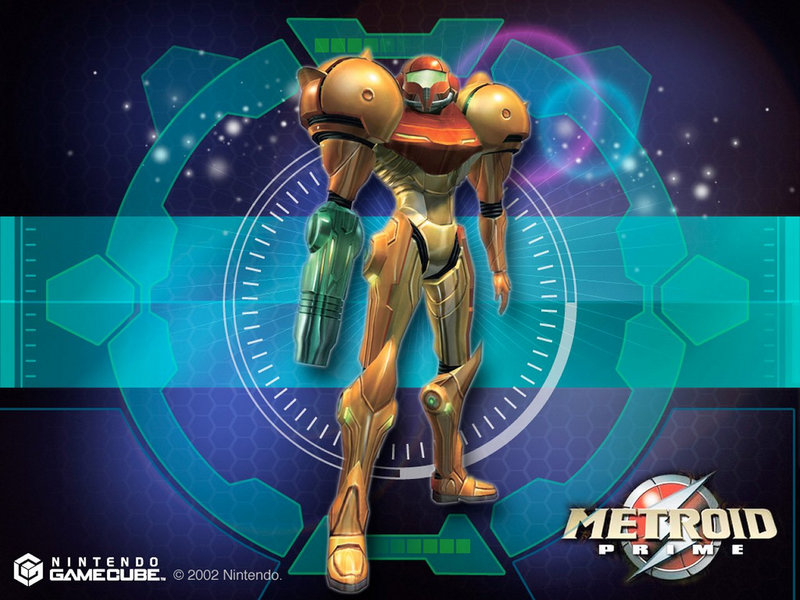
So what, exactly, are we celebrating at 24? Not just a great GameCube game, though it is that, and not just a technical flex, though the visor HUD, the seamless areas and the sheer density of Tallon IV still hold up. We are celebrating the proof of a principle the whole medium keeps having to re-learn: that a series’ identity lives in its structure and its mood, not in its camera. Retro and Nintendo changed the perspective, the dimension, the continent of the development team and the way the story was told — and kept the loneliness, the gating, the reading of a ruined world, and the feeling of a single hunter against a planet. Change everything except the soul, it turns out, and the soul carries.
Boot it up this week, if you still have the disc. Land in the Tallon Overworld, stand in the rain for a moment, and scan something before you shoot anything. That pause — hunter, helmet, a whole dead civilisation waiting to be read — is Metroid Prime at 24, and it has not dated a day.
— Chip
For more launches from this date, see This Day in Gaming History: November 18.